Connect with us
Anglostratits

Business

Afreximbank signs collaboration Memorandum of Understanding (MoU) with Caribbean Export Development Agency

Published

on

Afreximbank

The MoU is expected to result in increased trade and investment between Africa and the Caribbean, thereby encouraging mutual economic growth and development

NASSAU, The Bahamas, June 28, 2024/APO Group/ — 

African Export-Import Bank (Afreximbank) (www.Afreximbank.com) has entered into a Memorandum of Understanding (MoU) with the Caribbean Export Development Agency (CEDA) to formalise collaboration between the two institutions and provide a platform for exploring joint activities to support trade and investment flows between Africa and the Caribbean, and other collaborations.

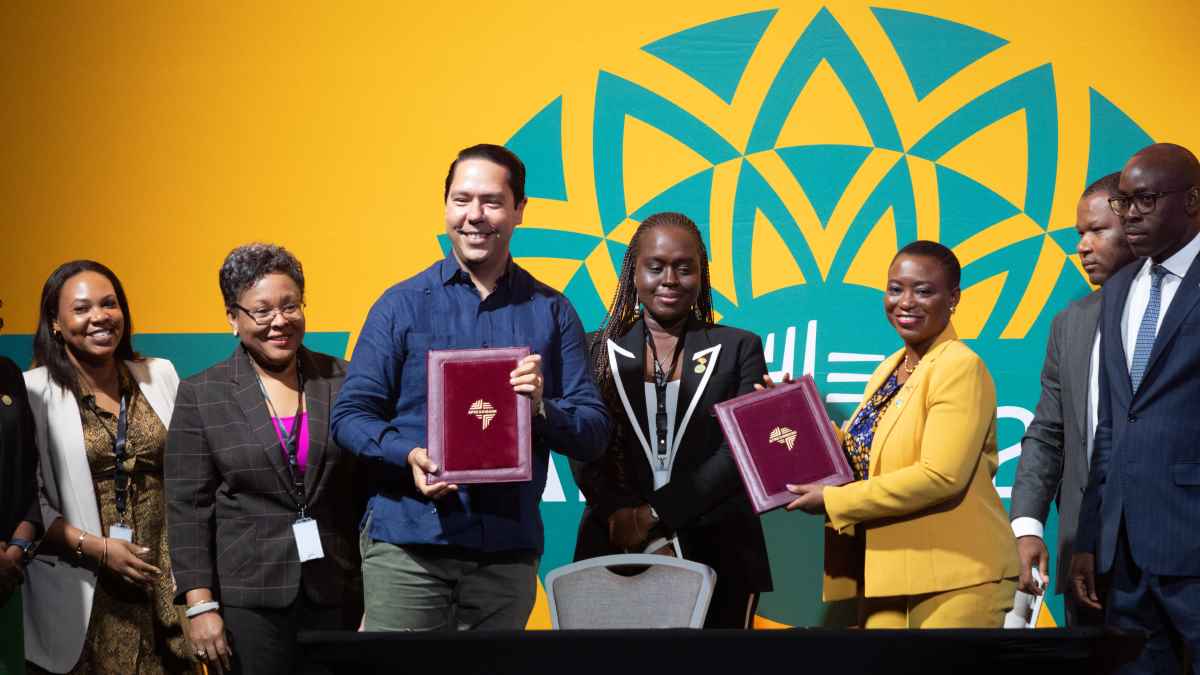
According to the terms of the MoU, signed on June 14, 2024, at the 31st Afreximbank Annual Meetings (AAM2024) and the 3rd AfriCaribbean Trade and Investment Forum (ACTIF), held in Nassau, The Bahamas, Afreximbank and CEDA will collaborate in capacity building and technical collaboration, knowledge sharing and information exchange, and trade and investment promotion and facilitation. The MoU is expected to result in increased trade and investment between Africa and the Caribbean, thereby encouraging mutual economic growth and development.

Signing the MoU on behalf of Afreximbank was Oluranti Doherty, Director, Export Development who represented Kanayo Awani, Executive Vice President, Intra-African Trade & Export Development Bank, while Leo Naut, Deputy Executive Director and Officer-in-Charge of CEDA, signed for his organisation.

Commenting on the MoU, Mrs. Awani said that the signing was part of Afreximbank’s efforts to see the concretisation of the African Union’s vision in designating the African Diaspora as the sixth region of the continent.

She highlighted Afreximbank’s significant progress in the Caribbean, including the inclusion of CARICOM member states in the African Vaccine Acquisition Trust (AVAT) program. She noted that 11 Caribbean Community member countries have joined the Bank as participating states, with the rest expected to join soon. Noteworthy achievements also encompass the hosting of three annual AfriCaribbean Trade and Investment Forums, the opening of an Afreximbank Regional Office in Barbados and the disbursement of financing facilities to St. Lucia for climate adaptation projects, and  Barbados for the development of sports infrastructure

Mrs. Awani attributed the success of those activities, in part, to the support received from key institutions in the Caribbean region and expressed confidence that the strategic partnership with CEDA would lead to a substantial increase in trade and other levels of economic cooperation between Africa and the Caribbean.

AAM2024, which was combined with the third AfriCaribbean Trade and Investment Forum (ACTIF2024), took place in The Bahamas from 12 – 15 June 2024.

Distributed by APO Group on behalf of Afreximbank.

Business

Africa’s Grid Constraints Come into Focus as Regional Markets Push Toward Integration

Published

on

Africa

Regional power pools are advancing and renewable pipelines are growing, but the regulatory and financial architecture needed to connect them remains the continent’s most critical infrastructure gap – an issue central to the Power Africa Today conference at AEW 2026

CAPE TOWN, South Africa, June 25, 2026/APO Group/ –Africa’s electricity demand is projected to nearly double to 2,291 TWh by 2050, requiring an estimated $30 billion in transmission and grid infrastructure investment to unlock and integrate new generation capacity. Yet across the continent, grid systems are struggling to keep pace with rapidly expanding supply pipelines and rising demand.

In Nigeria, repeated nationwide grid collapses as recently as February 2026 underscore the fragility of aging transmission infrastructure. In East Africa, tower failures along the 428 km Loiyangalani-Suswa line temporarily stranded output from Lake Turkana Wind Power – Africa’s largest wind installation. Meanwhile, demand growth pressures are accelerating across North Africa, where electricity consumption is expected to rise by around 50% by 2035, driven by urbanization, desalination projects, and climate-related temperature increases.

Despite these constraints, generation investment continues to accelerate across Africa, particularly in renewables, gas-to-power and hybrid systems. However, without equivalent investment in transmission and interconnection, much of this new capacity risks being underutilized or stranded. This growing imbalance between generation and grid capacity is driving a sharper focus on system-wide planning and regional market design – issues that will be central to the newly launched Power Africa Today conference at African Energy Week 2026. The platform will bring together policymakers, utilities, investors and developers to explore how regional interconnection, cross-border trading frameworks and financing structures can better align generation growth with grid expansion.

Power Markets Experiment with Reform

Alongside infrastructure challenges, Africa’s electricity sector is undergoing gradual – but uneven – market reform. Most countries still operate vertically integrated systems dominated by state utilities, but a growing number are introducing competitive frameworks to attract private capital and improve efficiency.

Zimbabwe opened its electricity market to full private participation across generation, transmission and distribution in 2025, targeting $9 billion in new investment. South Africa is advancing one of the continent’s most ambitious grid expansion programs, with plans for 14,500 km of new transmission lines and 133,000 MVA of transformer capacity by 2034, alongside mechanisms designed to crowd in private financing. Kenya, meanwhile, has introduced open access regulations enabling independent power producers to wheel electricity directly to multiple off-takers, reshaping how generation assets interface with the grid.

Interconnected electricity markets are the foundation of Africa’s industrial future

Regional Integration Remains Fragmented

Efforts to connect Africa’s fragmented power systems are progressing, though at different speeds across regions. In Southern Africa, the World Bank’s RETRADE SAPP program, approved in 2025, is deploying $12 million to strengthen renewable integration and transmission capacity across 12 member states. In East Africa, the Ethiopia–Kenya–Tanzania Electricity Highway is now in trial operations at up to 2,000 MW, marking a significant step toward a more interconnected regional grid.

West Africa is also moving toward deeper integration, with permanent synchronization of the West Africa Power Pool expected in 2026. Analysts, including the African Finance Corporation, argue that such synchronization is critical to unlocking large-scale hydropower potential and industrial demand across the region. Longer term, full synchronization between the Eastern and Southern African power pools – targeted for the end of 2026 – could create one of the world’s largest cross-border electricity trading corridors.

Building Bankable Financial Architectures

While interconnection is advancing, infrastructure alone is not enough to create investable electricity markets. Investors consistently cite the lack of standardized offtake structures, creditworthy counterparties, and cross-border payment guarantees as key barriers to scaling capital deployment.

New models are emerging to address these constraints. Africa GreenCo, operating across Zambia, Namibia and South Africa, is helping to aggregate independent power producers under a single creditworthy intermediary, standardizing power purchase agreements and reducing counterparty risk. At a broader level, AUDA-NEPAD estimates that Africa requires around $30 billion in additional investment to complete priority transmission corridors and establish three fully interconnected regional trading blocs by 2030.

“Interconnected electricity markets are the foundation of Africa’s industrial future,” said NJ Ayuk, Executive Chairman of the African Energy Chamber. “The question at Africa Energy Week is not whether integration is possible – the evidence is already there. The question is which regulatory frameworks and financial structures will get projects to financial close, and which markets will be ready when capital is looking to move.”

The Power Africa Today conference will run alongside AEW 2026, taking place October 12–16 in Cape Town, and will focus on the regulatory, financial and infrastructural architecture needed to build interconnected electricity markets capable of attracting institutional capital and delivering reliable, cross-border power at scale.

Distributed by APO Group on behalf of African Energy Chamber.

Continue Reading

Business

African Development Bank Group and La Francophonie Sign Partnership Agreement to Promote Youth Employment in Francophone Africa

Published

on

Remove term: African Development Bank African Development Bank

The agreement was signed during a meeting between the Secretary General of La Francophonie, Louise Mushikiwabo, and African Development Bank Group President, Dr Sidi Ould Tah in Paris, France

PARIS, France, June 25, 2026/APO Group/ –The African Development Bank Group (www.AfDB.org) and The International Organization of La Francophonie (OIF) on Wednesday entered a strategic partnership to strengthen digital skills, employability, and entrepreneurship of young people and women in five African countries: Benin, Cameroon, Guinea, the Democratic Republic of the Congo and Madagascar.


The agreement was signed during a meeting between the Secretary General of La Francophonie, Louise Mushikiwabo, and African Development Bank Group President, Dr Sidi Ould Tah in Paris, France. The agreement will address a major challenge faced by countries in the Francophone world and across Africa: providing young people with access to opportunities offered by the digital economy and fostering the emergence of a new generation of entrepreneurs.

The partnership calls for the implementation of training programs in digital professions and entrepreneurship, in fields such as web and mobile development, cybersecurity, artificial intelligence, and data analysis. Participants will also receive guidance toward employment and self-employment, as well as support for innovation and business creation, notably through training camps, prototyping activities, and partnerships with incubators and accelerators.

The African Development Bank Group and OIF will also work with national authorities in these five countries and training institutions to sustainably strengthen local capacities and promote ownership of the programs by national stakeholders. An initial pilot phase, lasting 12 to 24 months, will be rolled out in the five partner countries, followed by a gradual expansion to other member states depending on the results achieved.

The African Development Bank Group is pursuing a bold agenda based on “Four Cardinal Points” developed by Dr Ould Tah, the third of which is ‘Turning Demographics into a Dividend.’ This is about strategically converting Africa’s rapidly growing and youthful population into a decisive engine of inclusive growth, productivity, and innovation through large-scale investment in human capital—particularly youth and women.


It sees Africa’s growing young population not as a risk, but as a major asset. With the right policies and investments, this potential can create jobs, help small businesses grow, bring more informal businesses into the formal economy, and equip young people with the skills needed for the future. By investing more in education, science and technology, vocational training, entrepreneurship, finance, and digital tools, Africa can help its people drive economic transformation, stay competitive, and build lasting, resilient growth.

The OIF said the agreement marked the first concrete step in its initiative to mobilize innovative and additional funding for its most impactful projects.

Distributed by APO Group on behalf of African Development Bank Group (AfDB).

Continue Reading

Events

Paddles up! Hong Kong marks 50 Years of international dragon boat thrills

Published

on

Hong Kong

HONG KONG SAR – Media OutReach Newswire – 25 June 2026 – With top teams from around the world gearing up for the hotly contested Hong Kong International Dragon Boat Races this weekend (June 27-28), participants and spectators can expect a bumper programme of action, fun and entertainment along the Victoria Harbour waterfront in Tsim Sha Tsui – one of the city’s most vibrant districts known for its iconic skyline views and tourist attractions.

There is much to celebrate. This year marks the 50th anniversary of the Hong Kong International Dragon Boat Races as well as 35th anniversary of both the co-organiser, Hong Kong China Dragon Boat Association, and the sanctioning body, International Dragon Boat Federation (IDBF). The IDBF added to the occasion by announcing earlier this year the relocation of its headquarters back to Hong Kong.

Riding on the wave of excitement, the organiser, Hong Kong Tourism Board (HKTB), extended the annual Hong Kong International Dragon Boat Festival period to 13 days (June 19 – July 1), beginning on the historic Tuen Ng Festival (Dragon Boat Festival) and concluding on July 1, which is the 29th anniversary of the Establishment of the Hong Kong Special Administrative Region (HKSAR).

As the headline international flagship event of “Hong Kong Summer Fun”, Dr Peter Lam, Chairman of the HKTB, said the Festival not only ran over a longer period, but also featured a stronger race line-up and more vibrant entertainment programmes than in previous years, offering an experience found only in Hong Kong for locals and visitors, while showcasing Hong Kong’s position as the Events Capital of Asia.

More than 220 teams from 16 countries and regions will compete for top honours in the world‑renowned setting of Victoria Harbour. This year’s event also introduces the special 50th Anniversary Fishermen Invitational Cup and the 50th Anniversary Championship, paying tribute to the traditional spirit of dragon boat racing.

Visitors will be able to enjoy a series of thematic activities along the Avenue of Stars, including a 22-metre traditional wooden dragon boat, a dragon boat-themed installation in collaboration with the new film Minions & Monsters, live music performances and a line-up of intangible cultural heritage performances, including martial art Wing Chun, Chinese juggling diabolo, traditional musical instruments ruan and guzheng.

Highlighting Hong Kong’s reputation as the birthplace of modern international dragon boat racing, as well as its strengths as a global hub city, the IDBF has taken a significant step in its long‑term global strategy with the formal incorporation of International Dragon Boat Federation Limited in Hong Kong on 29 April 2026.

“Incorporation in Hong Kong is not a conclusion, but a beginning. It anchors our Federation in the city where our international story started and strengthens our ability to serve our members and the global dragon boat family,” said Claudio Schermi, President of the IDBF.

As part of this new chapter, the IDBF has applied for funding under “the Pilot Scheme to Strengthen the Presence of Hong Kong in Asian and International Sports Associations”, which was recently introduced by the HKSAR Government’s Culture, Sports and Tourism Bureau. The Pilot Scheme is an initiative designed to support Asian and international sports associations establishing their headquarters or regional headquarters in the city.

The Dragon Boat Festival has a long and colourful history dating back more than two thousand years. Held each year on the fifth day of the fifth lunar month, the day commemorates the patriotic poet Qu Yuan.

According to legend, Qu committed suicide for his beliefs by throwing himself into the Luo River. The villagers nearby raced out on their dragon boats, banging gongs and drums to scare away fish and other underwater creatures to stop them from eating Qu’s body. The tradition continues to this day, with dragon boat competitions taking place at locations across Hong Kong, each reflecting the unique characteristics of its neighbourhood.

Traditional dragon boat treats feature prominently during the festival, notably zongzi. These glutinous rice dumplings, traditionally wrapped in bamboo leaves and steamed or boiled, are widely available during the festive period.


Continue Reading

Trending