

Business
Absa Bank Kenya Partners with Huawei to Build a New Digital Foundation for Branch Networks

SD-WAN, as a next-generation technology and service, can help banks connect their branches and promote smart branch upgrades by constructing a powerful network
JOHANNESBURG, South Africa, September 30, 2022/APO Group/ —
“I see it as Lego blocks where the bottom layer is a strong technology foundation that gives us a platform to offer cutting-edge digital solutions to our customers. A strong, resilient network connects all the elements of the platform reliably.” – Moses Okundi, CIO of Absa Kenya
Who is Absa Bank Kenya?
Absa Bank Kenya is listed on the Nairobi Securities Exchange and is one of Kenya’s leading financial institutions. Established in 1916, the bank has been a major player in Kenya’s financial landscape, engaged in personal and corporate banking, enterprise, credit cards and bancassurance.
In line with the bank’s purpose of bringing possibilities to life, the bank offers end-to-end financial solutions to retail, enterprise and corporate customers, and its regional and global footprint enables it to offer cutting-edge financial solutions to its clients. The bank is a leader in the credit card space. It has also been associated with a number of market firsts, such as the launch of the first ATM, Sharia-compliant banking and unsecured lending. Absa Bank Kenya is part of Absa Group, one of the largest financial services institutions on the continent with a presence in 12 African markets and a global scale with offices in London and New York. In Kenya, the Absa is present in 38 counties. It has 83 branches, 212 ATMs and a robust Internet and mobile banking platform.
Facing the ever-changing customer needs over the past few years, Absa Bank regards “digital enablement” as one of the company’s key strategies. While accelerating enterprise innovation, Absa works closely with partners to accelerate digital transformation, provide convenient and high-quality innovative services for employees and customers, and further enable the creation of a digital Africa.
Bank Outlets Rethink Their Positioning as Epidemics and Digital Technologies Hit the Financial Industry
In recent years, the epidemic and digital technologies have continuously impacted traditional commercial banks. The diversified requirements of bank users and physical isolation brought by COVID-19 epidemic have accelerated the digital transformation of commercial banks. As a result, “mobile first” has become a top topic in the industry. More and more banks regard “mobile money” as the essential way to digital transformation. As consumers embrace mobile banking, digital channels absorb many traditional banking transactions. As a result, customers ’footprint at bank outlets start to decline, leading to the closure of many outlets. However, bank outlets remain an important channel for serving customers. According to a McKinsey study on June 2020: “The focus of branch offices will evolve to help customers with their complex needs.” In another Deloitte study on the outlook for banking and capital markets for 2021, “nearly half of bank respondents said their institutions are considering real-time interactions with bank staff through intelligent ATMs…”
There is no doubt that bank outlets are still indispensable in banks’ digital transformation journey. However, banks are supposed to re-examine the position of offline outlets. In the future, branch offices will act as face-to-face (F2F) channels and customer experience centers where customers handle complex transactions, solve problems and receive financial advisory services. Smart bank branch networks will be the key for banks to achieve this goal and support commercial banks’ digital strategies.
The Traditional Branches Connection Solution Hinders the Digital Upgrade of Banks. Who is the “Mr. Right” for this Situation?
However, traditional bank branch network architectures are no longer sufficient to support the upgrade of digital branches or even hinder it.
First, the cost of traditional WAN networking solutions for branch connection is too high. With the promotion of digitalization, the demand for real-time data transmission of financial transactions, services, and files in bank branches, as well as the demand for digital office and high-quality video/voice within branches, has exploded. However, most banks traditionally rely on Multi-Protocol Label Switching (MPLS) to implement network connections between headquarters and branch sites, as well as between branch sites. However, the cost of construction of MPLS links is too high. Most banks hesitate in the face of such high cost. This becomes an obstacle to the establishment of intelligent branches of banks.
Traditional solutions also fall short of meeting the requirements for banking agility and flexibility. Previously, the construction, configuration, and go-live of a network at a new bank branch could take weeks or even months. Furthermore, many services that should have been available to customers if there was a strong network cannot be provided in some areas due to a lack of professional staff. As a result, traditional solutions become an impediment to the agility requirements of banking in the digital age.
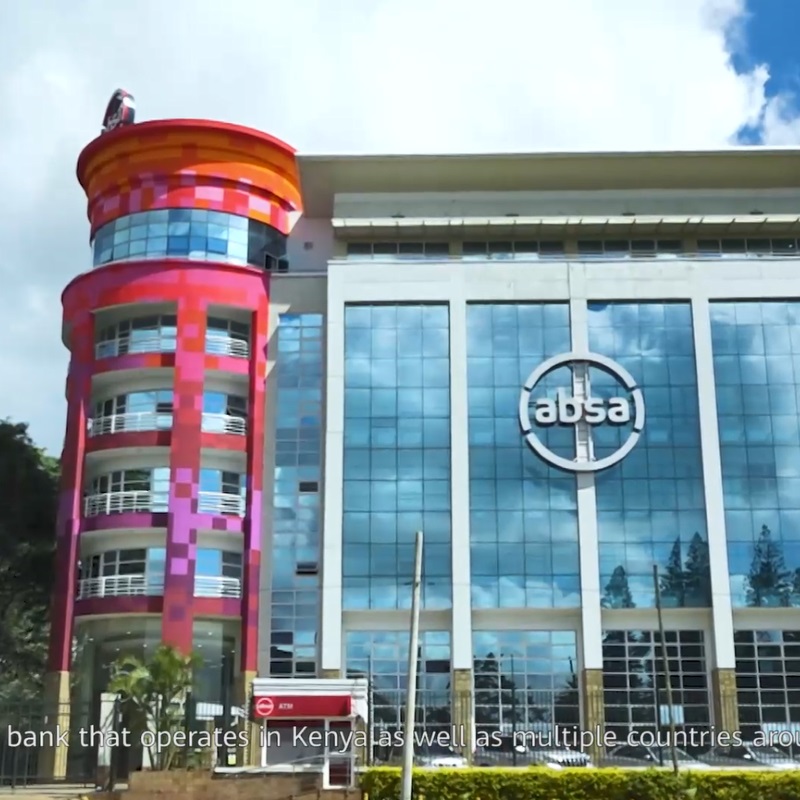
Absa Bank Kenya’s intelligent cloud-based branch network will serve as a critical foundation for the financial giant’s digital transformation
Furthermore, low network O&M efficiency becomes a pain point for banks’ digital transformation. Banks are typical of these situations: the network structure is complex and invisible, branch locations are dispersed, and network diagnosis cannot be performed remotely. As a result, when network problems arise, IT Technicians must handle them. It could take several hours or even days, which would be disastrous for the banks’ operations and result in significant losses. As we can see, when the continuity of banking services is threatened by a network problem, traditional solutions fail.
Since the traditional branch connection solution is obsolete in the digital era, what is the best solution for digital branch construction? SD-WAN (software defined wide area network) technology is the answer. SD-WAN, as a next-generation technology and service, can help banks connect their branches and promote smart branch upgrades by constructing a powerful network based on cost-effectiveness, agility, flexibility, scalability, security, and compliance.
Absa Bank Kenya Partners with Huawei on SD-WAN Solution to Build a New Digital Foundation for Branch Networks
As business continues to expand, Absa Bank Kenya is actively seeking the most appropriate network infrastructure. “We strive to offer our customers a seamless digital experience. We want to enable them to bank and transact without any hitch and in a seamless manner at the convenience of whatever they could be,” said Moses Okundi, CIO of Absa Bank Kenya. To realize that, the bank needed to build a new infrastructure to improve the efficiency of various banking services, reduce O&M costs, and enhance user experience at branches.
To meet the digital transformation requirements, Huawei and Absa Bank Kenya’s technical team conducted in-depth discussions and surveys. Based on the bank’s actual requirements and digital strategy, as well as Huawei’s strong technical reserves and construction experience in enterprise network and financial digital transformation, Huawei provided Absa Bank Kenya with a customized NCE-Campus-based SD-WAN solution. In addition to common SD-WAN capabilities, this solution comes with some other unique advantages including:
- High-performance and congestion-free forwarding:
- 3x high-performance in the industry, meeting SD-WAN development requirements in the next five years;
- Intelligent application routing ensures user experience for key applications:
- Application-level intelligent traffic steering + 5G plus Fiber on-demand scheduling + A-FEC enable 20% video packet loss without frame freezing and artifacts.
3) Full-process automation:
- Supporting multiple ZTP modes including emails, USB flash drive, etc. Network deployment at branches can be performed within minutes.
- Branch, device, application and link status are all visualized.
- Capable of centralized management and simplified O&M.
Finally, Absa Bank Kenya also selected Huawei as its digital transformation partner to build a cloud-based network between its headquarters and branches. This is prove that Absa Bank Kenya highly recognizes Huawei’s SD-WAN solution to meet its service expansion and digital innovation requirements during its digital upgrade.
Efficient, Reliable, Intelligent O&M, Accelerating Digital Transformation of Absa Bank Kenya.
What does an SD-WAN-based branch cloud network bring to Absa Kenya?
“We got to a point where we can manage traffic and distribute traffic evenly across various technology options or various connectivity options from various connectivity providers. The value of this is that it gives us robust resilience in managing that connectivity,” adds Okundi. Indeed, in the future, the branch network of Absa Bank Kenya will have intelligent traffic steering capability. It means the network can dynamically select MPLS links or internet links based on application quality and MPLS link quality, to ensure that key services use links with good quality. In addition, based on Huawei’s exclusive algorithm support, even if the quality of internet link is not so good, communication quality can still be ensured, which means that MPLS has a cost-effective alternative.
In addition, Huawei provides the iMaster NCE-Campus O&M platform for Absa Kenya, which can display the key O&M quality of devices, applications, and traffic. This platform can visualize application traffic of all branches, and therefore allows the IT team to monitor the dynamic data and adjust the bandwidth of each branch in a timely manner. This brings efficient and intelligent operations, as Okundi explains, ” For my tech team, we now have a very good level of visibility regarding the usage of the connectivity partners we have engaged. We are able to see where the usage is and how the traffic is distributed. And in the worst-case scenario where manual intervention is required, our team can pinpoint the challenges, making their intervention very accurate and efficient.”
These are just the tip of the iceberg in terms of the benefits provided by SD-WAN. Absa Bank Kenya’s intelligent cloud-based branch network will serve as a critical foundation for the financial giant’s digital transformation. As Okundi expounds: “I see it as a Lego blocks where the bottom layer is a strong technology foundation that gives us a platform to really offer cutting-edge digital solutions to our customers. And right at the bottom layer is a strong connectivity.” In the future, this powerful branch network will further promote the intelligent upgrade of Absa Bank and eventually help them evolve into intelligent customer experience centers. This digital foundation will continue to support the business expansion and innovation of Absa Bank Kenya to provide the most advanced and the best financial services to Kenya’s customers and enterprises.
Distributed by APO Group on behalf of Huawei.












Business
SLB commissions new fluids systems plant in Pemba to support Mozambique’s offshore energy development

Business
South African Energy Storage Association (SAESA) welcomes 4,600 MW battery storage prioritisation and calls for integrated energy planning

Business
Afreximbank welcomes launch of Africa Credit Rating Agency as an important step in strengthening Africa’s financial architecture

-

 Business4 days ago
Huawei and Qualcomm Announce Broad Patent License Agreement
-

 Business4 days ago
Cautious optimism returns to agency-side strategy as influence with clients grows
-

 Energy5 days ago
Malawi, Kenya, Eswatini Bring State Ambitions to African Mining Week (AMW) 2026’s National Mining Companies Forum
-

 Business4 days ago
African Energy Chamber (AEC), Ground State Market Solutions Sign Memorandum of Understanding (MoU) to Advance Canadian LNG, LPG Supply to Africa
-
Business5 days ago
Liberia Petroleum Regulatory Authority (LPRA) to Showcase Liberia’s 2026 Offshore Licensing Round in Cape Town
-
Business4 days ago
Africa’s Biggest Energy Movement Returns to Cape Town Next Week
-

 Events4 days ago
“Future Resonance — ShanghaiEye Night” Brings Shanghai to Washington, Fosters People-to-People Exchange Across the Pacific
-
Energy4 days ago
Kosmos Energy Chief Executive Officer (CEO) Andrew Inglis to Receive Mohammed S. Barkindo Lifetime Achievement Award at African Energy Week (AEW) 2026