Connect with us
Anglostratits

Business

Amid dipping optimism, marketers find reasons for resilience in 2027
Published

on

From disruption to opportunity: WARC’s Marketer’s Toolkit 2027 unveils five trends set to reshape global marketing in the year ahead

Based on WARC’s proprietary GEISTE methodology, insights from 1,000+ marketers worldwide and one-to-one interviews with marketing leaders

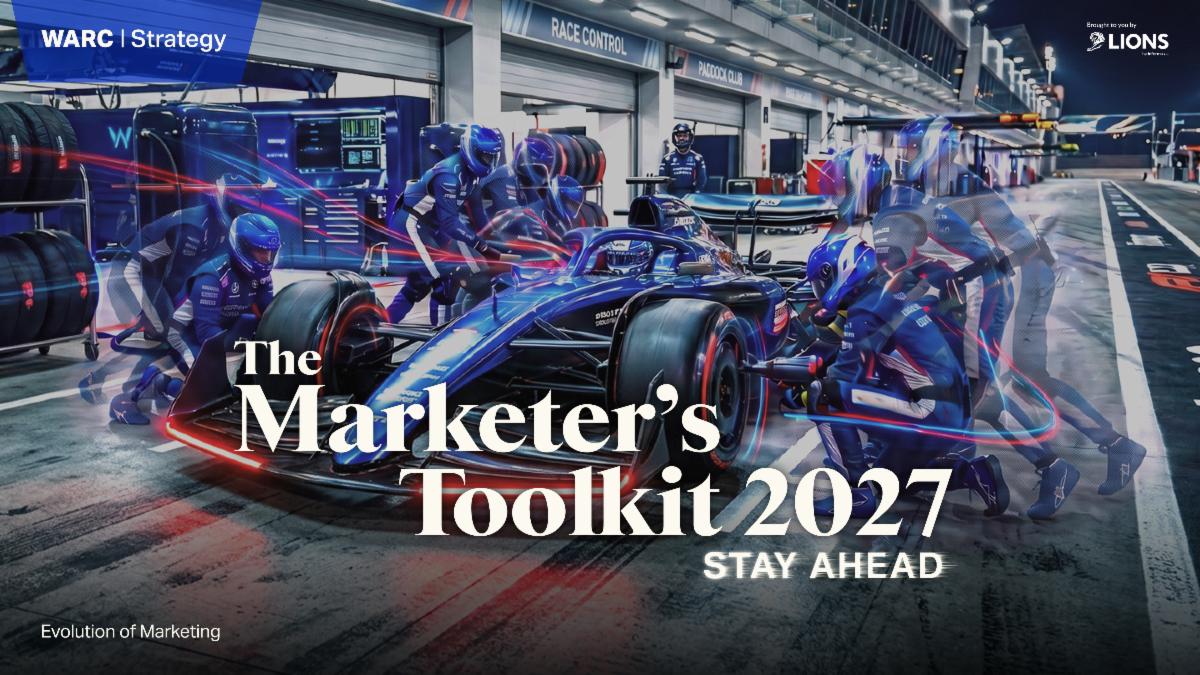
10 November 2026 – WARC today presents The Marketer’s Toolkit 2027, revealing five trends set to disrupt global marketing practices in the year ahead, and offers insights to help turn these disruptive areas into opportunities for growth.

Marketer optimism has dipped for the third year in a row, with just 46% expecting business to improve in 2027, according to WARC research. While that is a drop of nearly 20pp from three years ago, fewer marketers anticipate budget cuts. And even though WARC Media forecasts global ad spend growth will slow to 8.4%, reaching $1.46tn in 2027, emerging shifts could offer new opportunities, from important AI and social media evolutions to changing summer behaviours and the rise of the clip economy.


Aditya Kishore, Insight Director, WARC, says: “The macroeconomic backdrop remains challenging – a fading middle market, mounting sovereign debt, and a cost-of-living crisis are all still weighing on marketer optimism. But beneath these pressures, important shifts are reshaping the industry. AI agents are starting to influence how consumers shop, algorithms are superseding social connections on social media, and the rise of the clip economy is changing how brands connect with audiences. Marketers who understand these emerging trends – and act on them – have a genuine opportunity to turn disruption into growth in 2027.”


The trend identification for the report, now in its 16th year, is based on WARC’s proprietary GEISTE framework, which focuses on the broad macro trends across government, economy, industry, society, technology, and environment. It further incorporates a global survey of 1,000 marketing executives conducted in September and October 2026, one-to-one interviews with leading marketers worldwide, and analysis and insight from WARC’s global team of experts.


The five trends outlined in WARC’s Marketer’s Toolkit 2027 that will shape marketing strategies next year are:


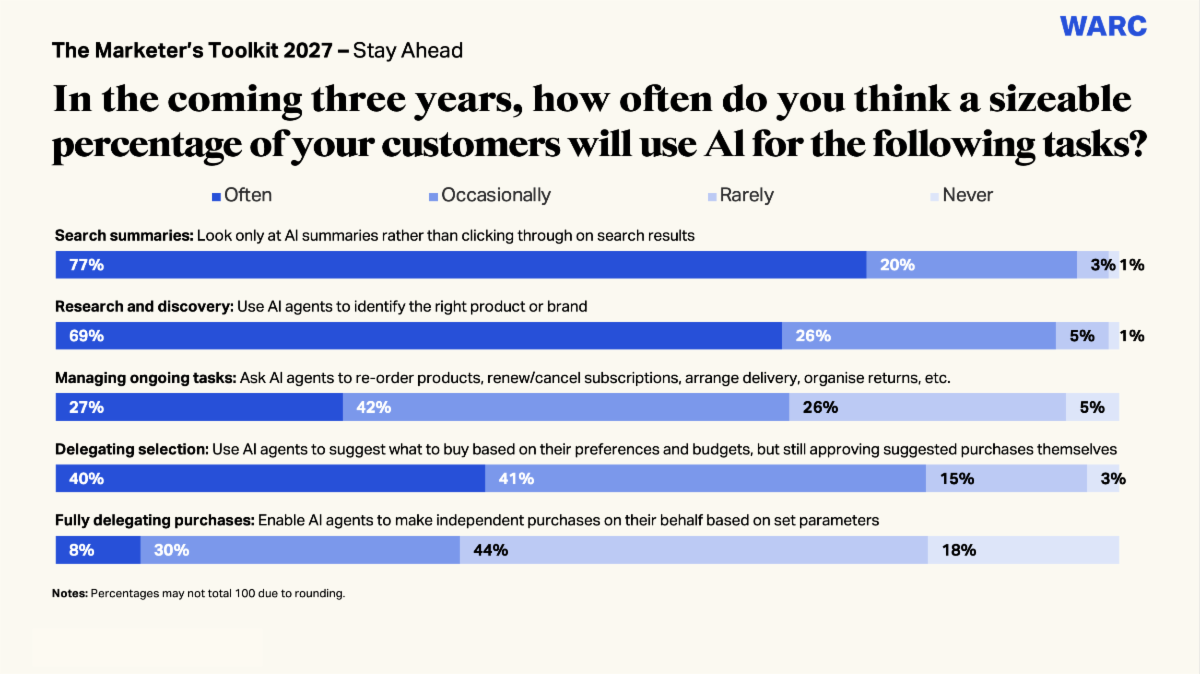
The drive to AI delegation:


Seven out of ten (69%) marketers expect customers to use AI agents for product research in the next three years, but just 8% expect full purchase delegation to AI.


PHD and WARC predict “agent-facilitated” consumer spending could reach $944 billion in 2026 and $3.4 trillion in 2030. As AI tools grow in sophistication, consumers will increasingly delegate everyday tasks, including purchases, to agentic assistants. This “delegation economy” is valuable, complex and requires holistic brand building, not just a relentless focus on AI optimisation.


Marketers are advised to: (1) build brands with people and AI in mind. (2) Assess how quickly AI delegation will reshape their individual category. (3) Break down internal silos to enable holistic thinking.

The post-social era:


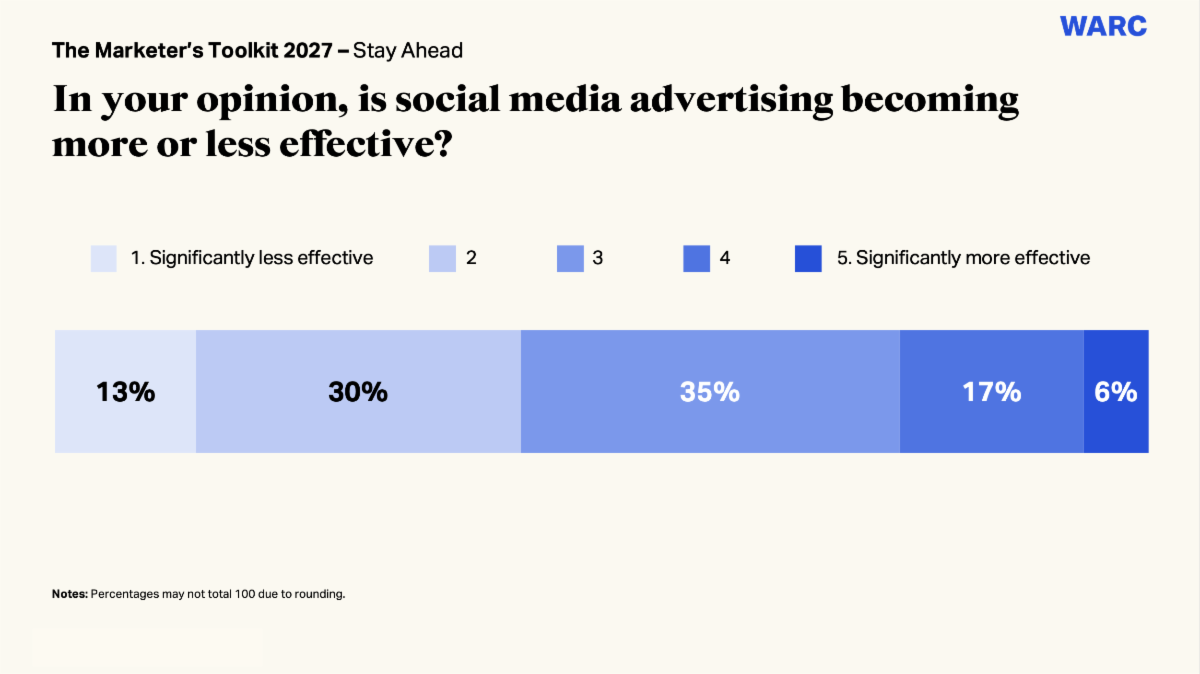
Two in five (43%) advertisers believe social media advertising is becoming “less effective”, but nearly six in ten (58%) feel ad buying practices are “too set” to cut platforms from media plans, even if traffic declines.


Social ad investment is set to hit $394.6bn globally this year – up 21.3% on 2025, per WARC Media, the fastest growth across all channels, even as we enter a post-social era.
Platforms no longer drive social connections. Instead, the algorithm is king, with audiences immersed in highly personalised, interest-based, and constantly refreshed content feeds. This impacts how brands plan, buy and measure campaigns in social media.

Marc Pritchard, Chief Brand Officer, Procter & Gamble, said: “You need to make sure that you create memory in the algorithm. What we’ve learned is that you need a much higher volume of content, a much higher variety of content, at a much higher velocity.”


Marketers are advised to: (1) Recognise algorithms penalise brands that don’t provide fresh creative. (2) Focus on resonance – distinct audience drivers such as motivations and pain-points – rather than volume for creative diversification. (3) Understand the broad range of reasons a consumer might buy your product. Audience insights will be key to post-social marketing.


The clip economy


Four in five (83%) marketers say short-form videos are a popular format among consumers, yet two in five (40%) doubt it can deliver the same brand halo as TV, film, and events.


Content is atomising into ever-smaller units, and the clip – not the original work it came from, but built to flood feeds, game the algorithm, and compound through network effects – has become where attention, discovery and engagement now concentrates. As distribution decentralises to fans, creators and algorithms, brands must rethink how content is packaged and released for a clip economy.


Marketers are advised to: (1) build distribution into the creative brief, deciding upfront what to hold back as a hero moment. (2) Brief creators as strategic partners, not just producers. (3) Plan content as a coherent, connected series, so each clip builds on the last.


David Sandström, CMO, Klarna, says: “I think that advertising has slowly regained its mojo due to clipping. I feel that advertising was paid for and pushed down people’s throats. It didn’t really understand how people really wanted to consume content. But now with clipping […] it feels like advertising is back a bit.”


The summer wildcard


Nearly half (45%) of marketers have not seriously considered how rising summer temperatures could affect their category, while only one in four (25%) have taken action.


Climate change is making summer a less predictable consumer season. Extreme weather is reshaping when, where and how people spend – disrupting established marketing occasions while creating new demands. Bloomberg reports that this summer’s heat resulted in a €17 billion hit to European GDP. Marketers may need to rethink seasonal assumptions, build flexibility, and identify opportunities for adaptation.


James Thornton, CEO, Intrepid Travel, said: “Climate change’s impact on travel isn’t going unnoticed by travellers […] For example, we’ve seen strong growth in demand into the cooler shoulder seasons, particularly in Europe in recent years. When customers do travel within the summer months, there has been notable rising demand for cooler destinations, including Iceland and Norway.”


Marketers are advised to: (1) understand how extreme weather affects their category across search, sales, rising prices and supply-chain disruption. (2) Build flexibility into marketing plans, preparing for disruption without losing sight of long-term brand building. (3) Find growth opportunities in climate adaptation.


The AI tightrope


Marketers are split on AI: four in ten (42%) expect it to boost marketing effectiveness, but just as many remain unsure, and one in five (19%) have negative expectations.


AI offers marketers the promise of near-limitless scalability and individual-level personalisation with advertising creatives, but consumers strongly mistrust AI. As marketers look to harness the power of AI, they will need to find the right balance between consumer concerns and best practices for AI utilisation.


Selina Sykes, Global VP Digital, Social and AI Transformation, Unilever, says: “You can’t just take the way you worked without AI and replace it with AI. You need to reimagine the workflow […] you need to think about the outcomes – and then work backwards to the process, inputs and where it starts to touch other parts of the marketing ecosystem.”


Marketers are advised to: (1) Strike the right balance between transparency and efficacy in communicating AI utilisation. (2) Find consumers’ acceptance threshold for AI-generated ads, which could vary by category. (3) Keep humans at the core – build campaigns with human ideation and judgement, while using AI to expand and adapt.


A complimentary sample of The Marketer’s Toolkit 2027 is available to read here.WARC subscribers can read the report in full. Tune into a deep-dive series of five podcasts running from 12 November.


The Marketer’s Toolkit 2027 is the centrepiece of WARC’s Evolution of Marketing programme, the leading source of insight into the changing face of marketing.



Business

ACG CEO Paulo J. Cruz to Speak at the Leadership Summit 2026 in Luanda on How Sport and Entertainment Districts Can Accelerate Africa’s Productive Economy
Published

on

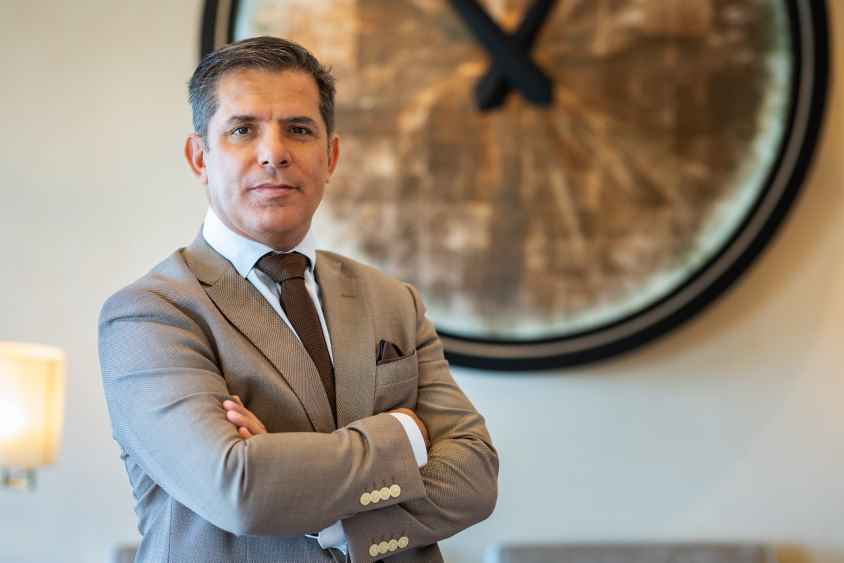
Paulo J. Cruz

Paulo J. Cruz joins CEOs from Angola’s telecoms, energy, data infrastructure, and technology sectors on the Productivity and Productive Economy panel at one of the country’s leading executive summits

LUANDA, Angola, November 10, 2026/APO Group/ –African Collaborations Group (ACG) (www.ACGafrica.com), the leading strategic project origination and collaboration platform focused on the industrialisation of sport in Africa through the origination of bankable sport and entertainment district ecosystems, today announced that its Founding CEO, Paulo J. Cruz, will speak at the 2nd Edition of the Leadership Summit 2026 (Cimeira de Liderança 2026) in Luanda, Angola, on 19 November 2026.


Mr Cruz will participate in Panel 3, “Productivity and Productive Economy,” alongside CEOs from Angola’s telecoms, energy, data infrastructure, and technology sectors, including the leaders of TVCABO Angola, Raxio Data Centres, Angola Cables, TIS, and EWT – Energy Water Telecom. The panel will be moderated by Kussi Bernardo, CEO of Multitel.

The Leadership Summit, held under the theme “Leadership that Generates Results: Strategy, Execution and Value,” convenes Presidents of Boards of Directors, CEOs, CFOs, and senior executives from Angola’s most strategic sectors, including oil and gas, mining, banking, telecoms, energy, industry, and agriculture. The event takes place at the Palmeiras Suite Hotel in Talatona, Luanda.

A Victory District™ generates revenue from 15 to 20 different asset types, creates thousands of permanent jobs, and operates 365 days a year

Mr Cruz will address how ACG’s origination of integrated sport and entertainment districts across Africa contributes directly to the transformation of the productive economy. His intervention will focus on how sport infrastructure, when conceived as a financially self-sustaining urban ecosystem rather than a standalone stadium, becomes a catalyst for job creation, tourism, diversified revenue generation, and long-term economic development.

“Sport infrastructure is not a social cost. It is a productive asset,” said Paulo J. Cruz, Founding CEO of ACG. “A Victory District™ generates revenue from 15 to 20 different asset types, creates thousands of permanent jobs, and operates 365 days a year. That is not a stadium. That is a contribution to the productive economy. I am honoured to share that vision alongside some of Angola’s most influential business leaders.”

ACG’s Victory District™ framework is designed to originate integrated, mixed-use sport and entertainment districts that move beyond single-venue development models. Each district combines stadiums, indoor arenas, training academies, hotels, conference centres, retail, entertainment, residential, and commercial space within a single masterplanned development, financed by private and institutional capital without reliance on public subsidy.

Mr Cruz brings more than 25 years of experience across Africa, the Middle East, and Europe in originating, structuring, and delivering large-scale infrastructure, urbanisation, and real estate development initiatives. Prior to ACG, he served as Senior Vice President at DAMAC Group, the largest private real estate developer in the Middle East, and as Group CEO of LandAfrique, a pan-African development platform focused on industrial parks, infrastructure, housing, and power projects across Sub-Saharan Africa.

The Leadership Summit 2026 is an initiative of Clube De Valor™, focused on leadership, strategy, execution, and value creation across Angola’s business landscape.

Distributed by APO Group on behalf of African Collaborations Group (ACG).


Continue Reading

Energy

South Sudan, Uganda, Kenya and Djibouti to Headline South Sudan Oil & Power (SSOP) 2026 Ministerial Panel
Published

on

SSOP

The Ministerial Panel will feature ministerial representatives from South Sudan, Kenya, Djibouti and Uganda

JUBA, South Sudan, November 10, 2026/APO Group/ –Senior energy and government representatives from South Sudan, Uganda, Kenya and Djibouti will participate in a ministerial panel at South Sudan Oil & Power (SSOP) 2026, taking place November 24-25 in Juba. The discussion will focus on strengthening regional energy cooperation, advancing cross-border infrastructure and attracting investment into East Africa’s petroleum sector.


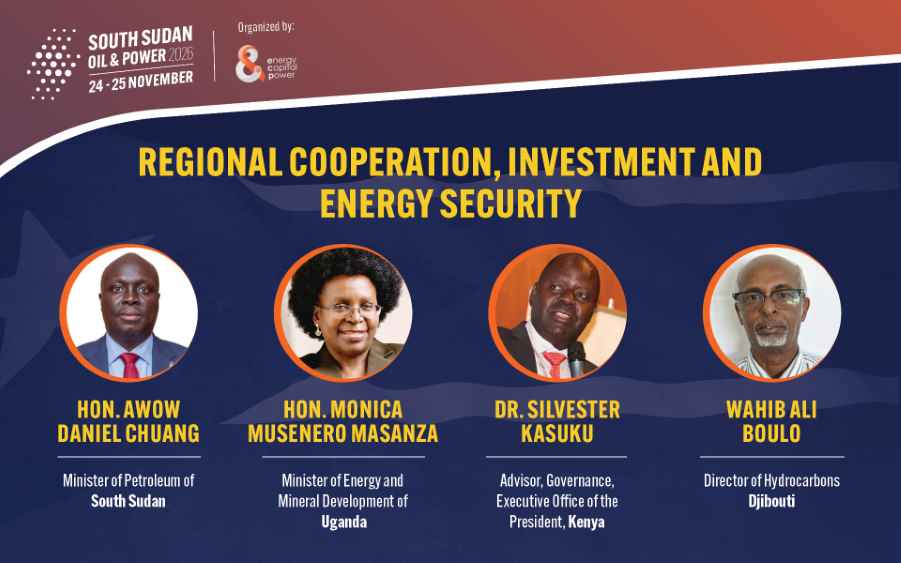
Titled Regional Cooperation, Investment and Energy Security, the panel will feature Awow Daniel Chuang, Minister of Petroleum of South Sudan; Monica Musenero Masanza, Minister of Energy and Mineral Development of Uganda; Silvester Kasuku, Advisor, Governance, Executive Office of the President, Kenya; and Wahib Ali Boulo, Director of Hydrocarbons, Djibouti.

Their participation comes as East Africa enters a new exploration and production cycle, backed by the start of upstream projects in Uganda and Kenya, a drive to strengthen cross-border trade by Djibouti and efforts to increase crude production in South Sudan. Regional cooperation is supporting these activities and SSOP 2026 will provide a platform to explore East Africa’s broader energy renaissance.

Minister Chuang joins the event as South Sudan opens its upstream market to international investors. Under efforts to raise production from 174,000 barrels per day (bpd) to around 230,000 bpd in the near term, the country is inviting investors to support brownfield development, accelerate exploration and expand refining capacity. Around 14 blocks are currently available.

Uganda is also promoting investment in exploration as the country prepares to start oil production from the Kingfisher and Tilenga oilfields in June 2027. The fields represent the country’s entry into commercial oil production. Crude will be exported via the East African Crude Oil Pipeline, currently 92% complete, which connects the fields to Tanzania’s Port of Tanga. To sustain upstream investment, the country also plans to launch a licensing round in 2026/2027.

https://apo-opa.co/4kJJLXP

https://apo-opa.co/4sOQOQW

Kenya is preparing to join East Africa’s oil producers as the country prepares for first production from the South Lokichar Basin in December 2026. Developed by Gulf Energy, the project targets 20,000 bpd in its first phase and 50,000 bpd in its second. The project coincides with investments in the downstream sector. In late-September 2026, Nigeria’s Dangote Group launched construction activities at a 700,000-bpd refinery in Lamu. A South Sudanese delegation, led by Minister Chuang, attended the groundbreaking ceremony.

https://apo-opa.co/4kJ16QA

https://apo-opa.co/4BV1kKL

As regional neighbors prepare for commercial oil production, Djibouti continues to strengthen its cross-border partnerships. The country signed an agreement with South Sudan in 2025 to develop the White Nile Trade Corridor, which aims to establish river and dry-port infrastructure in Juba, Bor, Malakal and Renk, connecting South Sudan to international trade routes through Djibouti. Boulo’s participation at SSOP 2026 creates new pathways for strengthened regional ties.

https://apo-opa.co/3WvoZ4h

Returning for its seventh edition under the theme Resource Renaissance – Energy-Fueled Growth for a New Generation, SSOP 2026 will provide a platform for policymakers, national oil companies, investors and infrastructure developers to examine how regional partnerships can strengthen energy security and accelerate project development.

For more information, visit www.SouthSudanOilPower.com.

Distributed by APO Group on behalf of Energy Capital & Power.


Continue Reading

Business

Merec Industries, a subsidiary of Invictus Investment Company PLC, builds first pasta manufacturing plant in northern Mozambique

Published

on

Merec

The plant will significantly expand Mozambique’s pasta production capacity and bring production closer to consumers in the north, while increasing the availability of high-quality fortified pasta in line with the country’s national food fortification requirements

Today, pasta is part of the basic food basket of Mozambicans

DUBAI, United Arab Emirates, November 10, 2026/APO Group/ —

  • Merec Industries, Mozambique’s largest flour milling company, is building the first pasta manufacturing plant in the north of the country, taking its coverage countrywide
  • Once complete, Merec’s plants will have the capacity to meet Mozambique’s domestic pasta demand and export the surplus, contributing to the country’s food security
  • The investment comes as Merec Industries prepares for its next phase of growth, with Helios Investment Partners set to become a minority shareholder in the business alongside Invictus Investment
  • Governor of Nampula Province visited the site in Nacala to view construction progress


Invictus Investment Company PLC (https://InvictusInvestment.ae/) (ADX: INVICTUS), a leading holding company specialised in agro-food commodities across the Middle East and Africa, today announced that its subsidiary Merec Industries (“Merec”) is building the first pasta manufacturing plant in the northern region of Mozambique, in Nacala. Once the plant is complete, Merec will be the only company in Mozambique with pasta manufacturing facilities in all three regions of the country: the north, central and south. Together with the expansion of its Machava industrial facility in the south, the new plant will take Merec’s total pasta production capacity beyond Mozambique’s national demand, enabling the country to meet its pasta demand from local production and export the surplus. Nacala is home to a deep-water port and is the gateway to the Nacala Logistics Corridor, which links Mozambique to Malawi and Zambia.

The Governor of Nampula Province, His Excellency Eduardo Abdula, visited Merec’s facilities to view construction progress and learn more about the developments of this investment. The plant will significantly expand Mozambique’s pasta production capacity and bring production closer to consumers in the north, while increasing the availability of high-quality fortified pasta in line with the country’s national food fortification requirements. It will also create direct and indirect jobs, develop local skills and involve businesses across the value chain, from production and logistics to distribution and sales.

Merec’s operating performance has improved significantly since it joined Invictus Investment in January 2025, prompting a more ambitious growth strategy to expand it beyond its core operations into new food categories in Mozambique and across the wider Southern African Development Community (SADC) region. In October 2026, Invictus Investment and Helios Investment Partners announced that Helios Fund V had entered into an agreement to acquire up to a 49% interest in Merec’s holding company, with Invictus Investment remaining the majority shareholder. The transaction is expected to close by the end of 2026, subject to customary closing conditions, including regulatory approvals.

Merec and Invictus Investment also signed cooperation agreements with the International Finance Corporation (IFC), a member of the World Bank Group, at the Lusophone Africa Investment Forum in Cabo Verde last month, to advance agribusiness in Mozambique and across Africa.

Commenting on the announcement, Amir Daoud Abdellatif, CEO of Invictus Investment, said: “Completing Merec’s pasta manufacturing footprint across Mozambique brings production closer to consumers and provides the local capacity needed to build a more resilient food business. This investment is part of our wider approach to growth, which involves taking majority positions in strong businesses, investing in their expansion and bringing in partners who can help take them further. Our ambition is to develop Merec into a regional food platform for Southern Africa, and this plant is an important part of the foundation for that.”

Eng. Luís Aveleira, Executive Board Member at Merec, added: “Today, pasta is part of the basic food basket of Mozambicans. Through this investment, we want to help ensure that Mozambique has the capacity to meet the needs of its own market, reducing its dependence on imported products. With industrial facilities in the north, central and south regions, we are strengthening our ability to supply the national market and contributing to the country’s objectives of promoting local production and import substitution. Beyond ensuring the supply of the domestic market, we also aim to build the capacity to generate production surpluses for export, contributing to foreign currency earnings and the growth of the national economy. We believe that investing in domestic production means investing in food security, industrialisation and the future of Mozambique.”

In addition to strengthening Mozambique’s food security and reducing its reliance on imports, the project reflects Invictus Investment’s focus on midstream and downstream assets across key African markets in support of its aim of becoming a fully integrated agro-food enterprise.

*Please refer to https://apo-opa.co/4sT7DdG for more information. 

Distributed by APO Group on behalf of Invictus Investment Company PLC.


Continue Reading

Trending