Connect with us
Anglostratits

Business

Zero-Carbon Village Rises in Tujia Countryside

Published

on

Tudianzi

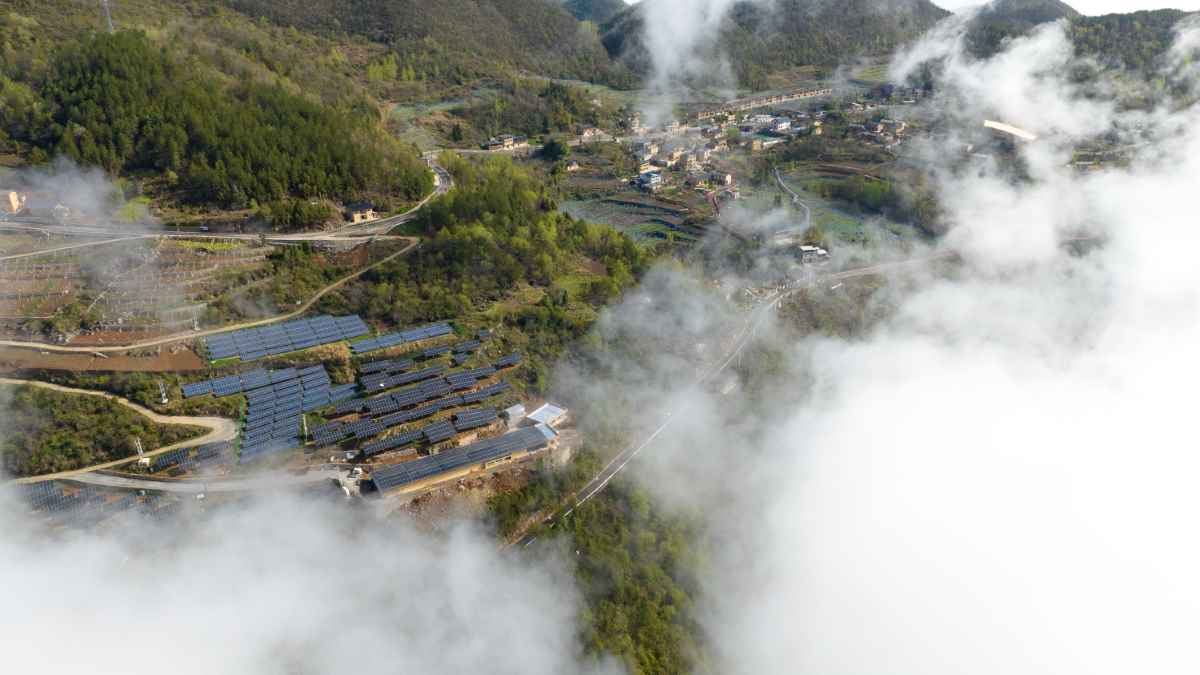
WUHAN, CHINA – Media OutReach Newswire – 22 April 2025 – During April’s Pear Blossom Festival, Tudianzi village, nestled deep in the mountains of central China’s Hubei Province, has welcomed over 50,000 visitors in just two days. In Tudianzi Village, tourists marveled at innovations like solar-storage integrated streetlights illuminating country paths, high-power EV charging stations eliminating range anxiety, and traditional Tujia cuisine cooked in all-electric kitchens — a vivid showcase of sustainable rural revitalization.

From Tudianzi Village, perched 1,200 meters above sea level, the mist-shrouded Wu Gorge stretches into the distance, while terraced pear blossoms blanket the slopes. A light breeze carries the delicate floral fragrance, marking the most picturesque season for this Tujia ethnic mountain village.

“The table actually charges my phone wirelessly!” exclaimed tourist Ms. Tan, surprised when her phone began charging on a solar-powered bench in the food corridor.

Located in Badong County, Enshi Tujia and Miao Autonomous Prefecture, Tudianzi Village earned its name during the Ming Dynasty as a rest stop for merchants on the ancient Tea Horse Road. Long secluded in the mountains, the village has now gained fame as a model for rural energy revolution, achieving 24/7 zero-carbon operations and 100% green electricity supply.

Solar panels are ubiquitous here — on rooftops, pavilions, plaza corridors, chicken coops, and pigsties. “The village’s solar capacity reaches 1,800 kW. At full capacity for one hour, it can generate 1,800 kWh, enough to power the entire village for a day,” said Chen Wentao, person in charge of the State Grid Enshi’s development department.

Reliable electricity was once a distant dream for villagers. Aging power infrastructure — characterized by extensive grid coverage, outdated single-radial network designs, and seasonal load fluctuations — left communities vulnerable to frequent and prolonged outages, particularly during extreme weather.

“Whenever thunderstorms struck, power lines would fail, plunging the entire village into darkness,” recalled 75-year-old Hu De’an. Like many residents, Hu once relied entirely on firewood for light and heat. “Our homes were filled with smoke, but seeing firewood piled under the eaves was the only way we felt secure,” he said.

In September 2020, China unveiled its ambitious “dual carbon” goals to the world: achieving peak carbon emissions by 2030 and carbon neutrality by 2060.

Studies showed that traditional biomass fuels like firewood, burned through direct combustion, operate at a mere 10-15% efficiency while generating heavy carbon emissions. This inefficiency has thrust rural China into a critical dilemma — how to build resilient, clean energy networks that meet growing demand without compromising sustainability.

A breakthrough came in March 2023 when China’s National Energy Administration and three other ministries launched a landmark initiative. The plan prioritizes pilot projects to accelerate rural energy transitions, coupling clean power adoption with broad rural revitalization objectives. By August 2023, State Grid Hubei Electric Power had spearheaded a flagship demonstration project in Tudianzi Village, targeting three pillars: stable clean energy supply, efficient resource utilization, and green industrial development.

During a recent visit to Tudianzi’s black pig breeding base — an operation producing over 4,000 hogs annually — reporters observed a model of integration. Solar panels crowned the spotless pigsty roofs, while odor-free pathways defied backward farm.

The transformation stems from a 30-kilowatt biogas plant constructed adjacent to the facility. Engineered by local power authorities, the system collects manure from the breeding base and kitchen waste from nearby households, channeling them into a closed-loop cycle of “biomass resources – biogas – electricity – fertilizer”.

“Biogas is converted into electricity, while its byproducts — digestate and residues — are processed into fertilizers for farmland, achieving circular biomass utilization and clean energy supply,” said Su Lei, senior engineer of State Grid Hubei Electric Power Research Institute. Notably, the installation of an 80-cubic-meter gas storage tank ensures nighttime green power supply and enables off-grid operations when integrated with flexible energy storage systems.

For local farmer Feng Cailong, the project has brought tangible economic gains. “Previously, disposing pig waste cost over 40,000 yuan annually. Now, delivering it directly to the biogas plant not only cuts disposal expenses but also saves more than 60,000 yuan yearly in electricity, disinfection, and fertilizer costs for forage cultivation,” he informed.

These developments epitomize Tudianzi’s rural energy transformation. After nearly two years of construction, the village has established a low-carbon energy system dominated by wind and solar power, featuring agile microgrid-distribution network interactions and coordinated “source-grid-load-storage” operations. A multidimensional industrial ecosystem integrating renewable energy, livestock farming, and eco-tourism is taking shape.

In 2024, the village’s electricity consumption surged to 537,000 kWh, a 188% increase from 2022. Since launching its energy revolution, Tudianzi’s annual renewable energy output reaches 1.44 million kWh, equivalent to saving 472 tons of standard coal while reducing CO₂ emissions by 1,436 tons and SO₂ by 43 tons annually.

“With the village’s total installed renewable energy capacity now reaching 1,871 kilowatts, we not only achieve full green power supply for the entire village but also export substantial surplus electricity to external grids,” explained Yang Lin, official of the Development and Reform Commission of Enshi Tujia and Miao Autonomous Prefecture.

Business

Sierra Leone Set to Showcase Offshore Ambitions with Petroleum Directorate of Sierra Leone (PDSL) Joining African Energy Week (AEW) 2026 as Strategic Partner

Published

on

African Energy Chamber

Sierra Leone is advancing offshore exploration, preparing a new licensing round and finalizing the formation of a new national oil company ahead of its Strategic Partnership with AEW 2026

CAPE TOWN, South Africa, March 26, 2026/APO Group/ –The Petroleum Directorate of Sierra Leone (PDSL) has joined African Energy Week (AEW) 2026 – scheduled to take place in Cape Town from October 12–16 – as a Strategic Partner. The Directorate will be positioned to leverage the event to highlight its open acreage, competitive fiscal framework and upstream integration plans to international investors, signaling Sierra Leone’s emergence as a frontier exploration hotspot in the MSGBC basin and across the wider Gulf of Guinea.


Italian energy major Eni and other international players have engaged in detailed geological studies across Sierra Leone’s offshore basin, underscoring rising confidence in the country’s hydrocarbon potential. Backed by enhanced 3D seismic reprocessing and basin-wide prospectivity studies, the PDSL is accelerating data-led de-risking efforts to unlock prospects such as Vega and attract fresh upstream capital.


A central focus for investors is the anticipated resumption of offshore drilling in 2026 – the country’s first campaign in nearly a decade. Following the conclusion of its fifth licensing round, which offered 56 offshore blocks, Sierra Leone is preparing to drill new wells targeting an estimated multi-billion-barrel resource base, supported by improved subsurface imaging and strengthened regulatory oversight.


PDSL’s participation at AEW 2026 reflects Sierra Leone’s serious commitment to unlocking its offshore potential through transparency, strong fiscal terms and data-driven de-risking

Sierra Leone is also in the final stages of establishing its first state-owned national oil company, which will hold a mandatory 10% carried interest in all exploration licenses. The government is targeting an overall 25–30% participation in projects, balancing national value capture with competitive terms for international operators.


Downstream integration is also gathering pace, with the 105–126 MW Nant gas-to-power plant in Freetown, developed by Anergi Group and TCQ Power, expected to nearly double national generation capacity when it comes online in 2027. In parallel, PDSL is spearheading plans for Sierra Leone’s first refinery to reduce reliance on roughly 15,000 barrels per day of imported refined products.


“PDSL’s participation at AEW 2026 reflects Sierra Leone’s serious commitment to unlocking its offshore potential through transparency, strong fiscal terms and data-driven de-risking,” said NJ Ayuk, Executive Chairman, African Energy Chamber, adding, “Their strategic vision aligns with Africa’s broader push for energy security, industrialization and investor partnership.”


With drilling set to resume, a national oil company nearing launch and integrated gas-to-power and refining projects advancing, Sierra Leone is entering a defining phase. At AEW 2026, PDSL is expected to present a clear message: the basin is open, the data is ready, and the opportunity is real.

Distributed by APO Group on behalf of African Energy Chamber.

Continue Reading

Business

Critical Mineral Projects to Watch Ahead of Invest in African Energy (IAE) 2026

Published

on

Energy Capital

The Uganda Chamber of Energy and Minerals, with both its CEO and governing council chairperson confirmed for Paris, will serve as the primary interface for investors seeking access to Uganda’s licensing framework and project pipeline

CAPE TOWN, South Africa, March 26, 2026/APO Group/ –Governments from West, Central and Southern Africa, with delegations confirmed for the Invest in African Energy (IAE) Forum in Paris next month, are each advancing critical mineral projects that span processing deals, development-stage assets and frontier exploration plays, giving investors a range of entry points across the minerals value chain.

Nigeria – Alumina Refinery & Lithium Processing

Nigeria struck a $1.3 billion deal with the Africa Finance Corporation in early March covering three components: construction of a one-million-ton-per-year alumina refinery, a national geoscience mapping program, and a joint investment vehicle to accelerate exploration and production across priority leases. Projected at 95% utilization over 20 years, the refinery is expected to add $1.2 billion to GDP annually and generate approximately $8 billion in foreign exchange earnings over its lifespan.

Separately, a $600 million lithium processing plant in Nasarawa State is at the commissioning stage, backed by ongoing mapping of lithium-bearing pegmatite belts across Kwara, Ekiti and Kaduna states. New mining licenses now require a local processing commitment covering at least 30% of output before export, a condition that directly shapes the investment structures available to foreign partners. Nigeria’s energy minister is among the confirmed delegations at IAE in Paris.

Zambia – Copperbelt Expansion & Cobalt Refinery


Copper output in Zambia is on course to clear one million tons in 2026, supported by First Quantum Minerals’ completed $1.25 billion S3 plant expansion at Kansanshi and Barrick Gold’s $2 billion program to double output at Lumwana by 2028. Several additional projects, including Sinomine’s Kitumba Mine and KoBold Metals’ Mingomba deposit, are also coming online this year, making Zambia one of the few places globally adding significant incremental copper supply in the near term.

Africa’s first cobalt sulfate refinery is targeting commissioning in Zambia in 2026, adding downstream processing capacity alongside the copper ramp-up. The Lobito Corridor, backed by a $553 million US Development Finance Corporation loan for Angola’s Benguela rail link, reduces export costs across the Copperbelt and improves project bankability for both mines and processing facilities seeking long-term offtake commitments.

Senegal – Falémé Integrated Iron Project

Senegal’s Falémé iron district in the Kédougou region holds over 600 million tons of probable reserves, including oxide ore at around 59% iron content and primary magnetite at roughly 45% Fe. The government launched the Falémé Integrated Iron Project as a phased program targeting 15 to 25 million tons per year at peak output, with national iron ore company MIFERSO conducting ongoing reserve verification.

The mineral export port at Bargny is operational and rail rehabilitation linking Kédougou to the coast is progressing under the Emerging Senegal Plan. The project is actively seeking a technical development partner. With port and rail infrastructure advancing independent of any single mining operator, Falémé carries lower logistics risk than comparable iron ore projects requiring greenfield corridor construction, which affects how financiers assess project bankability and timelines to first revenue.

Equatorial Guinea – Rio Muni Mineral Exploration

Equatorial Guinea’s Rio Muni mainland offers early-stage exposure to gold, bauxite, base metals, coltan and iron ore across largely underexplored onshore territory. The Ministry of Mines and Hydrocarbons has been opening the sector since its first public tender in 2019, with exploration contracts now in place and state geological mapping advancing in partnership with Rosgeo. Minister Antonio Oburu Ondo will address investors at IAE, with the minerals program expected to feature in bilateral meetings.

Uganda – Rare Earths & Minerals Sector Opening

Uganda holds rare earth deposits in ionic adsorption clay formations — a deposit type the IEA has flagged for low capital intensity relative to hard rock alternatives — alongside gold mineralization across greenstone belts in the West Nile, Karamoja and Mubende regions. The Uganda Chamber of Energy and Minerals, with both its CEO and governing council chairperson confirmed for Paris, will serve as the primary interface for investors seeking access to Uganda’s licensing framework and project pipeline, at the same time as the country’s Tilenga and Kingfisher oil developments move toward first oil.

Distributed by APO Group on behalf of Energy Capital & Power.

Continue Reading

Business

APO Group Takes Gold at 2026 SABRE Awards – Second Consecutive Win Across Different Clients and Sectors

Published

on

Recognition spans technology, global sport, and culture, reflecting APO Group’s cross-sector communications performance across Africa

JOHANNESBURG, South Africa, March 26, 2026/APO Group/ –APO Group (www.APO-opa.com), the pan-African communications consultancy integrating advisory, execution, and proprietary news distribution, has won gold in the Northern Africa category at the 2026 Africa SABRE Awards for its campaign, GITEX Africa Morocco 2025: A Media-Fuelled Journey for Tech Excellence.


Delivered for GITEX Africa, the campaign generated more than 3,600 media clippings across African and global outlets, positioning the event as the continent’s leading technology and startup platform, while reinforcing Morocco’s emerging status as a regional technology hub.

Being honoured at the SABRE Awards is particularly meaningful because it reflects the impact of communication designed specifically for how African markets work

APO Group was a finalist in two additional categories for campaigns delivered for international organisations operating across Africa:

  • The Africa Flag 2025 Tournament: Raising the Game in Cairo – National Football League (Media Relations category)
  • Broadcasting Greatness: Elevating African Hoops and Culture at BAL 2025 – Basketball Africa League (BAL) (Media, Arts & Entertainment category)

The SABRE Awards recognise excellence in branding, reputation management, and engagement across the global communications industry. This latest accolade adds to APO Group’s growing record at these prestigious awards, following its win in 2025 for a campaign delivered for Canon Central and North Africa, as well as multiple finalist placements for campaigns supporting leading institutions such as GITEX Africa, Africa’s Business Heroes, and the Global Africa Business Initiative.


“Being honoured at the SABRE Awards is particularly meaningful because it reflects the impact of communication designed specifically for how African markets work,” said Bas Wijne, Chief Executive Officer at APO Group. “Successful pan-African campaigns combine strategic planning and strong local execution, together with a clear understanding of how different markets, media environments, and audiences connect with a story. It’s about designing communications that deliver measurable outcomes and help organisations engage effectively and confidently across Africa’s diverse media landscape.”

In addition to its SABRE Awards success, APO Group has received multiple major industry honours over the past year, including Gold and Bronze at the Davos Communications Awards for excellence in strategic communications and campaign execution. The company was also named Africa’s Leading PR Agency – 2025 by Brands Review Magazine and Best Public Relations & Media Consultancy Agency of the Year – 2025 by World Business Outlook.Operating across 54 African countries, APO Group provides communications advisory services, public relations, and media distribution through its proprietary newswire, Africa Newsroom, which places content on more than 250 Africa-focused news platforms worldwide.

Distributed by APO Group on behalf of APO Group.

Continue Reading

Trending