Connect with us
Anglostratits

Business

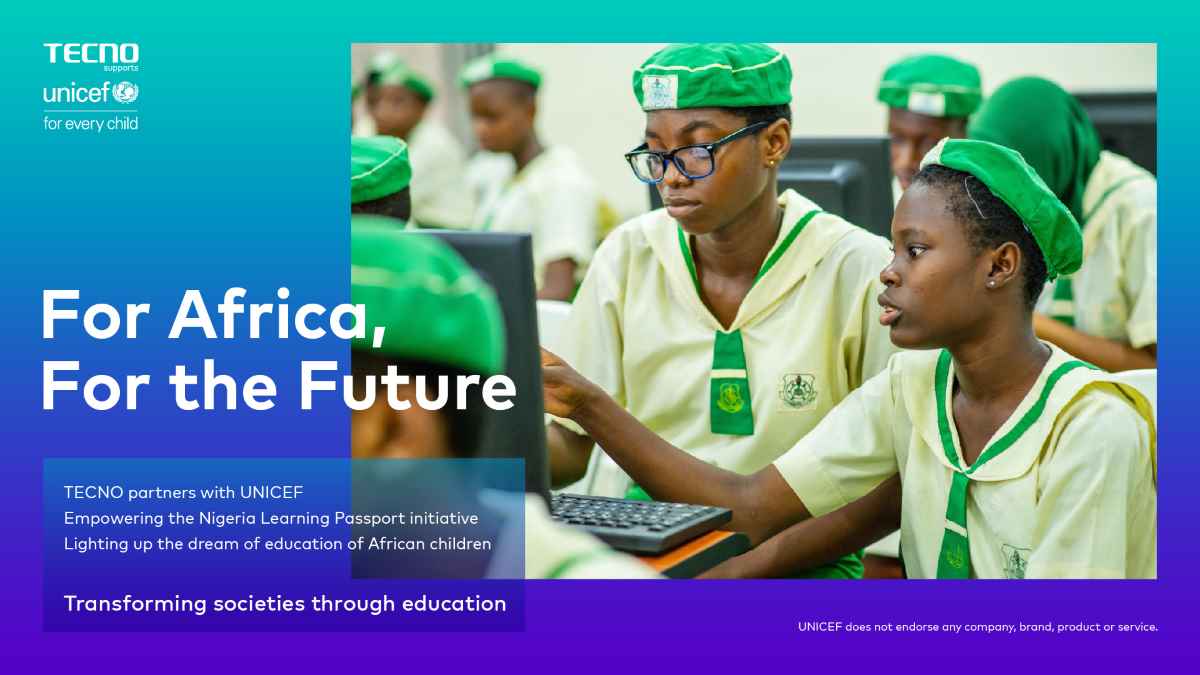
TECNO Partners with the United Nations Children’s Fund (UNICEF) Nigeria to Support Digital Learning for Children

Published

on

TECNO

To improve the quality of education for children and adolescents, the Federal Ministry of Education and UNICEF launched the innovative Nigeria Learning Passport programme in 2022

ABUJA, Nigeria, July 18, 2024/APO Group/ — 

TECNO (www.TECNO-Mobile.com), a leading innovative technology brand, has announced a partnership with the United Nations Children’s Fund (UNICEF) in Nigeria to support the implementation of the Nigeria Learning Passport, a digital learning platform.

In today’s world, too many children remain out of school, and many more are not learning. In Nigeria, the challenges in the field of education are particularly acute. To improve the quality of education for children and adolescents, the Federal Ministry of Education and UNICEF launched the innovative Nigeria Learning Passport programme in 2022. This initiative forms part of UNICEF’s broader global educational strategy, the Learning Passport, which was first established in 2018.

The platform provides curriculum-aligned materials in local languages through a combination of online and offline delivery, allowing children to access digital learning resources at any time, wherever they are. This ensures that quality education is available and accessible to all. The platform covers a full range of educational content, from foundational learning to skills development, and also provides professional training for educators.

This collaboration will allow us to provide more children, especially those in remote and underserved areas, with the quality education they deserve

The programme has expanded to 19 states across the country, ranking second among all participating countries with approximately 888,000 registered users.

TECNO is working with UNICEF to support the expansion and deepening of the Nigeria Learning Passport. The partnership will further strengthen content development, purchase and maintenance of technical equipment, and professional training for educators. In 2024, UNICEF plans to expand the Nigeria Learning Passport to include offline content for 50,000 children in remote and low-income areas, further reducing the education gap and improving the quality of education.

“We are pleased to partner with TECNO to enhance the reach and impact of the Nigeria Learning Passport,” said Cristian Munduate, UNICEF Country Representative in Nigeria. “This collaboration will allow us to provide more children, especially those in remote and underserved areas, with the quality education they deserve. Digital learning is a powerful tool in bridging educational gaps and ensuring that every child has the opportunity to learn and thrive. With TECNO’s support, we are one step closer to our goal of making education accessible to all children in Nigeria, empowering them to build a brighter future.”

Jack Guo, General Manager of TECNO, added, “As part of its Corporate Social Responsibility endeavours, TECNO keeps giving back to the communities where our business is present. Investing in education is an effective strategy for breaking the inter-generational transmission of poverty and contributing to social and economic development. Africa has the world’s youngest population structure, and the progress for African children is the progress of the world. Through the Learning Passport programme, we hope to help young people in Nigeria access sufficient education and development opportunities, becoming a strong engine for economic growth and social progress in Africa and even the world.”

By the end of 2023, the Learning Passport programme had expanded to 38 countries worldwide, with a total of 6.02 million registered users and more than 13,000 courses on offer. In 2020, the Learning Passport was recognised as one of the 50 Most Influential Projects by The Project Management Institute, and in 2021 TIME named the programme one of the best 100 inventions of the year.

Distributed by APO Group on behalf of TECNO Mobile.

Business

Afreximbank convenes Angola oil and gas financing forum to ad-vance local content and indigenous participation

Published

on

Afreximbank

The forum examined practical constraints facing indigenous companies, including access to appropriate financing, bankability, execution capability and market access

African Export-Import Bank (Afreximbank) (www.Afreximbank.com) hosted a Local Content Development Forum in Luanda, Angola, on 9 September 2026, bringing together government institutions, financial institutions, indigenous companies and industry players to explore financing opportunities across Angola’s oil and gas value chain.


Held at the Centro de Convenções de Talatona, the forum focused on how financing, partnerships and transaction structures could support the growth of Angolan companies across the sector, including opportunities in project finance, trade finance, downstream infrastructure and industrial development.

Angola remains one of Africa’s most significant energy markets, with Afreximbank having invested close to US$2 billion in the country’s oil and gas sector. The forum built on that engagement by examining how more Angolan companies could progress from participation into ownership and scale, when the right financing, partnerships and structures are made available to them.

Commenting on Afreximbank’s ambition to support the next generation of Angolan energy companies, Mr. Haytham Elmaayergi, Executive Vice President, Global Trade Bank, Afreximbank, said:

“Angola has built a strong platform for its energy sector, with Afreximbank playing a longstanding role in structuring, financing and mobilising capital to support its development at scale. The next phase is about enabling more Angolan companies to move from participation and service provision towards ownership and scale, drawing on the experience of successful indigenous African operators to turn that ambition into bankable transactions and build the next generation of national and regional champions.”

The next phase is about enabling more Angolan companies to move from participation and service provision towards ownership and scale


Speaking at the Forum, Berta Rodrigues Issa, President of ASSEA (Association of Indigenous Companies for the Oil Industry of Angola), congratulated Afreximbank on hosting the event, and for placing Local Content where it truly belongs: “A country does not industrialise merely by exporting more than it imports. It industrialises when it transforms its resources, develops productive capacity and builds companies capable of competing beyond its borders. That is why Afreximbank’s theme- “From Resources to Value” – is so deeply aligned with Angola’s Local Content agenda.

“For ASSEA, Local Content cannot be limited to the participation of Angolan-owned companies in one-off contracts. It must be a deliberate path towards capacity building, industrialization and competitiveness.”

The forum examined practical constraints facing indigenous companies, including access to appropriate financing, bankability, execution capability and market access, and considered how Afreximbank’s financing and advisory capabilities could help address these barriers.

Participants also drew lessons from Nigeria, where indigenous companies such as Oando and Heirs Energies have expanded their ownership and operating positions through significant acquisition transactions. Oando’s US$783 million acquisition of Nigerian Agip Oil Company increased its interests in OMLs 60–63 from 20% to 40%, while Heirs Energies acquired a 45% interest in OML 17 and assumed operatorship of the asset. The examples illustrated how indigenous African companies can scale into larger ownership and operating roles.

The forum also highlighted significant pipeline of opportunities across Angola’s oil and gas sector, including US$2.5 billion for Lobito Oil, US$1 billion for Sonangol, US$1.4 billion for Amufert and US$280 million for Itracom.

Discussions centred on how public institutions, local banks, industry operators and investors could work together to advance these opportunities towards implementation.

Distributed by APO Group on behalf of Afreximbank.


Continue Reading

Business

WezeshaAfricaKE launches a movement to unlock Africa’s untapped potential

Published

on

WezeshaAfricaKE

Built on the belief that potential exists everywhere, but opportunity does not, WezeshaAfricaKE seeks to unite businesses, governments, innovators, educators, investors, civil society and communities to remove barriers that prevent millions of Africans from contributing fully to society and the economy

My own journey taught me how quickly life can change and how easily potential can be overlooked when systems are not designed for inclusion

NAIROBI, Kenya, September 10, 2026/APO Group/ –WezeshaAfricaKE (www.WezeshaAfrica.org) today announced the launch of a bold Pan-African movement dedicated to unlocking one of the continent’s greatest but often overlooked assets – its people.


Built on the belief that potential exists everywhere, but opportunity does not, WezeshaAfricaKE seeks to unite businesses, governments, innovators, educators, investors, civil society and communities to remove barriers that prevent millions of Africans from contributing fully to society and the economy.

Founder Lillian Adero Agola says, “My own journey taught me how quickly life can change and how easily potential can be overlooked when systems are not designed for inclusion. WezeshaAfricaKE was born from a simple conviction that no one should be defined by their circumstances. This movement is about opening doors, creating opportunities and ensuring every African has the chance to realise their full potential. It is a call to action for Africa to recognise that its greatest natural resource has never been its minerals; it has always been its people.”

Connecting people to opportunities

WezeshaAfricaKE is a movement committed to unlocking opportunity through inclusion, innovation, entrepreneurship and economic participation.

We believe ability should never be defined by circumstance, and that every African deserves the opportunity to learn, work, build a business, contribute to society and live with dignity.

Its mission is to connect people, businesses and institutions to create practical opportunities that empower individuals, strengthen communities and grow Africa’s economy.

Because when people thrive, Africa thrives.

Across Africa, millions of talented people remain excluded, not because they lack ability, but because barriers in education, employment, finance, technology and infrastructure continue to limit opportunity.

These barriers cost individuals their futures. They also cost Africa its growth.

WezeshaAfricaKE believes inclusion is not charity but smart economics. Unlocking untapped potential creates jobs, drives innovation, expands markets, strengthens communities and accelerates sustainable development.

Globally, more than 1.3 billion people—around one in every six people—live with a disability, many of whom are of working age.

Research estimates that excluding people with disabilities from employment costs economies between 3% and 7% of Gross Domestic Product (GDP) through lost productivity and reduced labour participation.

In Kenya alone, disability exclusion has been estimated to cost the economy up to 6.95% of GDP annually.

These numbers tell a powerful story.

“The greatest opportunity before Africa is not simply creating new industries; it is ensuring that every person has the opportunity to contribute to them,” adds Agola. “When we unlock potential, we unlock economic growth.”

Why join the movement?

Africa cannot afford to leave talent behind. Because when one person succeeds, families prosper. When families prosper, communities grow. When communities grow, Africa grows.

WezeshaAfricaKE exists to create measurable and lasting impact by expanding access to employment; supporting entrepreneurship; promoting inclusive innovation; increasing financial independence; improving access to education and technology; building stronger families and communities; and restoring dignity through opportunity.

Together, we can create jobs, expand economic participation, build inclusive businesses and workplaces, support entrepreneurship and innovation, improve access to education and technology, influence policies that remove barriers, strengthen families and communities, and create generational wealth through opportunity.

A movement for everyone

The movement belongs to everyone and invites every African who believes talent should never be wasted. WezeshaAfricaKE calls on:

  • Businesses and employers
  • Entrepreneurs and innovators
  • Governments and policymakers
  • Investors and financial institutions
  • Schools, colleges and universities
  • Technology leaders
  • Development partners and NGOs
  • Community and faith-based organisations
  • Media and content creators
  • Youth leaders and volunteers

Real change happens when every sector plays its part.

Africa’s greatest resource has always been its people. “If you believe talent should never be limited by circumstance, that opportunity should be accessible to everyone and that Africa grows when all her people grow; then this movement is for you. Become a partner, an advocate, volunteer or employer of opportunity,” adds Agola. “Become part of WezeshaAfrica. Together, we can unlock potential, expand opportunity and build an Africa where everyone has the chance to thrive. We are leaving nobody behind.

Otherwise, why are we here?”

Follow the movement on Instagram @WezeshaAfricaKE and LinkedIn, or visit the website www.WezeshaAfrica.org

Distributed by APO Group on behalf of WezeshaAfricaKE.


Continue Reading

Business

IsDBI and Awqaf Mauritius Foundation Organize International Waqf Conference to Advance Community Empowerment and Sustainable Development

Published

on

IsDBI

The three-day programme convened ministers and lawmakers, waqf founders and managers, diplomats, imams, legal practitioners, non-governmental organizations, community leaders, academics, youth representatives and members of the wider Muslim community

PORT LOUIS, Mauritius, September 10, 2026/APO Group/ –The Islamic Development Bank Institute (IsDBI) (https://IsDBInstitute.org) and Awqaf (Mauritius) Foundation (AMF) successfully concluded the International Waqf Conference held in Port Louis, Mauritius, from 3 to 5 September 2026.


Organized under the theme “Reviving Waqf for Community Empowerment: Building Strong Waqf Foundations through Strategic Management, Good Governance and Sustainable Investment,” the conference provided a high-level platform to explore how waqf can be revitalized as a heritage institution and transformed into a modern driver of socio-economic development.

The three-day programme convened ministers and lawmakers, waqf founders and managers, diplomats, imams, legal practitioners, non-governmental organizations, community leaders, academics, youth representatives and members of the wider Muslim community. In addition to Mauritius, participants from Comoros, Madagascar, Malaysia, Singapore, Maldives, Mozambique, Reunion, Seychelles, South Africa, Tanzania and the United Kingdom attended the conference.

Participants examined the foundational principles of waqf, governance models, asset development strategies, investment approaches, practical solutions and examples, legal documentation and the role of waqf institutions in promoting transparency, accountability and long-term social impact.

The conference opened with a welcome address from AMF Chairman, Dr. Najmul Hussein Rassool, and speeches by the Honourable Muhammad Reza Cassam Uteem, Minister of Labour and Industrial Relations, and  the Honourable Shakeel Ahmed Yousuf Abdul Razack Mohamed, Minister of Housing and Lands.

This was followed by a keynote address by Mr. Yahya Aleem ur Rehman, Head of Knowledge Leaders, IsDBI, on “Reviving Waqf: Unlocking a Heritage Asset for Impactful Socio-Economic Development.” Sessions over the first two days covered the history and principles of waqf, the state of waqf in Mauritius, governance and accountability models, sustainable structuring of waqf assets, and international experiences from Southeast Asia, Europe and Africa.

The programme also featured a panel discussion on the Waqf Act 1941 and a dedicated session on the financing of waqf projects by IsDB’s Awqaf Properties Investment Fund (APIF) led by Dr. Mohamed Ali Chatti and Dr. Hassan Mahfooz. These discussions highlighted the importance of enabling legal frameworks, sound fiduciary oversight, strong documentation, professional asset management and innovative financing in advancing the waqf sector.

The final day was dedicated to a capacity-building workshop on “Strengthening Waqf Leadership: Capacity Building for Waqf Managers (Mutawallis) and Legal Practitioners.” The workshop focused on practical training in waqf development, management and operations, as well as the drafting of waqfnama, or waqf deeds, in line with Shari’ah requirements and the Mauritian legal context. The capacity building was delivered by experts from various jurisdictions including Mr. Aboubacar Salihou Kante from the IsDB Institute.

Experts from IsDBI, APIF and international partner institutions shared practical insights on the roles of waqif, mutawalli, beneficiaries and regulators; waqf development strategies and best practices; the design of waqf development plans; and the essential elements of a waqf deed. The training reinforced the need for clear governance structures, robust investment policies, risk management, compliance, monitoring and reporting mechanisms, and the effective use of technology in waqf administration.

The participation by IsDBI and APIF representatives in the conference underscored the IsDB Group’s commitment to supporting member countries and Muslim communities in strengthening Islamic social finance institutions, promoting knowledge-based solutions, and helping unlock the developmental potential of waqf. The Institute’s contribution reflected its broader mandate to advance capacity development, applied research and knowledge sharing in Islamic economics and finance.

IsDBI commends the Awqaf (Mauritius) Foundation for organizing the conference and for its efforts to raise awareness, build institutional capacity and encourage community engagement around waqf in Mauritius. The Institute also acknowledges the contributions of speakers and experts from Mauritius, Saudi Arabia, Malaysia, Singapore, South Africa, Türkiye and the United Kingdom, whose participation enriched the exchange of experiences and practical solutions.

Distributed by APO Group on behalf of Islamic Development Bank Institute (IsDBI).


Continue Reading

Trending