Connect with us
Anglostratits

Business

Global spend on sports media rights is forecast to reach $61bn this year, but a fragmented media landscape poses dilemmas for brand advertisers

Published

on

sports media

In the US brands are expected to spend an additional $2bn on the Paris Olympics while Euro 2024 will drive €250m in incremental ad spend across Europe – yet the boost will not be enough to reverse TV’s decline

WARC Global Advertising Trends: Sports media in the era of fragmentation

7 February 2024 – At a time when marketers are increasingly reliant on sport for mass reach, the sector faces fragmentation. Live sports rights are splintering between broadcast, over-the-top (OTT or streaming) and mobile apps, while social platforms are rising in importance for fans.

Sports media in the era of fragmentation, WARC Media’s latest Global Advertising Trends report, examines sport’s new media landscape, the challenges and opportunities for brand advertisers and how rights holders plan to sustain the economics of sport in the years ahead.

Alex Brownsell, Head of Content, WARC Media, says: “Sport is one of the last providers of true ‘water cooler moments’, and this year’s bumper schedule of major sporting events, such as the summer Olympics and Paralympics in Paris, the UEFA European Football Championships, and the T20 Cricket World Cup, will provide advertisers with unrivalled means to achieve mass reach.

“However, these enduring qualities are under threat as consumption fragments. In this report we take a closer look at the current state of sport advertising at a time when media consumption poses a dilemma for brand advertisers.”

Key insights highlighted in WARC’s Sports media in the era of fragmentation are:

Major live sport moments still deliver mass audience reach
Over 115 million viewers tuned in across Fox properties to watch Kansas City Chiefs defeat the Philadelphia Eagles in Super Bowl LVII last year making it the most watched US telecast of all time.

TV firms are spending ever greater sums for sports rights
Global spending on sports media rights is forecast to reach $60.9bn in 2024, per SportsBusiness data, up 18.9% on pre pandemic levels, with traditional broadcasters digging deeper to retain access to prime sports assets.

2024 will be a major year for live sport, as the Olympics returns
Broadcasters and streamers will be buoyed by the return of blue chip sports competitions this year, including the Paris 2024 Summer Games, UEFA Euro 2024, and the T20 Cricket World Cup.

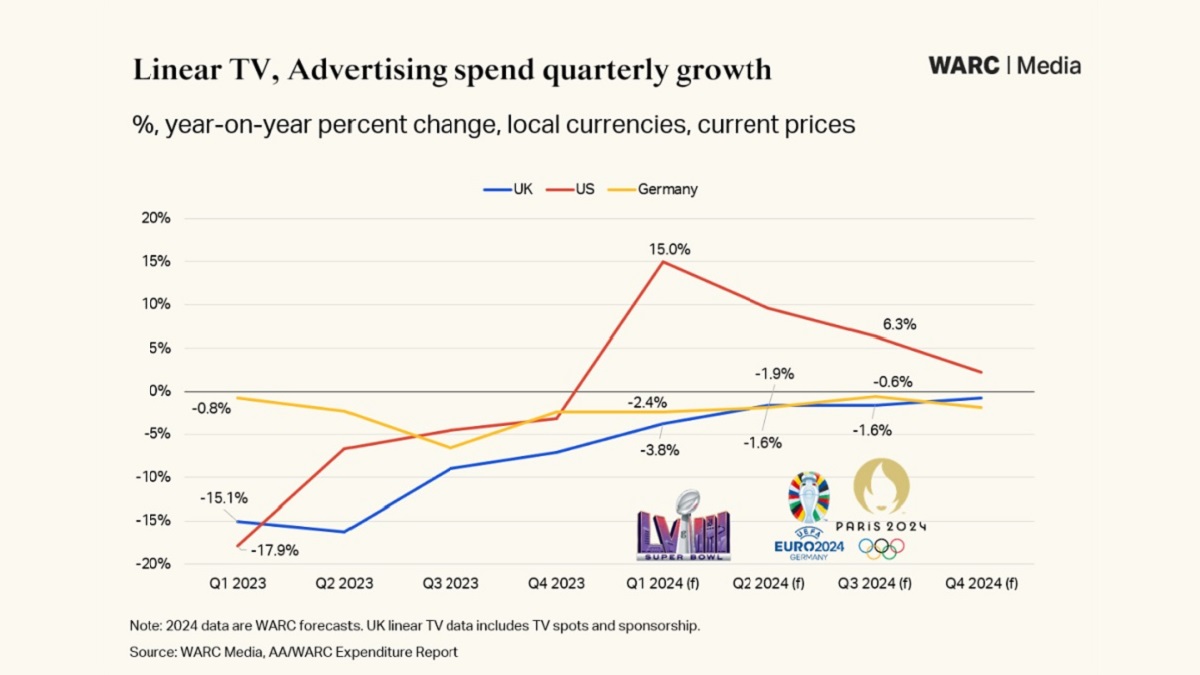
However, sport will not reverse declines in linear TV ad spend
In the UK, spend with linear TV is forecast to remain in decline (-1.6%) throughout the summer of 2024, according to WARC Media data. A similar picture emerges in Germany (-0.6%), which will host Euro 2024, although France bucks the trend (+4.9%). In the US, a recovery of linear TV spend (+6.3%) will owe more to favourable year-on-year comparisons and the upcoming US Presidential election than to sport.

Fragmentation of sports rights threatens mass reach moment
NFL coverage spans broadcast and cable TV (NBC, ESPN) as well as OTT (Peacock, Amazon Prime, YouTube TV) and mobile app (NFL+). It is becoming costlier and more complex for fans to follow all live games.

Social media is taking centre stage as a sports channel
93% of 18-24s engage with sport on social media at least weekly. However, Gen Z fandom is more ‘fluid’. Younger cohorts are often more interested in athletes’ stories, rather than teams or competitions.

Streamers are tapping into a passion for sports stories
Amazon and Netflix are beginning to acquire live sports rights. However, they are also capitalising on a desire for behind the scenes storytelling, with documentary series such as Netflix’s F1: Drive to Survive.

Advertising remains a key part of the Super Bowl experience
Nearly three quarters (73.0%) of those planning to watch Super Bowl LVIII on 11 February intend to watch the commercials. Last year’s broadcast earned Fox an estimated $650m in gross ad revenue, with brands spending up to $7m for a 30 second spot.

Adrian Sutherland, Vice President, Publicis Sports, comments: “Sports is the one constant within media plans. Live sport is getting the eyeballs and sport content is getting the engagement. However, in some sports, local fans may need at least three separate subscriptions to watch a full season of games. It is imperative platforms keep a strong content plan in place to keep consumers engaged.”

Read a complimentary sample report of WARC’s Global Ad Trends: Sports media in the era of fragmentation here, which also includes an exclusive interview with Jérôme Parmentier, VP, Media Rights and Content Partnerships, IOC. A WARC podcast discussing the findings outlined in the report will be available from 20 February.

Global Ad Trends, is a quarterly report which draws on WARC’s dataset of advertising and media intelligence to take a holistic view on current industry developments. It is part of WARC Media, which provides rigorous and accurate benchmarks aggregated and verified from over 100 reputable sources, empowering media decision makers to plan strategies with precision. WARC Media is available by subscription.

Business

South Africa’s Multi-Billion-Dollar Energy Transition Pipeline Takes Shape Ahead of African Energy Week (AEW) 2026

Published

on

African Energy Chamber

From LNG terminals and renewable energy corridors to hydrogen hubs and storage solutions, African Energy Week’s “Invest in South Africa” session will highlight the opportunities driving the country’s transition toward a more diversified and resilient energy future

CAPE TOWN, South Africa, August 11, 2026/APO Group/ –South Africa is undergoing one of the most significant transformations in its energy sector, as the country works to diversify its power mix, reduce reliance on coal and develop a more integrated energy system capable of supporting long-term economic growth. Combining electricity, natural gas, liquid fuels, hydrogen and energy storage, this evolving model is creating new opportunities for infrastructure development, industrial investment and public-private partnerships.

These developments will be explored during the “Invest in South Africa: Developing Integrated Energy Systems for an Inclusive and Resilient Energy Future” session at African Energy Week (AEW) 2026, where policymakers, investors and industry leaders will assess the commercial strategies, policy frameworks and financing models required to build a more flexible and diversified energy system.

The discussion comes as South Africa continues implementing its Just Energy Transition Partnership, a landmark initiative launched in 2021 that has mobilized an initial $8.5 billion commitment from international partners to support the country’s transition through investments in renewable energy, grid infrastructure, electric vehicles and green hydrogen. The program has since expanded discussions around blended finance mechanisms and private sector participation to accelerate project deployment.

South Africa’s energy transition represents one of the continent’s most significant investment opportunities

While renewable energy remains central to South Africa’s future power mix, gas infrastructure is expected to play an important role in providing flexibility as the country integrates increasing volumes of intermittent wind and solar power. The government’s Gas Master Plan and emerging gas policy framework aim to support the development of a domestic gas market while enabling new infrastructure investments.

Several major gas infrastructure projects are advancing as part of this strategy. At Richards Bay, the proposed Zululand Energy Terminal is being developed as South Africa’s first LNG import terminal and is expected to support Eskom’s planned 3,000 MW gas-to-power program, strengthening energy security and grid flexibility. Meanwhile, the Ngqura LNG terminal development at the Coega Special Economic Zone is progressing as a strategic gas import and regasification hub designed to support industrial users, independent power producers and future gas-to-power capacity. Together, these projects could establish critical infrastructure for South Africa’s emerging gas market while supporting industrial growth and the transition toward a more diversified energy system.

At the same time, the country is positioning itself as a potential global player in green hydrogen. Projects such as Sasol’s Boegoebaai green hydrogen development in the Northern Cape and the proposed Boegoebaai Special Economic Zone are targeting large-scale renewable-powered hydrogen production, with ambitions to develop export opportunities and create new industrial value chains.

The “Invest in South Africa” session will examine how the country can integrate gas, renewables, hydrogen and storage into a resilient energy system while managing the transition away from coal. Discussions will focus on investment pathways, infrastructure priorities and the partnerships required to deliver reliable power and inclusive economic growth.

“South Africa’s energy transition represents one of the continent’s most significant investment opportunities, but success will depend on building an energy system that delivers reliability, affordability and growth,” says NJ Ayuk, Executive Chairman of the African Energy Chamber. “By bringing together investors, policymakers and industry leaders, AEW 2026 will help advance the partnerships needed to transform South Africa’s energy ambitions into practical projects that benefit the economy.”

As South Africa reshapes its energy landscape, AEW 2026 will provide a platform for stakeholders to identify opportunities across gas, power, renewables, hydrogen and infrastructure – helping define the next chapter of the country’s energy future.

Distributed by APO Group on behalf of African Energy Chamber.

Continue Reading

Business

Five ways Emirates is helping customers travel with greater confidence

Published

on

Emirates

Customers travelling anywhere on the Emirates network receive one free date change on tickets booked from 2 April 2026, including journeys connecting through Dubai

DUBAI, United Arab Emirates, August 11, 2026/APO Group/ –From free date changes to industry-first comprehensive travel insurance, Emirates (www.Emirates.com) continues to give customers greater flexibility and more choice, as well as the ability to tailor their travel plans for more peace of mind, from booking to the moment they arrive at their destination.

Here are the latest measures at a glance:

1. Unlimited free date changes to Dubai

From 10 August 2026, customers travelling to Dubai can change their travel dates as many times as they need, free of charge, across every type of fare. Unlimited, free of charge changes run across Saver all the way through to Flex fares in Economy, and for Special, Saver and Flex fares in Business Class.*

Economy Flex Plus, Premium Economy, Business Flex Plus and First Class fares continue to remain fully flexible.

2. Refunds, at a fraction of the cost

Emirates has also substantially reduced refund fees on flights to Dubai to US$50 on Saver fares and US$25 on Flex fares in Economy. In Business Class, refund fees will be US$50 on Special and Saver fares and US$25 on Flex fares.** Together with unlimited free date changes to Dubai, this latest measure means customers can adjust or step away from a booking with minimal penalties, whatever their circumstances.

3. A free date change anywhere across the network

Customers travelling anywhere on the Emirates network receive one free date change on tickets booked from 2 April 2026, including journeys connecting through Dubai. Customers can also hold a fare for 24 hours at no charge while they finalise their plans.*

4. Comprehensive Travel Cover

Emirates’ Comprehensive Travel Cover is an industry-first insurance product covering a range of scenarios, including added conflict cover with reimbursement of medical expenses up to US$25,000 and a free trip extension of up to 30 days. The cover is not restricted by government travel advice. Customers are also covered for trip cancellation, baggage delay and loss, in addition to unlimited worldwide medical expenses and emergency evacuation.

Available at an accessible premium and across 27 countries, the cover can be purchased at the time of booking on emirates.com or added to an existing booking through Manage Booking.

Where flights are disrupted, Emirates will support with accommodation directly for impacted customers. Where onward connections on other airlines are affected, or Emirates services are unavailable, customers are rebooked to their destination at no additional cost, including where cancellations are caused by airspace disruptions.

5. More flexibility and savings for Emirates Skywards members

Emirates Skywards members can get more from their journeys, with greater flexibility, more opportunities to progress their tier and additional savings when using their Miles.

Until 31 August 2026, members can benefit from:

  • 20% fewer Tier Miles required to reach Silver, Gold and Platinum status.
  • 20% bonus Tier Miles on Emirates and flydubai flights.
  • More savings with Cash+Miles, with a special rate of 2,000 Miles = USD 30, instead of the usual USD 15, when using Miles towards Emirates or flydubai flights, excess baggage, lounge access and seat selection.

For more information, visit www.Emirates.com.


* An applicable fare difference may apply.

** No show fees remain unchanged.


Distributed by APO Group on behalf of The Emirates Group.

Continue Reading

Energy

Sonangol’s Sebastião Gaspar Martins Joins Angola Oil & Gas (AOG) 2026 as Angola’s Hydrocarbon Strategy Takes Shape

Published

on

As Angola’s national oil company expands its position across upstream production, refining and infrastructure, Sonangol Chairman Sebastião Gaspar Martins will join AOG 2026 to discuss the company’s role in driving the country’s next phase of investment

LUANDA, Angola, August 11, 2026/APO Group/ –Sebastião Gaspar Martins, Chairman of the Board of Angola’s national oil company (NOC), Sonangol, will speak at the Angola Oil & Gas (AOG) 2026 Conference & Exhibition, taking place in Luanda on September 9-10, with a pre-conference day on September 8. Martins joins the conference as Sonangol advances a portfolio of strategic projects spanning deepwater production, refining and petroleum infrastructure, reinforcing the company’s central role in Angola’s efforts to sustain oil output while strengthening domestic fuel security.

Sonangol is expanding its upstream portfolio through partnerships with leading international operators. In June 2026, the company joined Azule Energy (operator), Equinor and national concessionaire ANPG in reaching a final investment decision on the $5.1 billion Greater PAJ development in Blocks 31 and 31/21. Angola’s first integrated development spanning two blocks, the project will develop an estimated 252 million barrels of reserves through a new FPSO capable of producing 95,000 barrels per day (bpd), with first oil targeted for 2029.

Alongside operator TotalEnergies and Petronas, Sonangol is also advancing the Kaminho project, the first deepwater development in the Kwanza Basin. The project will monetize resources from the Cameia and Golfinho fields through an FPSO with a production capacity of 70,000 bpd, with first oil planned for 2028. In Angola’s shallow waters, Sonangol is leading an infill drilling campaign at Blocks 3/05 and 3/05A. Drilling of the Pacassa SW well is underway, with the Impala-2 development well scheduled to spud shortly thereafter.

Onshore, Sonangol is advancing exploration activities across several blocks. The company operates Blocks KON 11, 12 and 15 in the Kwanza Basin and holds interests in acreage in the Lower Congo Basin. In June 2026, its exploration and production strategy received a significant boost through a $2.65 billion financing package arranged by a syndicate of international lenders.

Sonangol is also playing a leading role in Angola’s downstream expansion. The first phase of the Cabinda Refinery was inaugurated in September 2025, marking an important step toward reducing the country’s dependence on imported petroleum products. The refinery has a planned processing capacity of 60,000 bpd, with Sonangol holding a 10% stake. Attention is also turning to the Lobito Refinery, where the company is engaging international financiers to close a $4.8 billion funding gap. Once completed, the 200,000-bpd facility will be Angola’s largest refinery, with its first phase scheduled to come online in 2027.

Against this backdrop, Martins’ participation at AOG 2026 comes as Sonangol accelerates investment across the upstream and downstream value chain. His participation will provide delegates with insight into the company’s strategic priorities while highlighting opportunities for collaboration with international operators, investors and financiers supporting Angola’s next phase of energy development.

Distributed by APO Group on behalf of Energy Capital & Power.

Continue Reading

Trending