Connect with us
Anglostratits

Business

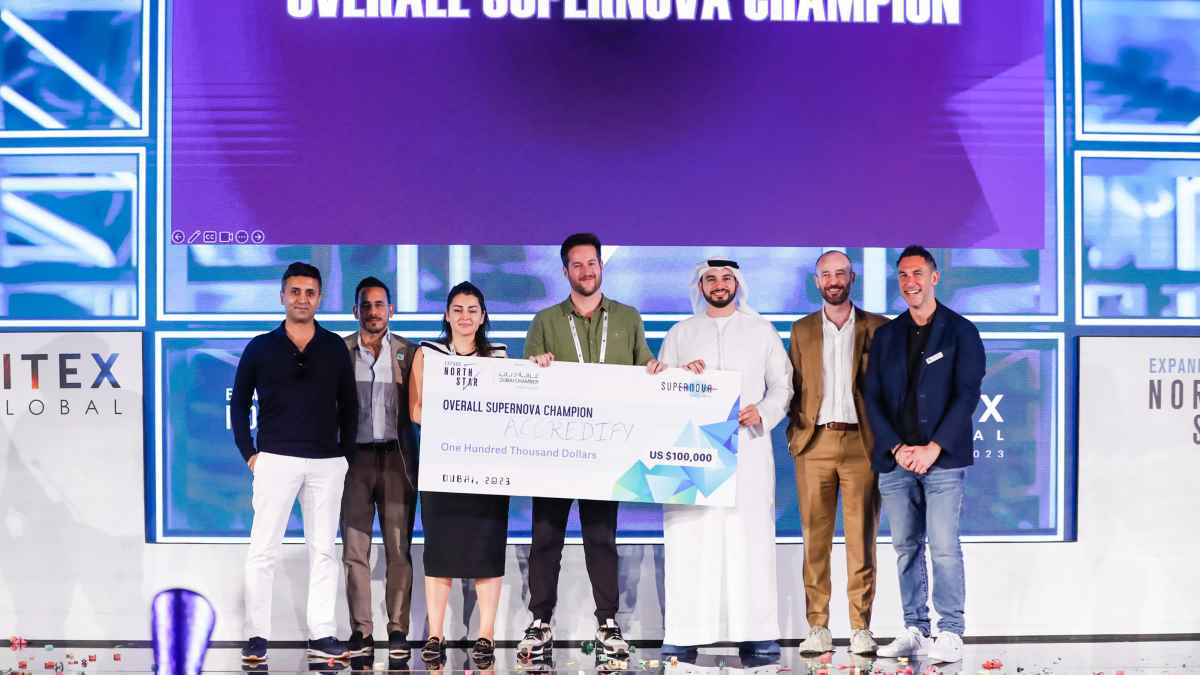
Accredify from Singapore beats 260 startups to win the 2023 Supernova Challenge

Published

on

Accredify

The Supernova Challenge is the biggest pitch competition in the Middle East, Africa and South Asia

DUBAI, United Arab Emirates, October 19, 2023/APO Group/ — 

Accredify, a Singapore-based startup and service provider for issuing verifiable documents and information, has emerged as the champion of the 2023 Supernova Challenge at Expand North Star Dubai (https://www.ExpandNorthStar.com/), the world’s largest startup event. The startup received the $100,000 grand prize after an intense final round of pitching against 27 global finalists from 521 entries.

The Supernova Challenge in partnership with the Dubai Future District Fund, is the region’s biggest startup pitch competition, offering $200,000 in total cash prizes. The challenge is a key feature of Expand North Star Dubai, which hosted its biggest edition this year. It attracted over 1800+ startups from over 100 countries to explore the emerging opportunities in Dubai’s dynamic, diverse and tech-driven digital economy.

Simon Gordon, Chief Commercial Officer of the winning team, said, “Supernova 2023 has been an incredible experience. It’s surreal to win this challenge at Expand North Star. This region, particularly the UAE, has so many great opportunities, and we are excited about using this prize money to expand our presence here.”

One of the judges at Supernova, Sharif El-Badawi, CEO of Dubai Future District Fund, commented, “It is encouraging to see a shift towards sustainable solutions that are better for the planet and its people. We witnessed several startups delivering concise yet compelling pitches that could impact our lives. The pitches we witnessed here at the Supernova Challenge are brimming with promise, unique innovations, and inspiring ideas.”

An expertly curated list of categories covered the latest trends in tech, inviting startups to showcase innovations that can solve some of our most pressing challenges. These included AI Disruptor, Fintech & Ecommerce Disruptor, Blockchain & Web3 Disruptor, Mobility & Smart Cities Disruptor, Healthtech & Wellness Disruptor, Martech Disruptor, Insurtech Disruptor in partnership with MENA Insuretech, Female Founder Award in partnership with the Sharjah Businesswomen Council, Africa Fast Award presented by GITEX Africa, Asia Fast Award, India Fast Award, and the Top MENA Award. In collaboration with GITEX Impact and Future Urbanism, Expand North Star also awarded the most proficient Sustainability and ESG Disruptor.

Thirteen category winners representing the USA, India, UAE, South Korea, France, UK, Nigeria, Switzerland, China and Bangladesh took home $8,000 each in prize money, while the winner of the Female Founder Award won $10,000.

The Supernova Challenge category winners were:

Sustainability and ESG Disruptor: Zenerate from the USA, a platform providing AI-powered feasibility solutions for real estate development.

AI Disruptor: Knorish, a platform that enables hobbyists, professionals and niche experts to build, launch, market and sell online courses powered by their own knowledge and as an extension of their own brand.

Fintech and E-commerce Disruptor: Appro Technologies from the UAE, a digital platform simplifying retail banking onboarding.

This region, particularly the UAE, has so many great opportunities, and we are excited about using this prize money to expand our presence here

Blockchain and Web3 Disruptor: Verofax from the UAE, a platform enabling real-time consumption data by offering a unique microsite per product.

Mobility and Smart Cities Disruptor: Innocel from France, a company providing clean energy solutions for a net zero future.

Healthtech and Wellness Disruptor: Skia from Korea, a digital surgery guide solution using augmented reality (AR) technology.

Martech Disruptor: Smartzer from the UK is a SaaS platform brands use to make live streams and videos interactive and shoppable to drive sales.

Female Founder Award: Matis from Switzerland, a platform empowering art market stakeholders with accessible and quantifiable tools for art authentication.

Africa Fast Award: Gifty from Nigeria, an app that helps people easily share gift lists with family and friends and avoid duplicating purchases.

Asia Fast Award: Urtopia from China, a company dedicated to revolutionizing urban transportation with its smart, sleek, and stealthy e-bikes.

India Fast Award: EyeROV from India, a marine robotics company providing underwater ROVs (remotely operated vehicles) to various industries.

Insurtech Disruptor: InsureCow from Bangladesh, a platform offering a 360° technology-powered cattle insurance and wellbeing monitoring solution.

Top MENA Award: Jalebi.io from the UAE is the world’s first restaurant operating system that helps restaurants save 5% on the cost of every order served.

The Supernova Challenge featured 40 startups selected from the Expand North Star global roadshow, a series of international pitch competitions held by the Dubai World Trade Centre and DCDE to attract startups to Dubai and foster collaborations with digital ecosystems in various countries.

Expand North Star hosted by Dubai Chamber of Digital Economy (DCDE) is the powerhouse startup show of GITEX Global, organized by the Dubai World Trade Centre (DWTC) concluded this week marking its largest-ever edition at its new Dubai Harbour venue.

For more information, please visit ExpandNorthStar.com

Distributed by APO Group on behalf of Expand North Star.

Business

Mukuru Partners with Flash to Add 170,000 Cash Pay-in Points Across South Africa

Published

on

Mukuru

New partnership brings remittance payments into township, peri-urban and rural spaza shops nationwide

JOHANNESBURG, South Africa, November 6, 2026/APO Group/ –Mukuru (www.Mukuru.com), a leading financial services provider, has partnered with Flash, a payments technology company with an extensive network of spaza shops across South Africa, adding 170,000 cash pay-in points where customers can now pay for their Mukuru remittance orders. The network includes Flash’s broader merchant footprint, giving Mukuru access to locations through Flash and its partner networks. These new locations are now operational, reducing the time and distance many customers currently travel to make a payment.

Previously, customers often had to travel to banks or dedicated payment outlets to pay for their Mukuru orders. Now, they can simply visit a spaza shop close to home, work or where they usually shop.

For people in townships, peri-urban and rural areas who rely on cash and have traditionally had limited access to formal pay-in points, particularly South Africa’s migrant communities, this change removes a real barrier and makes it easier to send money home. With these pay-in points inside spaza shops, Mukuru’s services become part of places people already go, meaning fewer extra trips and more timely payments.

Every additional pay-in point represents one less barrier for a customer trying to send money home

“Every additional pay-in point represents one less barrier for a customer trying to send money home,” said Erone Kyte, Commercial Manager: Cross-Border Remittances at Mukuru. “Our partnership with Flash gives us the scale to bring Mukuru’s services into the everyday spaces our customers already know and trust. It’s a meaningful step in making remittances simpler, more accessible and genuinely closer to the communities we serve.”

For Mukuru, working with Flash means reaching even more customers in underserved urban, township, and rural areas. By leveraging Flash’s established network, Mukuru can now offer cash pay-in options where they didn’t exist before. The expanded network is expected to help more people access Mukuru’s services, support growth in its South African customer base, and make cross-border payments more convenient.

Rens Rezelman, General Manager for Flash’s Merchant Division, commented, “Flash works to bridge the digital product and payments gap between businesses and consumers across the country. Launching Mukuru across our network presents another opportunity to bring a familiar brand closer to the people who need it most.”

The sector is now recognised as a R750 billion  industry. According to data tracked by Trade Intelligence, total turnover recently reached R197 billion, growing at roughly 15% annually. Research confirms that traditional trade and spaza shops are growing faster than large supermarket chains, with almost 80% of South African households shopping at these traditional trade outlets regularly. (https://apo-opa.co/4iDwZr8) Bringing Mukuru payments to these stores is a natural fit and helps shop owners draw in more customers and offer more services to their communities. Mukuru and Flash will build awareness of the new pay-in option through store, digital, and community promotions in the coming months.

This partnership is part of Mukuru’s ongoing drive to make cash pay-ins easier and improve access to remittance services for people living and working in areas with limited formal financial services. Over the past two years, the company has made similar moves to make its payment network bigger and more accessible across the region.

Mukuru customers looking to pay closer to home can easily find their nearest participating Flash pay-in point using the Mukuru app or website.

Distributed by APO Group on behalf of Mukuru.


Continue Reading

Business

How CESI is helping shape Africa’s next-gen power grids

Published

on

CESI

CESI, a global engineering and consulting company specialising in power systems and energy transition, has supported utilities, transmission system operators and public institutions

CAPE TOWN, South Africa, November 6, 2026/APO Group/ –Across Africa, power systems are undergoing a profound transformation. Rapid population growth, urbanisation, industrial development and ambitious electrification goals are increasing pressure on networks that must improve reliability, integrate growing volumes of renewable energy and strengthen regional interconnections.


For utilities, regulators and governments, this creates a dual challenge: planning future power systems while modernising the infrastructure required to operate them safely and efficiently.

Drawing on projects delivered across the continent CESI, a global engineering and consulting company specialising in power systems and energy transition, has supported utilities, transmission system operators and public institutions in addressing both long-term planning requirements and grid modernisation challenges. These experiences highlight how strategic planning and operational modernisation are becoming increasingly interconnected.

Planning for growth in a changing energy landscape

Many African countries are updating power sector strategies to reflect changing demand patterns, evolving technologies and new regional opportunities. National master plans in countries including Angola, Mozambique and Liberia are examining how generation, transmission and distribution systems can evolve over the coming decades while remaining technically feasible and financially sustainable.

A key trend is the growing emphasis on integrated planning. Rather than treating generation, transmission and distribution separately, stakeholders are increasingly assessing investments across the entire value chain to meet future demand efficiently and reliably. Demand forecasting methodologies are also evolving, considering industrial development, electric mobility and broader electrification trends.

Renewable energy integration is another central consideration. Africa possesses significant solar, wind and hydropower resources, but integrating these technologies requires careful assessment of transmission capacity, system flexibility, reserve requirements and grid stability. In this context, CESI has contributed to power sector master plans and network studies evaluating future development pathways while addressing reliability, economic and energy transition objectives.

Regional interconnections as strategic infrastructure

Regional integration continues to play an increasingly important role in Africa’s electricity sector. Future Interconnection projects linking countries such as Ethiopia and Somalia, Uganda and Tanzania, and Uganda and South Sudan demonstrate how cross-border infrastructure can enhance energy security and optimise the use of available generation resources.

Delivering these projects requires more than engineering analysis. Technical, economic, regulatory and operational considerations must be aligned among participating countries. Through its involvement in several interconnection initiatives at different stages across Africa, CESI has supported stakeholders in assessing feasibility, network performance and operational requirements for cross-border electricity exchanges.

As regional power markets continue to develop, interconnected systems are expected to contribute further to reliability, operational flexibility and efficient resource utilisation.

Modernising grid operations for greater reliability

Alongside long-term planning, utilities are investing in modern operational technologies to improve management of increasingly complex power systems. Control centres, SCADA systems, energy management systems (EMS) and telecommunications networks are becoming essential components of modern grid operations.

In countries including Mozambique and Angola, projects are supporting the development of advanced control centres capable of monitoring generation facilities, transmission networks and interconnections through integrated operational platforms. These systems provide operators with real-time visibility and decision-support capabilities that strengthen system reliability and operational efficiency.

Meanwhile, programmes in Tunisia and Nigeria illustrate how utilities are upgrading ageing SCADA and EMS infrastructures to meet evolving requirements. Modern solutions increasingly incorporate

  • cybersecurity,
  • wide-area monitoring capabilities and
  • renewable energy management functions.

CESI’s experience in control centres, SCADA/EMS systems and power system operations reflects the growing importance of digital technologies in enabling more resilient and responsive electricity networks.

Building resilience and technical capacity

Environmental and social considerations are becoming increasingly important across both planning and modernisation initiatives. Climate resilience now plays a central role in infrastructure development, particularly in countries exposed to extreme weather events or heavily dependent on hydropower resources. As a result, environmental and social assessments are increasingly integrated into project design and investment decision-making processes.

Capacity building is equally important. New technologies and analytical tools require utilities and public institutions to continually strengthen technical capabilities. Training and knowledge-transfer programmes have therefore become integral components of many planning, interconnection and grid modernisation projects, helping organisations develop the expertise needed to manage increasingly sophisticated power systems.

An integrated approach to Africa’s power future

Several common themes are emerging across Africa’s electricity sector. Utilities are adopting longer-term planning horizons, renewable energy is becoming a central driver of network development, regional interconnections are expanding opportunities for power exchange, and digitalisation is transforming power system operations.

Together, these trends point towards a broader evolution of African power systems. The challenge is no longer simply expanding infrastructure, but ensuring that future networks are planned, operated and modernised in a coordinated manner. Achieving this objective will require continued collaboration among utilities, governments, regulators, financiers and technical stakeholders.

Experience across the continent suggests that integrating sound planning with targeted grid modernisation can support the development of more reliable, resilient and adaptable power systems, helping meet Africa’s long-term economic and social development goals.

CESI is a partner of ESI Africa, the power, energy, water, transport and utility multimedia platform that forms part of VUKA Group.

Read the article and access more information: https://apo-opa.co/47Xr1g3

Distributed by APO Group on behalf of VUKA Group.


Continue Reading

Business

Bilateral Cooperation Anchors South Sudan’s Energy Renaissance

Published

on

Etu Energias

South Sudan Oil & Power 2026 provides a platform for South Sudan’s energy industry to connect with regional and international partners to accelerate oil and gas development

JUBA, South Sudan, November 6, 2026/APO Group/ –South Sudan is placing bilateral partnerships at the center of its energy renaissance. As East Africa’s sole oil producer seeks to expand geomapping, unlock 14 available exploration blocks, maximize brownfield production and strengthen access to regional energy markets, cross-border cooperation has become a strategic avenue for accelerating development.


The upcoming South Sudan Oil & Power (SSOP) conference – scheduled for November 24–25, 2026 in Juba – provides a platform to connect South Sudanese authorities with regional and international counterparts, drive new investment and forge strategic energy partnerships. Returning for its seventh edition, SSOP will connect South Sudan’s regional and global partners with emerging investment prospects across the oil value chain as the country eyes production targets of 230,000 barrels per day (bpd) in the near term and 450,000 bpd in the longer-term.

Strengthening Regional Petroleum Trade

Already a major exporter, South Sudan is actively pushing to establish a domestic refining industry while exploring cross-border petroleum trade opportunities with regional neighbors. The October 2026 meeting between South Sudanese President Salva Kiir and Kenyan President William Ruto marked a major milestone in strengthening bilateral energy and infrastructure cooperation to accelerate regional market growth.

The engagement builds on momentum generated in September 2026, when a delegation of South Sudan’s key energy leaders – led by Caretaker Minister of Petroleum Awow Daniel Chuang – attended the groundbreaking of Dangote’s $16 billion, 700,000-barrel-per-day refinery project in Kenya. Once operational, the refinery could open new markets for South Sudan’s crude while supplying refined products to meet growing domestic demand. Dangote Refinery CEO David Bird is speaking at SSOP 2026.

Expanding Trade Corridors and Bilateral Synergies

Beyond Kenya, South Sudan is actively solidifying strategic energy and trade arrangements across the region. Bilateral agreements signed with Uganda in October 2026 are designed to improve market access, remove trade barriers and streamline petroleum-product logistics and transport links. In April 2026, South Sudan and Ethiopia reaffirmed bilateral cooperation on infrastructure, transport and oil industry development following a meeting between President Kiir and Ethiopian Prime Minister Dr. Abiy Ahmed. These engagements underscore South Sudan’s growing focus on strengthening regional petroleum infrastructure, expanding cross-border trade and securing reliable crude export routes.

South Sudan Looks to International Partners

South Sudan is also strengthening engagement with international partners. Following an October 30 meeting between President Kiir and Russian President Vladimir Putin, Russia committed to training 40 South Sudanese professionals for the 2026/2027 period, leveraging its position as a major hydrocarbon producer to support the nation’s energy development.

Separately, South Sudan’s Minister of Energy and Dams Agok Makur Kur met with a delegation from the European Union to discuss foreign investment and bilateral cooperation, with discussions centering on co-developing national electricity networks and essential dam infrastructure.

SSOP 2026: Turning Partnerships into Tangible Projects 

As South Sudan strengthens ties with regional partners, SSOP 2026 serves as the official platform for deal-making, policy alignment and commercial collaboration. By bringing together public decision-makers, regional counterparts and private sector leaders, the event provides a platform to convert bilateral engagement into tangible project developments. For operators and investors looking to capitalize on South Sudan’s evolving oil and gas landscape, SSOP 2026 offers direct access to new opportunities across exploration, midstream infrastructure and regional energy supply chains.

Distributed by APO Group on behalf of Energy Capital & Power.


Continue Reading

Trending