Connect with us
Anglostratits

Sports

Rugby Africa Appoints Former National Basketball Association (NBA) Africa Executive Aïcha Diop as Chief of Staff to the President


Published

on

Rugby

In this strategic leadership role, Aïcha Diop will support Herbert Mensah, President of Rugby Africa, Executive Board Member of World Rugby and Chairman of World Rugby Regions

CAPE TOWN, South Africa, May 25, 2026/APO Group/ –Rugby Africa (www.RugbyAfrique.com), the continental governing body for rugby union in Africa, is pleased to announce the appointment of former NBA Africa executive Aïcha Diop as Chief of Staff to the President.


In this strategic leadership role, Aïcha Diop will work and support  Herbert Mensah, President of Rugby Africa, Executive Board Member of World Rugby, and Chairman of World Rugby Regions—the body uniting the presidents of all six continental rugby associations: Rugby Europe, Asia Rugby, Rugby Americas North (RAN), Sudamérica Rugby, Oceania Rugby, and Rugby Africa. In his capacity, Mr Mensah operates at the intersection of continental and global sports governance, engaging with heads of state, ministers, and leaders of development finance institutions to advance the role of sport as an engine for economic growth and social development. These combined mandates place him among the most influential sports administrators in Africa.

A seasoned international executive, Aïcha brings over 18 years of experience across Africa, Europe, the Middle East, and North America, combining strategic leadership, operational execution, and high-level expertise in marketing, brand development, and audience growth. She has held senior roles at NBA Africa and the Basketball Africa League, part of the team who launched the Basketball Africa League (BAL) where she led multi-market initiatives, coordinated cross-functional teams, and contributed to the growth and visibility of the organisation through impactful campaigns and programmes.

Attracting talent of this calibre reflects our ambition to elevate rugby across Africa and position Rugby Africa as a modern, high-performance organisation on the global stage

Her career also includes senior positions at IBM, where she managed regional initiatives across multiple African markets, aligning strategy with execution and supporting business growth. In addition, she has been involved in the delivery of major international sports and entertainment events, including Formula 1, UFC, and global football competitions, and broader sports ecosystem on the continent further strengthening her ability to operate in high-performance, international environments.

Aïcha holds a Master’s degree in Sport & Lifestyle Management from Rome Business School, as well as a Bachelor’s degree in Business Administration. Her combined academic and professional background provides a strong understanding of sports ecosystems, organisational dynamics, and audience engagement, supporting Rugby Africa’s ambitions to expand its reach and impact across the continent.

Herbert Mensah, President of Rugby Africa, commented: “We are delighted to welcome Aïcha Diop to Rugby Africa. Her exceptional track record, international exposure, and deep understanding of the sports and commercial landscape make her a remarkable addition to our leadership team. Attracting talent of this calibre reflects our ambition to elevate rugby across Africa and position Rugby Africa as a modern, high-performance organisation on the global stage.”

Aïcha Diop added: “It is a great honour to join Rugby Africa at such an exciting time for the sport across the continent. Under the leadership of President Herbert Mensah, Rugby Africa is playing an increasingly important role on both the African and global stage. The continued success of African rugby, exemplified by South Africa’s Rugby World Cup victories in 1995, 2007, 2019, and most recently in 2023, reflects the immense potential of the continent. I look forward to contributing to this momentum, supporting the delivery of Rugby Africa’s strategic priorities, and working alongside its stakeholders to further unlock the power of rugby as a driver of opportunity, unity, and sustainable development across Africa.”

In her role as Chief of Staff, Aïcha will work closely with the President to drive strategic initiatives, enhance coordination across member unions and stakeholders, and support the delivery of Rugby Africa’s long-term vision, including the continued expansion of competitions, partnerships, and youth engagement across the continent.

Distributed by APO Group on behalf of Rugby Africa.

Sports

More Than a Trophy: Africa’s Moment to Champion Women’s Football (By Isha Johansen)

Published

on

Global revenues from women’s sports are expected to reach at least $3 billion in 2026, an increase of 340% in four years

ABIDJAN, Côte d’Ivoire, October 19, 2026/APO Group/ —By Isha Johansen, former CAF (www.CAFonline.com) Executive Committee Member and the first West African woman to serve on the FIFA Council.

For years, Africa has been known for its growth story. Investment has flowed, new tech has been  growing fast, and a young, active population has inspired hope for the future.  Women’s football now offers another lens through which to consider that progress.  Following the conclusion of the TotalEnergies CAF Women’s Africa Cup of Nations in Rabat, Casablanca and Fez, the question is what happens next: whether the momentum generated by the tournament can translate into sustained investment in women’s football, stronger structures and more opportunities for the next generation of players. This tournament was much more than sport. It was a moment to spotlight gender equality, inclusion, and the changing role of women in African sports.


For too long, women’s sports have been seen as charity projects or CSR boxes to tick; not real investments. That’s changing. Stadiums are filling, fans are showing up, and real money is finally coming in. The message is clear: women’s football is no longer a side issue; it’s a huge opportunity Africa can’t afford to ignore.

Global revenues from women’s sports are expected to reach at least $3 billion in 2026, an increase of 340% in four years (https://apo-opa.co/3U7pm41). In Africa, the true value is still unknown. Most of the investment comes from sports associations, governments, and a handful of sponsors. Ticket sales and big broadcast deals are exceptions, not the rule. So women’s sports here are half-in, half-out: there’s new investment, but plenty of hurdles remain.

Some progress has been made, however. This year, the Confederation of African Football doubled Women’s Africa Cup of Nations prize money to $5.8 million, with $2 million for the winners. Last year, Nigeria’s NWFL Premiership landed its biggest private investment, a ten-year, ₦20 billion partnership, while South Africa’s Women’s League secured a R17 million naming rights deal.

The final whistle will pick a winner, but what happens next will show whether Africa is ready to make women’s football central to its future

The Women’s Africa Cup of Nations featured 16 teams, and money from TV and sponsors went up by 40%. Matches were shown on more than one hundred channels. Real interest grew across the continent. Africa’s fans,  young and energetic, followed their teams on platforms like TikTok and Instagram.

Despite the progress and growing support from fans,  challenges remain. Top female players are leaving for Europe or the US, where their skills are valued and rewarded. Without money from TV deals or steady support from local fans, women’s sports here will keep relying on outside help and quick fixes.

In South Africa, a few years ago, women’s national team players earned just a tenth of what the men did. The gap is closing, but it’s not gone. Women are still few in sports leadership roles, and coaching jobs mostly go to men. But pioneers like South Africa’s Desiree Ellis and Kenya’s Beldine Odemba show what’s possible when women get a real shot: excellence follows.

Mentorship is central to that possibility. Behind every player and coach who broke through, there was almost always someone who opened a door, offered guidance, or made room at the table. Formal mentorship programmes, pairing rising talent with experienced players, coaches, and administrators, gave young women a clearer path into leadership roles that had long been closed to them. To turn potential into progress, more is needed than just a few stars. Governments, sports bodies, and private investors must team up by building partnerships, investing in training grounds, leadership, mentorship, and the kind of infrastructure that lasts.

The private sector can’t afford to sit this out. New models like sportswomen-driven content, streaming platforms, and direct fan engagement can break old barriers. Organisations like Tibu Africa, a leading NGO empowering young people through sport, show how football can drive wider social change by building opportunities and breaking down barriers. Their work reminds us that every girl deserves a shot at the game and demonstrates the impact that partnerships between the private sector, government, and civil society can have.

Governments must make investing in women’s sports worthwhile, guarantee fairness, and keep things transparent. Regional bodies should align standards, share resources, and channel funds into grassroots development. And media matters too: having more women on camera or working behind the scenes changes opinions and gives new role models the chance to shine.

TotalEnergies’ partnership with the Confederation of African Football (CAF) is more than a sponsorship. It’s a commitment to building African football from the grassroots up, creating lasting opportunities for players, fans, and communities. Supporting CAF helps raise the visibility of women’s football and strengthens the sport as a force for unity and inclusion across the continent. This investment reflects an alignment of values: sustainable development, community empowerment, and celebrating Africa’s potential.

If Africa misses this window, old gaps will widen, and the chance to lead in women’s sports could be lost. But if we step up now, the rewards are huge: jobs, tourism, and growth everywhere you look. This tournament is more than a trophy. It’s a test of whether Africa will build up its talent or watch it leave. The final whistle will pick a winner, but what happens next will show whether Africa is ready to make women’s football central to its future.

Distributed by APO Group on behalf of Confederation of African Football (CAF).


Continue Reading

Sports

How the “Dual Olympic City” Activates the Sports Event Economy
Published

on

Dual Olympic City

BEIJING, CHINA – Media OutReach Newswire – 9 October 2026 – On the evening of October 6, after Djokovic won the first set of the men’s singles final, his opponent Alex de Minaur retired due to injury, giving Djokovic his seventh China Open title.

During the tournament, the excitement of the China Open extended from the courts to the entire park. The “second venue” with big-screen viewing, a rich variety of officially licensed merchandise, and food and beverage outlets full of everyday bustle blended the passion of sports competition with the city’s relaxed atmosphere, creating a diverse holiday viewing experience.


“After entering through the two ticket gates—north and south—of the National Tennis Center, there are officially licensed merchandise stores at both locations. During the National Day holiday, each of these two stores received over 10,000 visitors a day. Nearly a thousand products give everyone’s tournament memories a tangible carrier,” said Yin Xufei, head of the China Open officially licensed merchandise store.

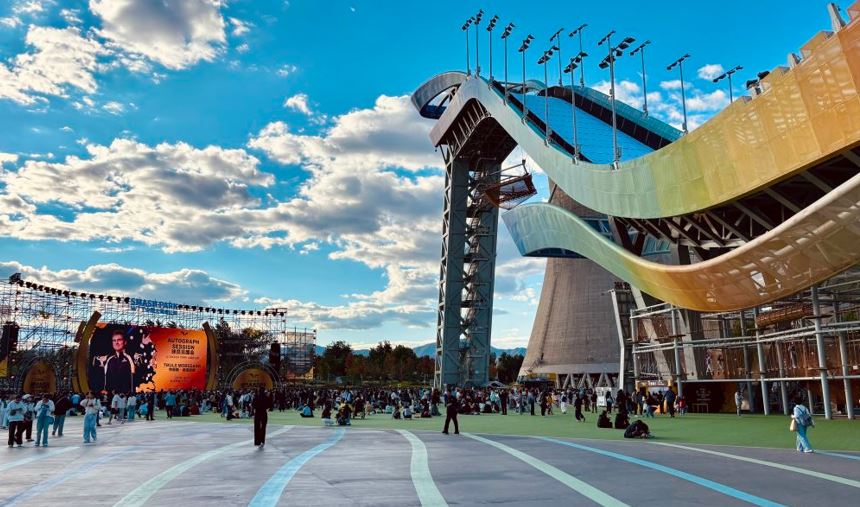
Also thriving thanks to the events is Shougang Park in Shijingshan, Beijing. The World Table Tennis (WTT) China Grand Smash held in this industrial-style park echoed the China Open during the National Day holiday for the third consecutive year, giving the most vivid footnote to the “Golden Week of Sports Events.”

“People can spend a whole day wandering around Shougang Park—dining, markets, and souvenirs are all available. Besides going into the venue to watch matches and cheer for the athletes, you can also feel the festive atmosphere of table tennis, China’s national sport, blending with the National Day holiday at the Grand Smash Park,” said Gao Yize, a fan from Xinjiang.

At the WTT China Grand Smash official licensed store, visitors and tourists stopped to learn about the tournament-themed T-shirt that lets you “Explore Shijingshan in One T-Shirt.” For those familiar with the “ticket stub economy,” this T-shirt is a “walking ticket stub.” Wearing the benefits during the tournament gives you access to exclusive discounts on dining, accommodation, and sightseeing at hundreds of partner merchants in Shougang Park, Yongdingheji, Moshikou Historical and Cultural Street, and other locations.

The “Golden Week of Sports Events” ignited a city. Led by high-level international events such as the China Open and the WTT China Grand Smash, competitive sports, mass sports, and youth sports events at all levels covered the north, south, east, and west of the “Dual Olympic City” and integrated into its streets and alleys.

During the National Day holiday, the Beijing Yizhuang GT World Challenge attracted over 26,000 spectators. By Tongming Lake, engines roared, and speed and passion were set against the lake and city scenery. The automobile-themed carnival, integrating race viewing, car culture, technology interaction, and leisure consumption, drove significant growth in surrounding dining, retail, and accommodation spending. In Miyun on the outskirts of Beijing, the China Men’s 3×3 Basketball League Championship linked cultural tourism resources and key commercial districts, opening the “Chao San” Market that brought together over 30 merchants offering Miyun’s Three Roasts, intangible cultural heritage “loufen” (starch noodles), and other specialties, allowing fans to enjoy food and buy local products after watching the games…

The “Dual Olympic City” has made holiday cultural tourism scenarios a standard feature of sports events, expanding event consumption scenarios and enhancing the event consumption experience, further demonstrating the enormous potential of the sports event economy.


Continue Reading

Sports

Beijing Marathon to Kick Off on October 18: Road Running Charm Blooms in the Golden Autumn Capital
Published

on

BEIJING, CHINA – Media OutReach Newswire – 29 September 2026 – On September 28, the 2026 Bank of China Beijing Marathon & National Marathon Championships held a press conference in Beijing, officially disclosing the event’s preparation details and competition arrangements. The race is scheduled to start on October 18, 2026, with a total field of 32,000 runners.

Founded in 1981, the Beijing Marathon is the oldest city marathon in China and a World Athletics Gold Label road race. Over more than four decades, it has evolved from a simple marathon event into a unique urban experience that traverses Beijing.


The Beijing Marathon boasts a highly distinctive course. The start line is set at Tiananmen Square. After setting off, runners follow Chang’an Avenue, passing through Fuxingmen and Fuxing Road, before heading north into the Xueyuan Road area in Haidian District, and finally arriving at the Olympic Park, where they sprint to the finish along the landscaped avenue between the Bird’s Nest and the Water Cube.

One of the most notable features of this year’s Beijing Marathon is the integration of the race with the National Marathon Championships. China’s top professional athletes will compete for championship placings on the same course, while mass runners set off alongside them, bringing professional competition and national fitness together on a single course. The event not only provides a high-level competitive platform for professional runners but also preserves broad participation channels for everyday runners, striving to strike a balance between competitive leadership, public participation, and organisational effectiveness.
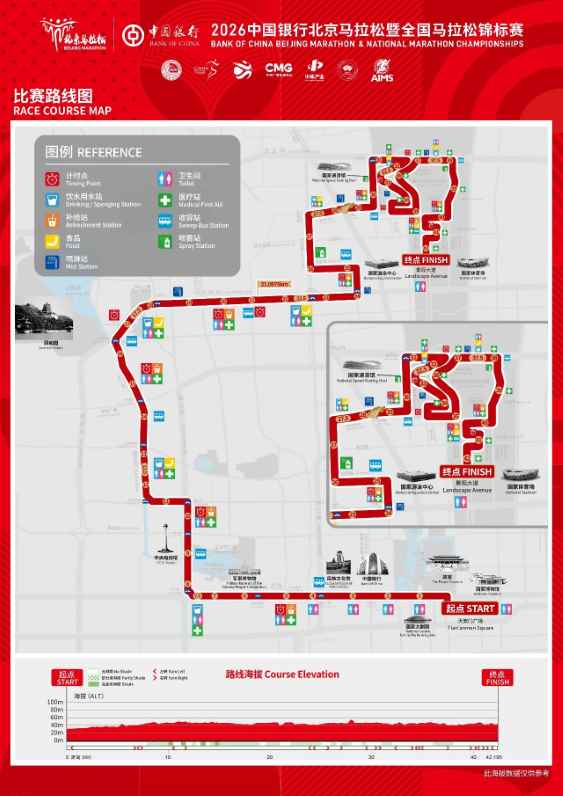
In terms of event support and civilised race organisation, the organising committee has simultaneously released a number of upgraded measures to comprehensively optimise the participant experience and safeguard race order, building a refined system of medical support, course supplies, and smart guidance, while continuing mature international event service standards. The event also emphasises green organisation, introducing reusable eco-friendly cups, multi-tap self-service water stations, backpack-style water supply equipment, and recyclable waste collection pools, among other environmental measures.

In golden autumn October, Beijing’s mild temperatures make it the perfect season for running. This year’s Beijing Marathon continues to be rooted in Beijing, the “Dual Olympic City,” showcasing the vitality of China’s road running and the urban charm of Beijing to runners and audiences around the world through professional race standards, international event-organising concepts, and profound urban heritage.


Continue Reading

Trending