Connect with us
Anglostratits

Business

République Démocratique du Congo (RDC): African Development Bank Group grants $260 million loan to strengthen agricultural sector and value chains

Published

on

RDC

The Democratic Republic of Congo (DRC) government and beneficiaries will provide counterpart funding of $51.2 million

ABIDJAN, Ivory Coast, July 19, 2024/APO Group/ — 

The Board of Directors of the African Development Bank Group (www.AfDB.org) approved a loan of $260.4 million to the Democratic Republic of Congo (DRC) to help finance the Project to Support the Development of Value Chains as part of its backing for the Agriculture Transformation Programme (PADCV-PTA).

The project, totalling $311.6 million, is being funded by a $250.4 million loan from the African Development Fund, the Bank Group’s concessional window, and another $10 million loan from the Transition Support Facility, a Bank Group mechanism for countries undergoing periods of transition. The DRC government and beneficiaries will provide counterpart funding of $51.2 million.

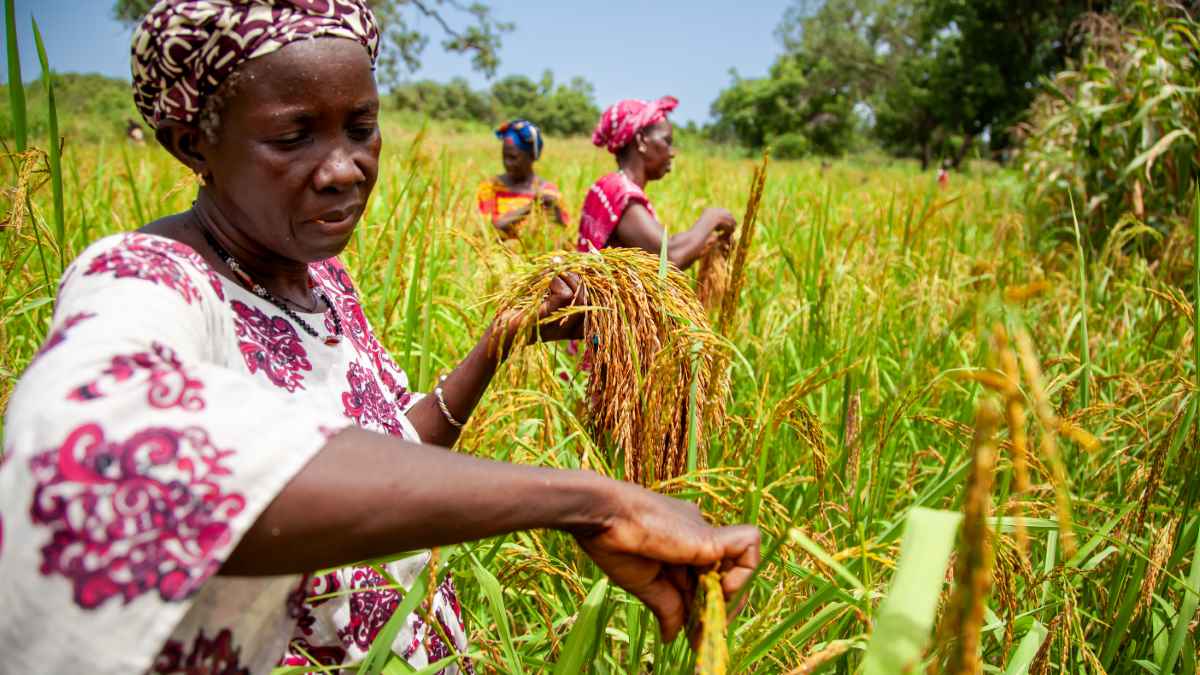
The project will contribute towards the country’s food self-sufficiency by boosting production of the main stape food crops of rice, cassava, maize and soya. This will significantly reduce large-scale food imports – which amounted to $3 billion in 2023 — 19 per cent of the national budget – and its vulnerability to external shocks, including climate change and armed conflict.

More specifically, the project aims to rebuild the seed capital of the rice, cassava, maize and soya value chains, to improve yields in a sustainable manner and to structure and facilitate the access of stakeholders in these value chains to markets and suitable financing.

Consequently, 295,000 hectares of maize, soya, cassava and rice will be sown, using improved seeds that are resistant to climate change. Some 1,600 farmer field schools and demonstration plots will be set up and run by supervisors for extension activities, including climate-smart farming techniques. The development of irrigated rice-growing areas will enable intensive production levels to be attained, with at least two cycles per year.

The African Development Bank is a strategic partner of the DRC, whose top authorities have decided to make agriculture the priority sector

The project will make inputs available to producers on credit at the start of the cropping season, repayable at harvest time, to build up working capital to facilitate long-term access to said inputs and equipment for the pre-processing of agricultural produce (threshers, winnowing machines, tarpaulins/drying areas) for the cooperatives of rice-growing area operators.

Some 600 km of rural tracks will be upgraded to open up production basins and facilitate access to consumption areas.

The project also aims to organise the value chain stakeholders into cooperative companies so that they can benefit from economies of scale through grouped orders and sales. It will bolster the bargaining power and capacity of small-scale producers to enter into ‘win-win’ partnerships. To facilitate access to funding, the project provides for a shared-cost financing mechanism.

In addition, it will also build the capacity of national agricultural research and seed system stakeholders in order to reestablish the national seed capital.

The project will be implemented in six provinces, namely Kongo Central, Kwango, Maï-Ndombe, Kasaï Oriental, Lomami and South Kivu – areas that are part of the direct supply basins of major cities and that can also supply neighbouring countries. All told, the area covered by the project is home to 24 per cent of the Congolese population, and some 900,000 farming households, including internally displaced people, will benefit directly from the project.

Ultimately, the project should increase yields of the targeted crops by 80 per cent, and boost agricultural production by 1.68 million tonnes per year and private agricultural processing by 4.1 million tonnes over five years, while reducing the DRC’s food imports by $500 million a year. All female heads of household in the area will benefit from the project, as will two million households, on an indirect basis. This pertains to three of the country’s major urban centres, Kinshasa, the capital city, Mbuji-Mayi and Bukavu, where food security will be strengthened for around 21 million inhabitants. The project will also enhance regional integration between the DRC and neighbouring Angola via trade in agricultural products.

Other beneficiaries of the project include government services (agricultural research units, seed sellers, farmers’ organisations), private organisations (processors and service providers), decentralised regional bodies, and women’s and youth organisations.

“The African Development Bank is a strategic partner of the DRC, whose top authorities have decided to make agriculture the priority sector for the country’s development,” said Serge N’Guessan, the Bank’s Director General for Central Africa. “This project, which has just been approved by the Bank Group’s Boards of Directors, will enable the rapid implementation of the National Food and Agriculture Pact, which is part of this national vision.”

Distributed by APO Group on behalf of African Development Bank Group (AfDB).

Business

Learning curves: Addressing the skills shortage in African mining

Published

on

mining

The discussion will unpack key factors contributing to the skills shortage and examine how stronger collaboration between mining companies, universities and Technical and Vocational Education and Training (TVET) institutions can help bridge the gap

CAPE TOWN, South Africa, March 23, 2026/APO Group/ –The African mining industry is undergoing rapid transformation, driven by technological advancements, increasing sustainability demands, and rising global demand for critical minerals. However, a widening skills gap continues to pose a significant challenge to the sector’s growth and long-term competitiveness.


To address this pressing issue, an upcoming webinar hosted by Vuka group’s Mining Review Africa will bring together industry experts to explore practical solutions for building a skilled and future-ready mining workforce across the continent.

The discussion will unpack key factors contributing to the skills shortage and examine how stronger collaboration between mining companies, universities and Technical and Vocational Education and Training (TVET) institutions can help bridge the gap. It will also consider how digitalisation and automation are reshaping workforce requirements, and what this means for the next generation of mining professionals.

Participants can expect insights on:

  • Key causes of the mining skills shortage across Africa
  • Strengthening collaboration between industry, universities, and TVET institutions
  • The impact of digitalisation and automation on workforce requirements
  • Strategies for developing the next generation of mining professionals
  • Practical solutions for upskilling and workforce development
  • How regional collaboration can develop a skilled workforce
  • Preventing the brain drain in African mining as skilled workers seek greener pastures


Event details:
Date: 7 May 2026
Time: 14:00 (SAST)

To register for the webinar, visit: https://apo-opa.co/4brnadB

Distributed by APO Group on behalf of VUKA Group.

Continue Reading

Business

Mining Review Africa Introduces French and Portuguese Website Translation

Published

on

vukagroup

By enabling multilingual access, Mining Review Africa aims to better serve its diverse readership, including industry professionals, policymakers and investors who rely on timely mining news and insights

CAPE TOWN, South Africa, March 20, 2026/APO Group/ –VUKA Group’s (https://WeAreVUKA.com/Mining Review Africa has introduced French and Portuguese translations on its website, responding to growing demand from readers across the continent.


This allows users to access content in multiple languages, improving accessibility for audiences in regions where English is not widely used.

We recognise that language should not be a barrier to information, especially in a sector that plays such a critical role in the continent’s economic growth

The move follows insights gathered by VUKA Group during its flagship mining events held across Africa, including DRC Mining Week, Angola International Mining Conference and Nigeria Mining Week The organisers noted a clear need for more inclusive communication, particularly in countries where French and Portuguese are dominant languages in business and industry engagement.

By enabling multilingual access, Mining Review Africa aims to better serve its diverse readership, including industry professionals, policymakers and investors who rely on timely mining news and insights.

“This development is part of our ongoing commitment to making mining content more accessible across Africa,” Mining Review Africa’s Editor-In-Chief, Gerard Peter said. “We recognise that language should not be a barrier to information, especially in a sector that plays such a critical role in the continent’s economic growth.”

The translation feature is now live and available to all users on the Mining Review Africa website.

Distributed by APO Group on behalf of VUKA Group.

Continue Reading

Business

Qianhai Launches OPC Mavericks Program to Empower Global AI Solopreneurs

Published

on

QianHai

SHENZHEN, CHINA – Media OutReach Newswire – 20 March 2026 – On March 18, Qianhai, a flagship hub for institutional opening-up, high-end services and technological innovation in southern China, officially opened the application portal for the Qianhai OPC (One-Person Company) International Community and launched its global OPC Mavericks Program. Adhering to the philosophy of “All Innovation, Zero Distraction”, the initiative aims to build the world’s leading ecosystem for AI-driven one-person companies.

Widely recognized as a pioneering zone for China’s institutional opening-up and a key innovation node in the Guangdong-Hong Kong-Macao Greater Bay Area, Qianhai leads the country in piloting cross-border cooperation, regulatory innovation and business-friendly reforms. It has grown into a highland for advanced services, tech research and development, and entrepreneurial ecosystems, connecting global talents, capital and technologies with the massive market of the Greater Bay Area.

The OPC Mavericks Program targets six elite groups: academic pioneers, tech veterans, global AI competition winners, elite prodigies, influential open-source contributors, and outstanding graduates in AI and computer science. Eligible projects should leverage generative AI, large language models, AI agents and automation to build sustainable closed-loop businesses.

As the world’s first vertical accelerator dedicated to OPCs, the community provides a tailor-made AI launchpad with the SENSE ecosystem and the “Eight Zeros” guarantee to remove startup barriers: supported office space up to 200㎡ for two years, talent housing up to 50㎡ per person, annual free computing power up to 50P, free LLM trials, Greater Bay Area market access, collateral-free loans, high-risk-tolerance seed funding, annual talent rewards up to 600,000 RMB, and one-stop services for visas, finance, IP, taxation and global internet access.

To help global innovators experience opportunities in the region, Qianhai offers the Shenzhen-Hong Kong 72-Hour Experience Pass, which was officially launched in 2025. This pass provides streamlined entry arrangements, guided visits to tech platforms, enterprises and research institutions in both cities, and on-site insights into the OPC entrepreneurship environment. It serves as a key channel for global talents to fully explore cooperation and development prospects in the Greater Bay Area.

The program supports AI solopreneurs to turn ideas into scalable businesses. Qualified applicants can submit core founder resumes and project pitch decks to inqianhai@qhidg.com to join the program and embrace new opportunities in the Greater Bay Area.

Continue Reading

Trending