Connect with us
Anglostratits

Business

Nigeria signs Intra-African Trade Fair 2027 host agreement; gears up for Africa’s biggest marketplace

Published

on

Nigeria

Nigeria to host the fifth Intra-African Trade Fair 2027 (IATF2027) from 5 to 11 November 2027

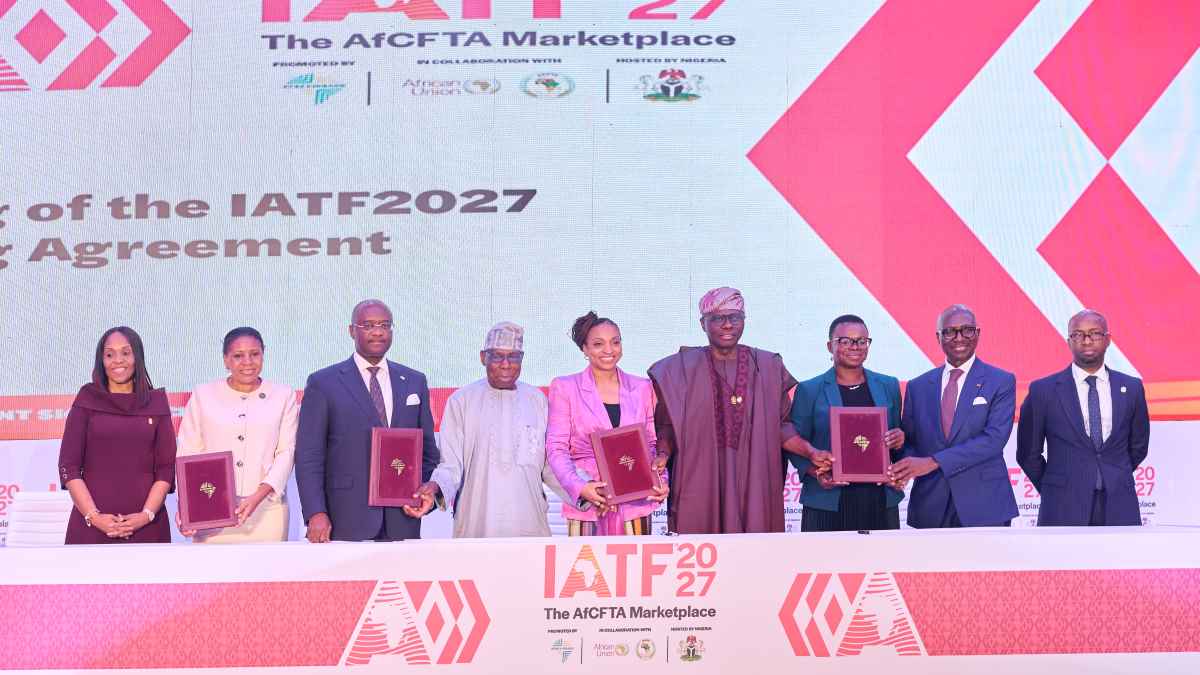
LAGOS, Nigeria, March 10, 2026/APO Group/ –The Federal Republic of Nigeria has today signed the host agreement for the fifth Intra-African Trade Fair 2027 (IATF2027), taking over the baton from Algeria which hosted the highly successful fourth edition that recorded US$49.94 billion in trade and investment deals.

The agreement signing ceremony was held in Lagos, the designated ‘host city’, in partnership with African Export-Import Bank (Afreximbank), the African Union Commission and the African Continental Free Trade Area (AfCFTA) Secretariat, reinforcing Nigeria’s central role in advancing Intra-African trade and economic integration across the continent.

Scheduled to take place from November 5 – 11, 2027, IATF2027 is targeting over US$50 billion in trade and investment deals, 100,000 visitors, 2,500 exhibitors, and participation from more than 100 countries. The Fair will be held under the theme “Global Africa, Smart Trade- From Market Access to Market Power” featuring diverse programme notably the trade exhibitions; AfCFTA-focused trade and investment forum; the Global Africa Day to strengthen ties with Africa’s diaspora; a B2B (Business-to-Business) & B2G (Business-to-Government) platform; Creative Africa Nexus (CANEX) to showcase Africa’s creative economy; the Sub Sovereign Governments Network for regional and local governments integration; special days for countries, public and private sector to showcase their trade and investment potential, tourism and cultural highlights; Africa Automotive Show; AU Youth Start-up pavilion for African youth start-ups; and the Africa Research & Innovation Hub (ARIH) for academia and researchers.

In just four editions since 2018, IATF has cumulatively generated over US$167 billion in trade and investment deals and welcomed more than 180,000 visitors from 132 countries. This strategic partnership creates a uniquely African framework that blends policy direction, financial backing, and trade facilitation. IATF benefits from continent-wide institutional alignment, setting it apart in both structure and purpose.

Delivering his opening remarks, H.E. Chief Olusegun Obasanjo, Chairperson of the IATF2027 Advisory Council and Former President of the Federal Republic of Nigeria, underscored the strategic importance of the Fair in shaping Africa’s economic sovereignty.

“The signing of this host agreement marks a momentous milestone for Nigeria and for the continent. Bringing IATF2027 to Lagos is historically significant, as this city hosted the Lagos Plan of Action adopted in 1980, which championed Africa’s industrialisation and economic self-sufficiency. We have to work hard to keep moving towards the Africa we want. I am confident that IATF2027 will surpass all previous editions in both scope and impact as we advance our shared goal for a unified African marketplace under the AfCFTA,” he remarked.

Commenting on Nigeria’s expanding footprint in intra-African commerce, H.E. Dr. Jumoke Oduwole, Federal Minister of Industry, Trade and Investment, highlighted Nigeria’s rising contribution to continental trade flows.

Together, we must align our markets, our industries and our talent to deliver the prosperous Africa we envision

Today, as the international trading system faces profound challenges, we must remain resolute in our commitment to mutually beneficial, rules-based trade. As we prepare to host Africa’s largest marketplace in Lagos in 2027, we have an opportunity not only to reflect on our reality but to design the future of African trade integration and economic transformation. The work ahead of us under the AfCFTA is not only expansive but also existential for our survival and prosperity. IATF 2027 will therefore be a defining moment in accelerating and transforming intra-African trade and investment. Together, we must align our markets, our industries and our talent to deliver the prosperous Africa we envision,” she affirmed.

Appreciating Nigeria’s longstanding partnership and leadership in advancing intra-African trade, Dr. George Elombi, President and Chairman of the Board of Directors of Afreximbank, commended the Government’s commitment to the AfCFTA vision, noting that Nigeria’s scale, entrepreneurial depth, and industrial capacity make it a natural host for the 2027 edition.

“Nigeria’s vibrant entrepreneurial spirit gives us confidence that IATF2027 in Lagos will be a remarkable event that strengthens trade and investment across the continent. The trade fair is about building a strong pan-African single market and expanding intra-African trade beyond the levels we see today. Our collective duty is to use this platform to build value chains, create jobs and generate prosperity for our people. When Africans decide to work together, as they will at IATF 2027, the opportunities for transformation are limitless,” he highlighted.

Nigeria remains central to the success of AfCFTA, not only because of its market size but also due to its resource base and industrial potential. As a leading producer of oil and gas, solid minerals, including limestone, iron ore, gold, and lithium, and key agricultural commodities, Nigeria combines industrial capacity with a vibrant SME sector and a dynamic role in intra-African trade. This unique mix positions the country to drive value chains that power regional integration and strengthen the continent’s economic resilience.

Describing Nigeria as a major contributor to African Union growth and regional economic transformation, H.E. Francisca Tatchoup Belobe, AU Commissioner for Economic Development, Trade, Tourism, Industry and Minerals, highlighted the importance of aligning industrial policy, mineral development, and trade facilitation to unlock Africa’s full potential.

“When we launched the IATF in 2018, it was a bold experiment in connectivity. It was not only a commercial event, but rather a strategic tool to increase intra-African trade, which remains stubbornly low. As we prepare for the fifth edition of the IATF, we must ensure that it propels intra-African trade and helps Africa reposition itself in the global trade landscape. We should therefore aim very high in 2027, especially as the IATF takes place in Nigeria, the most populous African country and one of the continent’s largest economies. Let us make IATF 2027 a defining moment that ignites new momentum for Africa’s investment, industrialisation and trade,” she said.

Reflecting on the broader continental impact, Cynthia E. Gnassingbé-Essonam, Director of Private Sector Engagement and Communications at AfCFTA Secretariat, who represented H.E. Wamkele Mene, Secretary General, AfCFTA Secretariat, emphasised that Nigeria’s host of IATF2027 reinforces collective efforts to operationalise the AfCFTA and deepen regional value chains.

“Today’s ceremony marks an important milestone in our collective efforts to advance the objectives of the African Continental Free Trade Area. The Intra-African Trade Fair has established itself as Africa’s premier marketplace for trade and investment, bringing together businesses, investors and policymakers from across the continent and the diaspora. Nigeria’s host of IATF 2027 is both timely and significant, and we are confident it will deliver an impactful trade fair that reflects the ambition of the AfCFTA and the aspirations of African businesses,” she commended.

For more information about IATF2027 please visit www.IntrAfricanTradeFair.com

Distributed by APO Group on behalf of Afreximbank.

Business

Oversight matters: Spotting payroll fraud in a digital world

Published

on

South Africa

Companies combine oversight and payroll platforms to stop criminals from stealing millions

JOHANNESBURG, South Africa, May 19, 2026/APO Group/ –South Africa’s government has put payroll fraud in its crosshairs. In its latest Budget Review document, the National Treasury prioritises digital payroll systems for state entities, combatting what some outlets have reported as over R4 billion in annual losses through fraudulent payroll payments.

This problem is not limited to the public sector. The Chartered Institute of Payroll Professionals estimates that South African businesses lose around R100 million annually through payroll fraud. Many of the cases involve manual and paper-based payroll systems that are easy to manipulate.


The adoption of digital payroll platforms can reduce and catch fraud before it becomes a serious issue. However, going digital is not enough, says Yolande Schoültz, founder of YSchoültz Attorneys and one of SA’s foremost payroll fraud experts.


“There is no doubt that digital systems are better than paper-based payroll management. But a digital system only makes it much easier to track down and stop fraud. The organisation must still put the right measures in place, such as approval policies and oversight checks.”


Payroll fraud red flags


Perpetrators of payroll fraud commit their crimes in several ways. A lone individual might skim money unnoticed by creating ghost employees or redirecting payments. They might collude with former employees, leaving the latter’s details on the system and splitting their salary payments.


Whatever the method, the most common aspect of payroll fraud is an administrator operating under little or no oversight, says Schoültz.


“There should be a chain of custody, such as someone signing off on salary calculations and doing spot checks to ensure everything is legitimate. But it’s amazing how often, even at large companies, the payroll administrator is working on their own and is the only one with proper access to the payroll system.”


If you can access regular reports and integrate payroll data with other systems, it becomes much harder for people to commit fraud, and much easier for you to catch them if they do

Payroll fraud has several red flags, including:


  • Unapproved bank accounts or changes to banking details.
  • Changes to employee, account, or reporting information right before or after a payroll run.
  • Excessive overtime, since payroll fraudsters often put in disproportionate hours to maintain control.
  • Strange login and backup hours, another attempt to maintain control and avoid scrutiny.
  • No system locks during payroll runs that would avoid manipulation of records and calculations.
  • Manually feeding calculations into other systems.
  • Frequent payment errors.
  • Payroll software isolated to one device that only the payroll administrator can access.


Individually, some of these warnings can be innocuous. They can be signs of an overworked administrator or lacking workplace strategies. But the presence of several is reason to be concerned, and some (such as changed banking details) are immediate cause for alarm.


Preventing payroll fraud with technology


Modern payroll platforms help organisations reduce fraud, but only when used correctly and alongside other safeguards.


“There is no magical app that just changes how you operate,” says Sandra Crous, managing director of payroll provider Deel Local Payroll. “A nutrition app won’t automatically get you to eat less, and a fitness app won’t suddenly get you to exercise more. You still have to make changes and use the app to reinforce your new behaviours. A payroll platform gives a business the tools to oversee and manage payroll through different layers, but the business must use those tools in accordance with its policies.”


Spot checks can quickly reveal issues that require more scrutiny. Payroll platforms support fraud detection and financial diligence in several ways:


  • System and bank account changes: The platform provides reports and audit trails, and generates custom reports for authorised employees.
  • Isolated access: Modern payroll platforms operate as cloud software, accessible to multiple authorised users and devices.
  • Single users: Secure accounts that give different people, such as auditors, finance directors, and HR heads, access to dashboards and reports.
  • Manual data entry: Payroll platforms integrate with other systems of record, sharing payroll data automatically and leaving no room for interference.
  • Obscure payroll information: Employee self-service (ESS) features enable employees to access payslips and other information directly, helping them spot irregularities.


An organisation must create oversight through clear policies, spot checks, and leadership oversight. The right payroll platform can even help people with limited payroll knowledge uncover strange behaviours.


“You won’t spot payroll fraud if you keep looking for big changes and payments,” says Schoültz. “Most payroll fraudsters siphon money over a long time and across multiple bank accounts, making it harder to detect. That’s much easier with paper-based systems, spreadsheets, and older payroll software. But if you can access regular reports and integrate payroll data with other systems, it becomes much harder for people to commit fraud, and much easier for you to catch them if they do.”

Distributed by APO Group on behalf of Deel Local Payroll, powered by PaySpace.


Continue Reading

Events

Thailand’s SUBCON Expo Hits $705 Million in Parts Trade as Global Manufacturers Seek New Suppliers

Published

on

SUBCON Expo

BANGKOK, THAILAND – Media OutReach Newswire – 19 May 2026 – SUBCON Thailand — ASEAN’s largest industrial sourcing expo — closed its 20th edition with an estimated USD 705.5 million in parts trade (approximately 23 billion baht), as manufacturers worldwide pushed deeper into Southeast Asia to broaden industrial partnerships. The event ran May 13–16 in Bangkok, drawing more than 50,000 participants and generating over 9,600 business matching pairs. It is co-organized by the Thailand Board of Investment (BOI), the Thai Subcontracting Promotion Association, and Informa Markets Thailand.

“SUBCON Thailand is not only the largest trade exhibition in ASEAN. It is a mechanism the BOI uses to connect Thai entrepreneurs to global supply chains, at a moment when massive global industrial restructuring is forcing every country to build a stronger base for its own manufacturers,” said Mr. Narit Therdsteerasukdi, Secretary General of the Thailand Board of Investment. “Thai entrepreneurs will be the backbone of Thailand’s economy in the years ahead. We will develop SUBCON into a platform that elevates their capabilities and plants Thailand more firmly on the global industrial supply chain map — in AI, semiconductors, modern vehicles, and automation.”

Companies said SUBCON Thailand let them source across electric vehicles, semiconductors and advanced electronics, automation and robotics, medical devices, and aerospace — finding buyers, suppliers, and industrial partners across all of them — in a single venue.

“SUBCON Thailand serves as a key platform where automotive and electronics companies connect and explore business opportunities. Through business matching sessions, good potential has been identified to deepen collaboration with Thai entrepreneurs and enhance local industry partnerships,” said Mr. Paulino Mendoza, Team Lead Global Processing Manager, BMW (Thailand) Co., Ltd.

“SUBCON Thailand is where Thai manufacturers prove their quality to the world. Business Matching connected us with buyers and partners we would not have found elsewhere. This is how Thai companies build the confidence to compete internationally,” said Ms. Waranchalee Suwanpimolkul, Assistant Managing Director, S.K. Polymer Co., Ltd.

Many BOI-network companies left with concrete results — procurement agreements, follow-up negotiations, and technology partnerships. Business Matching drew the highest satisfaction scores of any activity at the show, reflecting how central buyer-supplier connectivity is to the event’s appeal. The results point to broader confidence: companies at the show said Thai manufacturers are internationally competitive on quality and ready to integrate into global supply chains.

Looking ahead, the BOI plans to widen SUBCON’s scope — targeting AI, advanced electronics, modern vehicles, and logistics. The BOI will also expand Business Matching to reach a broader set of industries and build closer ties between Thai companies and overseas investors.

“SUBCON Thailand is a mechanism the BOI uses to put Thai entrepreneurs at the center of global supply chains — and to keep them there. The world is going through the biggest industrial shift in a generation. Every country is racing to build a stronger base for its own manufacturers. Thai entrepreneurs will be the backbone of Thailand’s economy, and we intend to make SUBCON the platform that gets them there — in AI, semiconductors, modern vehicles, and automation,” Mr. Narit said.

USD conversions based on an exchange rate of 32.6 baht per USD.

Thailand Board of Investment
Established in 1966, the Office of the Board of Investment (BOI) has continuously played an essential role for over 60 years in promoting value-adding investment for the country, from both foreign and Thai investors, to enhance national competitiveness and drive towards a new era of sustainable and balanced growth.

Investment Services Center — PR Section, The Office of the Board of Investment (BOI)

555 Vibhavadi-Rangsit Road, Chatuchak, Bangkok 10900 Tel. +66 (0) 2553 8111, Fax: +66 (0) 2553 8222


Continue Reading

Business

Africa Finance Corporation Approves US$100 Million Commitment to Africa-Focused Technology Fund Managers to Accelerate Africa’s Digital Industrialisation

Published

on

Africa Finance Corporation

Through this commitment, AFC will deploy catalytic capital in leading Africa-focused technology Funds and in particular African-owned fund managers

LONDON, United Kingdom, May 18, 2026/APO Group/ –Africa Finance Corporation (AFC) (www.AfricaFC.org), the continent’s leading infrastructure solutions provider, today announced that its Board has approved a commitment of up to US$100 million to invest in Africa-focused technology fund managers.

The launch comes at a pivotal moment for Africa. The continent’s digital economy is projected to contribute over US$700 billion to GDP by 2050, driven by a fast-growing, digitally connected population and accelerating enterprise adoption of technology. Yet despite this momentum, a persistent gap in long-term institutional capital continues to constrain the development and scaling of high-potential technology businesses across the continent.

Through this commitment, AFC will deploy catalytic capital in leading Africa-focused technology Funds and in particular African-owned fund managers. In doing so, AFC aims to address the underrepresentation of local capital in venture funding by catalysing greater participation from African institutional investors and deepening local ownership within the ecosystem.

Africa’s venture capital ecosystem has demonstrated real potential – the continent has produced nine unicorns, some of its leading fund managers have generated returns of up to 128 times the capital originally invested, and African start-ups raised US$3.8 billion in 2025 alone. Yet local institutional capital remains significantly underrepresented across many fund cap tables, with the majority of venture funding continuing to flow from international sources. AFC’s commitment is designed to shift that dynamic.

We trust that other development finance institutions, insurers, reinsurers and pension funds will follow AFC’s lead

Samaila Zubairu, President and CEO of AFC said: “Across the continent, young Africans are not waiting for the digital economy to arrive; they are seizing the moment — adopting technology, creating markets and solving real economic problems faster than infrastructure has kept pace. That is the investment signal. AFC’s US$100 million Africa-focused Technology Fund will accelerate the convergence of growing demand, rapid technology adoption, youthful demographics and the enabling infrastructure we are building. Digital infrastructure is now as fundamental to Africa’s transformation as roads, rail, ports and power — enabling productivity, payments, logistics, services, data and cross-border trade, while creating jobs and industrial scale.”

As part of the initial deployment, AFC has made anchor commitments to Lightrock Africa Fund II and Future Africa Fund III, positioning the Corporation across the full innovation lifecycle – from early-stage venture capital through to growth-stage scaling. These initial commitments represent the first tranche of a broader deployment, with AFC actively evaluating a pipeline of additional Africa-focused funds spanning a range of strategies and stages, with further commitments expected in the near term.

Pal Erik Sjatil, Managing Partner & CEO, Lightrock, said: “We are delighted to welcome Africa Finance Corporation as an anchor investor in Lightrock Africa II, deepening a strong partnership shaped by our collaboration on high-impact investments across Africa, including Moniepoint, Lula, and M-KOPA.

This commitment reflects a shared conviction in the opportunity to back high-growth, technology-enabled businesses with proven business models, strong fundamentals, and clear pathways to profitability. With aligned capital, a long-term perspective, and a shared focus on value creation, we are well positioned to support exceptional management teams and scale category-leading businesses that deliver attractive financial returns alongside measurable environmental and social outcomes.”

Future Africa is a venture capital firm that backs founders building technology-enabled solutions to Africa’s most pressing challenges, with a portfolio that includes some of the continent’s most celebrated technology companies. AFC’s investment in Future Africa Fund III strengthens the pipeline of innovation at the early-stage end of the market, backing founders solving important problems spanning financial inclusion, digital infrastructure, consumer technology and education.

Iyin Aboyeji, Founding Partner, Future Africa, said: “Young Africans are not waiting for the digital economy to arrive; they are already among its most active participants globally. What they need now are the skills, productive assets and infrastructure to build and scale within it. By investing in AI-native skills, financing productive tools such as phones and laptops, and expanding energy, connectivity and compute infrastructure, we can convert Africa’s greatest asset — its people — into critical participants in the new global economy. AFC’s US$100 million commitment is the anchor this moment demands. As our first multilateral development bank partner, AFC is sending a clear signal that digital is as fundamental to Africa’s transformation as agriculture, manufacturing and physical infrastructure. We trust that other development finance institutions, insurers, reinsurers and pension funds will follow AFC’s lead.”

Overall, the commitment builds on AFC’s broader strategy to deploy capital across integrated infrastructure systems, where digital platforms increasingly complement physical infrastructure to unlock value across sectors. By combining its balance sheet strength, structuring expertise, and pan-African network, AFC aims to establish itself as the leading institutional investor in Africa’s technology ecosystem – mobilising capital at scale while delivering sustainable, long-term development impact across the continent.

Distributed by APO Group on behalf of Africa Finance Corporation (AFC).

Continue Reading

Trending