Connect with us

Business

Harvestfield Strengthens Nigeria’s Healthcare Manufacturing Capacity with Local Production of Next-Generation Mosquito Nets

Published

on

Harvestfield

Operations at the company’s manufacturing facility in the Harvestfield Free Trade Zone, Ogun State, commenced on 13 September 2026, with the facility already supplying a World Bank-funded programme reaching 31 states

LAGOS, Nigeria, September 30, 2026/APO Group/ –Harvestfield Healthcare FZE (www.HarvestfieldHealthcare.com) has commenced commercial production of Synera DuoForte, a next-generation insecticide-treated nets in Nigeria, marking a new phase in the country’s capacity to manufacture a critical malaria prevention intervention locally.


Operations at the company’s manufacturing facility in the Harvestfield Free Trade Zone, Ogun State, commenced on 13 September 2026, with the facility already supplying a World Bank-funded programme reaching 31 states.

The facility is the first of its kind in Nigeria to be wholly Nigerian-owned and manufactures dual active ingredient long-lasting insecticidal nets of the pyrethroid-chlorfenapyr class. Harvestfield manufactures the nets under a manufacturing agreement with GDM Health Products, producing Synera DuoForte, a dual active ingredient long-lasting insecticidal net developed and owned by GDM.

Unlike conventional insecticide-treated nets that rely primarily on pyrethroids, these nets combine a pyrethroid with a second insecticide that works through a different mode of action.

The distinction is significant as mosquito populations across much of Nigeria have developed resistance to pyrethroid insecticides. While conventional nets can continue to provide a physical barrier, resistance can reduce their insecticidal effect. Dual active ingredient nets are designed to remain effective in areas where pyrethroid resistance has taken hold, and the World Health Organisation recommends this class of net for areas with established pyrethroid resistance.

Synera DuoForte is a WHO-prequalified product, developed and held under prequalification by GDM Health Products. The Harvestfield manufacturing site in Ogun State is also included as an approved manufacturing location under that prequalification, and the facility is separately certified by the National Agency for Food and Drug Administration and Control (NAFDAC) and ISO certified. These standards provide the foundation for manufacturing nets for national malaria programmes and other health interventions requiring internationally recognised quality systems.

Jon Bastow, a representative of GDM Health Products, said: “GDM is pleased to strategically partner with Harvestfield to bring Synera DuoForte to Nigeria, the country with the biggest global malaria burden, and support the prequalification of Harvestfield’s Ogun State manufacturing facility to make Synera DuoForte.”

Building the capacity to manufacture our own health products is central to Nigeria’s health security

Commenting on the development, the Coordinating Minister of Health and Social Welfare, Professor Muhammad Ali Pate, said:

“Building the capacity to manufacture our own health products is central to Nigeria’s health security. A Nigeria-based facility producing next-generation insecticide-treated nets to international standard, and already supplying programmes across thirty-one states, is the kind of capability the Renewed Hope agenda was created to build.”

For Harvestfield, the move into manufacturing builds on more than two decades of experience in Nigeria’s vector control sector. The Harvestfield group has operated in Nigerian vector control for 26 years, delivering more than 42 million insecticide-treated nets across all 36 states and serving as an exclusive national distribution partner for WHO-prequalified nets since 2018.

The transition from distribution to manufacturing also strengthens the domestic supply chain for insecticide-treated nets. Producing locally reduces dependence on overseas supply schedules and the 45 to 60-day ocean journey associated with imported nets, while creating greater capacity to respond as malaria control needs and insecticide resistance patterns evolve.

Commenting on the role of local manufacturing in strengthening Nigeria’s healthcare value chain, Dr Abdul Mukhtar, Presidential Initiative for Unlocking the Healthcare Value Chain (PVAC), said:

“PVAC exists to move Nigeria from importing its health products to making them. What matters is not only that a factory exists, but that it meets the standards international buyers accept and can supply at national scale. A facility based in Nigeria doing both is precisely the outcome this initiative was created to unlock.”

The investment also creates local manufacturing, technical, quality and regulatory capabilities that can support the production of other health products over time. For Harvestfield, the net manufacturing facility represents the first platform in a broader effort to build healthcare manufacturing capability in Nigeria.

This development is aligned with the Federal Government’s focus on strengthening domestic production of health products under the Renewed Hope agenda for health, the Presidential Initiative for Unlocking the Healthcare Value Chain (PVAC), and the Nigeria First procurement policy.

www.HarvestfieldHealthcare.com

Distributed by APO Group on behalf of Harvestfield Healthcare FZE.


Business

Solar, storage and the new realities shaping commercial & industrial energy decisions

Published

on

These themes are explored in Solar & Storage Industry Insights Volume, published by ESI Africa, part of VUKA Group, bringing together analysis, industry perspectives and practical insights for businesses operating within the evolving energy transition

CAPE TOWN, South Africa, October 1, 2026/APO Group/ –The conversation around commercial and industrial energy has moved well beyond whether businesses should invest in renewable power.

Across Africa, energy users are increasingly weighing questions around cost, security of supply, carbon compliance, financing, energy efficiency and the commercial value of storage. At the same time, project developers and investors are under pressure to demonstrate stronger business cases, credible energy claims and clearer pathways from ambition to implementation.


These themes are explored in Solar & Storage Industry Insights Volume, published by ESI Africa (https://apo-opa.co/4rKRXZA), part of VUKA Group, bringing together analysis, industry perspectives and practical insights for businesses operating within the evolving energy transition.

Explore the Solar & Storage Industry Insights Volume (https://apo-opa.co/4jxxDbQ)

From renewable ambition to better energy decisions

For commercial and industrial energy users, the challenge is multidimensional. Solar remains an important part of the solution, but organisations must also understand how projects are financed, how energy efficiency can reduce demand before new generation is built, where storage creates measurable commercial value and how sustainability commitments translate into credible reporting and compliance.

Webinar series

ESI Africa is extending these conversations through a series of webinars focused on some of the practical issues facing C&I customers and project teams.

Carbon compliance and credible energy claims: What C&I customers must get right examines the importance of credible carbon and renewable energy claims for organisations facing increased scrutiny of their decarbonisation strategies. Watch the webinar on demand (https://apo-opa.co/4xSZ0AE)

Solar funding for dummies: Approaches and speedy options, looks at the financing routes available to organisations considering solar projects, and the decisions that can influence how quickly projects move forward. Watch the webinar on-demand (https://apo-opa.co/4xZyohA)

Case studies in C&I energy efficiency: This discussion shifts the focus to reducing consumption, examining practical examples of how businesses can improve efficiency, and manage energy costs and strengthen operational performance. Watch the webinar on-demand (https://apo-opa.co/4rGs4K5)

Moving projects from discussion to delivery

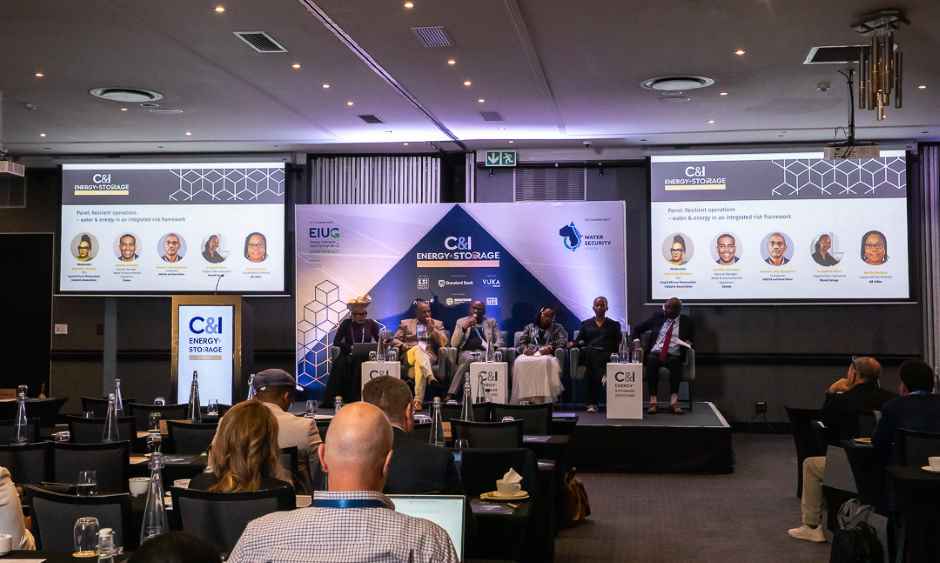
The same questions are shaping face-to-face industry discussions. At the C&I Energy + Storage Summit Johannesburg (https://apo-opa.co/4rIytEM), taking place on 28 and 29 October 2026 at The Maslow Hotel in Sandton, energy users, project developers, financiers and solution providers will examine the strategies businesses are using to improve power security and manage rising energy costs.

The programme moves from energy efficiency and demand management through to onsite generation, diversified energy sourcing and energy storage. It also examines the commercial value of storage beyond backup power, including peak shaving, demand charge management, resilience, renewable firming and hybrid solar-plus-BESS models.

Explore the C&I Energy + Storage Summit Johannesburg (https://apo-opa.co/4rIytEM)

The conversation extends to Zimbabwe on 17 November 2026, where the C&I Energy + Storage Summit Zimbabwe will be co-located with Zimbabwe Mining Week at Rainbow Towers in Harare.

With reliable energy capacity central to mining development and industrial growth, the one-day summit will connect mining companies, energy users, project developers, investors and solution providers around renewable energy, storage, project finance, operational cost containment and secure power supply.

Request more information about C&I Energy + Storage Summit Zimbabwe (https://apo-opa.co/4xZ64vE)

Bringing capital and projects into the same conversation

Technology alone will not determine the pace of Africa’s energy transition. Projects must also attract capital, demonstrate bankability and connect with the organisations able to help deliver them.

The Project & Investment Network, in partnership with the African Infrastructure Elites annual magazine, creates a platform for project owners, investors, financiers and solution providers to connect around power, energy and infrastructure opportunities, with a focus on moving viable projects closer to investment and implementation.

Explore the Project & Investment Network (https://apo-opa.co/4rFWCvD)

Recognising the projects already changing African infrastructure

While new projects move through development and financing pipelines, ESI Africa is also looking for the projects and people already demonstrating what successful infrastructure delivery can look like.

The African Infrastructure Elites: Projects and People magazine recognises leadership and project excellence across Africa’s infrastructure sectors, documenting the initiatives, partnerships and individuals helping turn complex energy, water and transport challenges into tangible outcomes.

Nominations provide organisations and industry professionals with an opportunity to put forward deserving projects and leaders for recognition and to contribute to a wider record of African infrastructure achievements.

Explore the African Infrastructure Elites and submit a nomination (https://apo-opa.co/3Tu9Sac)

What comes next for energy storage?

Storage is rapidly becoming a bigger part of the commercial energy conversation as businesses assess where batteries can provide resilience, tariff optimisation, renewable integration and new commercial value.

ESI Africa’s forthcoming Energy & Storage Industry Insights Volume 2026 will take a deeper look at the technologies, projects, investment considerations and market developments shaping the next phase of the sector.

Join the Energy & Storage Industry Insights Volume 2026 waiting list (https://apo-opa.co/3U1smyT)


Distributed by APO Group on behalf of VUKA Group.


Continue Reading

Energy

Awow Daniel Chuang Appointed South Sudan Caretaker Petroleum Minister as South Sudan Oil & Power (SSOP) Returns in November

Published

on

South Sudan Oil & Power 2026 welcomes the appointment of Awow Daniel Chuang as Caretaker National Minister of Petroleum ahead of the event’s seventh edition in Juba

JUBA, South Sudan, October 1, 2026/APO Group/ –Awow Daniel Chuang has been appointed Caretaker National Minister of Petroleum of South Sudan by President Salva Kiir Mayardit ahead of the country’s December elections, marking his return to lead the country’s hydrocarbons sector as the government seeks new investment in exploration, production and mature-asset redevelopment.


Minister Chuang brings extensive experience across South Sudan’s petroleum sector, having previously served as Minister of Petroleum as well as Director General, Undersecretary and Technical Advisor within the Ministry. His appointment comes as the country works to strengthen petroleum-sector management and attract international capital and technical expertise across its upstream industry.

Stepping into the role, Chuang has prioritized strengthening institutional cooperation, internal coordination and effective regulation within the Ministry of Petroleum. He has also emphasized addressing administrative and organizational challenges, improving accountability and strengthening coordination with the National Legislative Assembly as part of efforts to enhance oversight of South Sudan’s oil and gas sector.

The appointment comes ahead of the seventh edition of South Sudan Oil & Power (SSOP), taking place November 24–25, 2026 in Juba. Held in official partnership with the Ministry of Petroleum, SSOP 2026 will take place under the theme Resource Renaissance – Energy-Fueled Growth for a New Generation, bringing together government, industry, investors and technology providers to advance cooperation across the country’s energy sector.

SSOP 2026 will feature high-level panel discussions, networking opportunities, project showcases and technical workshops focused on emerging opportunities across South Sudan’s oil and gas value chain.

Upstream investment remans a key priority. South Sudan currently has14 blocks open to investors – A1, A2, A3, A4, A5, A6, B1, B4, C1, C2, D1, D2, E1 and E2 -, creating opportunities for international operators and investors to enter underexplored acreage.

Beyond exploration, the country is seeking investment in mature asset redevelopment and brownfield optimization as it works to increase recovery and production from existing fields. This creates opportunities for oilfield service companies and technology providers across drilling, enhanced oil recovery, field engineering and supporting infrastructure.

Against this backdrop, SSOP 2026 will provide a platform for the Ministry of Petroleum to engage international investors, operators, service companies and technology providers on the next phase of South Sudan’s petroleum-sector development.

Distributed by APO Group on behalf of Energy Capital & Power.


Continue Reading

Energy

Democratic Republic of Congo’s (DRC) Center for Expertise, Evaluation and Certification of Mineral Substances (CEEC) Brings Mineral Certification and Traceability Focus to African Mining Week (AMW) 2026

Published

on

The DRC certification authority will join AMW 2026 as it expands oversight of emerging mineral supply chains and analytical capacity

CAPE TOWN, South Africa, October 1, 2026/APO Group/ –A delegation from the Democratic Republic of Congo’s (DRC) state-owned certification authority, the Center for Expertise, Evaluation and Certification of Mineral Substances (CEEC), will participate at the African Mining Week (AMW) 2026 Conference, scheduled for October 14-16 in Cape Town.


Led by Director General Freddy Mwamba Kanyinku, the delegation will participate in discussions and networking engagements as the DRC seeks to strengthen mineral certification, traceability and value addition across its mining sector.

AMW 2026 coincides with the DRC’s drive to unlock an estimated $24 trillion in mineral wealth, with CEEC strengthening the certification and traceability systems needed to support investment and local value addition.

A key milestone for CEEC in 2026 was the certification of the DRC’s first lithium exports. In July, the agency certified the first lithium lots destined for international markets from Manono Lithium, expanding its role as lithium emerges alongside established Congolese mineral supply chains including copper, cobalt, gold, diamonds and 3T minerals.

The milestone comes as lithium emerges as a new component of the DRC’s critical-minerals strategy and demonstrates the importance of robust certification systems as the country diversifies its mineral production base and brings new projects online.

CEEC is also decentralizing its analytical and certification infrastructure across key provinces to improve operational oversight. Recent developments include the launch of a dedicated traceability office at Kamoto Copper Company in Lualaba Province, aimed at tracking copper and cobalt flows.

The agency is also developing its Lubumbashi National Laboratory to facilitate localized mineral analysis. The facility is scheduled for completion before the end of 2026 and is being developed to support mineral analysis and certification, with the complex targeting ISO/IEC 17025 accreditation.

CEEC is also expanding its international engagement as mineral diplomacy becomes increasingly important to the development of critical-mineral supply chains. In 2026, the institution acquired a representative building in Durban, South Africa, creating a platform for greater engagement with regional and international mining stakeholders and supporting the promotion of Congolese mineral products, traceability and responsible sourcing.

Against this backdrop, AMW 2026 provides an ideal platform for CEEC executives to engage with international investors, mining companies, governments, financial institutions and technology providers exploring opportunities across the DRC’s mining sector.

Distributed by APO Group on behalf of Energy Capital & Power.


Continue Reading

Trending

Exit mobile version