Connect with us
Anglostratits

Business

GITEX GLOBAL 2024: Artificial Intelligence (AI) revolution unveiled to the world on “AI Super Tuesday”

Published

on

GITEX GLOBAL

As AI takes centre stage in drug discovery, the world could soon witness the most significant shift in medicine since the advent of modern pharmaceuticals

DUBAI, United Arab Emirates, October 16, 2024/APO Group/ —

  • International exhibitors presented the most groundbreaking innovations helping shape the future of society and industry
  • “Cybersecurity Day” next up as world’s largest and best-rated tech event reaches halfway stage on Wednesday

Hot on the heels of a memorable first day where GITEX GLOBAL 2024 (http://apo-opa.co/4hlR7gj) opened the doors for its biggest-ever international edition, the entire global tech ecosystem experienced another action-packed agenda on Tuesday at Dubai World Trade Centre (DWTC).

Taking place from 14-18 October, GITEX GLOBAL presents a record-breaking edition in its 44th year – welcoming over 6,500 exhibitors, 1,800 startups, 1,200 investors alongside governments from more than 180 countries.

With five themed days locked in across the 2024 event programme, a technology taking the world by storm was the focal point as “AI Super Tuesday” presented the most groundbreaking innovations helping shape the future of society and industry.

A technology with vast transformative potential

As AI takes centre stage in drug discovery, the world could soon witness the most significant shift in medicine since the advent of modern pharmaceuticals. But with such rapid advancements, a mesmerising Tuesday session – ‘The Next Leap in Medicine: Are we on the Edge of a Breakthrough?’ – saw experts discuss whether AI transformation is fast approaching or further away than some anticipate.

Dr. Shameer Khader, Global Head and Executive Director – Computational Biology Cluster, Precision Medicine and Computational Biology at global pharmaceutical company Sanofi, gave AI an emphatic endorsement. He said: “Drug discovery on average takes 10-15 years and one project around $1.5-2 billion in cost. Is that something sustainable? The model must change, and we should harness AI capabilities and value across the ecosystem. We should optimise every single process to reduce development costs, streamline the drug discovery lifestyle, and build data disease models and infrastructure.”

In a special case study, audiences became acquainted with ‘BabyX’ – an interactive simulation of a lifelike infant through AI. This virtual animated baby learns and reacts like a human infant with a built-in virtual brain with detailed likeness to that of a human. Functioning through biological AI and an operating system called Brain Language, stimulated neurochemical reactions help BabyX decide how she will react – something that could prove revolutionary in the future AI economy.

Elaborating on the significance of BabyX, Dr. Mark Sagar, its creator who co-founded New Zealand-based Soul Machines, pointed out the defining difference between human and AI intelligence, adding: “As humans, we learn from a young age though exploring the world and experimenting. Play is such a key part of making intelligence open-ended and inventive, but it’s one thing what’s missing from current AI. If we’re ever going to regulate general AI intelligence, we need to build cognitive architecture that yields intelligent behaviour through a comprehensive approach.”

We should optimise every single process to reduce development costs, streamline the drug discovery lifestyle, and build data disease models and infrastructure

A catalyst for forward-facing collaboration

Alongside the profound transformative potential of AI, GITEX GLOBAL’s status as a catalyst for collaboration and forward-facing projects was on full display. A number of exciting high-profile partnerships were officially unveiled at the world’s largest and best-rated tech event, with one involved KAOUN – the world-leading organiser of business events and trade fairs, leading all GITEX events outside the UAE.

Tuesday saw KAOUN sign a Memorandum of Understanding with the Digital Dubai Authority to grow the GITEX ecosystem, support Dubai’s internationalisation strategy, and explore new partnership opportunities. Additionally, AWS and e& entered into a $1 billion-plus agreement as part of new strategic alliance to deliver cloud solutions and supporting AI deployment and digital transformation across the region. 

Tuesday casts spotlight on AI’s cross-sector impact and demands

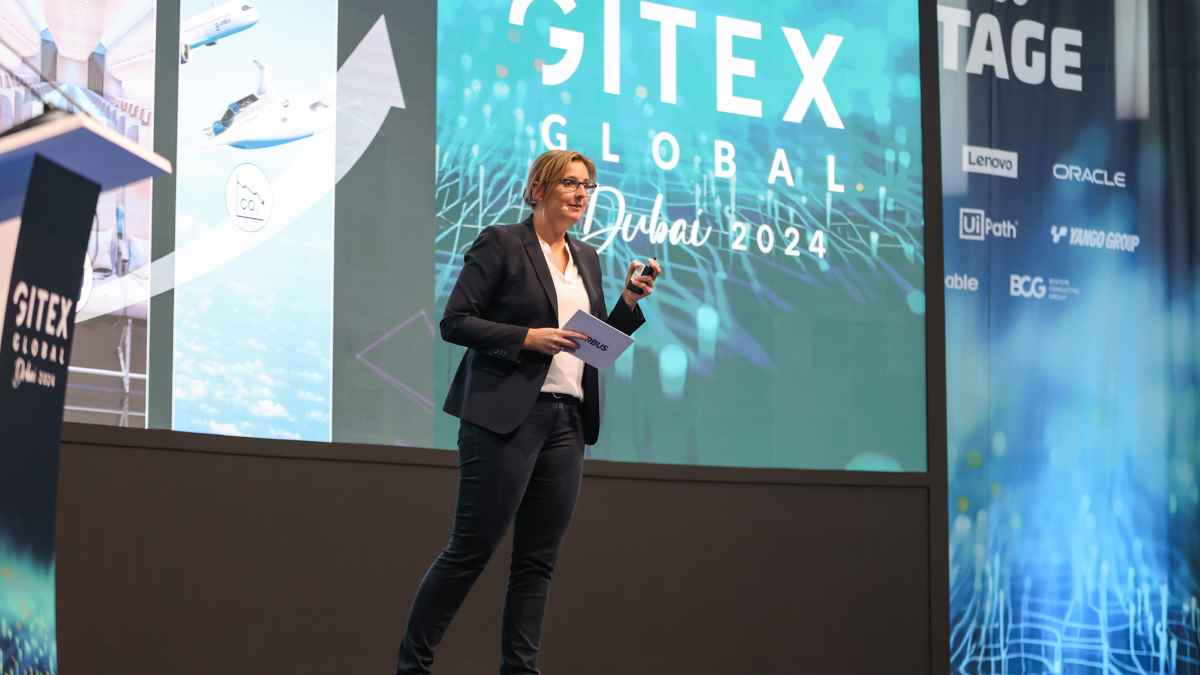
Elsewhere on the Super AI Tuesday agenda, another applauded show illustrated how high-performance computing is steering humanity’s quest for the next generation of aircraft. During ‘Quantum Maturation: Introducing The “Quantum Mobility Quest”’, companies were urged to move beyond the physical limits of present-day computing today and scale up future-focused solutions to unlock aviation’s vast potential.

Isabell Gradert, Vice President of Central Research & Technology, Airbus, Germany, said: “Aviation is embedded in the tapestry of our global-leading industries and is one with the highest computation needs. Quantum computing is seen as the next big gamechanger in the aviation industry and has the potential to solve the most complex aerospace challenges and create a paradigm shift in the way aircrafts are built and flown. This is a very exciting time.”

Additionally, audiences familiarised themselves with a wide of services and solutions being showcased by GITEX GLOBAL exhibitors. UAE-based Presight, the region’s leading big data analytics company powered by generative artificial intelligence (AI), unveiled its Intelli Platform, an AI-powered management and operations platform that lets cities, transport, energy, and infrastructure organisations immediately use Generative AI.

AWS also cast a spotlight on AWS Bedrock, a fully managed service that enables enterprises to easily build, customise, and deploy generative AI applications using foundation models from top AI providers, all through the AWS platform.

GITEX GLOBAL 2024 continues Wednesday as “Cybersecurity Day” welcomes an ensemble cast of thought leaders and experts to explore the emerging threats landscape, counter-infringement strategies, and tools organisations require in an increasingly digital world.

GITEX Editions (https://apo-opa.co/4h8xBn9) also presents Intelligent Connectivity (https://apo-opa.co/4hayjAy) with visitors set to explore how industry leaders can bridge digital divides and harness emerging technology to drive innovation and economic growth. The World Future Economy Digital Leaders Summit (https://apo-opa.co/4hlR8kn) also continues with another star-studded cast of world-renowned experts and innovative minds.  

GITEX GLOBAL is seamlessly connecting with the world’s largest network of tech events, including GITEX EUROPE Berlin, GITEX ASIA Singapore, GITEX AFRICA Morocco, and GITEX NIGERIA. These events are fostering collaboration and driving innovation to shape the tech landscape of tomorrow.

More information on GITEX GLOBAL, please visit www.GITEX.com

Distributed by APO Group on behalf of GITEX Global.

Energy

SBM Offshore Confirmed as Silver Sponsor for African Energy Week (AEW) 2026 Amid Africa FPSO Expansion Push

Published

on

African Energy Chamber

SBM Offshore will participate as Silver Sponsor at African Energy Week 2026, where they are set to showcase FPSO expansion in Angola, Namibia and Guyana amid strong financials and a deepwater innovation strategy

CAPE TOWN, South Africa, June 9, 2026/APO Group/ –Multinational oil and gas services company SBM Offshore will participate at this year’s African Energy Week (AEW) 2026 Conference and Exhibition as a Silver Sponsor, reinforcing the company’s long-term commitment to Africa’s expanding deepwater oil and gas industry. Their participation comes as SBM Offshore accelerates brownfield optimization projects in Angola while aggressively positioning itself for new frontier developments in Namibia’s Orange Basin.


SBM Offshore’s return to AEW, which takes place from October 12–16 in Cape Town, is expected to draw significant industry attention as operators, financiers and EPC contractors evaluate the next wave of floating production infrastructure across the Atlantic Basin. With more than 20 years of experience in Africa and over $31 billion in contract backlog globally, the company remains one of the world’s most influential FPSO suppliers.

The Sponsorship follows several major milestones announced during 2025 and 2026. On May 26, the American Bureau of Shipping approved SBM Offshore’s seawater intake riser technology developed alongside Shell. The system pumps cold seawater from depths of 700m to FPSO topsides, reducing onboard cooling energy demand and improving emissions performance for future African and South American projects.

The company’s financial position strengthened considerably following the $2.32 billion sale of FPSO One Guyana to ExxonMobil in February 2026. The transaction helped drive a 216% year-on-year increase in Q1 2026 directional revenue to $3.5 billion while reducing SBM Offshore’s net debt from $5.7 billion to $3.2 billion by March 21, 2026.

SBM Offshore continues to demonstrate the technical expertise, operational scale and long-term investment approach needed to advance Africa’s next generation of energy projects

In March 2026, ExxonMobil awarded SBM Offshore front-end engineering and design contracts for the Longtail development in Guyana. The proposed FPSO is expected to feature the world’s highest gas-handling capacity ever deployed on a floating production vessel, processing 1.2 billion cubic feet of gas and 250,000 barrels of condensate daily.

Across Africa, SBM Offshore continues expanding its offshore footprint. In Angola, the company signed multi-year extensions in December 2025 with Esso Exploration Angola for FPSO Mondo and FPSO Saxi Batuque in Block 15, extending operations through 2032. Brownfield upgrades and life-extension works commenced in early 2026 to support declining reservoir pressure management and maintain environmental compliance standards.

The company also finalized a share purchase agreement with Equatorial Guinea’s national oil company GEPetrol in December 2025, restructuring regional asset ownership and supporting localized operational transitions. The FPSO Aseng formally exited SBM Offshore’s lease-and-operate fleet during the same period as management responsibilities shifted toward Equatoguinean entities.

Namibia retains a central focus of SBM Offshore’s African growth strategy. The company is actively competing for TotalEnergies’ Venus FPSO contract in the Orange Basin, one of Africa’s largest recent offshore discoveries with estimated resources of roughly 2 billion barrels. SBM Offshore has expanded its Cape Town commercial engineering workforce while positioning its standardized technologies for upcoming South Atlantic developments.

“SBM Offshore’s participation at this year’s event reflects the growing momentum behind Africa’s deepwater industry and the critical role FPSO technology will play in unlocking new production. From Angola’s mature offshore hubs to Namibia’s frontier discoveries, SBM Offshore continues to demonstrate the technical expertise, operational scale and long-term investment approach needed to advance Africa’s next generation of energy projects,” says NJ Ayuk, Executive Chairman, African Energy Chamber.

Looking ahead, SBM Offshore aims to combine frontier expansion with lower-emission offshore production systems. Through partnerships with SLB and Cognite, the company is integrating industrial AI platforms to its global fleet while scaling standardized hull construction to accelerate project delivery timelines across Africa and Latin America.

Distributed by APO Group on behalf of African Energy Chamber.

Continue Reading

Business

Minister Kgosientsho Ramokgopa Joins African Energy Week (AEW) 2026 as South Africa Opens R400B Grid Expansion to Private Investment

Published

on

Kgosientsho Ramokgopa

South Africa has moved from rolling blackouts to a year of stable supply, and Minister Kgosientsho Ramokgopa now turns to the grid expansion and market reforms needed to keep the lights on and draw private capital

CAPE TOWN, South Africa, June 9, 2026/APO Group/ –Kgosientsho Ramokgopa, Minister of Electricity and Energy of the Republic of South Africa, has been confirmed as a featured speaker at African Energy Week (AEW) 2026, where he is expected to outline the next phase of the country’s power-sector recovery and the investment drive needed to expand the electricity grid.


Taking place October 12-16, AEW 2026 represents the largest energy gathering on the African continent, offering a strategic platform for dealmaking and partnerships. Minister Ramokgopa’s participation reflects the country’s ambitions to strengthen investment flows across the power and energy markets, supporting long-term generation resilience and improved transmission networks.

South Africa has moved from one of the worst phases of its electricity crisis to its most stable supply in years. The country recently passed a full year without load-shedding, and the grid is at its strongest in half a decade, with roughly 4,400 MW more generation on hand than a year earlier. The return of Kusile Power Station to its full output of about 4,800 MW helped anchor the turnaround.

South Africa’s recovery shows what disciplined execution can achieve, and opening the grid to private capital is the logical next step

With supply stabilized, Ramokgopa has reframed the current market challenge as being less about generation and more to do with transmission, offtakers and bottlenecks, pointing to more than 130 GW of generation projects that have yet to secure firm offtake agreements. That bottleneck sits at the center of the country’s largest infrastructure push. The Transmission Development Plan calls for 14,000 km of new power lines and 105 substations by 2030, at a cost of roughly R400 billion, to unlock an additional 22.5 GW of capacity.

Because neither Eskom nor the state can fund that build alone, the government has opened transmission to private investment for the first time through the Independent Transmission Projects (ITP) program. In December 2025, Ramokgopa named seven prequalified bidders for the first phase, all of them international-led consortia. The phase covers 1,164 km of high-voltage lines across seven corridors, with a combined value of about $1 billion. A request for proposals is expected in the second half of 2026.

“South Africa’s recovery shows what disciplined execution can achieve, and opening the grid to private capital is the logical next step,” says NJ Ayuk, Executive Chairman of the African Energy Chamber. “The real opportunity now is in transmission, and the investors who help build that network will open up generation that will change South Africa’s future for the better.”

Private appetite is already evident on the generation side. The latest round of the Renewable Energy Independent Power Producer Procurement Program drew 10.2 GW of bids against the 5 GW on offer. In the 2025/26 financial year, eight new independent power projects came online with a combined 800 MW, and another 1,610 MW is under construction.

Minister Ramokgopa is also expected to address the Integrated Resource Plan 2025, the government’s blueprint guiding new generation capacity, and the rollout of a competitive wholesale electricity market intended to open the sector beyond Eskom.

As AEW 2026 prepares to convene policymakers, investors and operators at the Cape Town International Convention Center this October, Minister Ramokgopa’s participation is the host nation’s signal that its power sector is open for investment.

Distributed by APO Group on behalf of African Energy Chamber.

Continue Reading

Energy

Carbon Markets Africa Summit (CMAS) 2026 programme launched as Africa’s carbon markets move from readiness to delivery

Published

on

CMAS

Positioned as a pan-African marketplace, CMAS connects policy, project pipelines, capital and buyers in a structured environment focused on enabling real deal flow

CAPE TOWN, South Africa, June 9, 2026/APO Group/ –Africa is emerging as an exciting destination to develop carbon market projects with improved policy certainty and more and more projects becoming investment-ready. As global carbon markets transition from rule-setting to real transactions, with Article 6 mechanisms moving into implementation and compliance-driven demand such as CORSIA accelerating, attention is shifting towards where credible supply, policy certainty and investment-ready projects can be delivered at scale.


Against this backdrop, the Carbon Markets Africa Summit (CMAS) that is organised by VUKA Group has released its official 2026 programme, outlining how Africa’s carbon markets can move beyond frameworks into execution, investment and transactions. The summit will take place from 13–15 October 2026 in Kigali, Rwanda, hosted by the Ministry of Environment of Rwanda, with UNDP and the African Development Bank (AfDB) as host organisations, the Development Bank of Southern Africa (DBSA) as host partner, and AUDA-NEPAD as the strategic institutional partner.

Positioned as a pan-African marketplace, CMAS connects policy, project pipelines, capital and buyers in a structured environment focused on enabling real deal flow.

This year’s programme reflects a changing market dynamic, one where integrity, quality and transaction readiness are becoming decisive.

Carbon markets are entering a more selective and operational phase. The question is no longer whether Africa has a role to play, but whether the continent can bring forward credible projects, enabling frameworks and market infrastructure to transact at scale,” said Emmanuelle Nicholls, Project Lead. “CMAS 2026 is designed as a response to that moment – connecting the actors, pipelines and capital needed to move from ambition to execution.”

Africa’s carbon markets must be built on integrity, equity, and continental coordination so that carbon finance delivers real value

Within this evolving context, the summit places strong emphasis on the foundations required to scale markets responsibly. As Estherine Fotabong, Director at AUDA-NEPAD, notes, “Africa’s carbon markets must be built on integrity, equity, and continental coordination so that carbon finance delivers real value for communities, ecosystems, and sustainable development across the continent.”

A programme built for execution

The CMAS 2026 programme spans the full carbon market value chain from policy and Article 6 implementation to project development, finance and transactions. Key highlights include the keynote opening session on delivering projects, capital and transactions at scale, a high-level dialogue on trust and market readiness, ministerial and technical roundtables, and sessions focused on buyer demand, investor priorities and deal structuring.


A central feature is a curated pipeline of African carbon projects across nature-based solutions, regenerative agriculture, carbon removals, waste-to-value and blue carbon, presented through project showcases, case studies and investment-ready deal rooms.

The programme also includes solution labs and technical workshops addressing critical bottlenecks—including Article 6 and CORSIA implementation, early-stage finance, MRV systems and project bankability, alongside live demonstrations of digital carbon infrastructure, ensuring focus on practical market development and delivery.

CMAS 2026 is hosted in Rwanda, a country advancing carbon market frameworks under Article 6, and takes place at a pivotal moment as global markets increasingly prioritise integrity, quality and real delivery at scale.

Distributed by APO Group on behalf of VUKA Group.

Continue Reading

Trending