The celebration’s special guest is the 500e Giorgio Armani, the refined limited edition which will be distributed globally and pair Italian excellence to eco-sustainability
TURIN, Italy, July 12, 2024/APO Group/ —
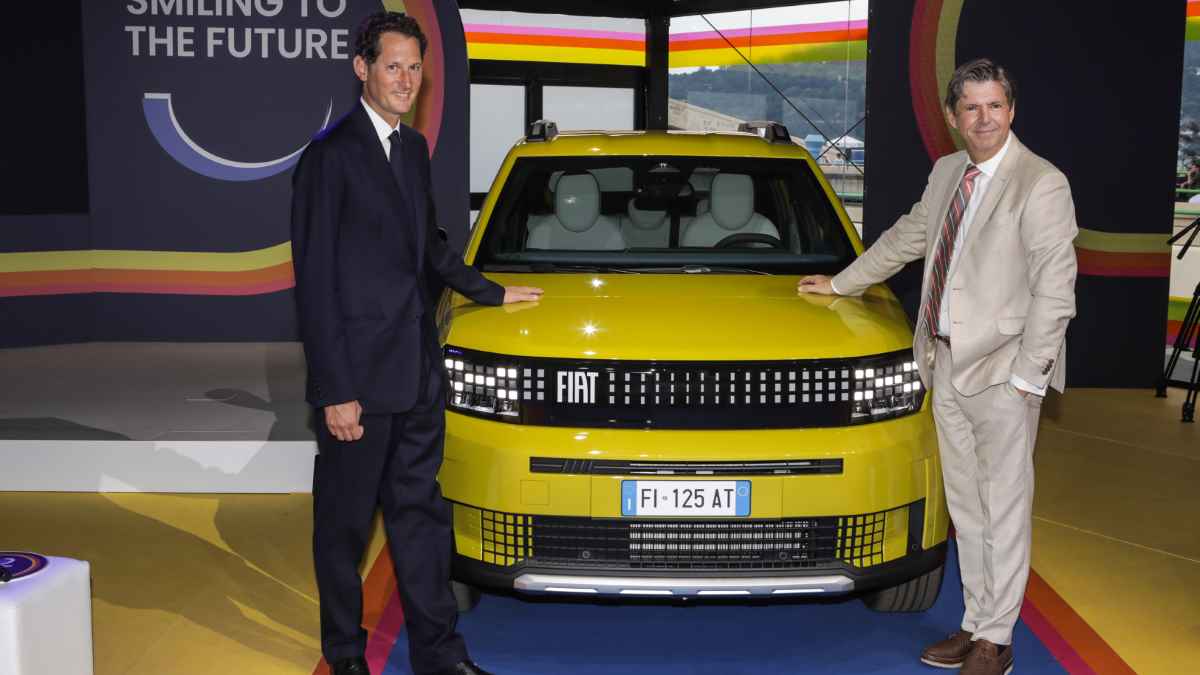
The “La Pista 500” at the Lingotto building in Turin hosted FIAT’s 125th anniversary “Smiling to the future” ceremony; Founded on July 11th 1899, FIAT (www.FIAT.com) is one of the longest-operating automotive brands in the world and is now set for an even brighter future. Olivier Francois, FIAT CEO, lays out FIAT’s vision for the next decade; World premieres for the Fiat 500e Giorgio Armani – the ultimate expression of Italian excellence – and the Fiat Grande Panda, the new global model which marks FIAT’s return to the Global mainstream market; Now open at the Pinacoteca Agnelli, the new Casa FIAT exhibition traces the brand’s history and its connection to the Lingotto building; The event is available on demand at the following link (https://apo-opa.co/3S41iLm).
FIAT’s 125th anniversary “Smiling to the future” event has just come to a close at the Lingotto building in Turin. The ceremony was both a celebration of a milestone which few automakers reach and the beginning of a new chapter in the brand’s long history of success, social relevance, and leadership which has all been fueled by a customer-first approach. The important event [watch at the following link (https://apo-opa.co/3S41iLm)] was attended by members of the international press, representatives of public institutions – including Minister of Enterprise and Made in Italy, Sen. Adolfo Urso, Vice President of the Senate, Sen. Licia Ronzulli, President of the Commission for Productive Activities, Commerce and Tourism of the Chamber of Deputies, On. Alberto Luigi Gusmeroli, President of the Piedmont Region, Alberto Cirio, Mayor of Turin, Stefano Lo Russo – and the top management of Stellantis: John Elkann, Chairman of Stellantis, Carlos Tavares, Stellantis CEO, and Olivier Francois, FIAT CEO and Stellantis CMO.
John Elkann, Stellantis Chairman, stated: “FIAT was born in 1899 out of a passion for progress. It was among the few companies that managed to transition from a craftsmanship stage to the industrial era. It represented the freedom to move anywhere for millions of people, and to do so with style. For 125 years we have never stopped working, seeking solutions, believing in our future, and defending tenaciously what we have built. We want to thank all the people who made possible for that Turin startup to become Stellantis today, one of the largest car manufacturers in the world.”
Carlos Tavares, Stellantis CEO, stated: “I’m delighted to be in the home of FIAT in Turin to celebrate 125 years and share the emotion of such a moment with all stakeholders. As one of the most iconic brands in our Stellantis constellation, FIAT brings true Italian flavor to the heart of our customers worldwide. For the third year in a row, FIAT is Stellantis number one brand in terms of volume. It leads in four domestic markets across the planet: Italy, Brazil, Turkey and Algeria. It drives the charge to offer clean, safe and affordable mobility to citizens around the world. I want to thank all of those who hold FIAT so dear since generations and work hard every day to ensure another 125 years of rich history. Fiat team shares the same passion and the same desire to always make our customers smile.”
Olivier Francois, FIAT CEO and Stellantis Global Chief Marketing Officer, stated: “FIAT has been synonymous with social relevance over the last 125 years, offering our customers what they really need based on the times in which they are living. And our customers want iconic and affordable city cars; frugal and inclusive compacts; family mobility; commercial vehicles and, last but not the least, Abarth for everyday fun, which is exactly what FIAT offers. Currently we have launched FIAT’s comeback to the global mainstream based on 3 pillars: Italian design and development, global platform and local relevance—and the Grande Panda is the first member of our new global family. Therefore, over the next decade, we’ll have the right offer for every customer. Because the customer is at the centre of everything for us.”
On July 11th 1899 in Turin, the articles of association were signed for the “Società Anonima Fabbrica Italiana di Automobili – Torino”. Today, after having produced millions of cars, a common thread connects the brand’s past to its present and future: namely, a specific way of understanding cars which sets the brand apart at a global level to this day and has led to products which simplify everyday life and bring joy to the streets of the world. The celebration’s special guest is the 500e Giorgio Armani, the refined limited edition which will be distributed globally and pair Italian excellence to eco-sustainability. The event also starred the Fiat Grande Panda, the new global model which will kickstart the Italian brand’s new era and the first of a new generation of FIAT vehicles. Furthermore, the event premiered the first real images of two other models in the new global family—an SUV and a fastback—which were introduced last February as concepts and now are at an advanced stage of development and planned to be launched in the following years.
The celebrations held in Turin ended with a stunning parade of classic and contemporary FIAT vehicles which were divided into groups—icons, city cars, compact cars, family cars and light commercial vehicles—which showed themselves off on the Lingotto building’s legendary track to showcase the global Italian brand’s technological and historical heritage. Moreover, since its beginnings, FIAT has demonstrated a strong propension towards internationality, with models produced throughout the globe, while keeping its heart and soul in the Piedmont capital where it was founded. And today with the Grande Panda, thanks to the synergy and opportunities provided by Stellantis, a new season has arrived for FIAT which will be characterized by inclusivity, ingenuity, Italian style, and a global spirit.
Fiat 500e Giorgio Armani
An important partnership between Giorgio Armani and FIAT was announced to mark FIAT’s milestone anniversary, coinciding symbolically with the birthday of Maestro Giorgio Armani. These two globally recognized Italian brands, having previously collaborated in 2020 with the launch of an exclusive, one-off 500e, have united again to create what may be the ultimate expression of Made in Italy on four wheels: the 500e Giorgio Armani. Never before have two global icons of Italian design, style, craftsmanship, ingenuity, and success come together to create such an “instant classic.” As suggested by the commercial aired during the event, this is a car to be worn, not driven—a tribute to the mastery of Giorgio Armani and the Centro Stile FIAT in Turin. The designer collaborated closely with the FIAT team for months to distil the essence of the two brands into a single creation. The same meticulous attention to detail, care for materials, colors, and style that goes into a new car or a fashion collection was applied here. Now, FIAT and Giorgio Armani have hit the catwalk together with the new 500e Giorgio Armani on the “La Pista 500”.
This level of craftsmanship, treatment, and detailing is rarely found in this segment, but is a hallmark of the 500, which epitomizes Made in Italy and Italian excellence. These features gain even more significance and value having been developed in collaboration with the greatest name in Italian fashion. Proudly produced at the FIAT Mirafiori plant in Turin, the new 500e Giorgio Armani is exclusively available in a hatchback model that represents the unmatched elegance of Giorgio Armani and the bold personality of the Fiat 500e.
Two unique and exclusive colors have been created for the 500e Giorgio Armani: Dark Green Micinalised, a contemporary and technical color that firmly reflects Giorgio Armani’s style and taste, and Ceramic Greige, a sophisticated and refined shade invented by Armani that blends gray and beige to create both the color and name.
For the exteriors, the Italian designers aimed to reduce contrasts and decoration to achieve a more monochromatic effect: pure, minimal, and in line with Armani’s style. The standout exterior design element is the wheels, exclusively designed to represent the GA logo on a macro scale. They become the car’s star feature, ensuring it stands out from afar. The specific design not only underlines the partnership but also improves aerodynamic performance with a slightly 3D surface. The warm burnished bi-tone anodized effect and the light lateral grooves add an extremely refined touch.
The interiors showcase meticulous craftsmanship, with chevron stitching and three-dimensional patterns on the central seat inserts reminiscent of classic tailoring techniques. Elegant and of the finest quality, the materials used inside the vehicle can be combined with innovative and technical processes, such as laser-cut wood for the dashboard insert, which is as soft and enveloping as luxurious fabric, or with highly artisanal solutions such as the intricate embroidery. The new 500e Giorgio Armani features the Milanese Maestro’s logo on the wheels and seats, while his signature appears on the dashboard, interior door, and rear window.
The car includes Full LED Infinity Design headlamps and a glass roof. Technologically, it comes equipped with a premium JBL audio system, a 7″ TFT Display, a 10.25″ Touch Screen NAV, DAB Radio, and Wireless CarPlay/Android Auto.
The 500e Giorgio Armani is powered by an electric motor with an output of 87 kW and 118 hp, offering a range of up to 320 km in the WLTP combined cycle. It also includes the most advanced ADAS and Level 2 assisted driving system. In line with the brand’s mission to promote Made in Italy at a global level, the limited-edition model will be sold in Europe, North America, the Middle East and Africa, Japan, and Australia from next year.
Grande Panda: FIAT’s new global model
The Grande Panda marks FIAT’s return to the global mainstream market. It has been developed based on 3 pillars: Italian design, global platform and local relevance. Sustainability, inclusiveness, simplicity and beauty are the values which gave life to the project, while the design took inspiration from the iconic Panda from the 80s—the “blue jeans” of the automotive industry, something perfect for every occasion and for every customer. Therefore, it is a socially relevant car, the car for everybody.
The Grande Panda is the literal clone of the first Panda, making it a new B segment vehicle which is both affordable and family friendly. The Grande Panda’s price will start from less than €25,000 for the fully electric version.
Designed in Italy at the FIAT Centro Stile in Turin, the Grande Panda makes use of a simple idea: a one-of-a-kind multi-energy platform which is installable anywhere in the world, a strictly Italian design and the possibility of choosing the best powertrain fit based on the needs of the customers, wherever they might be. In short, the new model marks FIAT’s transition from local production to a global range.
FIAT has been synonymous with social relevance over the last 125 years, offering our customers what they really need based on the times in which they are living
Thanks to its smart solutions and ease of use, it will be the first Panda in history to belong to segment B and will make FIAT customers’ driving experience easier around the world.
The spiral charging cable stands out as one of the most innovative solutions, making the charging experience easier and “tidier” than ever. The Grande Panda is the first vehicle on the market to include an integrated charging cable, which works in alternating current up to 7 kW. The spiral cable has a special housing under the hood, which allows for space saving in the trunk, and encourages practical everyday use as it is easy to handle and avoids the grime of traditional cables. This solution sets itself apart with its easy process: after opening the lid, the second step is to take out the cable and connect it to the charging station. Once the charge is finished, it is possible to easily return it to its housing thanks to the spiral shape of the cable.
As with its predecessor, the iconic 1980s’ Panda which changed the way we experience the automobile for over 40 years, the Grande Panda sports a cool personality and unexpected features, as well as an innovative and intelligent use of space. Specifically, the new vehicle sets itself apart from other cars in B-segment with the unique compactness provided by its small size (3.99 meters in length—below the segment average— 1.57 meters in height and 1.76 meters in width) and well-organized capacity thanks to its compact volume: for example, the trunk is 361 liters and the total capacity of the storage compartments located in front of the front passenger is 13 liters.
Essentially, the Grande Panda is the ideal companion for families and today’s urban mobility as it is able to comfortably transport 5 people. Furthermore, the Italian spirit of the new vehicle is showcased through its iconic and ironic design, which is synonymous with beauty, and the exteriors feature a special combination of structured lines and soft yet bold surfaces which highlight the robust wheel arches. Everything is made even more distinctive and cooler through the presence of rear and front skid plates in silver, glossy-black pillar finishes, privacy windows and 17” diamond-cut alloy wheels with FIAT logo hubcaps and an eye-catching X design.
As a tribute to the classic Panda, the Grande Panda is equipped with 3D-branded, low-relief letters on the doors which reflect the surrounding environment and enhance the lower part of the side. Seven liveries are available on the Grande Panda – red, white, black, green, brown, blue and yellow, in keeping with the “No Grey” initiative. Inside, a special homage has been made to the Lingotto building’s track, which inspired some of the elements of the interiors. In fact, the dashboard as well as the polycarbonate frame including 10’’ cluster and 10.25” digital radio feature a one-of-a-kind style which calls back to the shape of the Lingotto track and creates a distinctive and evocative look.
Special attention has been paid to the optimization of the space, which has been used in a smart way: for example, there are 13 liters of storage in the dashboard, 3 liters of which are found in just one compartment, allowing for an embarrassment of choice when it comes to stowing objects—a simple and ingenious trademark-FIAT solution which recalls the 1980s’ Panda’s timeless “pocket” dashboard.
The first of the new FIAT family will be available both in electric and hybrid versions. With a 44kWh battery and an 83-kW e-motor, the electric Grande Panda offers over 320 km* of range in the WLTP combined cycle, making it the perfect vehicle both for everyday use in the city and for weekend trips.
* Provisional values under homologation
Casa FIAT: a unique site to immerse oneself in the FIAT universe
The 125th anniversary is the perfect occasion to inaugurate the new Casa FIAT museum exhibition, a project created by the Pinacoteca Agnelli in collaboration with FIAT. The exhibition traces the brand’s history and its relationship with the Lingotto building, the legendary factory and iconic site of the brand’s industrial production in Turin which was designed by Giacomo Matté Trucco in the 1920s and restored by Renzo Piano in the 1990s.
Thanks to the use of an interactive display, the exhibition branches off into various thematic areas – Car Design, Architecture, Society and Kids – giving visitors the possibility to completely immerse themselves in the FIAT universe. Inside the museum, the story of FIAT gets told, from its early days to its most recent evolutions. Casa FIAT symbolically revolves around the wooden 500 Master model, with a museum itinerary which begins with the company’s founding year of 1899, when the founders gathered to sign the articles of constitution of the Società Anonima Fabbrica Italiana – Torino, giving birth to the FIAT name.
The story proceeds decade by decade, presenting various key moments in its history like the production of the brand’s most iconic cars, including the Fiat Nuova 500, the compact two-seater sedan launched in 1957, and the FIAT Panda, the versatile and innovative car made in 1980 by the designer Giorgetto Giugiaro. Throughout this exhibition, FIAT highlights the importance of its past and its roots, without taking its eye off the future, as demonstrated by the new Grande Panda. FIAT’s story does not come to an end at Casa FIAT.
FIAT is a Partner of Turin 2024 Capital of Business Culture
Since 1899, the history of FIAT has always been linked to Piedmont’s capital and, in the year of the 125th anniversary of its founding, FIAT is a partner of “Turin 2024 Capital of Business Culture”. Awarded by the General Confederation of Italian Industry, thanks to the Turin Industrial Union’s efforts, the prestigious prize not only pays tribute to the city’s manufacturing history, but also recognizes the ability of Turin businesses to look towards the future and confront today’s challenges like the ecological and digital transition, artificial intelligence, and the path for a more sustainable and inclusive society. FIAT is a proud partner of “Turin 2024 Capital of Business Culture” and will actively participate in it with some special initiatives in the event’s program. This includes the exhibition “Turin to the future. Business culture, the culture of innovation” held at the National Museum of the Italian Risorgimento in Turin which is open free to the public until September 29th. The exhibition includes seven multimedia and visual sections installed within the monumental corridor of the Italian Chamber of the National Museum of the Italian Risorgimento, with a focus on the history of Turin’s industrialization. The thrilling tale comes to a close with an immersive section dedicated to the future prospects for entrepreneurship in Turin.
Distributed by APO Group on behalf of FIAT.


















 Business5 days ago
 Business4 days ago
 Energy5 days ago
 Business5 days ago
 Events5 days ago