Connect with us
Anglostratits

Business

Comsol enters wholesale 5G home broadband market with backing from new shareholders

Published

on

Comsol

Comsol aims to blanket South Africa with around 2,000 base stations, representing one of the country’s largest standards-based and highest-capacity 5G networks

JOHANNESBURG, South Africa, August 20, 2026/APO Group/ —

  • New shareholder alignment funds the multibillion-rand buildout of a purpose-built 5G-Advanced fixed wireless access (FWA) network.
  • Wholesale model enables established ISPs, MVNOs, WISPs and new market entrants to access South Africa’s fastest-growing broadband category.
  • Network brings stable, high-speed home connectivity and greater consumer choice to a growing market across the nation, including underserved areas, starting in Gauteng.


Comsol (https://Comsol.co.za/), a South African fixed wireless connectivity and private network operator with a history spanning nearly three decades, is entering the home broadband market as a wholesale provider of 5G infrastructure. The move is backed by two new shareholders: Platform Investment Partners, which has made 10 founder-stage fibre investments across four geographies over the past decade, and Wimsey Capital, a privately held investment company.

The new shareholding follows the exit of Nedbank Private Equity, part of Nedbank CIB, from its investment in Comsol. Convergence Partners, a major shareholder and long-standing investor in the business, together with Solcon Capital, is investing additional growth capital. Founder and CEO Iain Stevenson (through Mactavish Investments) retains his stake and is also investing additional capital into the company. RMB arranged and provided an innovative and holistic funding solution that enabled the shareholder transaction and will support the business in its strategic capex roll-out plan.

The move gives South African internet service providers, mobile virtual network operators (MVNOs) and other potential partners access to a standalone 5G-Advanced* network purpose-built for fixed wireless access (FWA). Comsol owns and operates the network as an end-to-end wholesale product, while its partners control the customer relationship and go-to-market strategy, including branding, commercials and support.

One million households in Gauteng already covered

Comsol started building its network six months ago and already covers more than a million households in Gauteng. The company is targeting full coverage of Gauteng by March 2027. Expansion into the Western Cape, KwaZulu-Natal and major regional centres will follow in 2027 and 2028.

Comsol aims to blanket South Africa with around 2,000 base stations, representing one of the country’s largest standards-based and highest-capacity 5G networks. The network creates a new wholesale option for South African service providers, giving them more network capacity choice through new infrastructure, enhancing the competitive landscape to the benefit of the consumer.

“Comsol anticipates where the market is heading and builds ahead of demand,” said Stevenson. “This is why we were investing in licensed spectrum years before its strategic value was widely understood and building private 5G before the market had grasped what it would enable. We see 5G-Advanced for the home as a big growth opportunity.

“ICASA has allocated spectrum to network providers to expand broadband access and increase competition in the market. We believe the way to honour that mandate is to build wholesale infrastructure that extends high-speed broadband to new customer segments and creates a platform for more competition at the well-established service provider layer.”

Backed by investors with deep experience in telecom infrastructure

Comsol anticipates where the market is heading and builds ahead of demand

Shaun Clark, CEO of Platform Investment Partners, added: “We have spent years investing in the construction of open-access digital infrastructure in South Africa, and were founding investors in assets such as DFA, Conduct, Vumatel and N99. Our approach has always been to identify trends in technology adoption and invest behind them. We see fixed wireless as an important part of the connectivity market. Comsol is a natural fit with our portfolio of digital infrastructure businesses, which are all centred around a neutral host model.”

Richard Ladbrook, Director of Wimsey Capital, said: “We see a significant opportunity in 5G fixed wireless access to bring high-quality connectivity to more South African households. Comsol has a multi-decade track record of successfully building and delivering advanced wireless networks in diverse contexts. We are excited to back the business and partner with the world-class Comsol team as they build and scale this next phase of growth.”

Said Andile Ngcaba, executive chairman of Convergence Partners and chairman of the Comsol board: “Comsol is well positioned as the world transitions from 5G to 6G. The depth of its spectrum and nationwide network presence across all provinces creates a significant opportunity to serve South Africa’s enterprise, private and public sectors. Comsol’s platform is equally relevant to urban and rural markets, and to companies of all sizes.”

For Nedbank Private Equity this exit concludes a successful nine-year investment in Comsol. “We are proud to have supported the company’s growth, network rollout and value creation journey alongside management and our co-shareholders. The transaction positions Comsol strongly for its next phase of growth,” said Yougan Moodley of Nedbank Private Equity.

The commercial case for advanced home 5G

Comsol’s wholesale 5G-Advanced offering complements existing fibre networks, expanding consumer choice and the reach of home connectivity.  Approximately 15% of South African households are connected to fibre, largely concentrated in dense metro areas where trenching costs are justified. This leaves a significant market adjacent to suburban markets where 5G FWA can be deployed quickly and at a substantially lower cost. The 5G-Advanced FWA network deployed by Comsol provides high capacity to support home broadband at scale, enabling entire towns to be covered in weeks.

Regulatory and technology developments in recent years have further strengthened the commercial case for 5G-Advanced FWA home connectivity. Comsol received its C-band spectrum licence from ICASA in 2022, providing investors with the certainty to fund the network rollout. The allocated spectrum supports speed-tiered plans with competitive pricing for consumers. Meanwhile, declining 5G chipset and CPE costs have lowered the upfront cost for consumers and ISPs entering the 5G FWA market. As a new entrant into the 5G wholesale market, Comsol also benefits from a modern 5G-Advanced standalone core, unencumbered by legacy technologies.

These advantages of 5G FWA are expected to drive significant growth over the next five years. ICASA data shows FWA subscriptions growing by roughly 39% year on year in 2025.** BMIT predicts that 5G may account for up to 67% of all residential FWA connections by 2029, up from 35% in 2024.***

Built differently

Comsol’s network is one of only two production 5G standalone cores currently live in South Africa. The network offers a level of ultra-low latency and dedicated capacity control that hybrid 4G/5G deployments cannot match, along with roughly double the uplink performance of typical 5G mobile operator networks.

Comsol’s implementation of 5G-Advanced is IMT-conformant, taking advantage of standards-based technologies that deliver significantly greater capacity at a lower cost per bit. Comsol’s network is purpose-built to deliver high-capacity 5G home connectivity at scale.

Advantages for partners

Comsol operates as a wholesaler and does not compete with its consumer-facing partners. ISPs and other partners retain ownership of their go-to-market strategies, including product commercials, packaging, billing and branding. Comsol’s API-driven platform enables partners to bring a branded 5G-Advanced FWA offering to market in weeks, while retaining a high degree of control over their products and customer engagement.

Comsol has designed the network to enable ISPs to reach new customer segments with connectivity geared towards streaming, video calls and smart-home use that make up the bulk of home broadband needs. Its API-driven architecture gives partners the flexibility to build differentiated packages for different customer segments and implement or adapt products within hours, enabling them to respond quickly to changing market demand.

Distributed by APO Group on behalf of Comsol.


Business

African Energy Leaders Call for Action on South-South Oil and Gas Partnerships

Published

on

African Energy Chamber

At AEW 2026, industry representatives from Africa and the Caribbean say joint ventures, enforceable local-content rules and regional financing are needed to turn petroleum resources into domestic industrial growth

CAPE TOWN, South Africa, October 17, 2026/APO Group/ –African and Caribbean energy leaders called for stronger cross-border investment, technology transfer and enforceable local-content requirements to ensure emerging oil and gas producers capture more value from their resources during the session South-South Energy Partnership: Advancing Africa’s Oil and Gas Future in 2026 at African Energy Week (AEW) 2026 in Cape Town.


Ndapwilapo Selma Shimutwikeni, CEO, RichAfrica Consultancy, said partnerships could accelerate skills development.

“From a business perspective, we need to build partnerships that encourage joint ventures between experienced countries and emerging countries like Namibia,” she said. “We need to look beyond just oil production and actually look at the entire value chain.”

Building on Shimutwikeni’s remarks, Gilbert Yevi, Lead Consultant, Grenada Hydrocarbon Technical Working Group, called for partnerships that share risks and benefits rather than simply replace one source of financing with another.

We want cooperation and a collaboration in risk sharing, skill sharing, and sharing in the benefits

“We want cooperation and a collaboration in risk sharing, skill sharing, and sharing in the benefits,” he said.

Yevi also advocated regional training centers to pool expertise and help emerging producers access established industry capabilities.

Expanding on the topic of local content, Eric Williams, Principal Consultant and President, Royal Triangle Energy Solutions, said policies must be linked to a broader national development strategy, using petroleum resources to build domestic industries rather than focusing solely on exports.

“The Trinidad model is about using the molecules to develop the country,” he said, arguing that this vision should shape negotiations with upstream investors and the terms of petroleum contracts.

Omar Farouk Ibrahim, Regional Chair for Africa, World Energy Council, said national sovereignty concerns continued to limit practical regional cooperation, despite public commitments to collaboration.

“The first question they ask is: ‘Will the industry be in my territory?’ If it’s not, why should I? And for as long as we have this mentality, believe me, this cooperation and collaboration we’re talking about will just be theory,” he said.

Across the discussion, speakers emphasized that cooperation must translate into financing, enforceable commitments and local capabilities that endure beyond individual projects.

Distributed by APO Group on behalf of African Energy Chamber.


Continue Reading

Business

Nigeria NOW! opens its project boardrooms to global investors in Abuja

Published

on

Nigeria

With Nigeria’s annual mining revenue up more than tenfold to above N70bn, Nigeria NOW! brings global investors to Abuja on 19 and 20 November, where the Minister of Solid Minerals Development is Chief Host

First and foremost all international investors coming to Abuja should understand that Nigeria is ready and open for business

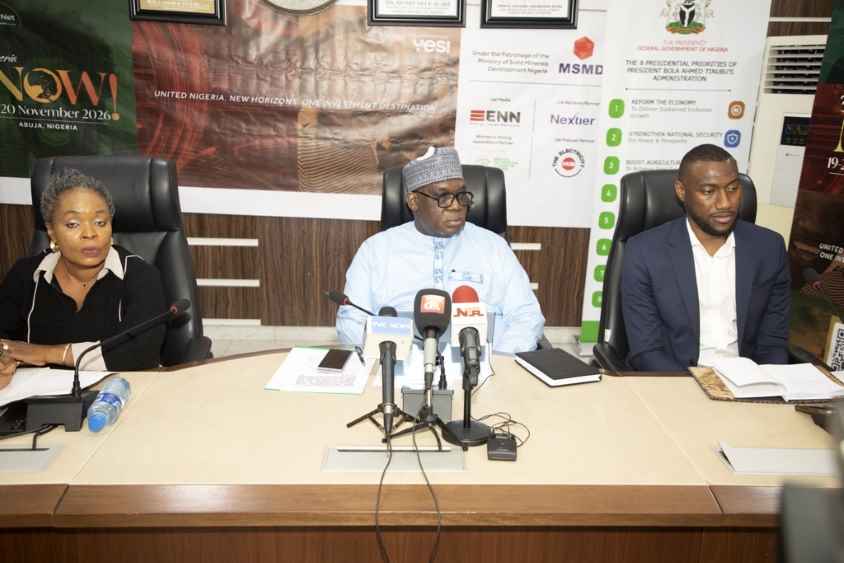
LONDON, United Kingdom, October 21, 2026/APO Group/ –Platinum group metals, gold, nickel, copper, lithium and rare earth elements lie together in one mineral province in Kaduna State, which the Minister of Solid Minerals Development announced in June as world-class and the Nigerian Geological Survey Agency has verified. The Ministry opens its doors to global investors at Nigeria NOW!, held at the Bola Ahmed Tinubu International Conference Centre in Abuja on 19 and 20 November.


Processing is following the discoveries, as lithium facilities of $600m in Nasarawa State and $200m near Abuja sit alongside a $400m rare earth processing project in Nasarawa, and mining lease applicants must now submit value-addition plans. Annual mining revenue has risen from about N6bn before the current administration to more than N70bn by the end of 2025.

The routes to export markets are moving too, as the Federal Executive Council has approved deep seaports at Bakassi and Ondo as public-private partnerships, with the Bakassi port alone valued at $2.27bn.

With a month to go, investors and developers travelling to Abuja will meet these projects at close quarters. In investor boardrooms, the Government of Nigeria will review specific projects in depth, from large-scale infrastructure to multilateral programmes such as Mission 300.

Speaking to Energy News Network in September, Tunde Arisekola, Senior Advisor, Geological and Minerals Information at the African Minerals Development Centre, who joins the minerals session on the first day, said that “first and foremost all international investors coming to Abuja should understand that Nigeria is ready and open for business”. In the same interview he described Nigeria’s economy as “stable, safe, peaceful and welcoming to all international investors”.

The programme opens with a welcome from the Chief Host, H.E. Dr Oladele Henry Alake, Minister of Solid Minerals Development, followed by sessions on how the Ministry of Power will drive capacity into Nigeria’s industrial hubs and on the policies opening the minerals sector to foreign investment, including domestic processing and value addition. The second day turns to the pipeline of transport and port infrastructure and the $1bn Domestic Green Bond, and closes with an investors’ clinic on the 2025 Tax Act.

Lagos State Government, a Nigeria NOW! partner, now regulates its own electricity market after NERC transferred oversight to the Lagos State Electricity Regulatory Commission. Hon. Biodun Ogunleye, Lagos State Commissioner for Energy and Mineral Resources, told Energy News Network that “capital follows bankable cashflows”. The state’s job, he said, is “to create both the infrastructure plan and the commercial architecture that makes that plan financeable”.

On Friday 20 November, YES! Nigeria runs alongside the main programme under the theme “Empowering Today’s Entrepreneurs, Building Tomorrow’s Industrialists”. Abuja University and Philomath University are partners, and the Youth Sustainable Development Network is Community Partner. Its opening session hands the stage to young Nigerians already at work in the sector, among them Damilola Hamid Balogun of YSDN and Emmanuel Terwase of Boost Power.

Nigeria NOW! is held under the patronage of the Minister of Solid Minerals Development, with the Lagos State Government, the Nigerian Indigenous Women in Mining & Natural Resources Organisation, Women in Mining, Nextier and The Electricity Hub as partners.

Distributed by APO Group on behalf of EnergyNet Ltd..


Continue Reading

Business

Global Islamic finance industry assets to reach US$10.5 trillion by 2030 as adoption broadens

Published

on

Global Islamic finance

The report draws on the Islamic Finance Development Indicator (IFDI), a global benchmark that assesses the development of the Islamic finance industry across 140 countries through five key areas, Financial Performance, Governance, Sustainability, Awareness, and Knowledge

For ICD, these developments reinforce the importance of ensuring that Islamic finance serves as a practical instrument for inclusive and sustainable economic transformation

KUALA LUMPUR, Malaysia, October 21, 2026/APO Group/ –LSEG, in collaboration with the Islamic Corporation for the Development of the Private Sector (ICD) (www.ICD-ps.org), the private sector arm of the Islamic Development Bank (IsDB) Group, today announced the results of the 2026 edition of the Islamic Finance Development Report at the Kuala Lumpur Islamic Finance Forum (KLIFF) in Malaysia.


Key findings of the report include:

  • The global Islamic finance industry maintained a strong growth trajectory in 2025, with total assets reaching US$6.5 trillion, up 9% year-on-year. Growth was supported by the continued expansion in Islamic banking, record sukuk issuance, strong Islamic fund performance, and new regulatory frameworks.
  • Malaysia, Saudi Arabia, the United Arab Emirates, Indonesia, and Pakistan retained their positions as the world’s most developed Islamic finance markets. These countries continued to benefit from comprehensive regulation, strong institutional development, active financial markets, and well-established knowledge ecosystems.
  • Several markets recorded notable gains in performance, including Türkiye, Tanzania, Kenya, Benin, Azerbaijan, and Uzbekistan, highlighting the growing momentum across both established and emerging Islamic finance markets.

The report also identified several structural trends that are shaping the industry’s development. Regulatory reforms and stronger market infrastructure are supporting growth beyond core markets, particularly across Africa and Central Asia. Sustainability guidelines are increasingly prioritised, although activity remains concentrated in developed markets. Digitalisation is also advancing, with FinTech, open banking, and tokenised sukuk influencing financing, issuance, and settlement while widening access to financial products. However, talent development is lagging industry expansion, emphasising the need for stronger specialist education.

Khalid Khalafalla, Acting Chief Executive Officer of ICD, said: “For ICD, these developments reinforce the importance of ensuring that Islamic finance serves as a practical instrument for inclusive and sustainable economic transformation. ICD remains committed to advancing private-sector development across its member countries through targeted financing and the promotion of Islamic financial solutions.”

Mustafa Adil, Head of Islamic Finance, LSEG, added: “Looking ahead, global Islamic finance assets are projected to exceed US$10.5 trillion by 2030, supported by continued Islamic banking expansion, growing sukuk issuance momentum, emerging-market adoption and demand for sustainable and digital financial solutions.”

The report draws on the Islamic Finance Development Indicator (IFDI), a global benchmark that assesses the development of the Islamic finance industry across 140 countries through five key areas, Financial Performance, Governance, Sustainability, Awareness, and Knowledge. It provides a holistic view of the global Islamic finance landscape, measuring progress in alignment with Islamic principles and supporting stakeholders in identifying opportunities for growth and reform.

Read full report: Link (https://apo-opa.co/3TTw9yq)

Distributed by APO Group on behalf of Islamic Corporation for the Development of the Private Sector (ICD).


Continue Reading

Trending