Connect with us
Anglostratits

Energy

Caribbean Energy Week 2026 Ignites Regional Oil and Renewables Dialogue

Published

on

CEW

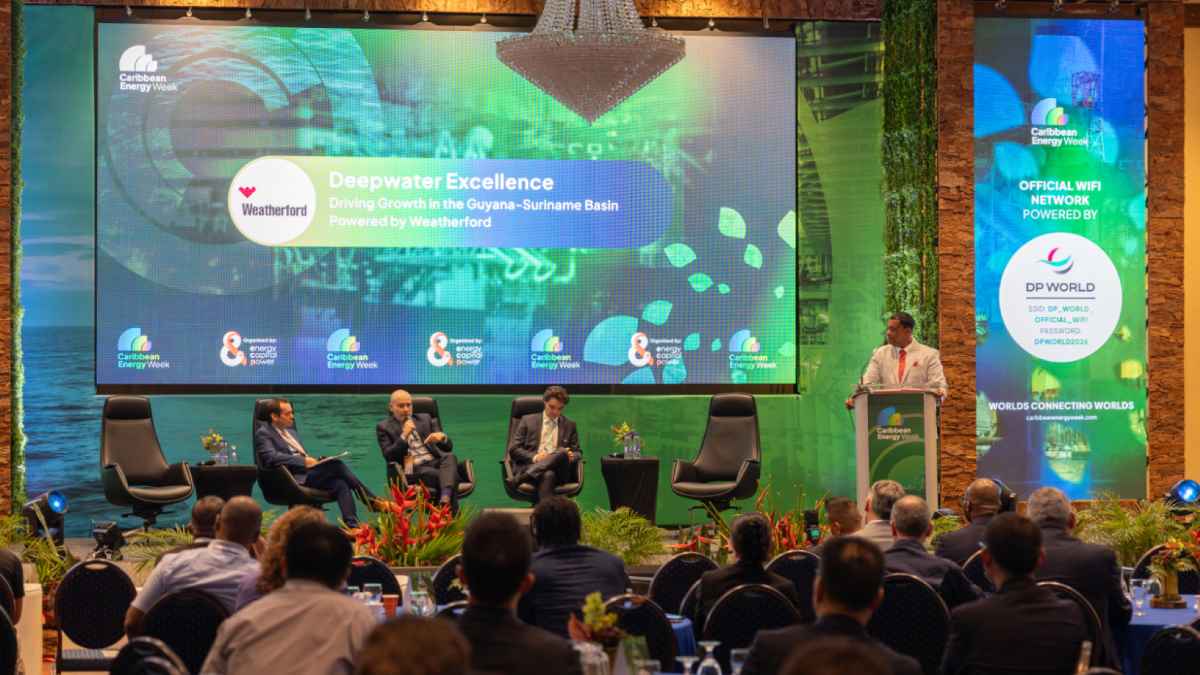
Caribbean Energy Week 2026 in Paramaribo gathered leaders, investors and national oil companies to discuss hydrocarbons, renewables, infrastructure, mining and carbon credits, spotlighting the region’s evolving energy landscape

PARAMARIBO, Suriname, April 2, 2026/APO Group/ –Caribbean Energy Week (CEW) 2026 kicked off in Paramaribo, Suriname, uniting government officials, investors and industry leaders to explore the region’s evolving energy landscape on 30 March. Day 1 highlighted discussions on hydrocarbons, renewables, power infrastructure, mining and carbon credits, featuring keynotes and panels with the Caribbean Community (CARICOM) and regional energy ministers, alongside executives from major national oil companies.


Caribbean Doubles Down on Oil

Caribbean leaders at CEW advocated a balanced energy strategy that embraces both oil and gas development alongside renewables, arguing that global demand growth necessitates a pragmatic mix. Surinamese Foreign Affairs Minister Melvin Bouva and Oil and Gas Minister Patrick Brunnings, as well as Trinidad and Tobago’s Energy Minister Ernesto Kesar highlighted the need to convert major discoveries – such as Guyana’s Stabroek Block and Suriname’s GranMurgu project – into sustained production. The ministers also said the projects have the potential to attract investment, enhance regional cooperation and build local capacity, while emphasizing that hydrocarbons will remain central to the region’s energy outlook for the foreseeable future.


Suriname is positioning itself as a key investment destination by advancing new frameworks to boost certainty and streamline project development, with first oil expected by 2028 and gas by 2030. Officials stressed that energy transition goals should be realistic, balancing decarbonization with immediate economic and energy needs, and ensuring that oil and gas revenue supports broader economic growth through workforce development, stronger local content and private sector participation.


Grenada Hydrocarbon Tender Launch

Grenada plans to launch a selective offshore hydrocarbon tender by the end of 2026 or early 2027, inviting oil and gas companies to bid on exploration blocks. Lead Consultant at the Grenada Hydrocarbon Technical Working Group Gilbert Yevi said the move aims to kick-start development of the nation’s unexplored offshore potential, backed by extensive seismic data and a technical working group focused on building the industry responsibly and competitively.


Afreximbank $5 Billion Caribbean Mandate

The African Export-Import Bank (Afreximbank) plans to use its expanded $5 billion CARICOM financing mandate to support Caribbean oil and gas development, local content growth and energy sector collaboration, especially as new producers emerge. The bank’s Caribbean head Okechukwu Ihejirika highlighted past financing – including backing Suriname’s Staatsolie stake in GranMorgu – and said the bank is building interregional platforms with CARICOM to attract capital and expertise to the region.


Caribbean Energy Financing Expansion

The Caribbean’s energy financing landscape is strengthening as the Afreximbank boots its CARICOM financing capacity from $3 billion to $5 billion, aiming to narrow the region’s funding gap for energy, infrastructure and industrial projects. Officials at CEW stressed that broad access to capital is critical to turning energy ambitions into reality, with the expanded facility set to support a variety of regional developments.


This expanded commitment signals a shift toward locally anchored financing structures capable of backing energy and logistics projects across Caribbean markets, while Caribbean authorities push to address infrastructure challenges and strengthen regional ties. Speakers also highlighted the importance of local content and workforce development in ensuring that resource development translates into domestic economic growth and cross-Atlantic cooperation with African partners is gaining momentum to share expertise and financing models.


U.S. Caribbean Energy Partnerships

The U.S. is intensifying energy partnerships in the Caribbean, focusing on Suriname’s expanding oil and gas sector and broader regional energy security. U.S. officials emphasize modern infrastructure, workforce development and sustainable investment aligned with long-term growth, while cautioning against unsustainable external financing. They highlighted U.S. firm’s role in exploration, citing APA Corporation’s work in Suriname and potential opportunities across the energy value chain.


Suriname’s GranMorgu Project Gains Momentum

Industry leaders expressed that Suriname’s offshore GranMorgu development is progressing quickly toward first oil in 2028, with TotalEnergies advancing FPSO construction, subsea testing and upcoming drilling campaigns while new infrastructure and supply chain capacity are built. Companies including SBM Offshore, Shell and Weatherford emphasized that beyond production, the project’s success will rely on workforce training, stronger local participation and long-term planning as Suriname’s offshore sector continues to mature.

Distributed by APO Group on behalf of Energy Capital & Power.

Energy

African Mining Week to Connect Investors with New Prospects as Global Gold Demand Skyrockets

Published

on

Energy Capital

African Mining Week 2026 will highlight emerging and lucrative investment opportunities for global investors as gold demand rises and prices hit record highs

CAPE TOWN, South Africa, April 23, 2026/APO Group/ –As global gold prices continue to reach record levels and demand surging, the upcoming African Mining Week Conference – The Most Influential Mining Conference in Africa – taking place on October 14–16 in Cape Town will connect global investors with investment opportunities across Africa’s burgeoning gold value chain. The event will host the Gold Forum, bringing together private and public sector stakeholders from Africa’s leading gold-producing countries alongside international investors to discuss the future of gold mining, trading and value addition.

With reduced reliance on the U.S. dollar and rising central bank purchases expected to keep gold demand elevated, prices are projected to remain above $5,000 per ounce through 2026. In response, African producers are accelerating project development to capitalize on these market trends and drive GDP growth. Central banks alone are forecasted to acquire around 755 tons of gold.

Ghana – Africa’s largest gold producer – aims to increase output to 6.5 million ounces from six million in 2025, through the acceleration of projects such as the Cardinal Namdini, Ahafo North, Black Volta and Bibiani mines, alongside artisanal and small-scale gold mining (ASGM) operations.

Similarly, Mali, Africa’s second-largest gold producer, seeks to increase production beyond the current 60 tons per year. Recent license renewals and grants – including Toubani Resources’ Kobada Mine, Barrick Mining’s Loulo-Gounkoto Mine, B2Gold’s Fekola Mine expansion, Compass Gold’s Massala Mine and Roscan Gold’s exploration permits – reflect a commitment to collaborate with global investors to unlock its gold potential.

The Democratic Republic of Congo (DRC) also aims to increase gold exports to 15–18 metric tons in 2026. Meanwhile, several projects across the continent have also reached final investment decisions, highlighting Africa’s focus on expanding gold production. Against this backdrop, the Gold Forum at AMW will serve as a key venue for connecting investors with upstream investment opportunities across the continent.

The Forum will also spotlight efforts to enhance local beneficiation to maximize the value of Africa’s gold resources. These include the DRC’s partnership with Lunga Mining to launch a pilot gold refinery in Kalemie. Ghana’s Gold Coast also partnered with South Africa’s Rand Refinery to enhance local gold processing in Ghana. Egypt is collaborating with the African Export-Import Bank to finance and develop an integrated gold value chain in the country while Mali is developing a refinery in partnership with Russian investors. Amidst this rapid expansion of Africa’s downstream infrastructure, AMW will provide a platform to discuss best strategies for unlocking investment to support the continent’s local beneficiation agenda.

In addition, African gold producers are increasingly implementing programs to formalize and empower ASGM operations, contributing to sector stability and growth. For instance, Ghana is leveraging its newly established Ghana Gold Board to support ASGM formalization. Meanwhile, the DRC is leveraging its ASGM Empowerment AXIS Program – a blockchain-based gold tokenization project – and the Goldconnect program – designed to formalize, secure and digitize artisanal gold mining. Coming into this picture, the AMW Gold Forum will connect investors with opportunities arising from Africa’s ASGM formalization initiatives.

AMW serves as a premier platform for exploring the full spectrum of mining opportunities across Africa. The event is held alongside the African Energy Week: Invest in African Energies 2026 conference from October 12-16 in Cape Town. Sponsors, exhibitors and delegates can learn more by contacting sales@energycapitalpower.com.

Distributed by APO Group on behalf of Energy Capital & Power.

Continue Reading

Energy

African Mining Week (AMW) to Highlight Artificial Intelligence (AI) and Advanced Tech Driving Africa’s $8.5T Mining Transformation

Published

on

Energy Capital

African Mining Week 2026 will have a strong focus on the use of AI to optimize mining sector opportunities and to address the industry challenges

CAPE TOWN, South Africa, April 23, 2026/APO Group/ –As African nations increasingly adopt advanced technologies and AI to optimize operations across the mining value chain, the upcoming African Mining Week (AMW) – The Most Influential Mining Conference in Africa, scheduled for October 14–16 in Cape Town – will bring together technology providers, investors, project developers and regulators to explore the digital transformation of the sector.


The event will feature a dedicated panel titled Leveraging Advanced Technologies & AI to Transform Mining Practices for Sustainable Growth, highlighting the use, challenges and investment opportunities of AI within Africa’s growing mining industry.

In the Democratic Republic of Congo (DRC), AI is rapidly reshaping exploration. Speaking at AMW 2025, Louis Watum Kabamba, the DRC’s Minister of Mines, said AI-enabled exploration has the potential to reduce resource discovery timelines to under three years. He emphasized the DRC’s efforts to leverage AI to unlock 90% of its geology and over $24 trillion in untapped minerals. In February 2026, the country partnered with Xcalibur Smart Mapping to employ advanced geospatial solutions for mapping critical minerals and mitigating exploration risks. The DRC is also collaborating with U.S.-based startup KoBold Metals to apply AI-driven techniques at the Mingomba Lithium Mine, enhancing lithium development.

Similarly, Burundi has partnered with KoBold Metals and Lifezone Metals to digitize its geological database and assess the 140-million-ton Musongati Nickel Project. In Zambia, KoBold Metals is applying AI at the Mingomba Copper Project to identify high-grade deposits and accelerate production, supporting a national strategy to increase output to three million tons by 2031.

Meanwhile, the Ghana Gold Board and the Ghana Geological Survey Authority are implementing AI-supported mineral prospectivity modeling to evaluate mineralization in Funsi, Atuna and Bensere East, supporting the country’s agenda to expand gold reserves and production.

Botswana is leveraging AI to diversify its mining sector beyond diamonds. Botswana Minerals has identified eight new copper deposits through AI-powered exploration, accelerating the country’s push into critical minerals.

As African nations launch new exploration projects to unlock the region’s $8.5 trillion in untapped mineral resources, AI and advanced technologies are expected to be central to their strategies. The AMW panel will provide a platform to discuss how AI can de-risk exploration, optimize operational efficiency and enable sustainable, value-added development across the continent’s mining sector. The event will unpack best AI practices to help Africa capitalize on its 30% share of global critical minerals, with demand projected to triple by 2030.

Distributed by APO Group on behalf of Energy Capital & Power.

Continue Reading

Energy

African Energy Chamber (AEC) Commends Nigerian Government for Swift Action to Safeguard Indigenous Energy Investment

Published

on

African Energy Chamber

Nigeria’s swift regulatory response in the Dawes Island dispute underscores renewed commitment to investor protection, production stability and a predictable upstream investment climate

LAGOS, Nigeria, April 23, 2026/APO Group/ –The African Energy Chamber (AEC) (www.EnergyChamber.org) commends the Nigerian Federal Government for its decisive and timely intervention in the Dawes Island marginal field dispute, reinforcing the country’s commitment to protecting indigenous investment and sustaining momentum in oil and gas production growth.


Following the recent Federal High Court ruling concerning the Dawes Island field, the Office of the Attorney General has moved swiftly to coordinate a response, directing the Nigerian Upstream Petroleum Regulatory Commission (NUPRC) to initiate an appeal. The NUPRC has since formally filed an application for leave to appeal, signaling a clear and unified government effort to uphold regulatory integrity and ensure continuity for operators delivering tangible results.

This proactive intervention sends a strong message to both domestic and international stakeholders: Nigeria remains committed to fostering a stable and predictable investment climate where performance, capital deployment and production are recognized and protected.

At the center of the dispute is Petralon 54 Limited, the Nigerian-owned operator of the Dawes Island oil block, which assumed operatorship in2021 following a marginal bid process. Since then, the company has invested approximately $60 million to rehabilitate infrastructure, drill multiple wells and bring the field into production – an achievement that stands out within Nigeria’s marginal field landscape.

Within a short timeframe, Petralon successfully drilled two wells –  DI-2 to 9,740 ft and DI-3 to 10,193 ft – evacuating over 200,000 barrels of crude to the Bonny Terminal and remitting excess of $900,000 in royalties to the Federal Government by March 2026. These results underscore the importance of ensuring that operators who deliver on their commitments are supported through consistent and transparent regulatory processes.

This intervention reinforces Nigeria’s position as a serious and responsive energy investment destination

“The Nigerian government’s swift action demonstrates a clear understanding of what is at stake,” said NJ Ayuk, Executive Chairman of the AEC. “Protecting investors who deploy capital, create value and contribute to national production is essential to maintaining confidence in the sector. This intervention reinforces Nigeria’s position as a serious and responsive energy investment destination.”

The development comes at a pivotal moment for Nigeria’s energy sector. Under the leadership of President Bola Tinubu, the country has seen renewed investor interest, with over $8 billion in upstream investment commitments recorded since 2023. Major projects, including Shell’s $2 billion final investment decision on the HI offshore gas project, TotalEnergies’ Ubeta development and Shell’s Bonga North deepwater project, highlight the scale of capital being mobilized.

Additional financing, such as Chevron’s $1.4 billion for deep and shallow water infill drilling, further reflects growing confidence in Nigeria’s regulatory and investment framework. Meanwhile, discussions around large-scale opportunities like the proposed Bonga South West development – potentially worth up to $20 billion – underscore the country’s long-term growth potential.

Indigenous companies remain central to this trajectory, now accounting for approximately 30% of Nigeria’s oil and gas production. Their role in driving output, creating jobs and strengthening local capacity continues to expand, making policy consistency and investment protection more critical than ever.

In parallel, downstream advancements such as Aliko Dangote’s 650,000-barrel-per-day refinery in Lagos are enhancing regional energy security, with increased exports of refined products helping to stabilize supply across African markets.

The AEC emphasizes that the government’s coordinated response to the Dawes Island case reflects a broader commitment to ensuring that Nigeria’s “drill or drop” policy is upheld – rewarding operators that actively develop assets while maintaining accountability across the sector.

The Chamber encourages all parties to support a swift and constructive resolution to the case, ensuring that ongoing operations are not disrupted and that Nigeria’s energy sector continues on its path toward increased output, energy security and economic resilience.

Distributed by APO Group on behalf of African Energy Chamber.

Continue Reading

Trending