Connect with us

Tech

Canon Central and North Africa Partners with Makerere University to Shape the Next Generation of Creatives

Published

on

Canon

Canon Academy Photo & Video workshops, journalism training, and virtual film school access to empower youth and strengthen creative education in Uganda

KAMPALA, Uganda, May 21, 2026/APO Group/ —
  • Practical training in photography, filmmaking, and journalism
  • Access to Canon’s interactive virtual film school for aspiring storytellers 

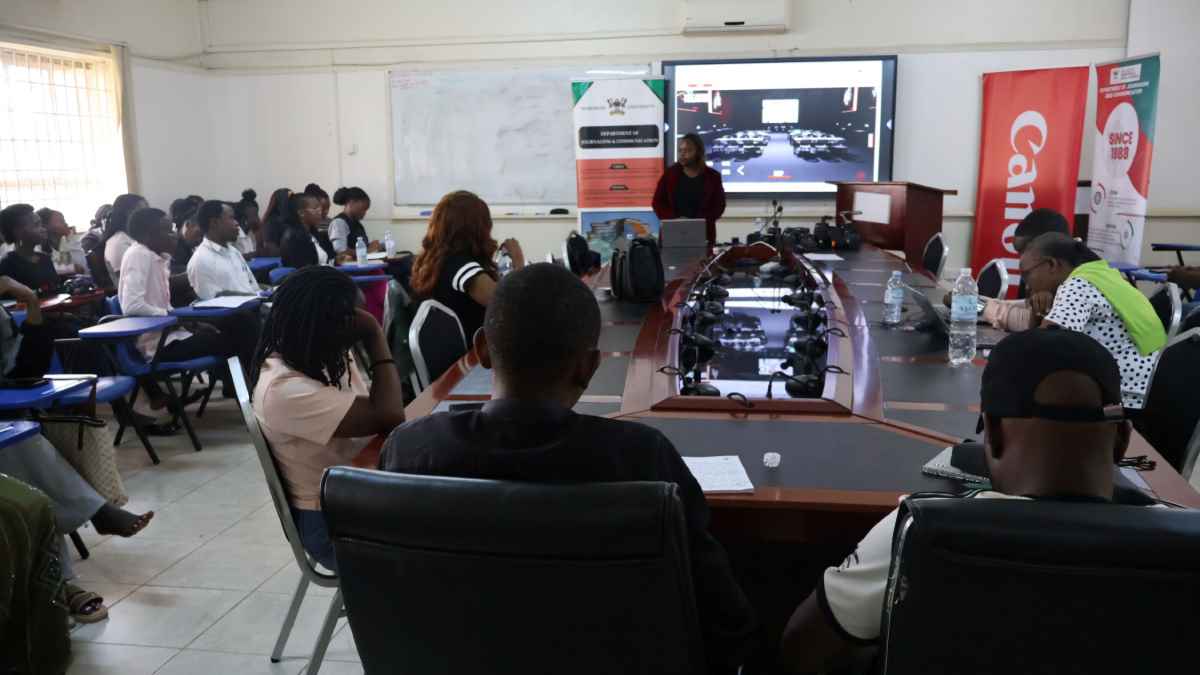
Canon Central and North Africa (CCNA) (www.Canon-CNA.com) has partnered with Makerere University in Uganda to deliver Canon Academy Photo & Video programmes, providing students with hands-on training in photography, filmmaking, and journalism.  The initiative will provide hands-on training in photography, filmmaking, and journalism, while giving students access to Canon Academy Video, Canon’s virtual film school.  The collaboration underscores Canon’s continued commitment to youth empowerment, creative education, and strengthening Africa’s visual storytelling industry as CCNA approaches its 10-year milestone in 2026.

Inspiring Tomorrow’s Storytellers

Rashad Ghani, B2C Business Unit Director, Canon Central and North Africa, said, “We’re proud to celebrate ten years of CCNA by investing in the next generation of creatives. Our partnership with Makerere University enables us to share Canon Academy’s resources with aspiring storytellers, helping them build the technical and creative skills needed to shape Africa’s visual narrative. By offering access to training, mentorship, and learning platforms, we’re supporting students on their journey into photography, filmmaking, journalism, and digital content creation.”

Our partnership with Makerere University enables us to share Canon Academy’s resources with aspiring storytellers, helping them build the technical and creative skills

Strengthening Educational Ties

The collaboration builds on Canon’s established relationship with Makerere University, where Canon has previously hosted training weeks and workshops. Makerere University, founded in 1922, has grown into one of Africa’s most prestigious institutions of higher learning, with a long tradition of excellence in journalism, media, and communication studies. By integrating Canon Academy workshops into the university’s curriculum, the initiative combines academic learning with practical, industry-focused training, helping prepare students for careers in Africa’s rapidly growing creative sector.

Overview of Workshops and Training

Students and local professionals can expect a diverse range of workshops and training sessions, including:

  • Dedicated Media Workshop: Local journalists and media professionals will join sessions led by Canon trainer Elayne Okaya, exploring Canon’s photo and video ecosystem and gaining hands-on experience with cutting-edge technology.
  • Canon Camera Innovation Workshop: Students will immerse themselves in Canon’s imaging tools, guided by Canon trainer Elayne Okaya, with insights into the latest products for content creation and practical demonstrations.
  • Journalism Workshops: Two sessions will focus on visual storytelling, ethics, and best practices in modern reporting, helping students strengthen their skills with Canon technology guided by certified trainer Miriam Watsemba.
  • Canon Academy Video Platform: Canon Educational Programmes Manager Katie Simmonds will introduce students to the virtual film school, guiding them through structured online learning and certification opportunities.
  • Basic Filmmaking Workshop: A three-day course led by Elayne Okaya will cover filmmaking fundamentals, including camera movement, scene structure, and production techniques, with access to Canon equipment for hands-on practice.

Supporting Africa’s Creative Economy

As Africa’s creative economy continues to expand, there is a growing need for practical training that equips young people with the skills required for careers in filmmaking, journalism, and digital content creation. By combining technical expertise with hands-on experience, initiatives like this help students build the confidence needed to succeed in a fast-evolving creative landscape. Dr Nakiwala Aisha Sembatya, the Chair department of Journalism and Communication noted that, “This collaboration gives our students direct access to industry expertise and practical experience in photography, filmmaking, and journalism. Canon’s training platforms will enhance our academic programmes and prepare students for careers in the media and creative sectors.”

Canon Miraisha and Long-Term Commitment

The partnership with Makerere University forms part of Canon’s broader Miraisha Programme and education-led ecosystem across Africa. By working with universities, training institutions, and creative communities, Canon supports young people in building careers in visual storytelling and digital content creation. As CCNA marks a decade of operations in Africa, the company continues to invest in initiatives that expand access to skills, nurture creative talent, and strengthen Africa’s future creative industries reflecting Canon’s Kyosei philosophy of living and working together for the common good.

Distributed by APO Group on behalf of Canon Central and North Africa (CCNA).

Business

Backbase Acquires Kasisto as African Banker Survey Names Legacy Information Technology (IT) the Top Barrier to Artificial Intelligence (AI) Adoption

Published

on

The acquisition embeds banking-grade agentic AI into Backbase’s operating model, closing the gap between African banks and cloud-native fintech competitors

JOHANNESBURG, South Africa, July 7, 2026/APO Group/ –Backbase (www.Backbase.com) announced the acquisition of Kasisto, a pioneer in agentic AI for banking and financial services. Kasisto’s agentic platform, financial services intelligence, and New York-based team are now part of Backbase and the AI-native Banking OS.


The transaction integrates Kasisto’s financial intelligence models into the Backbase platform, building an architecture that helps financial institutions overcome legacy IT constraints that have stymied digital transformation across Africa.

This announcement follows a recent survey of 277 bank executives across Africa, conducted by Backbase with African Banker magazine (https://apo-opa.co/4f7b9KZ), which revealed legacy system integration as the primary obstacle to AI adoption. This bottleneck prevents established institutions from scaling digital offerings fast enough to compete with agile, cloud-native fintechs and mobile money operators.

Legacy maintenance costs billions globally, but the impact is especially acute in Africa, where banks face high operational costs and a growing mobile-first unbanked population.

This acquisition addresses a structural constraint specific to how African banking has grown

This acquisition addresses a structural constraint specific to how African banking has grown,” said Ayman Daoud, Vice-President of Africa regions at Backbase. “We see too many banks build AI in isolated pockets, like a chatbot in digital self-service or automation in the contact centre, without resolving the disconnect between those teams and back-office operations. By embedding Kasisto’s reasoning AI into the core operating model, we’re giving African banks one system that can answer a question and complete the work behind it within the governance and compliance regulators require.

Banking-grade agentic AI, embedded in the Banking OS.

Kasisto’s platform, KAI, is purpose-built for regulated financial environments, unlike general-purpose AI models. It uses specialised financial LLMs that understand context, apply institutional judgment, and operate strictly within banking governance and compliance frameworks. In the continent, the platform has already been successfully deployed by Absa and Nedbank, where, in the latter, it cut the number of live agent conversations by half within just a year of launch.

Combined with Backbase’s flagship Banking OS, Kasisto’s conversational and agentic AI turns customer intent into governed execution: verifying eligibility, applying policy, and triggering workflows to resolve requests without manual handoffs. The result is AI that not only fields queries but finishes them, with proactive, compliant outbound engagement before a customer need becomes an inbound service request.

“Agentic AI will define how banks compete over the next decade. Africa is a particularly well placed to leapfrog western banks with decades-old core systems. Backbase and Kasisto give those institutions purpose-built agentic intelligence from day one, rather than retrofitting it onto legacy infrastructure later.” said Lance Berks, CEO of Kasisto.

Backbase’s engagement layer and Kasisto’s transactional AI give African financial institutions a way to bypass traditional IT modernisation cycles that often take years and have high failure rates.

Distributed by APO Group on behalf of Backbase.


Continue Reading

Business

StarCharge Releases Industry White Papers: From Infrastructure to Network Systems, Microgrids Moving from Customization to Scaling Up Development

Published

on

CHANG ZHOU, CHINA – Media OutReach Newswire – 7 July 2026 – The global new energy vehicle market has seen rapid growth in recent years. With continued strong expectations for new energy vehicle exports, the global electric vehicle (EV) charging market is entering a new stage of rapid expansion. Recently, StarCharge, the global leading brand of EV Charging equipment and smart energy systems, held a major industry seminar in Hong Kong and released two new white papers at the event, exploring two major transformative trends in the industry that are worth paying attention to.

According to the ‘Technical White Paper’ by StarCharge, for years, EV charging infrastructure has mainly been seen as support for vehicle sales expansion: building more chargers, expanding coverage, and speeding up charging.

However, this role is starting to change.

As electrification scales up, charging networks are becoming a part of the energy system itself. They are no longer just places for vehicles to top up; they are evolving into smart energy nodes connecting vehicles, the grid, distributed energy, storage, and digital management.

This shift from charging infrastructure to charging network systems shows that the industry is moving from basic access to integrated value: from charging services to energy services, from standalone stations to PV-storage-charging systems, from equipment deployment to scenario-based infrastructure.

StarCharge believes that the future charging network ecosystem will go through four major turning points.

Four Key Points Reshaping the Ecosystem

1. Charging Networks Are Becoming Energy Infrastructure

Charging infrastructure is going beyond its original role as just a support for EVs. As EV adoption grows, charging networks are becoming strategic energy infrastructure: they connect mobility demand with the grid, distributed energy, storage, digital platforms, and future energy services.

2. Defining the Scenarios for the Network

The future charging network won’t be shaped by hardware alone. Policies determine whether infrastructure should be built, technology determines the speed of construction, but real-world scenarios determine what the charging network actually needs to look like.

Urban commuting, highway trips, ride-hailing, logistics fleets, county and rural coverage, holiday peak demand, heavy trucks, mining areas, ports, airports, and autonomous driving all create different charging needs. Therefore, a mature charging network can’t be ‘one-size-fits-all’; it has to be designed around different vehicle types, operating hours, power requirements, reliability needs, and grid conditions.

3. Digital platforms turn charging networks into operable assets

A large charging network only truly has value when it can be scaled, optimized, and managed. This is exactly the core role of cloud platforms. They turn millions of charging points, users, stations, transactions, and energy flows into a measurable, controllable, and continuously optimized operating system.

StarCharge’s platform capabilities cover site selection, pricing, marketing, station operations, smart maintenance, charging safety, station robots, AI-based smart charging, fleet management, energy optimization, and ESG reporting. In other words, digital platforms are the key to transforming charging infrastructure from a heavy-asset network into smart, operable, and scalable assets.

4. Charging stations are becoming grid-friendly energy resources

The next-generation charging infrastructure won’t be defined by any single technology. It will be built on a complete tech stack, combining high-power charging, liquid cooling, integrated PV-storage-charging, DC bus architecture, V2G, automated charging, and AI-driven operations. In other words, future charging stations shouldn’t just be passive electricity consumers that add stress to the grid. Through energy storage, renewable energy integration, V2G, smart scheduling, and AI-based energy optimization, charging stations can become grid-friendly energy resources.

This means that aside from charging vehicles, a charging station can absorb renewable energy, buffer peak loads, respond to demand-side signals, support peak shaving and valley filling, regulate frequency, and provide carbon-neutral ESG data for fleet operators. Its business model will also go beyond charging fees, creating new value through energy services, data services, carbon-related benefits, and grid interaction capabilities.

Microgrids Have Emerged at the Right Time

At the same time, with the continuous development of distributed energy and photovoltaic energy, microgrids have emerged at the right time. They are not just a product, but a local energy system built around real-world scenarios.

In the latest “White Paper” on scenario-based microgrid technology, StarCharge points out that microgrids are moving from customized engineering projects toward scalable, replicable energy systems.

According to StarCharge, a microgrid is not a single device, nor is it just an energy storage product. It’s a local energy system designed around the needs of a specific scenario, coordinating local generation, loads, storage, control, and operational strategies within a defined electrical boundary.

Moreover, depending on the scenario—such as data centers, individual charging stations, zero-carbon industrial parks, or green mines—the energy challenges are completely different. The right microgrid is defined by the scenario it serves.

The white paper also highlights four high-value paths: electricity-computing synergy, independent power supply, zero-carbon parks, and green mines. In areas with weak grids or limited grid access, microgrids ensure the operation of critical loads. In emerging load scenarios like data centers and industrial parks, microgrids support renewable energy integration, energy resilience, and cost optimization. In high-tech-demand scenarios like mines, microgrids become the foundation for ensuring production continuity, energy transition, and ESG competitiveness.

The three-stage evolution of microgrids

As power sources and loads become increasingly DC, microgrid architectures are evolving from AC-dominated systems to AC-DC hybrid systems, and eventually toward microgrids with a higher proportion of DC.

Microgrid 1.0 — dominated by AC architecture. It integrates renewable energy into the existing AC grid framework, but its control heavily relies on grid-following management and support from the external grid.

Microgrid 2.0 — the AC-DC hybrid stage. AC and DC buses coexist, allowing PV, storage, and DC loads to connect more directly. Bidirectional power hubs, solid-state transformers (SST), and energy routers become important bridges between AC and DC systems. This stage balances strong AC compatibility with higher DC efficiency and is expected to remain mainstream in the next 10-15 years.

Microgrid 3.0—it’s the era of DC microgrids. As solar PV, wind power, battery storage, data centers, LED lighting, and EV charging increasingly move toward DC, DC microgrids can reduce repeated AC-DC conversion losses, simplify control, and support millisecond-level responses.

This evolution is closely linked to the mission of microgrids: breaking through energy access bottlenecks, enabling sustainable development, connecting technology, industry, policy, market, and community needs, and unlocking the integrated value of local energy systems.

In the future, StarCharge will steadily expand into the growing global markets for new EVs and renewable energy, building on its smart energy systems that have been widely validated in the Chinese market.


Continue Reading

Business

JustMarkets Launches Browser-Based Web Terminal for MT5 Trading

Published

on

The new browser-based terminal enables MT5 account holders to access trading tools without installing software, expanding the broker’s trading ecosystem

JOHANNESBURG, South Africa, July 7, 2026/APO Group/ –Global multi-asset broker JustMarkets (https://JustMarkets.com/) has launched its Web Terminal, a browser-based trading platform that enables clients to access their MT5 accounts directly through a web browser without downloading or installing additional software. The terminal is available to clients across all countries where the broker operates.

The Web Terminal was introduced following a preparation period that included technical optimization and user testing aimed at improving platform performance and usability before its public release.

Now every client can trade directly from their browser, with all the professional tools they need at their fingertips

Designed for MT5 accounts, the browser-based platform provides traders with access to a full trading environment from any compatible device. Users can access the terminal by selecting their trading account, clicking the “Trade” button, and choosing the “JustMarkets Terminal” option.

The Web Terminal includes a range of built-in trading features, including advanced charting tools with technical indicators, flexible trade volume settings, detailed information for tradable instruments, real-time market sentiment data, trading schedule and margin updates, and tools for managing multiple positions and pending orders through a single interface.

Commenting on the launch, a JustMarkets representative said: “At JustMarkets, we never stop evolving. With the Web Terminal, we wanted to remove every barrier between traders and the markets. Now every client can trade directly from their browser, with all the professional tools they need at their fingertips.”

The launch follows the introduction of the JustMarkets mobile trading application and marks another step in the company’s efforts to expand its trading ecosystem with browser-based solutions and additional trading tools.

Distributed by APO Group on behalf of JustMarkets.


Continue Reading

Trending

Exit mobile version