Connect with us
Anglostratits

Business

Africa Trade Development Forum Set to Convene Global Trade and Industry Leaders in Addis Ababa

Published

on

Africa

While much global trade conversation has focused recently on tariffs, the primary barrier to African trade lies in the technical, regulatory, financial, and logistical challenges of being able to export, often referred to as Non-Tariff Barriers

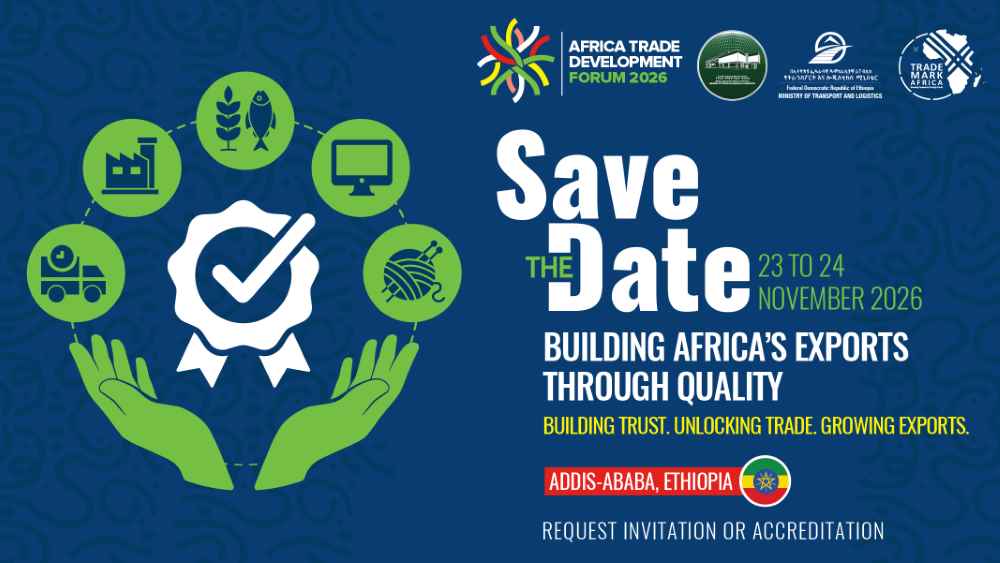
ADDIS-ABABA, Ethiopia, July 14, 2026/APO Group/ –Africa’s heads of government, policymakers, leading industrialists, and global partners will gather in Addis Ababa on 23 and 24 November 2026 for the Africa Trade Development Forum 2026. Co-hosted by the Ministry of Trade and Regional Integration of the Federal Democratic Republic Ethiopia and TradeMark Africa (TMA) (www.TradeMarkAfrica.com), the biennial summit arrives at a turning point for the continent’s economic integration and shifting global trade dynamics.


While much global trade conversation has focused recently on tariffs, the primary barrier to African trade lies in the technical, regulatory, financial, and logistical challenges of being able to export, often referred to as Non-Tariff Barriers.

ATDF 2026 offers an important opportunity to focus on these issues with clarity, seriousness and a shared sense of purpose

These Non-Tariff Barriers – such as the measures and processes that allow African companies to show international offtakers that they are meeting critical safety and sanitary standards – currently add an estimated 15% to 30% to regional trade costs. UNECA suggests that eliminating these barriers alone could surge intra-African trade by 52%.”Compliance costs are often higher than the tariffs themselves including actual import duties,” notes UNCTAD, citing that technical measures now regulate two-thirds of global trade.

The 2026 Forum will focus on priority, collective actions to harmonise standards, looking at what is needed to reduce compliance costs, accelerate quality certification, and ensure diminishing rejections of African goods by the world’s most lucrative markets.

Commenting on the forum, H.E. Hailemariam Desalegn Boshe, TMA Board Chair and former Prime Minister of Ethiopia said: “The next phase of Africa’s trade growth will depend on African firms showing that their products are as good as those of anywhere in the world. Businesses are up for the challenge – what we need to do, is to help assess and certify their goods, in a way that does not create a burden. ATDF 2026 offers an important opportunity to focus on these issues with clarity, seriousness and a shared sense of purpose.”

H.E. Kassahun Gofe (PhD), Minister of Trade and Regional Integration of the federal Democratic Republic of Ethiopia said: “Ethiopia is honoured to host the Africa Trade Development Forum 2026 at a time when the continent is placing renewed focus on the quality of its trade systems and the competitiveness of its markets. Standards and quality infrastructure are central to industrial growth, market confidence and the ability of African producers to compete within the continent and beyond. We look forward to welcoming leaders and institutions to Addis Ababa for a practical and forward-looking discussion on the reforms needed to strengthen trade in measurable terms.”

David Beer, Chief Executive Officer of TMA, added: “Africa’s trade ambitions will be realised by building the systems that allow African firms to compete better with the rest of the world, by showing their goods comply with the highest standards. Quality systems underpin that, as they build the trust that markets demand. ATDF 2026 will see leaders focus on how to help businesses make that happen.”

Distributed by APO Group on behalf of TradeMark Africa (TMA).


Business

Non-Governmental Organisation (NGO) Campaigns Against Perenco Threaten Energy Development in the Democratic Republic of the Congo (DRC)

Published

on

African Energy Chamber

Africa needs responsible energy investors that create jobs, support communities and expand energy access – not narratives that undermine the companies driving the continent’s development

JOHANNESBURG, South Africa, July 31, 2026/APO Group/ –Fresh criticism of Perenco’s operations in the Democratic Republic of the Congo (DRC) has once again brought one of Africa’s biggest energy development challenges the fore: NGO-led smear campaigns.

While framed as a challenge to one company’s environmental performance, the campaign reflects a broader pattern of NGO-led attacks on African oil development. As the voice of the African energy sector, the African Energy Chamber (AEC) strongly condemns the attack, recognizing it as a direct attempt to stop Perenco’s activities, limit DRC oil exploration and prevent any meaningful development across the country’s economy.


The scrutiny follows allegations published by Human Rights Watch regarding environmental impacts linked to Perenco’s operations in Muanda, as well as a government-commissioned environmental review that identified areas requiring further attention. Perenco has disputed aspects of the findings, maintaining that it operates in accordance with applicable regulations and has implemented environmental management measures across its operations.


For the AEC, this latest report demonstrates a tactic whereby NGOs rely on sensationalized rhetoric rather than facts and technical evaluations to promote a false narrative about energy companies’ operations. This approach has been seen across other smear campaigns, and the AEC strongly urges the Government of the DRC to be careful not to fall into this trap.


Perenco has spent more than two decades operating in the DRC, creating jobs, supporting communities, investing in infrastructure and helping deliver energy where it is needed most

Perenco has operated in the DRC for more than two decades, establishing itself as the country’s only producing oil operator through its onshore subsidiary Perenco Rep and offshore subsidiary Muanda International Oil Company. The company’s operations support average combined production of approximately 19,500 barrels of oil per day and employ around 1,500 DRC nationals, contributing to local economic activity and the country’s energy sector.


Beyond production, Perenco has invested in infrastructure and community development initiatives in Muanda. Through its 20 MW gas-fired power plant, the company supplies electricity to local installations, including those of the Société Nationale d’Électricité, while also providing power to the city of Muanda and surrounding villages.

The company has also supported community programs focused on education, healthcare, infrastructure, water access, electricity, employment, culture, sport and environmental initiatives. Across its global operations, Perenco has highlighted efforts to improve environmental management, reduce emissions and strengthen operational efficiency.

“Africa cannot afford to drive away the companies that are investing in our future,” said NJ Ayuk, Executive Chairman of the AEC. “Perenco has spent more than two decades operating in the DRC, creating jobs, supporting communities, investing in infrastructure and helping deliver energy where it is needed most. Companies operating in Africa must be held accountable, but accountability cannot become a pretext for undermining responsible investors who are helping African countries develop their resources and fight energy poverty.”

The AEC believes responsible resource development requires both strong environmental oversight and recognition of the companies working to create economic opportunity across the continent. Africa cannot achieve industrialization, strengthen energy security or expand access to reliable power without investment from experienced operators with the technical expertise and capital required to develop its resources.

The DRC, like many African countries, faces the challenge of balancing environmental protection with the need to leverage its natural resources for economic transformation. Achieving this balance requires strong regulatory institutions, transparent processes and partnerships between governments, companies and communities.

As global competition for energy investment intensifies, Africa must ensure that legitimate environmental discussions do not become a broader deterrent to responsible development. The continent’s future depends on attracting companies committed to long-term partnerships, responsible operations and delivering shared value.

The AEC will continue advocating for an energy sector that supports both environmental responsibility and economic progress, recognizing that Africa’s development goals require investment, expertise and partnerships.

Distributed by APO Group on behalf of African Energy Chamber.

Continue Reading

Business

Venezuela Energy Week’s London Showcase Highlights Competitive New Fiscal Framework for Upstream Investment

Published

on

Venezuela

Industry leaders outlined how a streamlined fiscal framework replacing more than 20 legacy levies is creating project-specific investment terms as Venezuela’s production reaches 1.2 million barrels per day

LONDON, United Kingdom, July 31, 2026/APO Group/ –Industry leaders at the Venezuela Energy Week London Industry Showcase on Thursday highlighted Venezuela’s newly implemented hydrocarbons framework as a major step toward restoring the country’s competitiveness as an upstream investment destination, pointing to simplified fiscal terms, greater operational flexibility and rising production as key drivers of renewed investor interest.

Presented to international investors and industry stakeholders in London, the country’s regulatory framework establishes a combined government take as low as 20% on greenfield upstream projects through a streamlined fiscal system that replaces more than 20 legacy taxes. According to industry analysis shared during the showcase, the reforms position Venezuela among Latin America’s most competitive upstream jurisdictions.


The new terms, set out in implementing regulations signed into force in July, pair a variable royalty with the Integrated Hydrocarbons Tax to produce combined rates of 20% for greenfield developments and 25% for extra-heavy and diluted crude projects. The windfall tax and shadow tax – both previously identified by investors as barriers to high-CapEx developments – have been repealed.


Carlos Bellorin, Executive Vice President of Macro Analysis at Welligence Energy Analytics, said his firm has modeled expansion under the new framework and found Venezuela’s terms highly competitive on a global scale. Production has recovered to approximately 1.2 million barrels per day, he said, with Welligence forecasting output to reach between 1.4 million and 1.6 million barrels per day by the end of 2026.


“Below two million barrels per day it’s an OpEx game,” Bellorin said. “After that, you need the big companies to come in.”


Juan Carlos Andrade, CEO of Araya Energy Group and Director and Legal Counsel at the Venezuelan Petroleum Chamber, said the regulatory overhaul has removed constraints that previously forced operators to resolve shortcomings through contractual workarounds. Operators now have the right to trade their own barrels, manage their own cash flow and develop on-site power generation.

Below two million barrels per day it’s an OpEx game


“This is no longer a theory,” Andrade said. “What exists is an opportunity.”


Andrade projected that Productive Participation Contracts could deliver between 250,000 and 500,000 barrels per day, with mixed operating companies contributing a similar volume. Combined, these two contract structures are expected to form the foundation of Venezuela’s near-term production growth.


The London Industry Showcase marks the first in a series of international engagements leading up to Venezuela Energy Week 2026, taking place October 26-29 in Caracas. The event will convene government officials, international operators, investors and technology providers to examine the country’s evolving regulatory framework, upstream opportunities and long-term energy development strategy.


Supporting Venezuela’s Earthquake Recovery


Our thoughts are with the people and communities affected by the recent earthquakes in Venezuela. As the country begins the long process of recovery, we encourage members of the global energy community to support relief and reconstruction efforts through the CAF Recovery and Reconstruction Fund for Venezuela, which channels contributions from individuals, companies and organizations to emergency assistance, essential services and long-term rebuilding efforts.


To learn more or make a contribution, please visit the CAF Recovery and Reconstruction Fund for Venezuela (https://apo-opa.co/4xdED11).

Distributed by APO Group on behalf of Energy Capital & Power.

Continue Reading

Business

Mining Review Africa Issue 4 now available for free download

Published

on

Africa

Beyond underground mining, Issue 4 shines a spotlight on water management strategies, highlighting technologies and practices that help mines improve water efficiency and sustainability

CAPE TOWN, South Africa, July 31, 2026/APO Group/ –The latest edition of VUKA Group’s (https://WeAreVuka.com/Mining Review Africa (MRA) Issue 4 is now available as a free digital magazine, featuring exclusive insights into the technologies, projects and trends shaping Africa’s mining landscape.

This issue explores the innovations transforming underground mining, with a strong focus on improving safety, productivity, and operational efficiency. Sponsored by UMS Group (https://apo-opa.co/3S81U5I) (https://UMSint.com/), the underground mining feature examines how digital technologies are reshaping modern mining operations.

DOWNLOAD MRA ISSUE 4 HERE: (https://apo-opa.co/4vVGeaP)

Leading this edition is the cover story, “Invincible Valves: Driving global growth through engineering excellence,” which highlights how the company continues to expand its international footprint through innovation and engineering expertise.

Readers can also explore a range of exclusive features, including:

  • Trinity Metals: Driving Rwanda’s critical minerals expansion (https://apo-opa.co/4xhybGE), examining the company’s role in developing one of Africa’s emerging critical minerals hubs.
  • Trident: Redefining tailings management in Africa (https://apo-opa.co/3TOKT0S), showcasing innovative approaches to safer and more sustainable tailings storage.
  • Digitising the deep: A pragmatic approach to underground mining technology (https://apo-opa.co/4x7NGkc), featuring Cementation Africa’s perspective on the practical adoption of digital solutions underground.
  • KEFI Gold: Tulu Kapi achieves liftoff (https://apo-opa.co/3S5B4Ly), providing an update on one of East Africa’s most anticipated gold developments.
  • Mental health: Under the hard hat is a human (https://apo-opa.co/4vWgmvp), exploring the growing importance of mental wellbeing across the mining industry.

Beyond underground mining, Issue 4 shines a spotlight on water management strategies, highlighting technologies and practices that help mines improve water efficiency and sustainability.

The edition also features the latest developments from East Africa, highlighting mining projects gaining momentum across the region and exploring how sustainable mining value chains can support long-term growth and industry resilience.

In addition, readers can access a special Electra Mining Africa preview, offering an early look at one of the continent’s premier mining, industrial and technology exhibitions.

Whether you are a mining executive, engineer, supplier, investor or industry professional, Mining Review Africa Issue 4 provides valuable insights into the trends and opportunities driving the sector.

Download your FREE (https://apo-opa.co/4vVGeaP) copy of Mining Review Africa Issue 4 today and stay informed with the latest developments from across Africa’s mining industry.

Distributed by APO Group on behalf of VUKA Group.

Continue Reading

Trending