Connect with us
Anglostratits

Business

Afreximbank and ZEP-RE deepen partnership to build trade, insurance and risk management expertise across Africa

Published

on

Afreximbank

The partnership will help build a stronger pool of African expertise capable of addressing increasingly complex issues at the intersection of trade, finance, insurance and risk

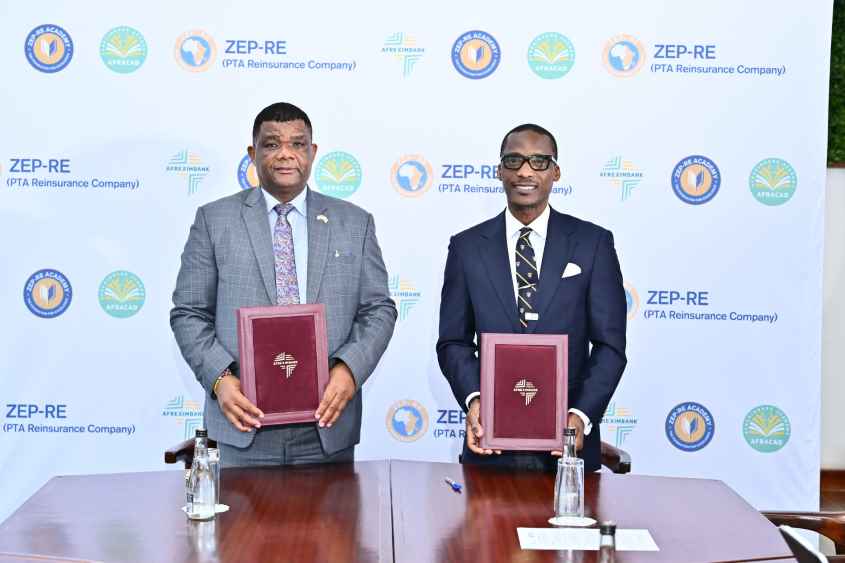
NAIROBI, Kenya, September 16, 2026/APO Group/ –African Export-Import Bank (Afreximbank) (www.Afreximbank.com) and ZEP-RE (PTA Reinsurance Company) have signed a Memorandum of Understanding (MoU) to build professional and institutional capacity in trade, insurance, reinsurance, risk management and trade facilitation across Africa.


The MOU brings together Afreximbank Academy (AFRACAD) and ZEP-RE Academy to create and scale learning, research and knowledge programmes that combine their expertise.

The agreement was signed at ZEP-RE’s offices in Nairobi by Mr. Stephen Kauma, Group Managing Director, Human Resources, Afreximbank, and Mr. Jephita Gwatipedza, Group Deputy Chief Executive Officer and Chief Operating Officer, ZEP-RE.

By combining Afreximbank’s deep expertise in African trade and trade finance with ZEP-RE’s extensive experience in insurance, reinsurance and risk management, the two institutions will develop practical learning solutions that equip professionals, institutions and market participants with the skills and knowledge to strengthen Africa’s growing trade and investment ecosystem.

Under the three-year partnership, AFRACAD and ZEP-RE Academy will work together across three (3) strategic pillars:

  1. The two institutions will co-create digital learning content, including e-learning courses, toolkits and African case studies, through a joint “content factory” approach that will identify thematic priorities and turn them into structured and reusable learning resources. These resources will be made available through AFRACAD’s digital learning platform and/or ZEP-RE Academy’s Learning Management System, expanding access to relevant learning across African markets.


Africa’s ability to expand trade and investment depends on more than financial resources and infrastructure

  1. Afreximbank and ZEP-RE will jointly design and deliver professional and executive development programmes in areas including risk and reinsurance, trade guarantees, trade facilitation, financial infrastructure and market development themes. These  may include short courses, executive masterclasses, certification programmes and other structured learning, delivered in person, virtually or through blended formats.
  2. The partnership will support research, knowledge creation and thought leadership through joint studies, webinars, policy dialogues and industry forums. These platforms will convene practitioners, regulators, development partners and private-sector leaders to exchange knowledge and develop practical responses to emerging market challenges.

Speaking at the signing ceremony, Mr. Stephen Kauma, Group Managing Director, Human Resources at Afreximbank, said:

“Africa’s ability to expand trade and investment depends on more than financial resources and infrastructure. It also depends on knowledge, skills and institutional capacity across our markets. Through AFRACAD, Afreximbank has made capacity building central to its mandate of transforming Global African trade. Our partnership with ZEP-RE brings together complementary expertise in trade finance, insurance, reinsurance and risk management. By combining these strengths, we can build practical, scalable and Global Africa-focused learning and knowledge solutions that equip professionals and institutions with the skills and knowledge to drive greater trade and investment across the continent.”

Mr. Jephita Gwatipedza, Group Deputy Chief Executive Officer and Chief Operating Officer at ZEP-RE (PTA Reinsurance Company), remarked:

“Trade cannot expand sustainably unless the institutions that finance and facilitate it can also understand, price and manage the risks involved. This partnership will connect trade finance with insurance and reinsurance expertise, helping to build stronger institutional capability across African markets. Its success will ultimately be measured not by the number of programmes delivered, but by whether professionals and institutions are better equipped to support Africa’s evolving trade and investment landscape.”

The MoU builds on the existing partnership between Afreximbank and ZEP-RE. In 2025, the two institutions launched the Trans-Africa Bond Alliance (TABA) (https://apo-opa.co/4gV3VMp) to strengthen insurance capacity, facilitate cross-border trade and support the efficient movement of goods and investment across Africa.

Since beginning operations in June 2025, TABA has supported approximately US$185 million in bonds in 2025 and US$280 million in the first quarter of 2026, with risks originating from 24 cedents across five countries. TABA supports Afreximbank’s African Collaborative Transit Guarantee Scheme (AACTGS) and the wider AfCFTA trade facilitation agenda by promoting a harmonised, technology-enabled approach to transit guarantees across African borders.

The wider African Collaborative Transit Guarantee Scheme is supported by US$1 billion in guarantee limits (https://apo-opa.co/4raTIia), including a US$300 million facility being implemented with ZEP-RE in the COMESA region. The initiative aims to reduce reliance on multiple national transit bonds, release working capital otherwise tied up as collateral and improve the efficiency and predictability of cross-border trade.

The MoU extends this collaboration into capacity building, strengthening the technical expertise and institutional knowledge needed for increasingly sophisticated trade, insurance and risk solutions across African markets.

The partnership will help build a stronger pool of African expertise capable of addressing increasingly complex issues at the intersection of trade, finance, insurance and risk, while supporting deeper regional integration and sustainable economic development across the continent.

The MoU will initially run for three (3) years and may be renewed by mutual agreement.

Distributed by APO Group on behalf of Afreximbank.


Business

Idris Elba’s Akuna Group launches free Artificial Intelligence (AI) filmmaking programme for creators in five African countries, in collaboration with Google

Published

on

Over fifty weeks, selected creators will move from a twelve-week academy into mentoring, pitching and production; Selected funded teams will make their films, which will be showcased in October 2027

Creators need a route from the classroom to the screen, and this programme carries them all the way, from their first application to a finished, funded film

FREETOWN, Sierra Leone, October 26, 2026/APO Group/ —An AI filmmaking programme for African creators opens today in Ghana, Kenya, Nigeria, Sierra Leone and South Africa. Applications are live at (https://AkunaLearning.com).

Akuna Learning, from The Akuna Group, chaired by Sir Idris Elba, today opened applications for From Script to Screen with AI, a free programme that equips eligible African creators to tell stories on screen leveraging artificial intelligence. Delivered in collaboration with Google and supported by US$1 million funding from Google.org, with curriculum developed by Curious Refuge, the programme is open to aspiring filmmakers in Ghana, Kenya, Nigeria, Sierra Leone and South Africa.


Applications are open now at (https://AkunaLearning.com) and close on 15 November 2026. The programme is free to apply and, for those selected, free to attend.

Over fifty weeks, selected creators will move from a twelve-week academy into mentoring, pitching and production. Selected funded teams will make their films, which will be showcased in October 2027. Creators will maintain control of their work, with no claim of ownership rights by the programme or partners running it.

From foundation to funded film

Every participant will complete a foundational course in AI filmmaking; then participants will be able to choose to specialise in one of five creative pathways:

  • Fiction: narrative filmmaking and scripted storytelling, from short film to series.
  • Documentary: real-world stories and factual filmmaking.
  • Animation: animated storytelling, motion design and visual world-building.
  • Advertising: branded storytelling, commercial content and creative campaigns.
  • Screenwriting: script development, dialogue and structure, writing from page to screen.

The programme is structured in five stages:

  1. Applications & Selection (October 2026 to January 2027). One open call across all five countries, closing on 15 November 2026, with review panels in each country and a final panel looking across all five.
  2. Learn & Get Certified (February to April 2027). Twelve weeks of online training with Curious Refuge, with weekly Akuna facilitation, in-person meet-ups in every country and certification at the end.
  3. Get Mentoring (April to June 2027). Graduates put forward their own one-page ideas. Shortlisted idea owners build teams, which then spend four weeks with mentors and subject experts.
  4. Pitch Your Film (June to July 2027). Mentor-endorsed teams pitch to panels drawn from Akuna, Google and the wider industry. Selected projects are funded.
  5. Produce Your Film (July to October 2027). Funded teams make their films with creative and technical support, then take them to festivals and showcases. The programme is for aspiring and emerging visual storytellers: filmmakers, screenwriters, animators, advertisers, digital content creators, photographers, designers, editors and visual artists. Applicants do not need AI experience, a film school qualification or a set number of years in the industry.


Sir Idris Elba, Chairman of The Akuna Group, said: “For me, this is about learning. This is about access to courses that help educate creators across the continent to tell their stories. Through Akuna Learning, we’re partnering with Google and Curious Refuge on ‘From Script to Screen with AI’, a remarkable training and mentorship programme teaching African filmmakers to use AI tools. Selected projects will receive production funding, and creators will retain control of their work. I’m looking forward to seeing the stories they choose, and how the education leads to employment and self-momentum, but helps shape the narrative of Africa.”

Khaled Gad, Chief Executive Officer of The Akuna Group, said: “Training on its own does not build an industry. Creators need a route from the classroom to the screen, and this programme carries them all the way, from their first application to a finished, funded film. It opens on the same day and runs to the same standard in all five countries. You do not need a film school background or any experience with AI to apply. You need finished work that shows what you can do, and your application in by 15 November.”

How to apply

Applications are submitted online at (https://AkunaLearning.com) between 26 October and 15 November 2026. Applicants must:

  • physically reside in Ghana, Kenya, Nigeria, Sierra Leone or South Africa;
  • be 18 or older on the date of application;
  • have access to a laptop, reliable internet and consistent power for the duration of the programme;
  • be able to commit fully to the twelve-week academy from February to April 2027, and to the later stages if they progress.

Applicants should include existing creative work, however modest, that shows their talent and commitment. Women are strongly encouraged to apply.

Distributed by APO Group on behalf of The Akuna Group.


Continue Reading

Business

African Energy Chamber (AEC) Applauds Afreximbank President George Elombi as Billions in Financing Drive Africa’s Industrial Growth

Published

on

African Energy Chamber

Since assuming leadership in October 2025, Dr. George Elombi has overseen major financing commitments across Africa’s energy, mining and industrial sectors

JOHANNESBURG, South Africa, October 26, 2026/APO Group/ –The African Energy Chamber (AEC) (https://EnergyChamber.org/) has commended Dr. George Elombi, President and Chairman of the Board of Directors of the African Export-Import Bank (Afreximbank), for his decisive leadership in advancing African industrialization, energy security and economic integration. Since succeeding Professor Benedict Oramah in October 2025, Dr. Elombi has overseen a series of landmark financing commitments spanning oil and gas, critical minerals, infrastructure and manufacturing, demonstrating the growing capacity of African financial institutions to mobilize capital for the continent’s development.


“I was privileged to attend the inauguration of Dr. George Elombi in October 2025 as Afreximbank President and Chairman, succeeding Professor Benedict Oramah. Since that day, I have watched a man of few words keep the promises he made not with grand speeches, but with practical action. At this crossroads in our history, Dr. Elombi understands that leadership is not about occupying the moment. It is about shaping the future,” states NJ Ayuk, Executive Chairman, AEC.

A cornerstone of Dr. Elombi’s commitment to Africa’s energy sector is the establishment of the Africa Energy Bank (AEB) alongside the African Petroleum Producers Organization. Designed to finance large-scale energy and infrastructure projects across the continent, the AEB will use a corridor approach, prioritizing projects that deliver regional economic development across four pillars: export infrastructure, domestic infrastructure, clean cooking and power. The bank is expected to become operational within weeks and begin financing projects at the start of 2027.

At this crossroads in our history, Dr. Elombi understands that leadership is not about occupying the moment

Dr. Elombi’s work is reflected in a series of milestones reached by Afreximbank in recent months as the bank moves to advance intra-African trade, mobilize capital and bring new countries into its mission. In April 2026, South Africa acceded to the Establishment Agreement of the bank, marking the entry of one of the continent’s biggest economies into the bank’s membership. With the move, Afreximbank launched major financial interventions in the country, including a $8 billion Country Program designed to deepen economic growth. According to Dr. Elombi, South Africa’s membership builds on a strong pipeline of Afreximbank-led projects in the country, exceeding $6 billion and spanning healthcare, energy, manufacturing, financial services and mining.

Beyond South Africa, Afreximbank continues to advance financing for strategic projects across a myriad of sectors. Notable transactions include a $3.8 billion agreement with Gabon to support manganese and gold trading as well as energy development and rail infrastructure; a $25 million facility for Lilium Gold to support operations at the Boungou and Wahgnion mines in Burkino Faso; and a $1.75 billion syndicated receivables-purchase facility for Angola’s national oil company Sonangol. In Nigeria, the bank announced a $2.5 billion underwriting commitment – part of a $4 billion syndicated facility – for Dangote Petroleum and Petrochemicals as well as a $750 million reserve-based lending facility for Heirs Energies, supporting indigenous African energy capacity.

The bank was also responsible for the first-recorded Southern African energy sector transaction through the Africa Trade Gateway – a one-stop digital trade ecosystem developed by Afreximbank and the African Continental Free Trade Area. The transaction features a $5.3 million cross-border gasoil trade involving Zimbabwe. One of the most significant developments

Afreximbank’s mandate transcends energy. The bank continues to mobilize capital for infrastructure that can connect African markets, supporting continent-wide industrialization and job creation. In healthcare, the African Medical Center of Excellence in Ajuba, a landmark 170-bed specialty healthcare center developed by Afreximbank, has set a new standard in healthcare in the country. The facility treats more than 5,000 patients from over 20 countries, with plans to expand to 500 beds in the near-term.

“This is more than a list of transactions; it is a practical expression of economic sovereignty, financing African businesses, moving African commodities, developing African infrastructure and keeping more value on the continent,” Ayuk said. “Dr. Elombi is running his race. He is not chasing applause; he is building momentum. He knows that Africa’s future will be secured by institutions that are bold enough to invest, disciplined enough to deliver, and confident enough to believe in Africa’s own capacity.”

Distributed by APO Group on behalf of African Energy Chamber.


Continue Reading

Energy

Libya Energy & Economic Summit (LEES) 2027 Places Infrastructure at the Center of Libya’s Energy Expansion with Dedicated Forum

Published

on

From gas processing and ports to downstream infrastructure and regional pipelines, LEES 2027 will examine the infrastructure required to support Libya’s next phase of energy growth

TRIPOLI, Libya, October 26, 2026/APO Group/ –Libya’s push to expand oil and gas production is creating a parallel requirement for investment in the infrastructure needed to process, transport and commercialize additional energy supplies. With more than $20 billion committed to the Waha concessions alone and major gas, industrial and logistics projects advancing, infrastructure integration is emerging as a key component of the country’s investment agenda.


Against this backdrop, the Libya Energy & Economic Summit (LEES) 2027, taking place January 23–25 in Tripoli, will feature a dedicated Infrastructure and Integration Forum. The forum will examine how Libya can convert its growing resource base into productive domestic infrastructure and stronger regional ties.

As Libya seeks to process more hydrocarbons domestically and capture greater value from refined products, the country’s National Oil Corporation (NOC) is pursuing refinery modernization and expanded petrochemical manufacturing. That strategy is being reinforced by upstream expansion, including a more than $20 billion, 25-year Waha development deal with TotalEnergies and ConocoPhillips targeting up to 850,000 barrels per day (bpd) of additional capacity.

Meanwhile, the National Development Agency has signed 13 agreements with Chinese companies for projects at the 1,000-hectare Magroun Industrial Zone, covering industrial chemicals, advancing manufacturing and construction materials. The Ministry of Industry’s 100-Day Plan is supporting the country’s wider development push through infrastructure and digital reforms aimed at improving industrial investment.

Gas provides another major infrastructure opportunity set to be showcased at LEES 2027. Eni’s $8 billion Structures A&E project is designed to move offshore gas to the Mellitah treatment plant, with infrastructure targeting 750 million cubic feet per day (mmscf/d) in 2027. The project follows the successful start-up of the Sabratha Compression Project in June 2026. Led by Eni in partnership with the NOC – through the Mellitah Oil & Gas joint venture – the project has an overall compression capacity of 440 mmscf/d.

On the maritime side, the $2.7 billion Misurata Port expansion is set to transform the facility into a major Mediterranean logistics hub, with planned capacity of 4 million containers annually and 8,400 direct jobs. The project also incorporates local supplier development, linking maritime expansion with efforts to build domestic supply chains.

Beyond domestic infrastructure Libya is strengthening its connections to regional neighbors. The country is advancing negotiations with Egypt for an 800-km Tobruk-Alexandria crude pipeline, estimated at $1.5 billion–$2 billion and targeting initial capacity of 150,000–250,000 bpd. The NOC is also working to maximize the 11-billion-cubic-meter annual capacity of the GreenStream pipeline, connecting coastal facilities in Libya to European markets via Sicily.

Taken together, these projects show an increasingly integrated Libyan investment agenda – connecting upstream production with downstream industry, gas infrastructure, logistics and cross-border energy markets. LEES 2027’s Infrastructure and Integration Forum will bring those investment opportunities together in one platform, highlighting the NOC and Ministry-led push to build the infrastructure required for Libya’s next phase of economic growth.

For more information about LEES 2027, please visit https://LibyaSummit.com/​.

Distributed by APO Group on behalf of Energy Capital & Power.


Continue Reading

Trending