Connect with us
Anglostratits

Business

Regional Economic Outlook 2026: Southern Africa Must Mobilise Development Finance at Scale to Close Annual $55 Billion Financing Gap

Published

on

The report reviews the region’s macroeconomic prospects, quantifies its development financing gap, and sets out reforms needed to strengthen financial systems and regional agency in a changing global economy

PRETORIA, South Africa, July 29, 2026/APO Group/ –Southern Africa must urgently mobilise development financing at scale to turn a gradual and uneven economic recovery into real gains in living standards, according to the African Development Bank’s (https://www.AfDB.org) 2026 Regional Economic Outlook for Southern Africa: Mobilising Southern Africa’s Development Financing at Scale in a Fragmented World, released on Tuesday.

The report reviews the region’s macroeconomic prospects, quantifies its development financing gap, and sets out reforms needed to strengthen financial systems and regional agency in a changing global economy.

The report projects regional growth rising from 2.1% in 2026 to 2.7% in 2027, supported by stronger household consumption and services. However, limited diversification, weak agricultural productivity, infrastructure gaps, and low domestic resource mobilization continue to constrain long-term growth and resilience, trimming gains in GDP per capita and efforts to tackle entrenched economic disparities.

A Widening Financing Gap

At the heart of the report is a stark diagnosis: Southern Africa’s development challenge is not simply a shortage of resources, but rather persistent constraints in mobilizing, intermediating, and deploying available capital effectively and at scale.

“The challenge is not simply a shortage of money. It is mobilising, intermediating, and deploying the capital that already exists, effectively and at scale, in an increasingly fragmented global economy,” said Kennedy Mbekeani, African Development Bank’s Director General for Southern Africa.

The Bank’s Chief Economist and Vice-President for Economic Governance and Knowledge Management, Kevin Urama, urged regional leaders to swiftly implement the New African Financial Architecture for Development (NAFAD), a continental initiative championed by President Dr Sidi Ould Tah and endorsed by African leaders earlier this year.

”It is only through the effective implementation of the key building blocks of the new financial architecture that the continent can weather the financial storms and increased volatilities and uncertainties that come with the ongoing fragmentation in the global financial markets,” Urama said.

Gross capital formation in the region fell to around 18.6% of GDP by 2025 — below the threshold needed for middle-income economies to achieve structural transformation. With tighter global financial conditions and declining concessional aid compounding the problem, Southern Africa is projected to face an annual financing shortfall of approximately $55 billion by 2030.

“The gap between domestic savings and investment reflects both a dependence on external funding and poor utilisation of local resources,” the report states, citing weak financial intermediation, poor project preparation, and a lack of long-term funding sources as key barriers to converting available capital into productive investment.

 Inflation Eases, but Risks Remain Elevated

It is only through the effective implementation of the key building blocks of the new financial architecture that the continent can weather the financial storms

On the macroeconomic front, the report finds inflation moderating significantly across the region — falling from 26.1% in 2024 to 12.3% in 2025, with a further decline to 8.4% projected for 2026.

Despite a cautiously positive trajectory, the report cautions that fiscal deficits, rising public debt burdens, and external imbalances continue to constrain policy space. Poverty reduction has slowed owing to income losses, inflation, and climate shocks, while persistent inequality, unemployment, and weak service delivery continue to limit welfare gains. Stringent global financial conditions could trigger capital outflows and exchange rate depreciation, adding further pressure to an already fragile recovery.

Untapped Capital

The report identifies a signifcant underutilized financing sources across the region — from diaspora remittances and institutional investors to capital markets and natural resource wealth — though their potential varies widely by country. Remittances play an outsized role in Lesotho and Zimbabwe, while Namibia and South Africa benefit from deeper capital markets and substantial pension assets, pointing to untapped scope for greater institutional investor participation.

To close the financing gap, the report recommends an integrated policy agenda: strengthening fiscal capacity and public financial management; curbing resource leakages and illicit financial flows; de-risking investment through targeted instruments and expanded blended finance; and mobilizing institutional capital — including pension funds, insurance companies, and sovereign funds — through public-private partnerships. It also calls for leveraging digital technologies to formalize economic activity, broaden the tax base, and reinforce the fiscal social contract.

The report argues that Southern Africa must move beyond bank-centric financial models to build deeper, more integrated capital markets capable of channelling long-term assets from pension and insurance funds.

South Africa in Focus

Alongside the regional outlook, the Bank unveiled its South Africa Country Focus Report (CFR) 2026, which applies the development financing theme at country level and shows that even Africa’s most developed capital market faces a significant financing challenge.

“Fragmentation in the global economy is not simply a threat to South Africa. It is also an opening,” said Hendrik Oosthuizen, in a speech on behalf of South Africa’s National Treasury. “As traditional sources of concessional finance contract and become more contested, the countries that prosper will be those that get better at mobilizing their own capital and at making themselves an attractive, well-governed destination for others’ capital.”

South Africa’s GDP growth rose to 1.1% in 2025 from 0.5% in 2024, supported by agriculture and stronger finance, real estate, and trade activity. Growth is projected at 1.2% in 2026 and 1.6% in 2027, aided by improved energy supply and Operation Vulindlela reforms (https://apo-opa.co/3U1q1U8). Electricity and water shortages, freight and port inefficiencies, and vulnerability to global risks continue to weigh on the outlook. Unemployment remains high at 31.4%, while public debt is expected to peak at 78.9% of GDP in 2025/26.

The report notes that South Africa’s October 2025 exit from the Financial Action Task Force (FATF) grey list, after successfully completing 22 anti-money laundering and counter-terrorism financing reforms, helped strengthen investor confidence and supported Moody’s Ratings’ May 2026 outlook upgrade from stable to positive. These developments also underscore that stronger governance, and institutional credibility can lower capital costs.

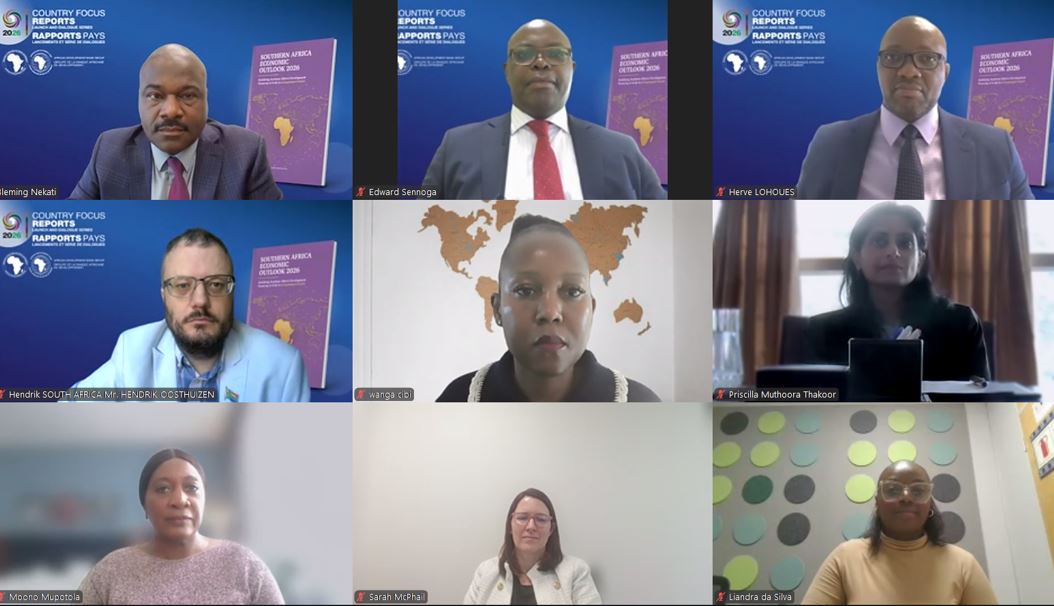
Both reports were presented by Edward Sennoga, the Bank’s Lead Economist for Southern Africa, ahead of a fireside chat, “Mobilizing development financing at scale: from Regional Trends to Country Perspectives.” moderated by Hervé Lohoues, the Bank’s Acting Director of the Country Economics Department, the discussion drew participants from South Africa’s National Treasury, the South African Reserve Bank, Nedbank, the Southern African Development Community (SADC), officials across the region, and members of the public.

Click here (https://apo-opa.co/3TLKGvr) to download the full report.

Distributed by APO Group on behalf of African Development Bank Group (AfDB).

Energy

Africa Finance Corporation (AFC) Deepens Angolan Investment Drive as Angola Oil & Gas (AOG) 2026 Elite Sponsor

Published

on

Africa Finance Corporation

With close to $1 billion invested in the country and a growing role in energy and infrastructure financing, the institution is positioning itself as a strategic financial partner for Angola

Multilateral finance institution the Africa Finance Corporation (AFC) is expanding its role in Angola’s energy and infrastructure sectors, having invested close to $1 billion across the country’s power, rail, logistics and critical minerals industries. Reflecting its growing commitment to the market, the institution has joined the Angola Oil & Gas (AOG) Conference & Exhibition as an Elite Sponsor ahead of this September’s event in Luanda.


The sponsorship comes as AFC and Angola continue to strengthen their partnership. In 2025, Angola became a sovereign shareholder in AFC through a landmark $184.8 million equity investment commitment, reinforcing the institution’s role in mobilizing capital for strategic projects across the country. Angola’s Sovereign Wealth Fund also invested $25 million in AFC, further demonstrating the country’s confidence in the pan-African infrastructure financier.

That partnership is already translating into major transactions. In July 2026, AFC reached financial close on a $753 million financing package for the Lobito Corridor Railway Project, serving as Co-Financial Adviser alongside Eaglestone. The financing includes $553 million from the U.S. International Development Finance Corporation and $200 million from the Development Bank of Southern Africa and will support the rehabilitation, upgrade and long-term operation of the 1,300-km railway linking the Port of Lobito with the Democratic Republic of Congo border.

Beyond transport infrastructure, AFC is also supporting Angola’s upstream oil and gas industry. The Corporation invested $60 million as part of a $190 million debt facility backing Angolan independent Etu Energias’ acquisition of interests in offshore Blocks 14 and 14K. The transaction enabled Etu Energias to acquire a 20% stake in Block 14 and a 10% stake in Block 14K, doubling its net production at the time from approximately 9,000 to 19,000 barrels per day.

AFC’s participation at AOG 2026 reflects its expanding footprint in Angola and creates new opportunities to engage with project developers, operators and government stakeholders. As the country’s premier oil and gas event, AOG has established itself as the leading platform for advancing investment, financing and partnerships across Angola’s hydrocarbon value chain.

Taking place on September 9-10, with a pre-conference program on September 8, AOG 2026 will bring together government officials, financiers, operators, service companies and investors to examine the opportunities shaping Angola’s energy future. As an Elite Sponsor, AFC will showcase its expertise in structuring and mobilizing capital for large-scale African infrastructure and energy projects while reinforcing its long-term commitment to Angola’s economic development.

Distributed by APO Group on behalf of Energy Capital & Power.

Continue Reading

Business

Sputnik Africa Joins African Energy Week 2026 as Media Partner

Published

on

African Energy Chamber

Sputnik Africa joins African Energy Week 2026 as a Media Partner, expanding international coverage of Africa’s energy investment opportunities and partnerships

CAPE TOWN, South Africa, July 28, 2026/APO Group/ –Sputnik Africa has joined African Energy Week (AEW) 2026 as an official Media Partner, expanding the event’s international media reach ahead of the conference taking place on October 12-16 in Cape Town. The partnership strengthens global visibility for Africa’s premier energy investment platform.

As an official Media Partner, Sputnik Africa will help amplify discussions surrounding investment opportunities, policy developments and commercial partnerships emerging from the conference. The collaboration broadens AEW’s engagement with audiences across Africa and internationally while expanding coverage of major announcements, strategic dialogues and project developments taking place throughout the event.

The 2026 program features an expanded agenda focused on investment mobilization across the energy value chain. Town Hall sessions will examine fiscal reforms and regulatory competitiveness, while the Upstream E&P Forum will address frontier exploration, gas development and regional cooperation. dedicated finance, downstream and technology tracks will further explore infrastructure investment, AI adoptions and digital transformation.

Country spotlights will showcase licensing rounds, upstream opportunities and national reform programs from African producers seeking new investment. These sessions will provide international companies and financial institutions with direct access to policymakers and project developers while highlighting commercially attractive opportunities spanning hydrocarbons, power generation, infrastructure and emerging energy technologies.

African Energy Week has always been about connecting Africa’s energy opportunities with global investors, technology leaders and strategic partners

As such, Sputnik’s participation reflects its growing presence across the continent through multilingual news coverage and regional broadcasting platforms. Publishing in English, French, Swahili and Amharic, the outlet covers diplomacy, business, infrastructure, technology and economic developments affecting African markets while expanding distribution through digital platforms, FM radio and institutional media partnerships.

In recent months, Sputnik Africa has expanded coverage of Russia-Africa economic cooperation, infrastructure investment, transport connectivity and energy collaboration. The platform has also reported extensively on discussions surrounding nuclear energy, industrial development, AI governance and broader Global South partnerships, reflecting growing international interest in Africa’s evolving economic landscape.

The organization has steadily expanded its physical footprint since establishing its first African editorial center in Addis Ababa, Ethiopia, in February 2025. The bureau serves as a production hub for English and Amharic programming while supporting locally produced reporting and strengthening the organization’s long-term presence on the continent.

Operational growth continued through the launch of FM broadcasting services in Ethiopia before expanding radio operations into additional African markets, including Burkina Faso. Sputnik Africa has also broadened institutional engagement through journalism training initiatives and educational partnerships, including collaboration with the University of Education, Winneba in Ghana under its SputnikPro program.

“African Energy Week has always been about connecting Africa’s energy opportunities with global investors, technology leaders and strategic partners. Sputnik Africa’s participation as a media partner expands the reach of those conversations, helping showcase the projects, policies and partnerships that are driving the continent’s energy future to audiences across Africa and beyond,” says NJ Ayuk, Executive Chairman, African Energy Chamber.

The partnership between Sputnik Africa and AEW 2026 reinforces the conference’s commitment to engaging a broad international media network capable of showcasing Africa’s investment story to global audiences. By expanding coverage across multiple languages and regions, the collaboration supports greater visibility for investment opportunities, policy reforms and commercial partnerships shaping Africa’s evolving energy sector.

Distributed by APO Group on behalf of African Energy Chamber.

Continue Reading

Business

Afreximbank’s largest ever bond issuance raises US$1.5 billion

Published

on

Afreximbank

The transaction attracted strong demand from international investors across the UK, Europe, Asia and the United States, with the order book peaking at US$3.8 billion

CAIRO, Egypt, July 28, 2026/APO Group/ –African Export-Import Bank (Afreximbank) (https://www.Afreximbank.com/) has successfully priced a US$1.5 billion dual-tranche Reg S/144A senior unsecured benchmark Eurobond, marking its first US dollar public bond issuance since July 2021 and its largest bond issuance to date. The bond was issued in two tranches: US$750 million with a 5.5-year tenor, maturing in January 2032, and US$750 million with a 10-year tenor, maturing in July 2036.

This successful issuance shows the confidence that investors continue to place in Afreximbank and in Africa’s growth story

The transaction attracted strong demand from international investors across the UK, Europe, Asia and the United States, with the order book peaking at US$3.8 billion. The issuance was approximately two times oversubscribed, with demand evenly split across both tranches. Supported by the robust demand, Afreximbank tightened pricing by 37.5 basis points on each tranche, resulting in final yields of 6.25% for the 5.5-year tranche and 7.125% for the 10-year tranche.

This successful return to the US dollar public bond market follows the Bank’s issuances in alternative formats and currencies in recent years, including Samurai bond issuances in 2024 and 2025 and a Panda bond issuance in 2025.Commenting on the transaction, Chandi Mwenebungu, Afreximbank’s Managing Director, Treasury and Markets, and Group Treasurer said, “This successful issuance shows the confidence that investors continue to place in Afreximbank and in Africa’s growth story. For us, this is a clear sign that the market continues to believe in Afreximbank’s work and in Africa’s economic prospects. Our role remains to connect capital to the opportunities that will drive trade, industrialisation and growth across the continent.”

HSBC Bank plc acted as the Global Co-ordinator, while Standard Bank of South Africa Limited, Standard Chartered Bank, Commerzbank Aktiengesellschaft and MUFG Securities EMEA plc, acted as Joint Lead Managers and Joint Bookrunners. This transaction marks another milestone in Afreximbank’s funding journey and underscores the bank’s continued ability to access international capital markets on competitive terms while connecting global capital to Africa’s long-term growth story.

Distributed by APO Group on behalf of Afreximbank.

Continue Reading

Trending