Connect with us
Anglostratits

Business

Africa’s Grid Constraints Come into Focus as Regional Markets Push Toward Integration
Published

on

Africa

Regional power pools are advancing and renewable pipelines are growing, but the regulatory and financial architecture needed to connect them remains the continent’s most critical infrastructure gap – an issue central to the Power Africa Today conference at AEW 2026

CAPE TOWN, South Africa, June 25, 2026/APO Group/ –Africa’s electricity demand is projected to nearly double to 2,291 TWh by 2050, requiring an estimated $30 billion in transmission and grid infrastructure investment to unlock and integrate new generation capacity. Yet across the continent, grid systems are struggling to keep pace with rapidly expanding supply pipelines and rising demand.

In Nigeria, repeated nationwide grid collapses as recently as February 2026 underscore the fragility of aging transmission infrastructure. In East Africa, tower failures along the 428 km Loiyangalani-Suswa line temporarily stranded output from Lake Turkana Wind Power – Africa’s largest wind installation. Meanwhile, demand growth pressures are accelerating across North Africa, where electricity consumption is expected to rise by around 50% by 2035, driven by urbanization, desalination projects, and climate-related temperature increases.

Despite these constraints, generation investment continues to accelerate across Africa, particularly in renewables, gas-to-power and hybrid systems. However, without equivalent investment in transmission and interconnection, much of this new capacity risks being underutilized or stranded. This growing imbalance between generation and grid capacity is driving a sharper focus on system-wide planning and regional market design – issues that will be central to the newly launched Power Africa Today conference at African Energy Week 2026. The platform will bring together policymakers, utilities, investors and developers to explore how regional interconnection, cross-border trading frameworks and financing structures can better align generation growth with grid expansion.

Power Markets Experiment with Reform

Alongside infrastructure challenges, Africa’s electricity sector is undergoing gradual – but uneven – market reform. Most countries still operate vertically integrated systems dominated by state utilities, but a growing number are introducing competitive frameworks to attract private capital and improve efficiency.

Zimbabwe opened its electricity market to full private participation across generation, transmission and distribution in 2025, targeting $9 billion in new investment. South Africa is advancing one of the continent’s most ambitious grid expansion programs, with plans for 14,500 km of new transmission lines and 133,000 MVA of transformer capacity by 2034, alongside mechanisms designed to crowd in private financing. Kenya, meanwhile, has introduced open access regulations enabling independent power producers to wheel electricity directly to multiple off-takers, reshaping how generation assets interface with the grid.

Interconnected electricity markets are the foundation of Africa’s industrial future

Regional Integration Remains Fragmented

Efforts to connect Africa’s fragmented power systems are progressing, though at different speeds across regions. In Southern Africa, the World Bank’s RETRADE SAPP program, approved in 2025, is deploying $12 million to strengthen renewable integration and transmission capacity across 12 member states. In East Africa, the Ethiopia–Kenya–Tanzania Electricity Highway is now in trial operations at up to 2,000 MW, marking a significant step toward a more interconnected regional grid.

West Africa is also moving toward deeper integration, with permanent synchronization of the West Africa Power Pool expected in 2026. Analysts, including the African Finance Corporation, argue that such synchronization is critical to unlocking large-scale hydropower potential and industrial demand across the region. Longer term, full synchronization between the Eastern and Southern African power pools – targeted for the end of 2026 – could create one of the world’s largest cross-border electricity trading corridors.

Building Bankable Financial Architectures

While interconnection is advancing, infrastructure alone is not enough to create investable electricity markets. Investors consistently cite the lack of standardized offtake structures, creditworthy counterparties, and cross-border payment guarantees as key barriers to scaling capital deployment.

New models are emerging to address these constraints. Africa GreenCo, operating across Zambia, Namibia and South Africa, is helping to aggregate independent power producers under a single creditworthy intermediary, standardizing power purchase agreements and reducing counterparty risk. At a broader level, AUDA-NEPAD estimates that Africa requires around $30 billion in additional investment to complete priority transmission corridors and establish three fully interconnected regional trading blocs by 2030.

“Interconnected electricity markets are the foundation of Africa’s industrial future,” said NJ Ayuk, Executive Chairman of the African Energy Chamber. “The question at Africa Energy Week is not whether integration is possible – the evidence is already there. The question is which regulatory frameworks and financial structures will get projects to financial close, and which markets will be ready when capital is looking to move.”

The Power Africa Today conference will run alongside AEW 2026, taking place October 12–16 in Cape Town, and will focus on the regulatory, financial and infrastructural architecture needed to build interconnected electricity markets capable of attracting institutional capital and delivering reliable, cross-border power at scale.

Distributed by APO Group on behalf of African Energy Chamber.

Business

Enlit Africa seeks contributions that move the conversation from strategy to execution: ensuring a Future Fit Africa
Published

on

Africa

Share your expertise with Africa’s power, energy and water community, connect with decision makers from across the value chain and contribute to the conversations shaping the continent’s next generation of infrastructure and investment

CAPE TOWN, South Africa, September 25, 2026/APO Group/ –Speaker submissions are open for Enlit Africa, created by VUKA Group (www.WeAreVuka.com), as it returns to the CTICC, Cape Town from 11–13 May 2027.

Do you have a project, lesson, strategy or innovation that Africa’s energy sector should hear about?


We invite utilities, project owners, developers, IPPs, commercial and industrial energy users, municipalities, policymakers, regulators, financiers, researchers and industry practitioners to submit abstracts sharing practical experience, case studies, research, projects and lessons from across Africa’s changing energy and water sectors.

What are we looking for?

We particularly encourage non-vendor speakers to submit contributions across:

  1. Enlit Africa Main Stage – From Strategy to Execution
    Policy, market reform, investment, leadership and the decisions required to turn Africa’s energy ambitions into implementation.
  2. Generation
    New capacity, generation technologies, energy security, operating performance and Africa’s evolving energy mix.
  3. Transmission & Distribution
    Grid expansion, modernisation, open access, system operation, cross-border interconnection, digitalisation and infrastructure investment.
  4. Municipal Forum:Municipal management, with an emphasis on electricity and water – with a strong emphasis on service delivery.
  5. Power Hub:Technical advancements in power generation, transmission, distribution and more. Technical presentations encouraged.
  6. Water Hub:Technical insights into water management and solutions.
  7. Water Security Hub: Strategy, finance, management and technology application for water security.
  8. Project & Investment Hub: Project developments, country roundtables, project briefings, finance, and innovative financing models (including M300).
  9. Renewable Energy & Storage:Covering both technical and strategic applications of renewables and storage.

What makes a strong submission?

We want to hear about what is happening on the ground.

Tell us about:

  • A project being implemented or developed
  • A challenge your organisation has solved – or is still trying to solve
  • Lessons from implementation
  • New research or industry findings
  • Innovative financing or commercial models
  • Technologies being deployed in real operating environments
  • Policy or regulatory changes and what they mean in practice
  • Approaches that could be replicated elsewhere in Africa

Preference will be given to submissions that provide practical insights, measurable outcomes and lessons that the wider industry can apply.

Why present at Enlit Africa?

Africa does not need another conversation about what should happen. Help us explore how we make it happen and how we ensure Africa is future fit.

Share your expertise with Africa’s power, energy and water community, connect with decision makers from across the value chain and contribute to the conversations shaping the continent’s next generation of infrastructure and investment.

Submission details

Abstract length: 300–500 words
Submission deadline: 29 January 2027
Speaker feedback: 7 December 2026 – 5 February 2027

Visit the Enlit Africa website to submit your speaker abstract: https://apo-opa.co/4d2TTq2

Distributed by APO Group on behalf of VUKA Group.


Continue Reading

Business

CEM Africa Awards 2026 set to recognise Africa’s leading Customer Experience (CX) talent and innovation
Published

on

CEM Africa Awards

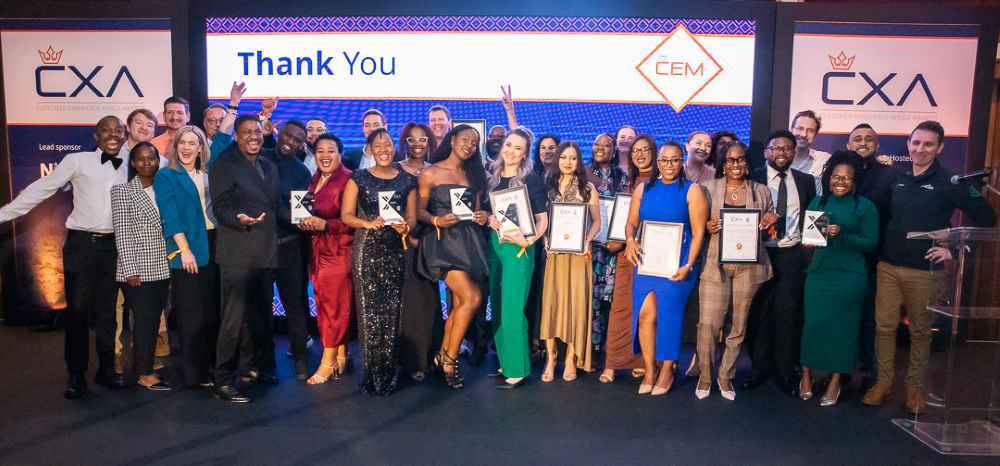
The 2025 awards attracted more than 80 entries and 31 finalists, culminating in eight award winners
The calibre of organisations and individuals recognised through the CEM Africa Awards demonstrates just how much extraordinary CX work is being done across the continent


JOHANNESBURG, South Africa, September 25, 2026/APO Group/ –Customer experience professionals, teams and organisations across Africa have just days remaining to enter the 2026 CEM Africa Awards, with free applications closing on 30 September 2026.


Taking place on 10 November 2026 at the NH Hotel in Sandton, Johannesburg, the Customer Experience Africa Awards form part of the CEM Africa platform and recognise the individuals, teams, technologies and initiatives raising the standard of customer experience across the continent.

For organisations considering whether to enter, the company they could be keeping provides a compelling indication of the calibre of the awards.

A growing roll call of African CX leaders

The 2025 awards attracted more than 80 entries and 31 finalists, culminating in eight award winners. Finalists represented organisations spanning financial services, technology, telecommunications, retail, insurance, public services and social impact.

Among them were Absa, Capitec Bank, Santam, Telesure Investment Holdings, Equity Bank, Takealot.com, NTT DATA, Frogfoot, Telviva, Harambee Youth Employment Accelerator, the University of Pretoria and South Africa’s Department of Social Development.

The 2025 winners included Serisha Iyer of Absa Corporate and Investment Banking, named Rising Star in CX; Alma Angela Olela of Jubilee Health Insurance, named CX Leader of the Year; and Franco Cotumaccio of Shadow Global, winner of Breaking Barriers in CX.

Corporate winners included Telesure Investment Holdings for Best Overall CX Solution, Krisp for Best Use of AI, Telviva for Best Enterprise Contact Centre Platform, Harambee Youth Employment Accelerator for Best Customer Experience Team of the Year and the University of Pretoria for Best Citizen Experience Initiative.

That follows a 2024 edition in which winners included NCBA Bank, MultiChoice, Digital Solutions Group, Absa Bank and Telviva, alongside individual CX leaders from across the continent.

More than a trophy

For entrants, recognition through the CEM Africa Awards puts their work in front of a wider African CX community and an independent judging panel drawn from across the industry.

The 2026 judging panel includes global CX specialist Ian Golding; Andrew (Dré) Enebeli, Head of CX & Engagement at Access Bank; Dr Oliver Museka, President and Founder of IRDM College Eswatini; Jonathan Daniels, Managing Director of CX Centric; Joven Pillay, Partner and Head of Customer Consulting at KPMG; and Qaalfa Dibeehi, Managing Partner at Human2Outcome.

This year’s awards recognise excellence across four broad pillars – People, Innovation, Transformation and Government – covering categories including CX Leader of the Year, Rising Star in CX, Breaking Barriers in CX, Best Overall CX Solution, Best Use of AI, Best Enterprise Contact Centre Platform, Best Customer Experience Team of the Year, Best Digital Transformation in Public Services and Best Citizen Experience Initiative.

“The calibre of organisations and individuals recognised through the CEM Africa Awards demonstrates just how much extraordinary CX work is being done across the continent. These awards give that work a platform. Whether it is a major transformation programme, an innovative use of technology or an individual changing how their organisation thinks about the customer, we want to make sure Africa’s best work is being seen and recognised.”

  • Briteny Price, Event Manager and CEM Africa Awards Director

Final opportunity to enter

Applications for the 2026 CEM Africa Awards are free and remain open until 30 September 2026. Finalists will be announced in October, ahead of the awards ceremony on 10 November at the NH Hotel, Sandton.

Organisations, teams and individuals working to improve customer and citizen experience across Africa are encouraged to submit their entries before the deadline.

Apply for the CEM Africa Awards 2026 by 30 September 2026

Submit your application (https://apo-opa.co/4hdcimx)

Explore the CEM Africa Awards

Visit the CEM Africa Awards website (https://apo-opa.co/4iNXzzM)

Distributed by APO Group on behalf of VUKA Group.


Continue Reading

Business

Emirates to bring the A350 to Nairobi, introducing next-generation cabin experiences
Published

on

Emirates

The introduction of the A350 also marks the first time Emirates’ highly acclaimed Premium Economy cabin will be available to customers flying to and from Kenya, complementing the airline’s enhanced Business and Economy offerings

  • From 25 October, Nairobi becomes the 32nd destination to be served by the Emirates A350
  • Latest-generation aircraft introduces Emirates’ acclaimed Premium Economy cabin to Kenya for the first time, along with enhanced Business and Economy Class cabins
  • Deployment reinforces Emirates’ continued investment in Kenya and commitment to delivering an exceptional customer experience across its Africa network


Emirates (www.Emirates.com), the world’s largest international airline, will soon serve Nairobi with its newest aircraft type, the Airbus A350 (https://apo-opa.co/47hy1nv). From 25 October 2026, the A350 will operate on EK717 and EK718, bringing Emirates’ latest-generation cabin experience to customers travelling between Dubai and Nairobi. The Emirates A350 is defined by spacious, bright cabins, enhanced technology, connectivity, and the airline’s signature hospitality across all three cabins.


The introduction of the A350 also marks the first time Emirates’ highly acclaimed Premium Economy cabin will be available to customers flying to and from Kenya, complementing the airline’s enhanced Business and Economy offerings.


Christophe Leloup, Emirates Country Manager in Kenya said, “The arrival of the A350 in Nairobi marks an exciting new chapter for Emirates in Kenya. We’re delighted to bring our latest aircraft and onboard experience to our customers in market, with more comfort, choice and thoughtful touches in every cabin. Combined with our growing flight schedule, the A350 gives customers travelling on the Dubai-Nairobi route something new to discover, while building on the experience they know and love from Emirates.”


What passengers can expect from the A350

The newest aircraft type to join Emirates’ all widebody fleet, the A350 accommodates 298 passengers in three spacious cabins – Business, Premium Economy and Economy. The bright and airy cabins have been thoughtfully designed to provide more space and comfort in every cabin, whilst cutting-edge technology and enhanced entertainment options elevate every journey.


Making its debut in Kenya, Emirates’ Premium Economy cabin offers elevated comfort, comparable to a Business Class experience on many airlines. The cabin is spacious with leather reclining seats that feature a generous pitch, adjustable headrests and more legroom. Customers can enjoy in-seat charging points, a wood-finished side cocktail table, a 13.3-inch TV screen, a generously sized pillow and blanket, complimentary amenity kits on select flights – including the Dubai-Nairobi route – and a globally exclusive sparkling wine, Chandon Vintage Brut 2017.

We’re delighted to bring our latest aircraft and onboard experience to our customers in market, with more comfort, choice and thoughtful touches in every cabin


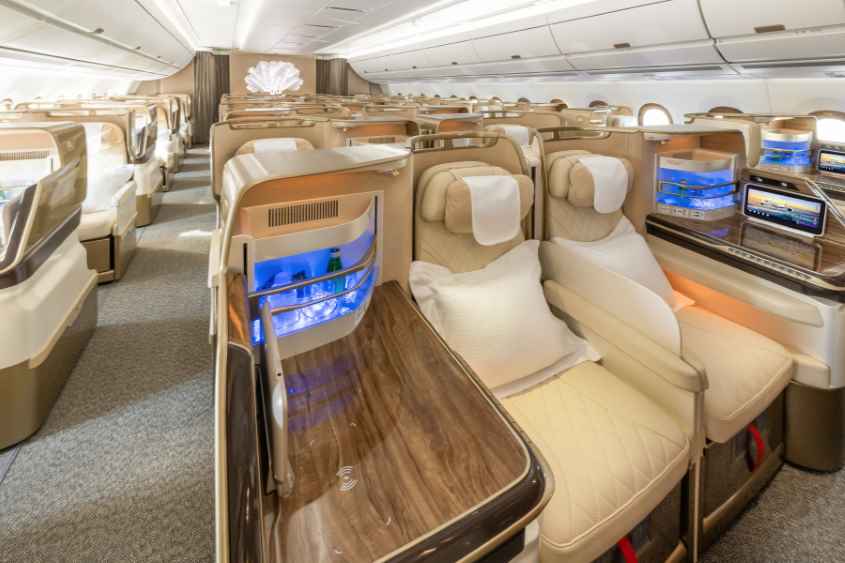
Business Class is configured in a 1-2-1 layout ensuring every passenger has direct aisle access and a spacious, private environment for both work and relaxation. The fully lie-flat seat is wrapped in soft cream leather and features a personal minibar and wireless charging for comfort and convenience. At the back of the cabin is a snack display area allowing passengers to help themselves to refreshments throughout the flight.


Economy Class features an all new, airy colour palette of sky blue, bronze and cream, complemented by lighter-toned wood finishings. Each seat features the airline’s upgraded ice inflight entertainment system on a 13.3inch 4K adjustable touchscreen, while generous seat pitch and leather headrests provide support, comfort and extra legroom.


Continuing to raise the bar in Kenya

The deployment of the A350 follows a series of enhancements to the Emirates customer proposition in Kenya, including the introduction of the third daily flight between Dubai and Nairobi in July. With 21 flights per week, customers have greater flexibility and connections between Kenya and key markets across Europe and the US, via Dubai.


Nairobi is also home to Africa’s first Emirates World (https://apo-opa.co/4yeI34C) store, which opened in 2024, offering customers a more immersive way to discover Emirates’ products, while offering more convenience and personalised service.


Earlier this year, Emirates introduced further flexibility for customers in Kenya through a partnership with Cellulant, launching a split-payment solution (https://apo-opa.co/4xLYG6R) that allows travellers to combine multiple payment methods across 24-hour instalments when purchasing airfares.

Tickets can be booked now on Emirates.com, the Emirates App, or via both online and offline travel agents as well as Emirates World Store (https://apo-opa.co/46Kglkc) in Nairobi. Emirates continues to offer flexible booking policies for added peace of mind while travelling. Every ticket booked after 10th August 2026 comes with free unlimited dates changes to Dubai and one complimentary date change to anywhere else in the world, in addition to significantly reduced refund fees across all cabins and fare types, allowing passengers to adjust their travel plans with minimal penalties.

Distributed by APO Group on behalf of The Emirates Group.


Continue Reading

Trending