Connect with us
Anglostratits

Business

Equatorial Guinea to Launch EG Ronda 2026 Licensing Round at African Energy Week (AEW) 2025 Amid Surge in Upstream Investment

Published

on

African Energy Chamber

Equatorial Guinea will launch its new EG Ronda 2026 licensing round at this year’s AEW: Invest in African Energies 2025 conference, offering new acreage, world-class fiscal terms and major investment opportunities in upstream oil and gas

CAPE TOWN, South Africa, September 3, 2025/APO Group/ –Equatorial Guinea will launch its highly anticipated EG Ronda 2026 licensing round at this year’s African Energy Week (AEW): Invest in African Energies, taking place from September 29 to October 3 in Cape Town. The licensing round takes place Monday 29 September and forms part of the country’s broader strategy to revitalize its upstream sector, attract new investment and unlock exploration and production opportunities offshore. The licensing round will be officially unveiled during a high-level session – Equatorial Guinea’s New Exploration Drive – at AEW: Invest in African Energies 2025, led by Antonio Oburu Ondo Minister of Hydrocarbons and Mining Development, Equatorial Guinea. During this session, detailed geological data will be presented, offering investors insight into the structure, stratigraphy and prospectivity of Equatorial Guinea’s offshore basins.


In preparation for EG Ronda 2026, the Ministry of Hydrocarbons and Mining Development has partnered with U.K.-based Searcher Seismic on a $60 million program to acquire and reprocess 2D and 3D seismic data across uncharted acreage. The initiative aims to provide prospective investors with high-quality datasets, de-risking exploration and highlight frontier potential across Equatorial Guinea’s offshore basins. By offering robust technical data packages, the government seeks to boost competitiveness, restore investor confidence and strengthen long-term energy security.

AEW: Invest in African Energies is the platform of choice for project operators, financiers, technology providers and government, and has emerged as the official place to sign deals in African energy. Visit www.AECWeek.com for more information about this exciting event. 

The licensing round comes at a pivotal moment for Equatorial Guinea, with a series of recent developments underscoring renewed international interest in the country’s oil and gas sector.

In June 2025, energy major ConocoPhillips transported its inaugural LNG cargo from the Punta Europa facility, advancing the country’s flagship Gas Mega Hub initiative. Following its 2024 acquisition of Marathon Oil, ConocoPhillips now holds interests in the Alba Unit and Block D, securing long-term participation in both gas and liquid development. This company is also undergoing an infill drilling campaign in Alba Block, Independent operator Trident Energy continues to deliver strong results from Block G – home to the Ceiba and Okume fields – where it holds a 40.375% operated stake. In late 2024, the company brought online its first infill well and is enhancing subsea integrity through a digital twin solution developed with Canadian technology firm Enaimco. Upstream oil company Kosmos Energy, a partner in Block G with a 40% participating interest, recently completed an exploration drilling campaign and is reprocessing seismic data with advanced technology to high-grade future opportunities. Both companies are focused on sustaining production while de-risking future development, reinforcing Equatorial Guinea’s status as a hub for upstream investment.

EG Ronda 2026 represents a major step in unlocking Equatorial Guinea’s offshore and onshore potential

Oil and gas company Panoro Energy has also expanded its footprint with the signing of a production sharing contract (PSC) for Block EG-23, in partnership with Equatorial Guinea’s national oil company (NOC) GEPetrol. The shallow-water block covers 600km2 and holds an estimated 104 million barrels of oil and condensate and 215 billion cubic feet of gas in contingent resources. Panoro Energy is initially undertaking subsurface studies before moving into exploration drilling, highlighting the untapped potential of Equatorial Guinea’s offshore acreage.

Meanwhile, hydrocarbon exploration company Vaalco Energy is advancing development of Block P, which holds the Venus discovery and over 20 million barrels of recoverable oil. With a final investment decision expected soon, the project is targeting first oil in 2026 and peak output in 2028. The entry of Vaalco Energy to Equatorial Guinea marks another milestone in the country’s drive to restore production growth.

Multinational energy corporation Chevron entered Equatorial Guinea by acquiring Noble Energy. This major recently signed two new PSCs for Blocks EG-06 and EG-11, representing a $2 billion investment with GEPetrol. Located near the Zafiro field, the blocks include deepwater acreage and a prior discovery at Avestruz-1. The agreements underscore the renewed confidence of international majors in Equatorial Guinea’s resource base and fiscal environment, as the country positions itself for a new era of exploration-led growth.

As the country’s NOC, GEPetrol is driving the transformation of Equatorial Guinea’s upstream sector through strategic partnerships, deepwater field redevelopments and targeted operational advancements. By optimizing legacy assets, accelerating exploration and implementing technical innovations, the company is aiming at boosting production, strengthening operational efficiency and reinforcing its position as a premier national operator. Equatorial Guinea’s offshore geology is characterized by deepwater and shallow-water sedimentary basins rich in hydrocarbons. The region features a mix of Tertiary and Cretaceous reservoirs, with proven structural traps and complex stratigraphic plays. Significant potential exists in both proven fields and underexplored frontier acreage, particularly in the deepwater areas, where high-quality reservoirs and source rocks create exploration targets for oil and gas development.

On the regulatory side, Equatorial Guinea is focused on being highly competitive on a global scale.  Essential regimes have just gone or are going under a revision for optimization. The oil and gas companies were very instrumental to the recent reform of the Tax Regime, as well as the reform of the Labor Regime. The reform of the Petroleum Regime is said to be active by the end of the year 2025.

“EG Ronda 2026 represents a major step in unlocking Equatorial Guinea’s offshore and onshore potential. It will attract leading investors, drive exploration and stimulate sustainable growth. We are committed to offering world-class fiscal and regulatory terms to support this development” states Minister Ondo.

“Against this backdrop of heightened activity, EG Ronda 2026 will serve as the official platform to unlock the next wave of investment and exploration success in Equatorial Guinea. The licensing round offers new acreage opportunities to explore proven and innovative plays in modest water depths, with world-class fiscal packages and increasingly attractive terms. By offering improved and competitive fiscal frameworks alongside high-quality exploration potential, EG Ronda 2026 will launch the next era of exploration success when Equatorial Guinea will become, again, a global exploration and commercial hotspot for the industry.”

Click here (https://apo-opa.co/4nb9GWi) for your exclusive invitation to EG Ronda 2026.

Distributed by APO Group on behalf of African Energy Chamber.

Energy

Niger’s Petroleum Minister Hamadou Tini Confirmed for MSGBC Conference

Published

on

Etu Energias

Hamadou Tini confirmed as speaker at MSGBC 2026, leading Niger’s petroleum delegation to Dakar

DAKAR, Senegal, November 25, 2026/APO Group/ –Niger’s Minister of Petroleum, Hamadou Tini, will be among the government representatives attending MSGBC Oil, Gas & Power 2026 in Dakar, Senegal, where he is scheduled to speak about the country’s oil and gas sector and its development plans. His participation comes as the country expands upstream production, advances frontier exploration and strengthens regional energy partnerships to establish itself as a major crude exporter.


Minister Tini will lead a delegation that includes Abdoul-Razack Hima Hassoumi, Technical Adviser to the Minister responsible for local content and strategic partnerships, and Amadou Hassane, a Petroleum Geophysics Engineer at the Ministry of Petroleum. The summit will provide a platform for the delegation to present investment opportunities across its petroleum value chain, engage international operators and mobilize capital for exploration and infrastructure.

Niger has been stepping up efforts to develop its petroleum industry, with exploration and refining among its top priorities. One of the country’s latest projects is the Kafra exploration campaign, being developed with Algerian state-owned company Sonatrach. The program, launched in August 2026,  includes a well targeting depths of around 3,900 metres, as authorities look to establish the basin’s potential. China National Petroleum Corporation has also been expanding production capacity in the Agadem Rift Basin from 20,000 barrels per day (bpd) to 90,000 bpd.

Export infrastructure remains critical to monetizing these upstream investments. The approximately 2,000-km Niger-Benin pipeline connects the Agadem fields with the Sèmè-Kpodji export terminal, providing access to international crude markets. Niger is also pursuing the Trans-Saharan Gas Pipeline with Nigeria and Algeria, creating opportunities for domestic gas utilization and regional energy trade.

Beyond production and exports, Niger faces opportunities to strengthen domestic refining and fuel distribution. The 20,000-bpd SORAZ refinery in Zinder remains central to local petroleum supply, while recent shortages have highlighted the importance of expanding processing, storage and distribution capacity alongside upstream development.

The government has also signed an agreement for a proposed $1.9-billion refinery and petrochemical complex in Dosso. With a planned processing capacity of 100,000 bpd, the project would mark a significant addition to Niger’s refining ambitions and its efforts to process more crude domestically.

These developments come as West Africa’s energy industry continues to attract attention from international investors. Senegal is already producing oil from the Sangomar field and developing the Greater Tortue Ahmeyim LNG project alongside Mauritania.

Against this backdrop, MSGBC Oil, Gas & Power 2026 will bring together government officials, energy companies, investors and industry experts from across the region. The conference and exhibition will run from December 1–3 at the Centre International de Conférences Abdou Diouf (CICAD) in Diamniadio, Dakar.

Energy Capital & Power will once again bring together the people driving West Africa’s energy industry, from government leaders and project developers to investors and energy companies. Join the conversation and find out more at www.MSGBCOilGasandPower.com.

Distributed by APO Group on behalf of Energy Capital & Power.


Continue Reading

Energy

Triple A Services, China’s Zoomlion Sign Equipment Distribution Deal During South Sudan Oil & Power (SSOP) 2026

Published

on

SSOP

The partnership positions Triple A Services & Petroleum as an authorized distributor of Zoomlion’s industrial equipment across South Sudan’s oil, gas, construction and agriculture sectors

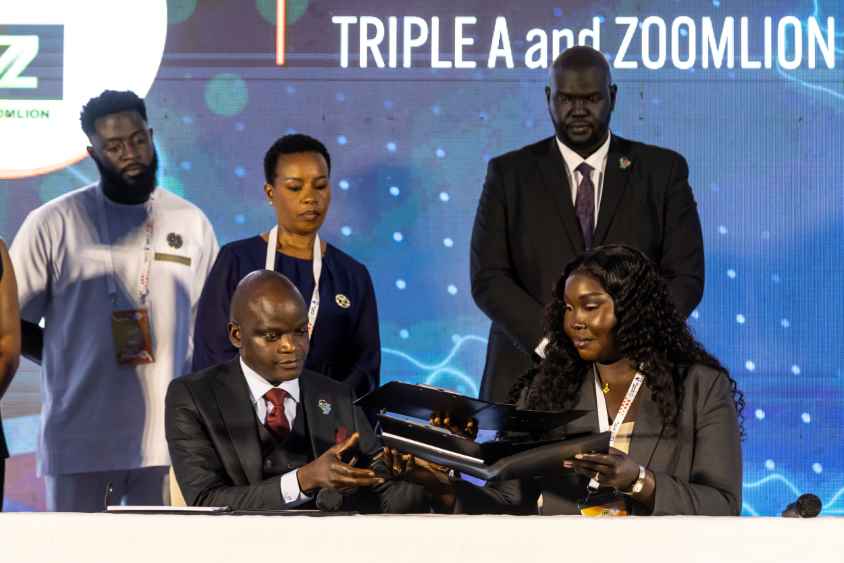
JUBA, South Sudan, November 25, 2026/APO Group/ –South Sudanese petroleum, lubricants and oilfield logistics company Triple A Services & Petroleum Ltd and Chinese manufacturing company Zoomlion Heavy Industry Science & Technology Co. have signed a partnership agreement aimed at improving access to machinery and industrial equipment in South Sudan.


Signed during the seventh edition of South Sudan Oil & Power 2026 in Juba, the deal positions Triple A Services & Petroleum as an authorized distributor of Zoomlion’s equipment, providing contractors, developers and energy sector operators with access to modern machinery, spare parts and technical support.

Today marks a landmark step for industrial growth in our region

“Today marks a landmark step for industrial growth in our region. By signing this strategic partnership with Zoomlion, one of China’s top three heavy equipment manufacturers, Triple A Services & Petroleum is proud to serve as their authorized dealer across oil, construction and agriculture,” stated Atong Amos Agook Juac, CEO, Triple A Services & Petroleum.

The agreement comes as South Sudan seeks to deploy modern equipment and technology to optimize production at mature oilfields while advancing exploration across its 14 available greenfield blocks. With the country targeting crude production of 200,000 barrels per day within the next two to three years, demand for industrial machinery, technical services and oilfield logistics is expected to grow.

Equipment covered by the deal includes earth moving machinery, hoisting and lifting solutions, concrete machinery, mining and foundation equipment, access and material handling as well as agricultural and specialized machinery.

“We are not only bringing world-class machinery, local technical training and accessible after sales support directly to our market; we are also empowering local businesses to build faster while creating new career opportunities for our engineers, mechanics, and operators,” added Juac.

Distributed by APO Group on behalf of Energy Capital & Power.


Continue Reading

Business

Amini Releases Soma, an Open Artificial Intelligence (AI) Model to Take Nations from Analogue to AI-Ready

Published

on

Built by an African company from work that began in Barbados, Soma-1X Lite outperforms frontier models on a leading public document benchmark, at ten percent of their cost

BRIDGETOWN, Barbados, November 25, 2026/APO Group/ –Amini (https://www.Amini.ai/) today released Soma-1X Lite, a compact, open-weight AI model that converts paper records into structured, machine-readable data. Small enough to run on a single GPU within a government’s sovereign infrastructure, Soma shows that countries of the Global South can build world-class AI for their own context, on their own terms. The model is available today on Hugging Face (https://apo-opa.co/4fPHTcI)


The biggest leapfrog opportunity of the AI age

Across the Global South, most knowledge remains offline. It sits on paper: cabinet papers, land registries, civil registries, geological surveys, and handwritten ledgers in languages no AI benchmark was designed to test. Because AI learns from what it can read, those countries are largely absent from the systems now shaping the global economy.

Amini sees in that gap an opportunity. Countries that have never fully digitised do not need to move from analogue to digital and then, a decade later, from digital to AI. They can go straight from analogue to AI-ready. That takes tools that handle difficult documents at national scale and run on infrastructure a country controls. Soma was designed around those requirements:

  1. Small and sovereign. Two billion parameters, running on a single GPU, so inference runs entirely within an institution’s own infrastructure and data never leaves its jurisdiction.
  2. Globally competitive. A score of 84.7 on olmOCR-Bench (https://apo-opa.co/3UWoRui), ahead of Gemini 3.8 Flash, GPT-5.5, and Claude Sonnet  5.
  3. Affordable at national scale. About 15,000 pages an hour, at an estimated $0.22 per 1,000 pages in GPU compute.
  4. ​Fluent in a diverse set of local low-resourced languages. The lowest average error rate of five open models evaluated across ten African languages, including Swahili, Yoruba, Hausa and Wolof.

“Constraint has always been our superpower,” said Kate Kallot, founder and CEO of Amini. “We did not ask how big we could build. We asked how small we could build and still stand among the best in the world.”

“This is the biggest leapfrog opportunity of the AI age, and the biggest opportunity for inclusion,” Kallot added. “Inclusion is not a seat at a table someone else built. It is our languages, our stories, our culture and our knowledge systems, read correctly and kept at home.”

Shaped by the history of Barbados

Soma’s story began in Barbados. Through R.O.A.D. (Reclaiming Our Atlantic Destiny) (https://Road.bb/), the Government of Barbados is preserving and digitising one of the world’s most extensive archives documenting the history of Atlantic slave societies: millions of pages, many handwritten, fragile and centuries old. Working on these records, alongside cabinet papers and other government archives, shaped how Soma was built. Faded ink, handwritten annotations, complex tables and damaged pages became the problems the model was trained and tested to solve.

Constraint has always been our superpower

Over the past year, Soma has processed millions of government records in private, sovereign environments. The work has since extended to Botswana, where Amini is digitizing geological maps and mineral resource records still on paper, with the Central African Republic to follow.

“These records are not simply collections of names, dates and events; they hold the traces of human lives. Some people are named, and others appear only in fragments in the official record. Making these materials searchable is important, but it is part of the deeper work of restoring memory, dignity and humanity, enabling Barbadians and the wider diaspora to find themselves in the record, reconnect families and communities, and reclaim histories thought to be long lost. Our partnership with Amini demonstrates what becomes possible when technology is designed in service of the archive, and with people first.”  Chereda Grannum, Programme Manager, ROAD

Sovereignty through cooperation

Soma is released with open weights, so any government, archive, university or developer can run it privately and build on it. It builds on open-source research, and Amini is returning its work to that community.

Its origins span regions: an African company, the archives of a Caribbean nation, the geological records of Botswana and ten African languages. Amini sees this as a model for how Global South countries can reduce dependence on a handful of frontier providers: by pooling knowledge, sharing models and solving common challenges together.

“The Global South has as much to teach AI as it has to gain from it. We chose Amini because they share that conviction. Together, we’ve turned Cabinet papers and centuries of Barbadian history into intelligence our citizens and public servants use every day. Soma-1X Lite shows we can build world-class AI on our own terms. And when we build for the Global South, we build for most of humanity.” –  Senator the Hon. Jonathan Reid, Minister of Innovation, Industry, Science and Technology of Barbados

Availability

Soma-1X Lite is available now on Hugging Face (https://apo-opa.co/3Xv7otD). Full benchmark results and methodology are published on Amini’s technical blog (https://apo-opa.co/4CCuVcm).

In Swahili, soma means “read”.

What’s next?

Amini is releasing Soma-1X Lite’s model weights, inference instructions, and evaluation code, enabling researchers and developers to reproduce its results, build upon the model, and adapt it to their own needs.

The next release will extend Soma to more underrepresented languages and scripts, historical and handwritten archives, and complex records such as maps, forms and registries. Through continued research, and real world feedback from its government  deployments, Amini aims to make document intelligence more capable, accessible, and relevant to institutions worldwide.

Distributed by APO Group on behalf of Amini.


Continue Reading

Trending