Connect with us
Anglostratits

Business

Red Sky Energy Secures 35% Stake in Block 6/24, Eyes New Deals in Angola

Published

on

Red Sky Energy

Prioritizing proven or developed assets, the Australian firm is seeking new opportunities in Angola

LUANDA, Angola, January 16, 2025/APO Group/ — 

Australian exploration and production company Red Sky Energy has made its first foray into Africa’s oil and gas market, acquiring a 35% stake in Block 6/24, offshore Angola. Speaking exclusively to Energy Capital & Power (www.EnergyCapitalPower.com), the company’s CEO Andrew Knox cited the Angola Oil & Gas (AOG) conference as pivotal to making the deal happen. Knox participated in a panel discussion during AOG 2024 and the company’s Block 6/24 acquisition underscores the impact the event plays as a platform for engaging with the industry and securing deals.  

What specific factors made Angola an attractive destination for Red Sky Energy’s first international venture? 

Red Sky Energy has been looking at certain opportunities [across the continent] for the last three years and found there are significant opportunities in Angola. The deal we signed represents our first foray into the African continent and is extremely exciting for us. Angola’s production is circa 1.1 million barrels a day and is a well-established market. We focus on proven resources or developed assets, and those with discovered resources that we can use our expertise to develop and bring to market. In Angola, we are seeing plenty of opportunity to do just this. There are a lot of smaller fields situated nearby established infrastructure.  

Currently, for our first entry, we were not looking to operate. We would like to get comfortable in the market and engage with all the players first. However, we are not married to the idea of non-operator. We will also look at operating positions in the future. There is a lot of oil in Angola, with good opportunities and a very supportive government. What the country has done in recent years – with changing their structuring, the establishment of the National Oil, Gas & Biofuels Agency and the improvement of the fiscal terms – is what has attracted us to the market.  

Please elaborate on the potential of Block 6/24, particularly the significance of the Cegonha oil discovery? 

We acquired this interest through direct negotiation with the government. Block 6/24 is located approximately 12km from Luanda and the refinery, which is very convenient for us. It also has an existing well and the Cegonha oil discovery, making it the perfect opportunity for first-entry into the country. The crude is heavy, with an API of roughly 20. However, there is production of that sort of crude in nearby fields, so it won’t be a problem for us to produce, potentially sign an offtake agreement and get the crude to the Luanda refinery.  

How do you envision the partnership with Sonangol and ACREP contributing to the development of Block 6/24?  

We have partnered with Sonangol, the national oil company, as well as ACREP. We have a 35% stake, Sonangol will operate with 50% and ACREP with 15%. Firstly, Sonangol knows the market. They are on the ground in a big way, and so for us, there are no challenges associated with bringing a foreign operator to the country for the first time. Sonangol is well established and has good connections in country. Secondly, ACREP is also a national company. They are a smaller player but quite nimble and we are impressed with their solutions in terms of the way we develop the field.  

The agreement outlines extensive geological and geophysical studies over three years and a potential drilling decision in Year 4. What key milestones does Red Sky Energy hope to achieve in this timeline? 

We are looking at studies and possibly reprocessing existing seismic data. There is approximately 3,000 km² of seismic on the license and we will look to potentially reprocess that partially and assess how to develop the field. On the way forward: do we re-enter the existing well? Will we do a sidetrack or a new appraisal well? This is what we are currently analyzing. We are not waiting three years to drill the well; this is just the timeframe for when we need to make a decision to drill. Obviously, we are looking to see if we can bring that timeframe forward.  

Beyond Block 6/24, what are Red Sky Energy’s long-term ambitions in Angola? 

We are looking at a lot of opportunities in Angola. We hope to create a major profit center for the company in the country. But we are focusing on existing discoveries or those in production – we won’t be looking outright at exploration at this point in time.   

What role did Angola Oil & Gas 2024 play in facilitating the deal?  

Angola Oil & Gas was instrumental for us in so many ways. It was our first participation at the conference and we were able to meet everyone. Everyone from the industry attends the event and it was exceptionally helpful for us. We were very pleased with the way the conference went and we learnt a lot from it. It was very well set-up and well-run conference. In 2025, we will definitely be attending again. In summary we are pleased to now be involved, we are looking at other opportunities and it is a wonderful place to do business in the oil and gas space. We will certainly be pursuing other prospects in Angola – watch this space.  

Distributed by APO Group on behalf of Energy Capital & Power.

Business

Zimbabwe’s Deputy Minister of Energy to Speak at South Sudan Oil & Power (SSOP) 2026 in Juba

Published

on

Etu Energias

The country’s entry into upstream oil and gas development creates opportunities for cooperation with South Sudan, East Africa’s sole commercial oil producer

JUBA, South Sudan, November 20, 2026/APO Group/ –Hon. Yeukai Simbanegavi, Deputy Minister of Energy and Power Development, Zimbabwe, has been confirmed as a speaker at the South Sudan Oil & Power (SSOP) conference on November 24-25 in Juba, organized by Energy Capital & Power (https://EnergyCapitalpower.com). Deputy Minister Simbanegavi will be accompanied by Phanuel Muverengwi, Acting Director of Petroleum.


Deputy Minister Simbanegavi joins ministerial representatives from Uganda, Kenya and Djibouti to discuss strategies for improving regional energy ties as East and Southern Africa take steps to strengthen cross-border infrastructure development, petroleum trade and power connections.

Her participation comes as the country advances its first major onshore gas project, opening new opportunities for Zimbabwe to draw on South Sudan’s experience in commercial petroleum production, upstream investment and infrastructure development. Led by Invictus Energy, the Cabora Bassa Project represents a significant step towards establishing Zimbabwe’s first commercial upstream industry while unlocking one of Africa’s largest and last untested frontier rift basins.

https://Invictus-Energy.com

The project is quickly advancing towards development. In November 2026, Invictus Energy commenced well services equipment mobilization for the upcoming Musuma-1 exploration well. The Exalo Rig 202 is progressing rig-up activities at the site ahead of the November drilling campaign as the company looks to add to its existing condensate discoveries at Mukuyu-1 and Mukuyu-2. Estimated to hold as much as 1.2 trillion cubic feet of gas and 73 million barrels of condensate, the project will provide a domestic source of fuel to industrial and mining projects within the country.

https://apo-opa.co/48vGVP2

While Zimbabwe’s exploration is primarily gas-focused, South Sudan’s experience offers lessons in structuring petroleum agreements, attracting international operators, developing local service industries and building infrastructure to commercialize discoveries. The country remains East Africa’s only major commercial oil producer, with approximately 3.5 billion barrels of proven reserves and an established upstream industry supported by international partners and joint operating companies. Current priorities include increasing production to 230,000 barrels per day in the near-term while attracting investment in 14 available exploration blocks.

For Zimbabwe, lessons in exploration, project design and infrastructure development could support its nascent upstream industry, while South Sudan’s established joint operating companies – including Dar Petroleum Operating Company, Sudd Petroleum Operating Company and Greater Pioneer Operating Company – provide examples of the partnerships required to move from exploration to sustained production.

Beyond upstream development, both countries are prioritizing investments in power expansion and cross-border interconnections. Zimbabwe’s ZIZABONA transmission corridor aims to strengthen connections with Zambia, Botswana and Namibia, while the proposed 2,400 MW Batoka Gorge hydropower – developed with Zambia – aims to strengthen security of supply. South Sudan is also targeting regional power development through the African Development Bank-funded South Sudan-Uganda Power Interconnection Project and expanded transmission networks with Ethiopia.

https://apo-opa.co/4AGYZS6

https://apo-opa.co/48uhrBG

These initiatives create opportunities for cooperation on cross-border infrastructure financing, transmission development and regional electricity trade, making Deputy Minister Simbanegavi‘s participation at SSOP 2026 that much more significant. Held under the theme Resource Renaissance – Energy-Fueled Growth for a New Generation, SSOP 2026 will bring together government officials, national oil companies, international investors and technology providers to advance investment across South Sudan’s oil, gas and power sectors.

For more information, visit www.SouthSudanOilPower.com. ​

Distributed by APO Group on behalf of Energy Capital & Power.


Continue Reading

Business

Storspay Registers With the Financial Transactions and Reports Analysis Centre of Canada (FINTRAC) as It Expands Business-to-Business (B2B) Cross-Border Payroll Across Africa and the Rest of the World

Published

on

FINTRAC

Canadian fintech completes money services business registration, giving businesses and their teams in Africa a verifiable, regulated way to send and receive cross-border payroll and vendor payments

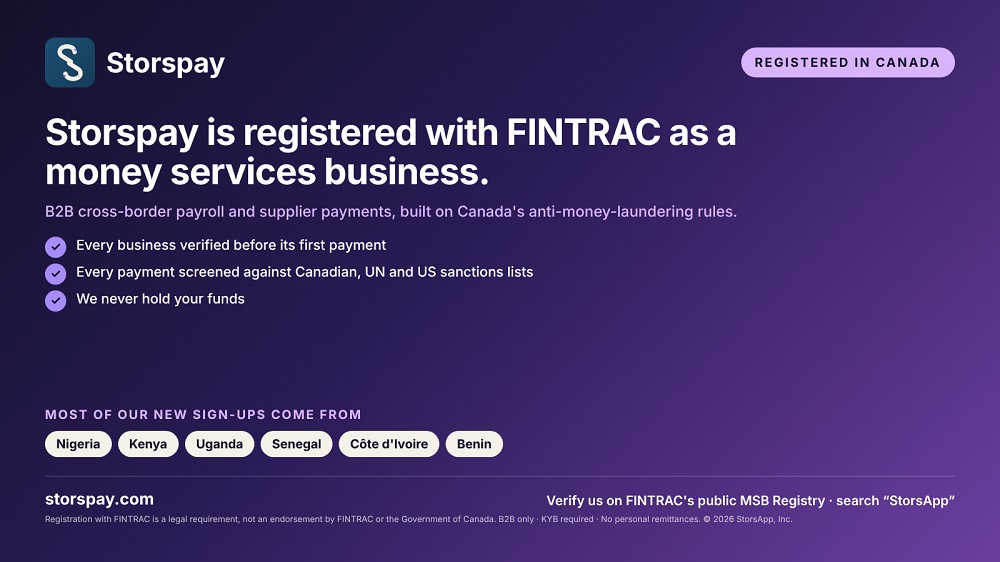
CALGARY, Canada, November 20, 2026/APO Group/ –Storspay (https://Storspay.com/), the B2B cross-border payroll and vendor payment platform operated by StorsApp Inc., today announced that it is registered with the Financial Transactions and Reports Analysis Centre of Canada (FINTRAC) as a money services business (MSB registration number N300002335). Registration details are listed on FINTRAC’s public Money Services Business Registry at https://apo-opa.co/4tcma4b.


Storspay connects businesses in North America with the employees, contractors and suppliers they pay in Africa, Asia and Latin America. Payments are delivered in local currency to bank accounts and mobile money wallets, and businesses manage every payment from a single dashboard.

For a company in Lagos, Nairobi, Dakar or Abidjan, getting paid by a client abroad should be fast, transparent and safe

The registration comes as demand on the platform grows fastest in six African markets: Nigeria, Kenya, Uganda, Senegal, Côte d’Ivoire and Benin, where most of Storspay’s new sign-ups now originate.

Every business on Storspay is verified before its first payment, and every payment is screened against Canadian, United Nations and United States sanctions lists. Storspay does not hold customer funds; payments are executed through regulated financial infrastructure partners.

“For a company in Lagos, Nairobi, Dakar or Abidjan, getting paid by a client abroad should be fast, transparent and safe,” said Dr. Adebayo Alonge, Founder and CEO of StorsApp Inc. “Registration with FINTRAC means our customers and partners can check for themselves that we operate under Canada’s anti-money-laundering rules. That trust is the foundation for everything we are building across Africa.”

Storspay serves verified businesses only and does not offer personal remittances. Businesses can learn more and sign up at https://Storspay.com/.

Distributed by APO Group on behalf of StorsApp Inc. (Storspay).


Continue Reading

Business

News Lounge Comes to Türkiye, Fostering Dialogue Across Borders

Published

on

Türkiye

ANTALYA, TURKEY – Media OutReach Newswire – 14 November 2026 – News Lounge, the flagship program of China News Service, welcomed its first group of international guests since its overseas debut in Türkiye on Tuesday on the sidelines of COP31 in Antalya.

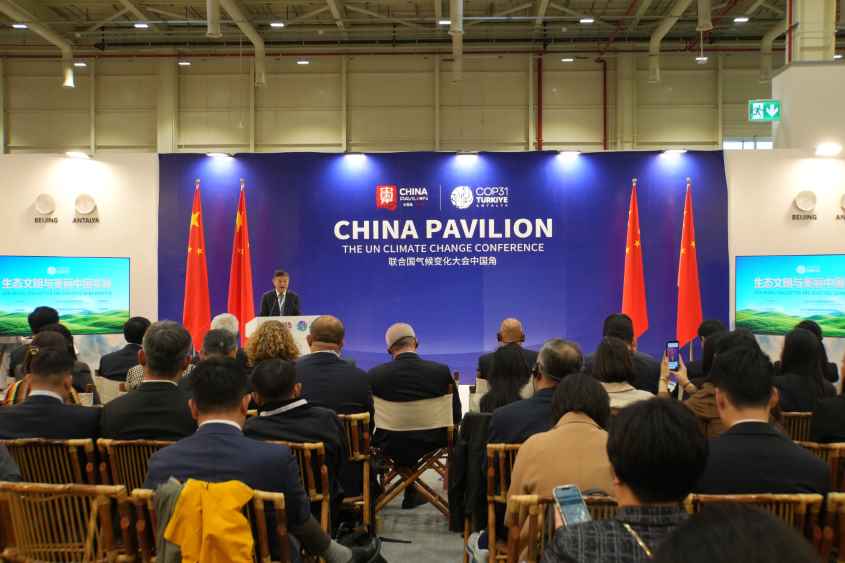
The side event Ecological Civilization and Beautiful China Practice is held at the China Pavilion on Nov.10, 2026, in Antalya, Türkiye, on the sidelines of the 31st Conference of the Parties to the UN Framework Convention on Climate Change (COP31). (Photo: Wang Qingkai, Xu Junjie)

Themed Ecological Civilization and Beautiful China Practice and held at China Pavilion, the side event was jointly hosted by the Research Center for Xi Jinping Thought on Ecological Civilization and China News Service, with the Policy Research Center for Environment and Economy of the Ministry of Ecology and Environment and China News Network serving as co-organizers.


At the event, Huang Runqiu, minister of the Ministry of Ecology and Environment of China, delivered remarks. Li Gao, head of the Chinese Delegation to COP31, vice minister of the Ministry of Ecology and Environment of China, presided over the speech session. Hu Jun, director general of Research Center for Xi Jinping Thought on Ecological Civilization and Policy Research Center for Environment and Economy of the Ministry of Ecology and Environment, and Yu Lan, deputy editor-in-chief of China News Service and president of China News Network, attended the event.

The international guests included Simon Stiell, executive secretary of the United Nations Framework Convention on Climate Change; Chris Bowen, COP31 President of Negotiations, Australian Minister for Climate Change and Energy; and Fatih Birol, executive director of the International Energy Agency.

Drawing on their professional expertise, the international guests shared perspectives on global climate governance and discussed opportunities stemming from China’s green transition.

The scene was marked by dynamic exchanges across borders and disciplines. Participants agreed that global climate governance requires multilateral cooperation, and China’s ongoing ecological and energy transition offers actionable lessons for the world.

China’s contribution to global climate governance

Simon Stiell, executive secretary of the UNFCCC, spoke highly of China’s practical green transition efforts, saying China’s energy transition achievements are “like nowhere else on Earth.”

Stiell said China has long been a firm friend of multilateralism and consistently engaged across the UN’s broader agenda, notably UN Climate Change work, giving strong impetus to the steady advancement of global climate governance.

He observed that “China’s South-South cooperation has also supported the transition to clean energy and climate resilience in many developing countries.” China’s domestic energy transition has also spurred innovation and driven lower costs across the globe.

He singled out China’s commitment to strive for enhanced outcomes beyond its updated nationally determined contribution (NDC). To him, this shows great wisdom and foresight.

Stewart Maginnis, deputy director-general of the International Union for Conservation of Nature, shared his views on China’s efforts to build an ecological civilization. From his observations, what truly impressed him about China’s ecological civilization is not merely a green agenda, but a strategic choice and a fundamental asset of coexistence.

“People can prosper without undermining the ecosystems that sustain them,” Maginnis said, adding that environmental protection and economic development need not compete in China.

Maginnis also praised China’s efforts in carrying out pioneering ecological work. China’s ecological restoration work covers not only forests, but also rivers and wetlands. It goes beyond tree planting to removing pressures that prevent ecosystems from effectively functioning, he said.

Economic opportunities in green and low-carbon development

Fatih Birol, executive director of the International Energy Agency (IEA) took notice of the trend of electrification and said it is expanding to more areas in the world. He spoke highly of China’s pioneering efforts in energy transition, noting that China has achieved remarkable progress in electric vehicles, renewable energy and battery storage, and boasts competitive industrial chains covering hydropower, solar, wind power, energy storage and clean fuels.

During his visit to China in September 2026, he held discussions with relevant Chinese authorities and visited Tsinghua University. He was deeply impressed by China’s vibrant innovation momentum.

“The world is entering the electric age,” Birol stated, adding that advancing electrification brings multiple benefits: it boosts economic growth and safeguards energy security, while helping tackle climate change and improve air quality. China’s role in clean energy is indisputable and it has shown the way for the world. He called on all countries to build consensus and jointly set targets for electrification.

Beneath the electrification wave, the scale and cost of renewable energy supply remain a key market focus.

Chris Bowen, president of negotiations for COP31, highly recognized China’s key role in the global renewable energy transition. He also agreed that accelerating the renewable energy transition and electrification is the way forward in the face of increasing living costs driven up by the energy crisis, fossil fuel reliance and rising power demand from artificial intelligence.

Citing the IEA’s Renewables 2025 report, he said global renewable energy capacity will expand by 4,600 gigawatts between 2025 and 2030, with China standing pivotal thanks to its scale and influence. Bowen stated that China’s sustained investment in renewables and efforts to bring down solar and battery costs “support its own deep decarbonization while delivering benefits across the globe.”

Laura Clarke, chief executive officer of ClientEarth said that China in recent years has witnessed a remarkable green transition, becoming a global leader in green technology. Meanwhile, she also pointed out that China’s ambitions for ecological civilization and Beautiful China also have major global implications.

“China is also showing the major economic opportunities in green and low-carbon sectors,” commended Clarke. Additionally, Clarke noticed that the country is increasing partnerships with other countries, which will help advance the global green transition.

A people-centered just transition

As green technologies gain industrial momentum, their impacts on people’s daily lives and human health also merit attention.

Barbara Vrede, global head of Social Impact and Sustainability Strategy, Novartis, said human health and planetary health are closely linked. China is a key country where Novartis translates its global sustainability ambitions into local action.

Vrede highlighted Novartis’ Sichuan Forestry Carbon Sink, Community and Biodiversity Project, launched in 2010. The project has established nearly 4,000 hectares of forest and planted approximately 21 million trees, benefiting more than 4,200 households and over 18,000 residents while generating approximately 40 million yuan in labor income for local communities. “This experience has shown us that environmental action can create ecological, social and economic value,” Vrede said.

She expressed Novartis’ willingness to deepen cooperation with partners in China on ecological restoration, biodiversity protection and sustainable community development, contributing to a healthier and more sustainable future for people and the planet.

Yamide Dagnet, senior vice president, international, at the Natural Resources Defense Council (NRDC), described COP31 as an “implementation and transition COP,” emphasizing the need to translate climate commitments into concrete action. She stressed that climate action must put people at the center, improve lives, create opportunities and bring local communities along in the green transition.

Dagnet said the concept of a just transition aligns with the essence of China’s ecological civilization. Renewable energy can not only support the energy transition but also drive economic growth and shared prosperity.

She expressed hope that China’s green transition experience could offer useful insights to other countries through South-South cooperation, South-North cooperation and international exchanges, helping turn transition challenges into opportunities for shared prosperity and sustainable development.

Centered on climate issues, the dialogue leveraged international guests’ on-the-ground observations and first-hand accounts, translating China’s ecological progress into resonant narratives for a global audience.

Leveraging this event, News Lounge extended its reach to a major multilateral platform, marking a meaningful breakthrough in its international outreach.



Continue Reading

Trending