Connect with us
Anglostratits

Energy

United States (U.S.) Pushes Energy Partnership in Caribbean, Eyes Suriname’s Growing Oil Sector

Published

on

United States

Washington called for investment-led partnerships at Caribbean Energy Week, positioning U.S. companies as a strategic alternative amid rising global competition

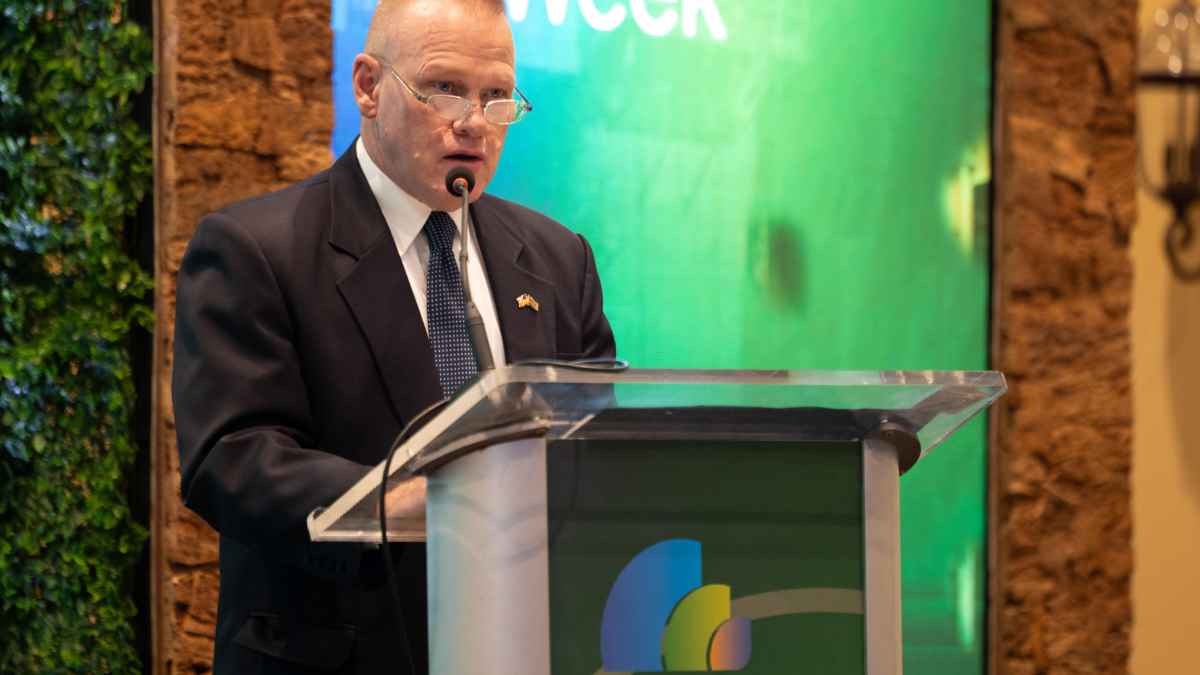
PARAMARIBO, Suriname, April 1, 2026/APO Group/ –The United States is stepping up its push for deeper energy and infrastructure partnerships in the Caribbean, with a focus on Suriname’s emerging oil and gas sector and the region’s long-term energy security, according to Paul Watzlavick, Chargé d’Affaires at the U.S. Embassy in Paramaribo.

“It’s increasingly clear that this region is an essential partner to the U.S.,” Watzlavick said. “We want partnerships that support a strong workforce, keep our people safe and respect the sovereignty of every country.”


He stressed that energy security in the Caribbean goes beyond production, highlighting the need for modern infrastructure, updated technologies and stronger systems across power generation and transmission. “We need energy systems that are up to date. The needs here are very different from Trinidad or Texas, but the goal is the same,” Watzlavick said.


Framing the region within a broader geopolitical context, Watzlavick warned against reliance on external actors offering unsustainable financing. “The Western Hemisphere is our home – we are your neighbors. We want a neighborhood that is not manipulated by outside powers that do not share these goals,” he said.


Today’s investments in Suriname and CARICOM should be focused not only on immediate needs, but on how we want this region to look 50 years from now

“We have all seen what happens when contracts for power projects or pipelines come with unsustainable debt, opaque terms or technology that cannot be operated or is manipulated from far away. Our view is simple: energy and natural resources should strengthen the countries that own them. Extraction should not be a one-way street.”


Highlighting the role of U.S. companies, Watzlavick pointed to APA Corporation’s offshore exploration success in Suriname. “[APA] took a risk pioneering offshore exploration in Suriname, and now we’ll see the first oil in two years,” he said.


He added that U.S. firms can bring broader capabilities across the value chain. “Other U.S. companies can deliver modern refineries, manage complex systems… and there’s opportunity beyond that.”


Looking ahead, Watzlavick emphasized the importance of aligning investment with long-term development goals. “Today’s investments in Suriname and CARICOM should be focused not only on immediate needs, but on how we want this region to look 50 years from now,” he said.

“If we link American and Caribbean resources, combining reliable fossil energy with modern grids and infrastructure, we can power the entire region to a brighter future.”


Distributed by APO Group on behalf of Energy Capital & Power.

Energy

African Mining Week (AMW) to Link Investors with Africa’s Coal Prospects Amid Rising Global Demand

Published

on

Energy Capital

African Mining Week 2026 – scheduled for October 14 – 16 in Cape Town – will connect global investors with opportunities across Africa’s coal value chain amid surging demand driven by ongoing disruptions to global energy shipping routes

CAPE TOWN, South Africa, April 1, 2026/APO Group/ –As disruptions to global shipping routes continue to increase energy prices – with oil prices reaching over $100 per barrel in March 2026 – the upcoming African Mining Week (AMW) conference will connect global investors with emerging supply and investment opportunities across Africa’s coal value chain.


The event will feature a panel titled Africa’s Mining Opportunity in the Geopolitical Sphere, examining how ongoing geopolitical tensions and disruptions to global shipping routes are reshaping energy markets and creating new opportunities for Africa’s coal mining sector.

Coal demand is rising as Asian economies turn to coal to stabilize power generation and mitigate volatility in oil and gas prices caused by ongoing disruptions in the Strait of Hormuz – a waterway between the Persian Gulf and the Gulf of Oman, which transports 20% of the world’s oil and gas. According to research from Morgan Stanley, coal demand in South Korea, Japan and Taiwan could increase by 1.5 – 2 million tons per month should disruptions in the Strait of Hormuz persist. This represents an 8 – 10% increase in import demand, presenting an opportunity for coal-producing regions such as Africa to expand exports, strengthen revenues and contribute to global energy security.

African producers are already positioning themselves to capitalize on this growing demand. For instance, South African mining company Exxaro Resources targets to increase coal exports by 12% in 2026 to approximately 8 million metric tons (Mt), up from 7.1 million tons in 2025. In 2025, the company reported higher coal production and sales volumes of 39.9 Mt and 39.6 Mt respectively, alongside a 2% increase in coal export volumes, highlighting its potential to contribute to the growing demand.

At the national level, efforts by South Africa to revamp its rail infrastructure will increase export capacity by an additional 6 million tons in 2026, enabling the country to capitalize on the growing coal demand for higher export revenue. Meanwhile, Mozambique’s plan to boost coal production by 15% to over 22 million tons in 2026 comes at a strategic moment, positioning the country to benefit from rising coal demand amid ongoing disruptions in the Strait of Hormuz.


Zimbabwe, having achieved a 100% increase in coal exports in the first eight months of 2025, is well positioned to leverage its production and export capacity to expand its role in the global coal supply chain. Similarly, Botswana, pursuing a strategy to diversify its mining sector beyond diamonds through expanded coal production, is strategically positioned to capitalize on the rising coal demand and oil and gas market disruptions to boost revenue.

Against this backdrop, AMW 2026 will serve as a strategic platform connecting global investors with opportunities across Africa’s coal mining value chain – from exploration and project development to infrastructure and export logistics.

Co-located with the Invest in African Energies: African Energy Week conference and exhibition – Africa’s premier gathering for energy stakeholders – the event will offer attendees a unique opportunity to engage with stakeholders across both the mining and energy sectors, fostering partnerships that support Africa’s growing role in meeting global energy demand.

Distributed by APO Group on behalf of Energy Capital & Power.

Continue Reading

Energy

Ghana Boycotts Africa Energies Summit as Industry Pushes Back Against Discrimination

Published

on

African Energy Chamber

Ghana’s decision to withdraw from the London-based Africa Energies Summit signals a growing industry stance against discrimination, exclusion and the sidelining of African stakeholders in conversations about Africa’s energy future

JOHANNESBURG, South Africa, April 3, 2026/APO Group/ –Ghana has moved to boycott the upcoming Africa Energies Summit in London this May, a decision that reflects growing frustration across the African oil and gas industry over discrimination, exclusion and the marginalization of African voices at events that claim to represent the continent’s energy future. Energy Chamber Ghana has released a statement calling on Ghanaian energy authorities to reconsider their participation in the summit, expressing deep concerns regarding discriminatory hiring practices and the continued exclusion of African professionals. The move sends a strong signal: Africa’s energy industry must be shaped with African institutions and companies at the center of the conversation.


The decision to withdraw mirrors similar actions taken by other African industry stakeholders in recent months and reflects a broader shift across the sector, where governments, national oil companies and indigenous firms are increasingly pushing back against platforms that exclude African participation. Mozambique made the decision to withdraw from the summit in March 2026, while petroleum ministers from the African Petroleum Producers Organization also moved to boycott the event. Ghana’s boycott is not simply about one event; it is about principle, representation and ensuring that African countries are treated as equal partners in discussions about their own resources.

The announcement by Energy Chamber Ghana follows careful consultation with stakeholders across the country’s petroleum, gas and broader energy ecosystem, with the Chamber calling on Ghanaian institutions, policymakers, engineers, investors and academics to take the approach – at least until corrective action is demonstrated by Frontier Energy Network, the organizers of the summit. The Chamber highlighted that “Ghana is not a spectator in Africa’s energy story,” and that, “Africa cannot be treated as a marketplace for attendance while Africans are treated as optional participants in execution.”

Africa’s energy sector cannot accept a future where conferences built on African participation exclude African professionals from meaningful roles behind the scenes

“Ghana has invested heavily in building engineers, economists, regulators and nnovators who are shaping this continent’s energy trajectory. Platforms that carry Africa’s name must reflect Africa’s people. Until we see transparency and measurable inclusion, it is both reasonable and responsible for stakeholders across our ecosystem to reconsider participation,” Joshua B. Narh LLM, MBA and Executive Chairman of the Energy Chamber Ghana said on LinkedIn.

Ghana’s decision to boycott the event comes at a critical time for the country. With goals to stabilize oil production, monetize gas and shift capital toward infrastructure that anchors long-term industrial growth, the country is promoting African-led investment and development across its market. In 2026, the country is seeing consolidation by IOCs as well as accelerated expansion by indigenous operators. Around $3.5 billion has been committed to infill drilling and reservoir management to stabilize output, while efforts are underway to unlock new frontiers in the Voltaian Basin. The Jubilee and TEN licenses have been expanded to 2040, while advancements at the Second Gas Processing Plant, the 1.2 GW Thermal Power Plant and downstream LPG are anchoring Ghana’s gas strategy. These projects showcase a market that is moving in the right direction and eager to unlock more value from its resources.

Despite this momentum, the actions of international conference producers to continue excluding African professionals’ risks undermining the very partnerships and growth the industry is trying to build. At a time when African countries are working to attract capital, build local capacity and strengthen regional energy cooperation, industry platforms should be supporting these goals – not creating barriers to participation. Energy Chamber Ghana highlighted valid concerns surrounding Frontier’s discriminatory approach to hiring Black professionals, emphasizing that Africa must not be invited to events to simply attend conversations about itself. According to the Chamber, local content must not be positioned as a conference theme, but reflected in practice by conference organizers themselves.

“Africa’s energy sector cannot accept a future where conferences built on African participation exclude African professionals from meaningful roles behind the scenes,” he noted.

Ultimately, Ghana’s call to boycott the Africa Energies Summit is about more than a single summit in London. It reflects a broader industry movement toward African-led development, African-led dialogue and African-led investment strategies. If Africa is to fully develop its oil, gas and energy resources, the continent must not only control its resources, but also its narrative, its platforms and its partnerships.

Distributed by APO Group on behalf of African Energy Chamber.

Continue Reading

Energy

Rift Over Oil and Gas Discrimination Claims Evident in Institutional Boycott of London African Energy Summit

Published

on

African Energy Chamber

The African oil industry – led by the continent’s petroleum ministers – will continue to boycott the upcoming Africa Energies Summit in London until the organizers address concerning policies around discrimination and local content

JOHANNESBURG, South Africa, March 31, 2026/APO Group/ –The industry-wide boycott of the upcoming Africa Energies Summit will continue as the conference organizers Frontier Energy Network refuse to abandon their policy of discrimination. The Mozambique oil industry alongside petroleum ministers from the African Petroleum Producers Organization have already withdrawn from the conference, citing concerns over the treatment of Black professionals and broader local content issues. With Frontier – led by Daniel Davidson – refusing to address the company’s decision to not hire Black professionals and the continued exclusion of Black voices, the African Energy Chamber (AEC) (https://EnergyChamber.org) calls on the continued boycott of the event.


“Our narrative and voices matter. Any company that wants to operate in the continent with a mindset of excluding Africans will fail. That’s why Africans are staying away from Africa Energies Summit 2026 and I am pleased that the petroleum ministers I have talked to have supported us by staying away from being part of the anti-African meeting in London,” states NJ Ayuk, Executive Chairman, AEC. “We thank the leadership of African ministers in their fight against this unjust behavior.”

Frontier’s discrimination sends an important message to the industry: now, more than ever, we have to prioritize local content and continue fighting for equality, skills development and fair practices. Several large-scale projects across the continent have already embedded local content within their developments. In the Republic of Congo, Wing Wah committed to boosting local content through the development of a training center aimed at equipping Congolese with skills to access to new jobs across the industry. Namibia’s cabinet approved an Upstream Local Content Policy to ensure that oil operations are inclusive and Africa-focused.

Any company that wants to operate in the continent with a mindset of excluding Africans will fail

The East African Crude Oil Pipeline – spearheaded by TotalEnergies and China National Offshore Oil Corporation – has taken a holistic approach to local content by prioritizing three pillars: employment and training, procurement of local goods and services and proposals for technology transfer and capacity building. Recent industry moves reflect the impact of local content in Africa, with African entrepreneurs buying IOC assets. Oando acquired operatorship of Angola’s Block KON 13. Renaissance Africa Energy Holdings acquired Shell’s Nigerian assets. These highlight a growing trend of IOC-trained entrepreneurs taking over projects.

Nowhere has local content been more visible than Africa’s emerging natural gas sector. As Equinor looks at developing the $42 billion Tanzania LNG project, the company is already integrating local content within the project dynamics. Engagement with the Petroleum Upstream Regulatory Authorities is underway to develop Local Content Plans, while efforts to prioritize local contractors, suppliers and employees are in motion. The Greater Tortue Ahemyim project in Senegal and Mauritania – operating since 2025 – also featured specific local content components. A national technician training program was established, over 300 local companies were contracted with 3,000 jobs created, while community investment and knowledge transfer formed the backbone of the project.

Mozambique is showing similar momentum. All of the country’s major LNG projects – Coral, Mozambique LNG and Rovuma LNG – are prioritizing local content. Mozambique LNG alone plans to spend $4.5 billion on services contracted by Mozambican suppliers. South Africa’s recently introduced Draft Upstream Petroleum Resources Development Regulations reinforce mandatory local participation, requiring operators to submit plans for skills development, employment equity and procurement. These moves signal a continental push towards inclusion and collaborative energy partnerships.

“Across all of these projects, the AEC has been there fighting. International oil companies such as ExxonMobil, Chevron, bp and Eni have been some of the greatest champions of local content and STEM in Africa. Imagine if, after all the work they have done, conference producers send a message that the industry has no place for someone because of their skin color?” states Ayuk, adding “Seismic companies should also do their part. They have a horrible track record of not hiring and promoting Africans. I hope they change.”

During times such as this, legacy producers such as Angola, Nigeria, the Republic of Congo and Libya must continue championing local content, setting a strong example for other countries. On the other hand, emerging and frontier markets such as Liberia, Namibia, The Gambia, Sierra Leone and more have a strategic opportunity to embed local content within their regulatory and energy systems from the start. They must avoid the mistake of starting on the wrong foot.

“We can’t stop our relentless support for the oil industry. We must be 100% pro oil and pro local content,” Ayuk concluded.

Distributed by APO Group on behalf of African Energy Chamber.

Continue Reading

Trending