Connect with us
Anglostratits

Business

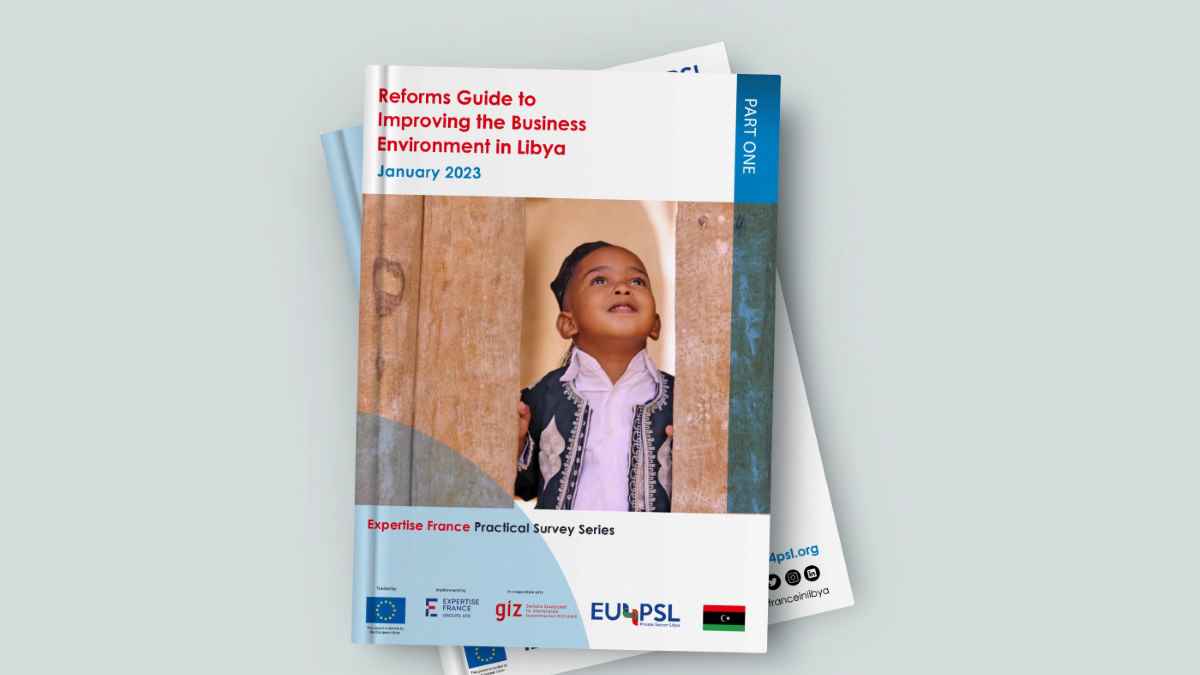
Reforms Guide Identifies Top Reform Priorities to Improve Business Environment in Libya

Published

on

Reform Guide

The “Reform Guide’s” main goal is to enable constructive public-private dialogue and provide practical proposals to accelerate the economic reform process

TRIPOLI, Libya, June 8, 2023/APO Group/ — 

More than 600 Libyan companies participated in a recent survey to identify necessary reforms for a better business environment in Libya. The result, the 2023 “Reforms Guide” (https://apo-opa.info/3P4tltg) presents 20 top-priority reforms needed to create a more business-friendly environment and support the growth of the private sector in Libya.

The World Bank’s “Ease of doing business” index (https://apo-opa.info/43NDKO5) ranks Libya at its bottom end (186th out of 190 countries). In a large-scale consultative process with Libyan entrepreneurs, chambers of commerce, government officials as well as Libyan and international economic experts, a recent survey sheds light on issues hindering Libyan enterprises’ growth potential, such as the unavailability of equipment leasing, the high legal fees of enterprise registration and registration renewal, and the lack of online credit card payments.

Based on the survey’s findings, a consortium of Libyan and international experts identified the key issues Libyan enterprises of all sizes and sectors said they face and offered concrete recommendations to facilitate a sustainable reform process. The “Reform Guide’s” main goal is to enable constructive public-private dialogue and provide practical proposals to accelerate the economic reform process by focusing on key and achievable steps that will have the maximum positive impact on the country’s economy.

This guide is considered a practical beginning to guide government reform measures and enrich the dialogue between the public and private sectors in order to improve the business environment and investment climate. The Ministry of Economy and Trade will work continuously to build an effective dialogue that enhances confidence between stakeholders from the public sector, the private sector, the finance sector, and civil society institutions”. Said Mr. Suhel Busheha, Libyan Deputy Minister of Economy and Trade for Trade Affairs.

Identifying the necessary reforms for improving the business environment in Libya is the first step towards a more diversified and resilient economy and sustainable growth

Identifying the necessary reforms for improving the business environment in Libya is the first step towards a more diversified and resilient economy and sustainable growth,” said Marton Benedek, Head of Cooperation at the EU Delegation to Libya. “Libya has an enormous potential and a vibrant start-up ecosystem. The EU aims to support the growing network of SMEs in Libya and to help job-seekers build the skills on demand in today’s job market.”

The Reforms Guide has been developed in cooperation with the German Agency for International Cooperation (GIZ) (https://apo-opa.info/43rJ89L) in the framework of the EU4PSL (http://EU4PSL.org) project, funded by the European Union and implemented by Expertise France (https://www.ExpertiseFrance.fr) to support the development of the Libyan private sector.

We’re grateful and honored to support the formalization and publication of this reforms guide, a key element to connect public and private sectors in a constructive dialogue aiming at improving the business environment in Libya.” Said Mr. Julien Schmitt, Country Representative and Programs Director at Expertise France Libya. “We will continue our engagement through the economic diversification and digitalization project “E-NABLE” (https://E-NABLE.lyto support our Libyan partners in implementing the relevant mitigation actions to provide the most suitable and sustainable solutions to the top priority reforms identified in the guide.”

In addition to being a powerful practical tool for economic development in Libya, the Reforms Guide showcases an excellent opportunity for the business community, the international community, CSOs, and Media to participate actively in the reform process and monitor the progress made with priority reforms for Libya’s economic resilience and development.

The Reforms Guide is available for download (https://apo-opa.info/3P4tltg) on the EU4PSL website (http://EU4PSL.org).

Distributed by APO Group on behalf of Expertise France.

Business

The International Islamic Trade Finance Corporation (ITFC) and the Islamic Republic of Mauritania Sign US$ 1 Billion Framework Agreement to Strengthen Trade and Economic Development

Published

on

ITFC

Under the agreement, ITFC will mobilize financing and technical support for priority sectors of the Mauritanian economy, particularly energy, banking, and private sector development

JEDDAH, Saudi Arabia, March 10, 2026/APO Group/ –The International Islamic Trade Finance Corporation (ITFC) (www.ITFC-IDB.org), a member of the Islamic Development Bank (IsDB) Group, signed a US$ 1.0 billion Five-Year Framework Agreement with the Islamic Republic of Mauritania covering the 2026–2030 period to strengthen cooperation and support the country’s economic development priorities through strategic trade finance and capacity-building initiatives.


The signing took place during the official visit of H.E. Dr. Abdallah O. Souleymane O. Cheikh-Sidia, Minister of Economic Affairs and Development and IsDB Governor, to the IsDB Group Headquarters in Jeddah. The agreement was signed at ITFC Headquarters by H.E. Dr. Abdallah O. Souleymane O. Cheikh-Sidia and Eng. Adeeb Yousuf Al Aama, Chief Executive Officer of ITFC, in the presence of H.E. Mohamed Lemine Dhehby, Governor of the Central Bank of Mauritania and IsDB Alternate Governor for Mauritania, as well as representatives from ITFC and members of the Mauritanian delegation.

The Framework Agreement reflects the strong partnership between ITFC and the Islamic Republic of Mauritania establishing a strategic framework to support the country’s socio-economic development and expand its trade capacity over the next five years.

Under the agreement, ITFC will mobilize financing and technical support for priority sectors of the Mauritanian economy, particularly energy, banking, and private sector development. The partnership will facilitate financing for the import of energy commodities, provide trade finance facilities and Confirmation Lines for Letters of Credit to local banks, and support small and medium-sized enterprises (SMEs). It will also include technical assistance programs to enhance agricultural productivity and promote trade facilitation in strategic sectors of the economy.

Speaking during the occasion, H.E. Dr. Abdallah O. Souleymane O. Cheikh-Sidia, Minister of Economic Affairs and Development of Mauritania, highlighted that the agreement will help mobilize critical financial resources to support national development priorities and foster sustainable economic growth.

Eng. Adeeb Al Aama, CEO of ITFC, noted that the agreement demonstrates ITFC’s continued commitment to supporting its member countries through trade-driven development and will help strengthen key sectors of Mauritania’s economy while expanding opportunities for trade and investment.

Since its inception in 2008, Mauritania has been a longstanding partner of ITFC, with cumulative approvals exceeding US$1.2 billion supporting key sectors of the economy and contributing to enhance the country’s trade and development capacity.

Distributed by APO Group on behalf of International Islamic Trade Finance Corporation (ITFC).

Continue Reading

Business

US Federal Court Dismisses All Claims Against Binance in Anti – Terrorism Lawsuit

Published

on

Binance

While the Court has allowed plaintiffs 60 days to file an amended complaint in light of a recent appellate decision, Binance is confident that no amended pleading will be able to cure the fundamental deficiencies the Court identified

JOHANNESBURG, South Africa, March 9, 2026/APO Group/ –Court rejects allegations that Binance (www.Binance.com) assisted, participated in, or conspired with terrorists. This represents a decisive legal dismissal of all claims


Binance, the world’s largest cryptocurrency exchange by registered users, announced today that a U.S. federal court in the Southern District of New York has dismissed all claims brought against the company under the Anti-Terrorism Act (ATA). The lawsuit involved 535 plaintiffs who alleged that Binance provided material support related to 64 terrorist attacks.

In a 62-page decision, the Court found that plaintiffs failed to establish any of their central allegations: that Binance assisted terrorists, that Binance associated itself with terrorist attacks, that Binance participated in or sought to advance those attacks, or that Binance engaged in any conspiracy with terrorist organizations.

“This dismissal is a complete vindication of all false allegations,” said Eleanor Hughes, Binance’s General Counsel. “The court has unambiguously rejected the false and damaging narrative that Binance assisted terrorists. We have always maintained that these claims were without merit, and today’s ruling confirms that. We will continue to defend ourselves aggressively against any litigation or reporting that misrepresents who we are and how we operate.”

We will continue to defend ourselves aggressively against any litigation or reporting that misrepresents who we are and how we operate

A Full and Complete Legal Victory

The Court’s decision to dismiss all claims — across every allegation, represents a decisive legal victory.

While the Court has allowed plaintiffs 60 days to file an amended complaint in light of a recent appellate decision, Binance is confident that no amended pleading will be able to cure the fundamental deficiencies the Court identified. The underlying claims have been thoroughly examined and rejected.

Commitment to Compliance and Legal Integrity

Binance has consistently invested in industry-leading compliance infrastructure, regulatory engagement, and legal governance. Today’s ruling affirms that Binance’s operations do not support, facilitate, or enable terrorism in any form.

The company will continue to engage constructively with regulators worldwide, operate within established legal frameworks, and pursue vigorous legal action where necessary to correct false and misleading narratives about its business.

Distributed by APO Group on behalf of Binance.

Continue Reading

Business

Africa’s hotel development pipeline hits record high as East Africa leads in construction momentum

Published

on

Africa

675 new African hotels and resorts in the pipeline as Africa records fastest inbound tourism growth globally

The data clearly show that Africa’s hotel development story is being driven by a handful of high-performing markets, with Egypt firmly at the forefront

CAPE TOWN, South Africa, March 10, 2026/APO Group/ –The 2026 Hotel Chain Development Pipelines in Africa report by W Hospitality Group reveals a record 123,846 rooms across 675 hotels and resorts. This represents year-on-year growth of 18.6%, or 12.2% on a same-store basis.


While the overall pipeline reflects strong continental expansion, the data show that development activity is increasingly concentrated in a small number of dominant markets. The top ten countries now account for 79% of total pipeline rooms and more than 75% of new signings, reinforcing their growing influence on Africa’s hotel development trajectory.

Egypt leads with 45,984 rooms across 185 properties – more than one third of the entire African pipeline and over four times the number in second-placed Morocco, which has 10,606 rooms. Together, Egypt and Morocco account for more than 45% of total pipeline rooms, and their share continues to grow due to the high volume of new signings. Egypt alone recorded 39 new deals last year and anticipates 33 openings in 2026, reinforcing its sustained development momentum.

As Trevor Ward, Managing Director of W Hospitality Group comments, “The data clearly show that Africa’s hotel development story is being driven by a handful of high-performing markets, with Egypt firmly at the forefront in both signings and projected openings.”

Hotel Chain Development Pipelines in Africa 2026
Top 10 countries by number of rooms

Rank

Country

Hotels

Rooms

Average Size

1 Egypt 185 45,984 249
2 Morocco 75 10,606 141
3 Nigeria 57 8,480 149
4 Kenya 35 6,190 177
5 Ethiopia 34 5,964 175
6 Cape Verde 17 4,328 255
7 Tunisia 15 4,189 279
8 Tanzania 29 4,159 143
9 South Africa 31 4,136 133
10 Ghana 26 3,942 152


Beyond overall scale, the pipeline status data reveal that execution momentum is currently strongest in East Africa. Ethiopia and Kenya both have nearly 80% of their rooms under construction, closely followed by Tanzania at 77.5%.

This compares with significantly lower proportions of projects under construction in markets such as Nigeria and Cape Verde. While North Africa dominates in overall volume, East Africa is leading in terms of projects actively progressing toward completion and near-term delivery.

As Trevor Ward comments, “What stands out this year is the strength of East Africa in terms of projects moving forward. Kenya, Ethiopia and Tanzania show some of the highest construction ratios on the continent, which suggests that this is where we are likely to see new supply coming through in the short to medium term.”

Hotel Chain Development Pipelines in Africa 2026
Top 10 countries by pipeline status

Rank

Country

Hotels

Rooms Total

Rooms Under Construction

%

1 Egypt 185 45,984 23,622 51.4%
2 Morocco 75 10,606 6,859 64.7%
3 Nigeria 57 8,480 3,328 39.2%
4 Kenya 35 6,190 4,922 79.5%
5 Ethiopia 34 5,964 4,768 79.9%
6 Cape Verde 17 4,328 374 8.6%
7 Tunisia 15 4,189 2,673 63.8%
8 Tanzania 29 4,159 3,222 77.5%
9 South Africa 31 4,136 2,778 67.2%
10 Ghana 26 3,942 2,196 55.7%


At the operator level, development activity remains highly concentrated among a small number of global brands. Marriott International leads with 31,782 rooms, followed by Hilton and Accor, with the Big Five global chains – including IHG and Radisson Hotel Group – accounting for around 80% of all pipeline hotels and rooms across Africa.

Although more than 65,000 rooms are forecast to open in 2026 and 2027, historical actualisation rates suggest delivery may fall short of projections, highlighting the ongoing gap between ambition and execution.

Hotel Chain Development Pipelines in Africa 2026
Anticipated opening years of pipeline deals

Anticipated Opening Date

Hotels

Rooms

Cumulative New Rooms

2026 183 31,768 31,768
2027 177 33,381 65,149
2028 131 25,065 90,214
2029 60 11,001 101,215
To Be Confirmed 124 22,631 123,846


A deeper analysis of these trends – including signings, construction progress and anticipated openings – will be presented at the Future Hospitality Summit Africa, taking place from 31 March to 1 April in Nairobi.

Distributed by APO Group on behalf of Future Hospitality Summit Africa (FHS Africa).


Continue Reading

Trending