Connect with us
Anglostratits

Events

Paul Chan highlights Hong Kong’s strengths before concluding his visit to the WEF Annual Meeting in Davos

Published

on

Paul Chan

HONG KONG SAR – Media OutReach Newswire – 23 January 2026 – Paul Chan, Financial Secretary of the Hong Kong Special Administrative Region (HKSAR), wrapped up his attendance at the 56th Annual Meeting of the World Economic Forum (WEF) in Davos, Switzerland yesterday (January 22). During the WEF Annual Meeting 2026, themed “A Spirit of Dialogue”, Mr Chan met with political, business and financial leaders to brief them on the latest situation in Hong Kong as well as the city’s new opportunities for partnership and investment.

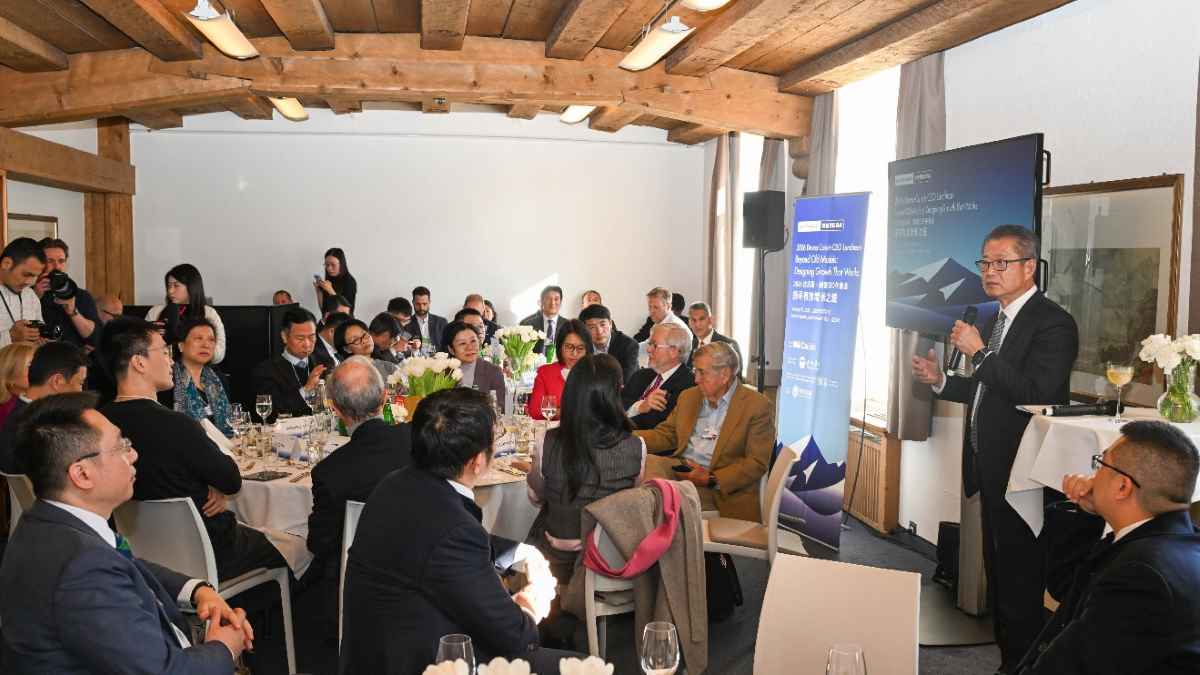
A day earlier (January 21), Mr Chan spoke at the 2026 Davos-Caixin CEO Luncheon themed “Beyond Old Models: Designing Growth That Works”. He outlined the steady progress Hong Kong has made over the past couple of years, and shared the city’s development vision and strategic positioning in its three key growth engines — finance, trade, and innovation and technology.

The Financial Secretary highlighted that breakthroughs in technologies such as artificial intelligence and blockchain are driving profound industrial transformation and economic growth. Under the “one country, two systems” policy, Hong Kong is actively exploring and piloting initiatives in financial and technological innovation. With strong collaboration among neighbouring cities in the Guangdong-Hong Kong-Macao Greater Bay Area that boast robust innovation and technology industrial chains, Hong Kong holds tremendous development potential and is a worthwhile investment destination.

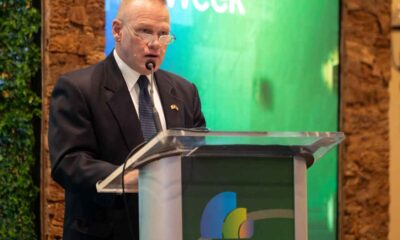
HKSAR’s Financial Secretary Paul Chan delivers keynote remarks at the 2026 Davos-Caixin CEO Luncheon in Davos, Switzerland.

Mr Chan also spoke at a dinner themed “China in Focus”, sharing his views on China’s development, international relations, as well as capital market developments in both the Chinese Mainland and Hong Kong.

During a business exchange session of the WEF Annual Meeting, Mr Chan interacted with nearly 100 leaders from various sectors and regions. The discussion covered topics such as the outlook for the United States and global economies, strategies to enhance economic resilience, and ways to promote growth.

The Financial Secretary also held bilateral meetings with the Deputy Prime Minister of Cambodia, Mr Sun Chanthol, and the Minister of State for Financial Affairs of the United Arab Emirates, Mr Mohamed bin Hadi Al Hussaini respectively. They exchanged views on the global economic and trade landscape and matters of mutual interest, and explored ways to strengthen bilateral economic and trade co-operation.

On the final full day of his visit to Switzerland (January 22), Mr Chan spoke at a WEF Annual Meeting thematic session titled “How to Finance Decarbonization?”. The event examined how public-private collaboration can continue to support the goal of achieving carbon neutrality, amid global economic slowdown, high debt levels in advanced economies and geopolitical developments.

Mr Chan (second left) speaks at a WEF Annual Meeting thematic session titled “How to Finance Decarbonization?”

Mr Chan shared Hong Kong’s strategies in striving to achieve the city’s target for carbon neutrality by 2050. These strategies include leveraging government policy to steer behavioural changes among enterprises and consumers, such as providing tax concessions for electric vehicles and incentives for green buildings. He also mentioned financial support for trials of innovative technologies, such as sustainable hydrogen-powered transport, to encourage innovation.

Hong Kong actively facilitates private capital participation in the decarbonisation process through a rich green finance ecosystem, such as green bonds and Environmental, Social and Governance (ESG) funds. The HKSAR Government also encourages financial innovation, including the issuance of tokenised green bonds to allow wider investor participation in green projects, and the securitisation of loans for infrastructure projects to release capital for reinvestment into new projects.

Mr Chan also met with leaders from political, business and international organisations, including the President and Chief Executive Officer of the WEF, Mr Børge Brende, and the First Deputy Managing Director of the International Monetary Fund, Mr Dan Katz. Moreover, Mr Chan held separate meetings with the Global Chairman of PricewaterhouseCoopers, Mr Mohamed Kande; the Chief Executive Officer of AXA Group, Mr Thomas Buberl; and the Vice President of Global Public Policy of Amazon Web Services, Mr Michael Punke, to exchange views on the current global economic and market situation, as well as technological development.

Mr Chan was among some 3,000 leaders from various sectors around the world who attended the WEF Annual Meeting 2026.

Events

As global power structures shift, Invest Africa convenes The Africa Debate 2026 to redefine partnership in a changing world

Published

on

Debate

The Africa Debate 2026 will provide a platform for this essential, era-defining discussion, convening leaders to explore how Africa and its partners can build more balanced, resilient and sustainable models of cooperation

LONDON, United Kingdom, February 5, 2026/APO Group/ –As African economies assert greater agency in a rapidly evolving global order, Invest Africa (www.InvestAfrica.com) is delighted to announce The Africa Debate 2026, its flagship investment forum, taking place at the historic Guildhall in London on 3 June 2026.

Now in its 12th year, The Africa Debate has established itself as London’s premier platform for African investment dialogue since launching in 2014, convening over 800 global decision-makers annually to shape the future of trade, finance, investment, and development across the continent.

Under the theme “Redefining Partnership: Navigating a World in Transition”, this year’s forum will focus on Africa’s response to global economic realignment with greater agency, ambition and economic sovereignty.

The Africa Debate puts Africa’s priorities at the centre of the conversation, moving beyond traditional narratives to focus on ownership, resilience and long-term value creation.

“Volatility is not new to Africa. What is changing is the opportunity to respond with greater agency and ambition,” says Invest Africa CEO Chantelé Carrington.

“This year’s edition of The Africa Debate asks how we strengthen economic sovereignty — from access to capital and investment to financial and industrial policy — so African economies can take greater ownership of their growth. Success will be defined by how effectively we turn disruption into leverage and partnership into shared value.”

The Africa Debate 2026 will provide a platform for this essential, era-defining discussion, convening leaders to explore how Africa and its partners can build more balanced, resilient and sustainable models of cooperation.

Key challenges driving the debate

Core focus areas for this year’s edition of The Africa Debate include:

This year’s edition of The Africa Debate asks how we strengthen economic sovereignty — from access to capital and investment to financial and industrial policy

Global Realignment & New Partnerships

How shifting geopolitical and economic power structures are reshaping Africa’s global partnerships, trade dynamics and investment landscape.

Financing Africa’s Future

The growing need to reform the global financial architecture, new approaches to development finance, as well as the strengthening of market access and financial resilience of African economies in a changing global system.

Strategic Value Chains

Moving beyond primary exports to build local value chains in critical minerals for the green economy. Also addressing Africa’s energy access gap and mobilising investment in renewable and transitional energy systems.

Digital Transformation & Technology

Unlocking growth in fintech, AI and digital infrastructure to drive productivity, inclusion, and the next phase of Africa’s economic transformation.

The Africa Debate 2026 offers a unique platform for high-level dialogue, deal-making, and strategic engagement. Attendees will gain actionable insights from leading policymakers, investors and business leaders shaping Africa’s economic future, while building strategic partnerships that define the continent’s next growth phase.

Registration is now open (http://apo-opa.co/46b19gj).

Distributed by APO Group on behalf of Invest Africa.

Continue Reading

Energy

Investors Look to Paris to Gauge Africa’s 2026 Energy Pipeline

Published

on

Energy Capital

Energy ministers from Senegal, Nigeria, Zambia and Djibouti are confirmed to attend the Invest in African Energy Forum in Paris, giving investors a firsthand view of which African energy markets are ready to turn policy into bankable projects

PARIS, France, February 5, 2026/APO Group/ –As global energy investment becomes more selective, capital is concentrating on African markets that combine near-term project delivery, regulatory momentum and credible financing pathways. The confirmation of energy ministers from Senegal, Nigeria, Zambia and Djibouti at the Invest in African Energy (IAE) 2026 Forum in Paris highlights markets where governments are actively engaging investors to advance priority projects.


Senegal: From Exploration to Project Delivery

In Senegal, attention has shifted from exploration success to project delivery and commercial structuring. First oil from the Sangomar field, operated by Woodside, marked the country’s entry into the producer ranks, while the Greater Tortue Ahmeyim LNG project, led by bp and Kosmos Energy, continues to anchor gas export ambitions.

Phase 2 expansion discussions remain a focal point for investors assessing long-term LNG supply potential and capital requirements. Minister of Energy, Petroleum & Mines Birame Soulèye Diop has emphasized streamlining gas sales frameworks and clarifying domestic allocation – critical for investors balancing export revenues with local power and industrial demand.

Nigeria: Scale Meets Infrastructure Momentum

Nigeria’s investment case is defined by scale and long-awaited infrastructure progress. Its vast gas reserves have historically been under-monetized, but pipeline milestones now signal tangible momentum. The 614-km Ajaokuta–Kaduna–Kano gas pipeline, a $2.8 billion project, has completed its main line and is moving toward commissioning in 2026, capable of delivering up to 2 billion cubic feet per day of gas to northern industrial and power markets.

Minister of State for Petroleum Resources (Gas) Dr. Ekperikpe Ekpo has consistently framed gas infrastructure expansion, pricing reform and domestic offtake development as central to Nigeria’s economic strategy, providing investors with clearer signals on where government support and policy continuity are strongest.

Zambia: Diversification for Energy Security

Zambia’s energy landscape is being reshaped by repeated droughts, which have exposed vulnerabilities in its hydro-dominated power system. This has accelerated the push toward diversification, creating opportunities for private investment in thermal generation, gas-fired power, renewables and regional power trade through the Southern African Power Pool.

Minister of Energy Makozo Chikote has highlighted the urgency of attracting private capital into generation and transmission infrastructure, aligning policy priorities with investor demand for bankable projects backed by credible offtake agreements and regional demand growth.

Djibouti: Infrastructure-Led, Regionally Focused

Djibouti offers a more targeted investment case. Positioned at a strategic crossroads in the Horn of Africa, its energy strategy prioritizes enabling regional power flows rather than large-scale domestic consumption. Geothermal developments, such as the Assal field, and cross-border power interconnections with Ethiopia position Djibouti as a regional transit and services hub.

Minister of Energy and Natural Resources Yonis Ali Guedi has highlighted energy security and export-oriented infrastructure as pillars of national development, appealing to investors seeking stable, long-term returns supported by multilateral finance and regional integration.

The IAE Forum returns to Paris on April 22–23, 2026, at a moment when governments and investors are increasingly focused on execution. By connecting energy ministers with banks, DFIs, project developers and institutional investors, the forum offers a practical setting to assess project readiness, financing structures and policy alignment across multiple markets. For investors navigating a more disciplined capital environment, IAE 2026 provides direct access to the decision-makers shaping near-term opportunities – bridging the gap between project ambition and capital deployment ahead of African Energy Week later in the year.

Distributed by APO Group on behalf of Energy Capital & Power.

Continue Reading

Energy

Upstream Petroleum Unit Joins Namibia International Energy Conference (NIEC) 2026 Amid Namibia’s Drive for First Oil

Published

on

Namibia’s Upstream Petroleum Unit will participate in NIEC 2026, engaging investors and stakeholders to advance upstream policy, attract investment and support the country’s first oil ambitions

WINDHOEK, Namibia, February 5, 2026/APO Group/ –Namibia’s newly established Upstream Petroleum Unit (UPU) – operating directly under the Presidency – has confirmed its participation at the 8th Namibia International Energy Conference (NIEC), taking place from April14-16, 2026, in Windhoek. As Namibia edges closer to first oil, the Petroleum Unit’s involvement signals the government’s commitment to shaping upstream policy, fostering investment and promoting partnership between regulators and industry.


The UPU, led by Kornelia Shilunga, Special Advisory and Head, and Carlo McLeod, Special Advisor and Deputy Head, is responsible for overseeing the country’s upstream petroleum sector. Established within the Presidency, the Unit develops regulatory frameworks, monitors compliance and ensures Namibia’s oil and gas policies create an enabling, investor-friendly environment. Its presence at NIEC 2026 will allow the Unit to engage directly with international and local stakeholders, highlight Namibia’s regulatory and governance priorities and discuss strategies for sustainable upstream development.

Now in its 8th edition, NIEC has established itself as Namibia’s premier energy platform. The conference convenes policymakers, investors, regulators, service providers, financial institutions, innovators and civil society, providing a forum to discuss developments across oil, gas, renewables, nuclear and power generation. For the UPU, NIEC 2026 offers a unique venue to present the government’s upstream priorities in the context of Namibia’s broader energy transition, including first oil production targeted for 2029.

The active participation of the Upstream Petroleum Unit at NIEC 2026 underscores the country’s commitment to creating a transparent, investment-ready upstream sector

Namibia’s upstream sector is currently experiencing significant momentum. TotalEnergies is preparing a final investment decision for its Venus project in 2026, while new discoveries by Rhino Resources and Galp Energia are attracting investor interest. New players have either entered the market or consolidated their portfolios in recent years. Oregen Energy increased its ownership in WestOil Limited, granting the company a 33.95% indirect interest in Block 2712A; Eco (Atlantic) secured the PEL 97, 98, 99 and 100 licenses; while Stamper Oil & Gas Corp acquired BISP Exploration Inc., gaining access to five oil and gas blocks in the Orange, Walvis and Lüderitz basins.

At the same time, Namibia is investing in renewables, green hydrogen, nuclear and grid expansion, demonstrating a holistic approach to energy security and diversification. The UPU’s participation ensures that upstream petroleum development remains aligned with these wider national objectives.

Over the years, NIEC has evolved from a platform for dialogue into a strategic hub for investment and partnership. With over 2,500 delegates expected from more than 45 countries, 400 speakers and participation from more than 1,500 companies, the conference provides the UPU with a high-profile stage to engage key stakeholders. The conference also emphasizes in-country value creation, local skills development and youth engagement through initiatives such as the Future Energy Leaders Program and internship opportunities.

“Namibia is at a pivotal moment in its energy journey,” says Selma Shimutwikeni, Founder and CEO of RichAfrica Consultancy. “The active participation of the Upstream Petroleum Unit at NIEC 2026 underscores the country’s commitment to creating a transparent, investment-ready upstream sector. This engagement will not only attract global investors but also ensure that Namibia’s first oil ambitions are achieved responsibly, sustainably and with maximum in-country value.”

By participating in NIEC 2026, the UPU reinforces the government’s focus on building a strong, well-regulated upstream sector capable of supporting Namibia’s first oil ambitions while attracting sustainable investment. The Unit’s active engagement at the conference will play a key role in ensuring that Namibia’s upstream petroleum sector grows responsibly, transparently and in alignment with the country’s energy transition goals.

The African Energy Chamber serves as the strategic partner of NIEC 2026, working alongside government and industry to advance investment, local content and responsible energy development in Namibia.

Distributed by APO Group on behalf of African Energy Chamber.

Continue Reading

Trending