Connect with us

Energy

Oil & Gas Arbitration in Africa Moves Up the Investor Agenda at African Energy Week (AEW) 2026

Published

on

African Energy Chamber

A dedicated Upstream E&P Forum panel will examine how resource nationalism, ESG requirements and geopolitical disruption are reshaping dispute resolution across Africa’s oil and gas sector

CAPE TOWN, South Africa, September 2, 2026/APO Group/ –As African governments seek greater state participation, higher local content and a larger share of resource revenues, the terms governing oil and gas investments are changing across the continent. Since 2014, 31 African countries have reformed their mining and petroleum codes, creating new commercial and regulatory considerations for international investors. The resulting environment is placing greater emphasis on how upstream agreements anticipate regulatory change, protect investments and resolve disputes when commercial assumptions shift.


African Energy Week (AEW) 2026, taking place October 12–16 in Cape Town, will bring this issue into focus through a dedicated session at the Upstream E&P Forum: Resource Nationalism, ESG and Investor Protection: The New Frontier of Oil and Gas Arbitration in Africa. Sponsored by Africa-focused legal and advisory firm CLG, the panel will bring together operators, investors, legal practitioners and government representatives to examine how commercial agreements can be structured to manage disputes before they escalate.

Nigeria provides a clear example of how the legal architecture around upstream investment is evolving. The Petroleum Industry Act, enacted in 2021, overhauled the country’s petroleum fiscal and regulatory framework, changing the terms governing production-sharing contracts, joint ventures and other upstream arrangements. Nigeria has also strengthened its dispute-resolution framework through the Arbitration and Mediation Act of 2023, while the Nigerian Upstream Petroleum Regulatory Commission has promoted an Alternative Dispute Resolution Center designed to provide a sector-specific mechanism for resolving upstream disputes.

You cannot do a deal in Africa today without thinking seriously about how you would resolve a dispute if the terms change

Senegal illustrates another dimension of the challenge. Following first oil at the Sangomar field in 2024 and a rapid production ramp-up, the government established a commission to review existing oil and gas contracts with operators including Woodside and bp. While governments retain the sovereign right to review their resource agreements, such processes can alter the commercial assumptions underpinning investments and raise questions around stabilization provisions, production-sharing terms and other contractual protections.

Across parts of West Africa, political transitions, security disruptions and changes to mining and petroleum legislation are adding further uncertainty for investors. At the same time, geopolitical shocks and shifting global energy policies are testing agreements that were negotiated under very different market conditions. For companies committing billions of dollars to long-life upstream projects, the ability to anticipate and manage those changes has become an increasingly important component of investment decisions.

Arbitration remains a central tool. A review by Nigerian law firm OAL found that by 2025, most cross-border oil, gas and power agreements in Africa expressly identified arbitration as the preferred dispute-resolution mechanism. At AEW 2026, the Upstream E&P Forum panel will examine why arbitration continues to dominate cross-border energy contracts and how bilateral investment treaties, domestic legislation, ESG obligations and changing regulatory requirements interact when disputes arise.

“You cannot do a deal in Africa today without thinking seriously about how you would resolve a dispute if the terms change. We’re increasingly seeing arbitration planning as part of the commercial conversation from the start, and rightly so,” said NJ Ayuk, Executive Chairman of the African Energy Chamber. “That commercial focus is central to AEW 2026, which brings governments, investors, operators and legal experts together to address the practical conditions required to unlock the continent’s next wave of energy investment.

The Resource Nationalism, ESG and Investor Protection session will examine the intersection of contractual protections, regulatory change, political risk and the technical complexities of energy projects, giving investors and governments a practical forum to consider how stronger dispute-resolution frameworks can support Africa’s next generation of oil and gas investment.

Distributed by APO Group on behalf of African Energy Chamber.


Energy

Venezuela Energy Week (VEW) 2027 Deal Room Targets Joint Ventures, Service Agreements and Offtake Partnerships

Published

on

Register as a commercial partner at Venezuela Energy Week 2027 to connect with Venezuelan operators, projects and strategic energy opportunities

International operators, oilfield service companies and strategic partners are invited to register as commercial partners for the Venezuela Energy Week (VEW) 2027 Deal Room, where companies can pursue joint ventures, service agreements, technology deployments, offtake arrangements and other commercial opportunities.


Taking place February 22–25 at the Simón Bolívar Convention Center in Caracas, the Deal Room will bring international companies into direct discussions with local operators, project developers, asset owners and regional leadership. As international companies re-engage with Venezuela’s oil and gas industry, the platform aims to facilitate project-level discussions and establish commercial relationships spanning upstream development, infrastructure, technology and energy supply.

For international operators and investors, the Deal Room provides an opportunity to identify assets and local counterparties for joint development. Venezuela’s push to increase oil production to 1.3 million barrels per day (bpd) in 2026 and 1.5 million bpd in 2027 is creating potential openings for companies with the technical expertise, operational capacity and financial resources to participate in field rehabilitation, enhanced oil recovery, drilling and production expansion. Partnerships with Venezuelan operators can provide a route to developing assets and sharing project responsibilities.

Recent agreements demonstrate how partnerships have already begun to take shape. In September, Chevron secured expanded development rights in the Orinoco Belt, underpinning plans by its Venezuelan joint ventures to invest more than $7 billion over five years. Eni also signed a 25-year contract with PDVSA to assume operatorship of the Junín 5 heavy-oil field, giving the company responsibility for its technical, financial and commercial development.

Oilfield service companies and technology providers can pursue commercial agreements supporting these activities. Demand spans drilling and workover equipment, artificial lift, engineering, digital production systems, reservoir technologies, power solutions and other services required to restore production and improve the performance of existing infrastructure.

Commercial partnerships are advancing this area. In September, Halliburton signed separate agreements with Eneva and WESCA covering development opportunities, field evaluation and technical planning, while SLB signed a framework agreement with PDVSA in June spanning field development, digital technologies and workforce training.

The commercial opportunity extends beyond upstream operations. Companies can explore technology and service partnerships supporting gas processing and transportation, refinery rehabilitation, power generation, grid infrastructure and energy logistics, creating multiple routes for international suppliers and specialist firms to establish a presence in the market and for Venezuelan companies seeking to strengthen their portfolios.

Recent agreements reflect growing momentum in these areas. In September, GE Vernova signed a strategic alliance with PDVSA to rehabilitate electrical infrastructure serving Venezuela’s oil industry. More recently, Baker Hughes partnered with PDVSA, Venezuelan engineering company Lindsayca and Fulcrum LNG to pursue gas processing, transportation and commercialization projects.

Offtake and supply agreements offer another route for strategic participation. Companies can negotiate arrangements linked to specific oil, gas or refined-product assets, while international trading and downstream partners can explore supply relationships connected to Venezuela’s expanding production and processing capacity. Trading companies Vitol and Trafigura have already secured agreements to purchase and market Venezuelan oil, while international refiners are increasingly pursuing direct supply relationships with PDVSA.

The Deal Room will also provide direct access to the institutions shaping project development and commercial activity, including the Ministry of Hydrocarbons, PDVSA and its operating leadership. These relationships can help companies identify counterparties, clarify project requirements and develop commercial frameworks around specific opportunities.

As international activity accelerates across Venezuela’s energy sector, the Deal Room offers companies a focused setting to identify partners and convert market interest into concrete commercial relationships.

International operators, service companies and strategic partners can register to engage as commercial partners at the Venezuela Energy Week 2027 Deal Room. To engage as a commercial partner email info@venezuelaenergyweek.com or visit https://apo-opa.co/4z16kLV for more information.

Distributed by APO Group on behalf of Energy Capital & Power.


Continue Reading

Business

Côte d’Ivoire’s Poro Power Solar Plant Earns International Awards for Pioneering Africa Finance Corporation-Led Project

Published

on

The facility is expected to become Côte d’Ivoire’s largest solar plant when operational in 2027

LONDON, October 23, 2026/APO Group/ –Côte d’Ivoire’s Poro Power solar project has received international recognition for a pioneering investment structure led by Africa Finance Corporation (AFC) (www.AfricaFC.org/), demonstrating how African capital can be mobilised to develop essential infrastructure and accelerate the transition to cleaner energy. The facility is expected to become Côte d’Ivoire’s largest solar plant when operational in 2027.


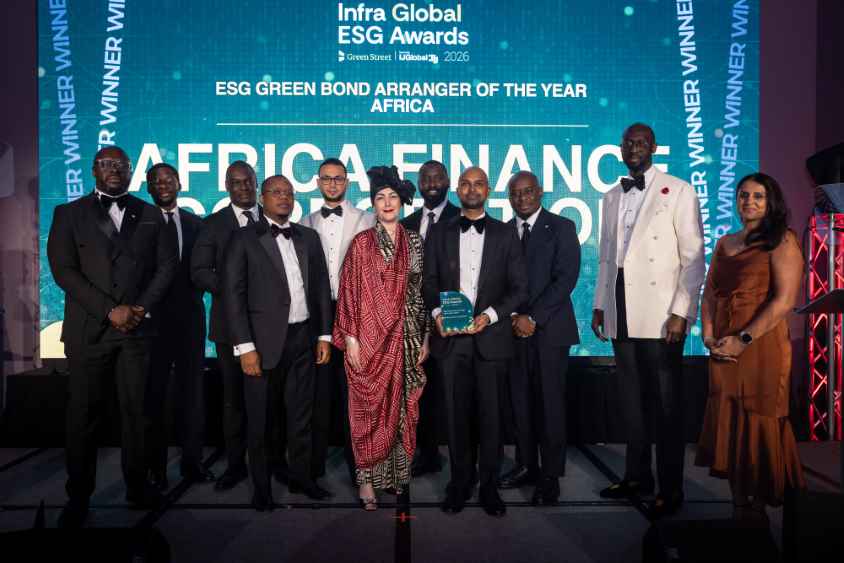
The project won ESG Green Bond Deal of the Year for Africa at the recent Infra Global ESG Awards 2026 in London, while AFC received ESG Green Bond Arranger of the Year for Africa. The double honours recognise the innovation behind the Poro Power transaction and AFC’s role in structuring and mobilising investment for sustainable infrastructure.

Developed by Ivorian entrepreneurs, the 66-megawatt solar plant is under construction in northern Côte d’Ivoire near the city of Korhogo. It is projected to generate approximately 136 gigawatt-hours (GWh) of electricity annually, meeting the needs of more than 100,000 households and benefiting an estimated half a million people.

Beyond providing homes, public services and businesses with reliable power, the project will help Côte d’Ivoire towards meeting its target of increasing renewable energy’s share of electricity generation to 45% by 2030. The Government of Côte d’Ivoire is enabling projects such as Poro Power through its initiative to encourage local private-sector participation in large-scale renewable energy projects, led by the Ministry of Mines, Petroleum and Energy under Minister Mamadou Sangafowa-Coulibaly.

“These awards are a tremendous recognition for an Ivorian project developed to meet the needs of our own communities,” said Jean-Marc Aie, Chairman and CEO of Poro Power 1 S.A. “Our ambition is not simply to generate clean electricity, but to support businesses, create opportunities and contribute to the development of Côte d’Ivoire. The Ministry’s strategy to empower local private developers to undertake large-scale renewable energy projects, together with AFC’s investment and innovative financing structure, has been instrumental in bringing Poro Power to this stage.”

Poro Power demonstrates that African financial institutions have both the capital and the expertise to finance large-scale renewable energy infrastructure through our own markets

The €65 million financing package, equivalent to approximately FCFA 42.6 billion, was raised through a green bond — an investment instrument that enables institutions to lend money to projects delivering environmental benefits. It was the first project-finance green bond in both Côte d’Ivoire and the West African Economic and Monetary Union (WAEMU), establishing a precedent for French-speaking West Africa, and was led, structured and fully funded by African institutions. The transaction allowed investors to participate in both euros and CFA francs, making it also Côte d’Ivoire’s first dual-currency green bond. Together, these features demonstrate how African financial institutions can mobilise their own capital for major infrastructure projects, using financing structures suited to African markets.

AFC invested €43 million (approximately FCFA 28.2 billion) in February 2026 and acted as anchor investor, lead underwriter and co-arranger. The equivalent of a further €22 million was raised from African investors, including local and regional banks, pension funds, insurance companies and high-net worth investors.

The bond has a 15-year term, a fixed interest rate of 8.75%, and quarterly repayments following a two-year construction grace period. The financing combines the flexibility of a bond with safeguards normally used in project finance, including first-ranking security, dedicated revenue accounts and contractual protections that separate the project’s cash flows from other activities. These measures help protect investors and align repayments with the plant’s expected revenues.

By bringing together AFC’s investment alongside capital from other African institutions through a structure that accommodates both local and international currencies, the transaction offers a potential model for financing further renewable energy and infrastructure projects across the region. Its significance extends beyond Poro Power, providing a practical example of African money financing African projects and a structure that could be replicated across the continent.

“Poro Power demonstrates that African financial institutions have both the capital and the expertise to finance large-scale renewable energy infrastructure through our own markets,” said Sameh Shenouda, Executive Board Member and Chief Investment Officer of AFC. “By combining the protections required for long-term project finance with the flexibility of capital markets, we have created a structure that can attract a broader range of African investors. This is an important model for mobilising the investment needed to expand reliable electricity supply, support industry and accelerate the energy transition across the region.”

Once operational, the plant is projected to avoid approximately 72,000 tonnes of carbon dioxide emissions annually — equivalent to taking around 15,600 petrol-powered cars off the road for a year.

The project includes a commitment to allocate €0.01 for every megawatt-hour of electricity generated towards to initiatives intended to benefit local communities.


Distributed by APO Group on behalf of Africa Finance Corporation (AFC).


Continue Reading

Business

Algeria Energy Minister Brings Regional Power Expertise to MSGBC 2026

Published

on

Minister Mourad Adjal joins Algeria’s Hydrocarbon Minister Mohamed Arkab at the Dakar conference, bringing new perspectives on power and renewable energy development

DAKAR, Senegal, October 22, 2026/APO Group/ –Algeria’s Minister of Energy and Renewable Energies Mourad Adjal will participate as a speaker at MSGBC Oil, Gas & Power 2026, bringing senior government expertise on gas, power infrastructure, renewable energy and regional energy integration to the event’s investment and policy discussions. Minister Adjal joins Algeria’s Hydrocarbons Minister Mohamed Arkab at the event, taking place December 1–3 in Dakar.


His participation comes as Algeria advances major renewable energy and hydrogen programs while strengthening its position as a regional energy partner. The country is implementing a 15,000 MW renewable energy program through 2035, with a first phase comprising 3,200 MW of solar capacity currently underway. The program offers relevant experience for MSGBC countries seeking to expand generation capacity while integrating larger shares of renewable power into their energy systems.

Hydrogen is also becoming a major component of Algeria’s energy strategy. The country is participating in the SoutH2 Corridor, which aims to establish infrastructure linking North African hydrogen production with European markets, while the Algeria-Europe Alliance for Hydrogen is progressing toward the publication of its feasibility study results in 2027.

These developments have direct relevance to the MSGBC region, where Mauritania and Senegal are positioning themselves for large-scale green hydrogen development alongside expanding oil and gas production. The combination of new generation capacity, transmission infrastructure and export-oriented energy projects is creating growing demand for integrated regional energy systems.

Minister Adjal also brings extensive experience from Algeria’s electricity and gas sector at a time when MSGBC countries are developing gas-to-power infrastructure and cross-border energy connections. Senegal is advancing domestic gas utilisation and new power capacity, while Mauritania is combining LNG development with emerging hydrogen projects and wider plans for energy-intensive industrial development.

Before becoming minister in September 2025, Adjal served as Chairman and CEO of Sonelgaz, Algeria’s state-owned electricity and gas utility, from December 2021. He previously led the Electricity and Gas Distribution Company and held senior regional roles including President of the Mediterranean Transmission System Operators Association and Chairman of the Maghreb Electricity Committee.

His participation adds senior North African perspective to an MSGBC market increasingly focused on converting resource discoveries into producing assets, reliable power and integrated infrastructure. As Senegal, Mauritania and neighbouring markets develop gas, electricity and renewable projects, Adjal’s experience across utility-scale energy systems will contribute to discussions on building the infrastructure required for the region’s next phase of growth.

MSGBC Oil, Gas & Power will convene international operators, service companies and investors in Dakar to explore opportunities across the region’s energy sector. To secure a delegate pass or learn more, visit www.MSGBCOilGasandPower.com or email sales@energycapitalpower.com.

Distributed by APO Group on behalf of Energy Capital & Power.


Continue Reading

Trending

Exit mobile version