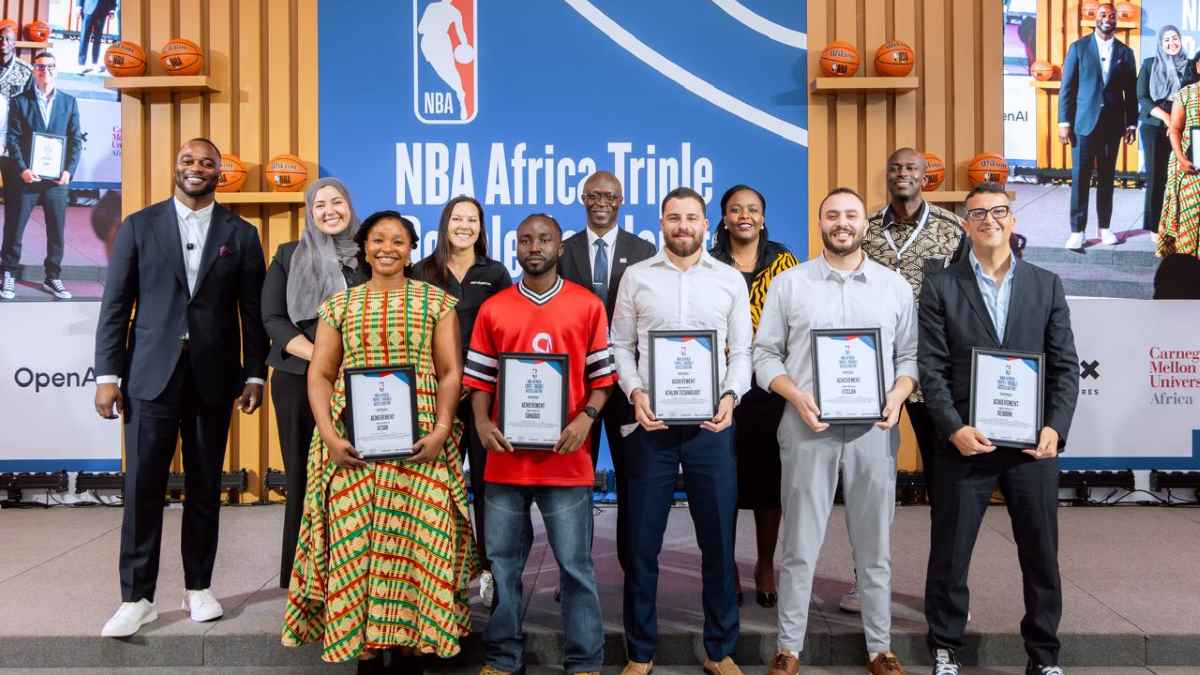
DUBAI, United Arab Emirates, November 26, 2026/APO Group/ –On 25 November 2026, the NBA announced (
https://apo-opa.co/4jCIj8D) a EUR 10 billion initiative to develop arenas and entertainment districts across Europe, bringing together some of the world’s largest investors, including Blackstone, Ares Management, and Arctos Partners. The initiative is linked to the launch of NBA Europe, a 16-team league projected to begin in October 2027, with franchises valued at between USD 500 million and over USD 1 billion. New arenas are planned in Milan, Paris, Barcelona, Madrid, Berlin, London, and other major cities.
Nicolas Pompigne-Mognard (www.Pompigne-Mognard.com), who was appointed in 2022 by then FIFA Secretary-General Fatma Samoura, under the presidency of Gianni Infantino, as a member of the FIFA Task Force for Infrastructure Development in Africa and subsequently founded African Collaborations Group (ACG) (www.ACGafrica.com) to address the continent’s sport infrastructure gap, responded:
“Three things have happened in a matter of weeks. First, the World Bank, the International Olympic Committee, and the Agence Française de Développement published a landmark report on Africa’s sport economy concluding that standalone stadiums have failed the continent and that integrated districts are the way forward. Then FIFA President Gianni Infantino, speaking in Abuja, said publicly that Nigeria lacks the infrastructure to host a FIFA World Cup – confirming that decades of building standalone stadiums across Africa have not delivered the infrastructure the continent needs. Now the NBA and the world’s largest investors are putting EUR 10 billion behind sport and entertainment districts in Europe. They are not building standalone arenas. They are building exactly what ACG has been originating for Africa: integrated districts with arenas surrounded by hospitality, entertainment, retail, media, and community assets designed to generate revenue every day of the year. The institutions identified the problem. The highest authority in world football confirmed it. And now global capital is backing the solution. The model ACG has been advocating is no longer a thesis. It is a global consensus.”
“The NBA’s initiative confirms what we have been saying since ACG’s inception: the future of sport infrastructure is not the venue. It is the district.”
“The NBA has just demonstrated something remarkable: the ability to convene Blackstone, Ares, and Arctos behind a single vision for sport and entertainment infrastructure. That is exactly the kind of convening power that Africa needs. The 2026-27 NBA season opened with a record 60-plus players of African heritage on opening-night rosters. Players of Nigerian heritage alone accounted for 10% of the entire 2026 NBA Draft. The NBA already operates NBA Africa and the Basketball Africa League. The talent pipeline is there. The audience is there. What is missing is the infrastructure. We are calling on the NBA to apply the same convening model to Africa — to bring global investors to the table for the continent that produces so much of its talent.”
“Today, Africa exports its athletes the way it exports its oil, diamonds, gold, copper, and cocoa. The raw material leaves. The value — the arenas, the broadcast deals, the sponsorship revenue, the merchandise, the tourism — is captured elsewhere. The NBA’s European initiative shows that the right convener can change that equation. If the NBA can bring Blackstone and Ares to the table for Europe, it can do the same for Africa. The talent justifies it. The demographics justify it. The growth trajectory justifies it. What has been missing is the model and the convening power to structure the opportunity. ACG provides the model. The NBA has just proven it has the convening power.”
What the NBA has done is prove that sport and entertainment districts are a bankable asset class that the world’s largest investors will back
Pompigne-Mognard founded ACG after serving on the FIFA Task Force for Infrastructure Development in Africa, created to support President Gianni Infantino’s goal of accelerating sport infrastructure across the continent. ACG’s model, the Victory District, is an integrated sport, cultural and entertainment district that addresses exactly the gap the NBA’s European initiative is filling in Europe.
“A Victory District starts by making the stadium and arenas multi-sport and multi-purpose from day one — not a football-only or basketball-only venue, but a facility that hosts multiple sports, concerts, exhibitions, and national events. Then it surrounds those venues with 15 to 20 additional asset types: indoor arenas, aquatics centres, athletics tracks, concert and live entertainment venues, conference and exhibition centres, hotels and hospitality, retail and food and beverage, co-working and office space, sports and wellness medicine clinics, athlete and vocational training academies, media and broadcast production facilities, residential components, and cultural and creative economy hubs. Every asset is a revenue stream, part of a unique circular ecosystem. The district is never empty because it is never dependent on a single sport or a single event.”
“When creative industries are embedded in the same district — studios where content is produced, arenas and stages where it is performed — one plus one makes three. Athletes, artists, entrepreneurs, and audiences share the same infrastructure, and the economic engine serves them all.”
“This is how sport infrastructure becomes financially sustainable. The revenue from the district’s commercial, hospitality, entertainment, and residential components pays for the infrastructure that sport alone could never justify. Governments do not need to subsidise it. Investors earn returns. Jobs are permanent, not temporary. And the community gains a destination that works every day, not a monument that works 25 days a year.”
Paulo J. Cruz, Founding CEO of ACG, who joined from DAMAC Group, the Middle East’s largest private developer (USD 9.8 billion in sales in 2025), said:
“What the NBA has done is prove that sport and entertainment districts are a bankable asset class that the world’s largest investors will back. The NBA did not invest EUR 10 billion itself. It convened the investors, structured the opportunity, and created the conditions for capital to flow. That is exactly what ACG does for Africa. We are early investors that originate the projects, structure the investment, and align the stakeholders — governments, DFIs, private investors, pension funds, sport bodies, and communities — behind financially sustainable district ecosystems.”
“If the NBA can convene this level of investment for Europe, imagine what is possible for Africa — a continent of 1.4 billion people, a sport economy projected to reach USD 20 billion by 2035, and an athlete pipeline that is feeding every major league on earth. The opportunity is not smaller. It is earlier. Our mission is to industrialise sport in Africa and to bring the value-chain back to the continent.”
ACG is currently in discussions with six African governments at presidential or ministerial level. Its 29-member Advisory Board includes Fatma Samoura, former Secretary General of FIFA, and Paulo Gomes, former Executive Director of the World Bank. A separate 17-member Research and Impact Advisory Panel, comprising scholars from Princeton, Johns Hopkins, Ohio State, the University of Illinois, and other leading institutions worldwide, including two UNESCO Chair holders, independently reviews every critical milestone of a Victory District programme.









 Business4 days ago

 Business4 days ago

 Business4 days ago
 Business4 days ago

 Hospitality4 days ago

 Business4 days ago

 Business4 days ago

 Business4 days ago