Connect with us
Anglostratits

Business

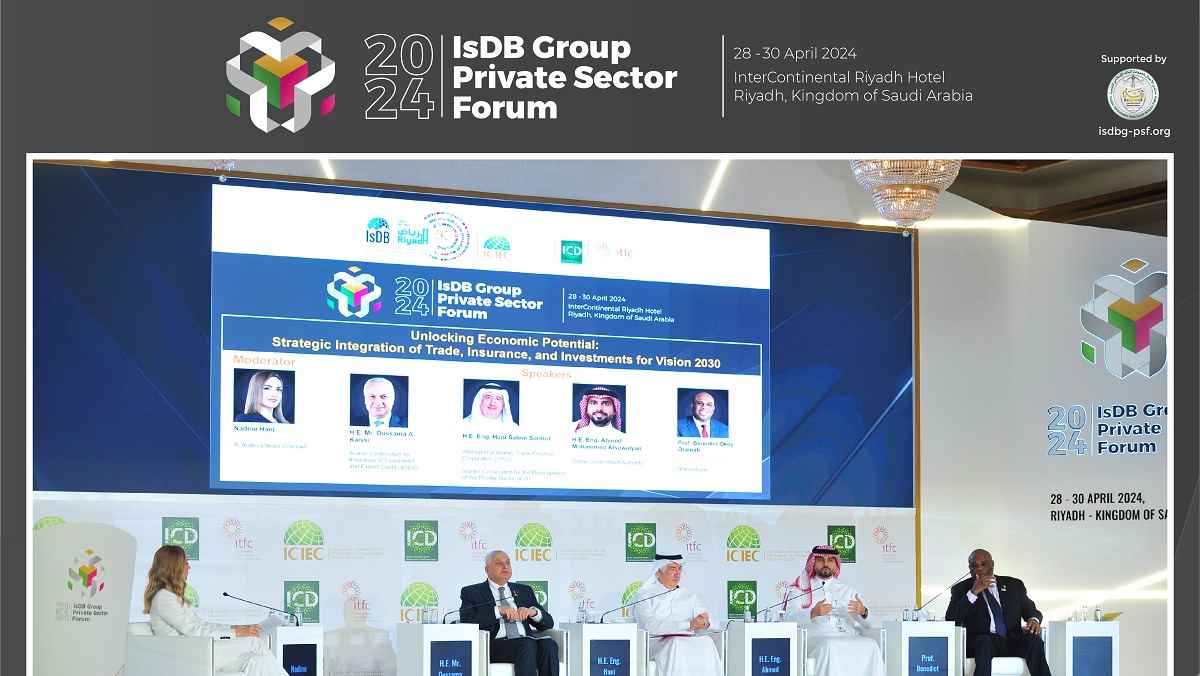
IsDB Group Private Sector Institutions organized the 12ᵗʰ Edition of the “Private Sector Forum” Riyadh, Saudi Arabia, 28-30 April 2024

Published

on

IsDB

This event served as a gateway for potential investors interested in Saudi Arabia and as a platform to promote the KSA Vision2030

RIYADH, Saudi Arabia, May 1, 2024/APO Group/ — 

The private sector institutions of the Islamic Development Bank (IsDB) Group successfully organized the 12th edition of the “Private Sector Forum – 2024”. Held from 28th to 30th April 2024 at the Intercontinental Hotel in Riyadh, Saudi Arabia, the Forum took place on the sidelines of the Annual Meetings of the IsDB and the Golden Jubilee of the Islamic Development Bank under the patronage of the Custodian of the Two Holy Mosques, King Salman Bin Abdelaziz Al Saud.

The primary objective of the Private Sector Forum was to provide a unique platform for the global business community to connect, network, and explore investment and trade opportunities offered by member countries. Additionally, the Forum showcased IsDB Group activities, projects, services, and initiatives across member countries, highlighting the organizations’ role in promoting Public Private Partnership (PPP) projects and its services to the private sector. This event served as a gateway for potential investors interested in Saudi Arabia and as a platform to promote the KSA Vision2030.

This year’s forum has been instrumental in facilitating a valuable exchange of knowledge among leading experts and stakeholders

The event attracted more than 2,000 participants, including government officials, Chairpersons, Presidents, and CEOs of local and international companies, multilateral and financial institutions, chambers of commerce and industry, business associations, investment promotion agencies, individual investors, and entrepreneurs. The Forum facilitated parallel business to business (B2B) and business to government (B2G) meetings, enabling business communities across member countries to establish valuable connections. Moreover, the event featured exhibitions for partners, a competition for start-ups, and, for the first time, recognized and awarded notable organizations and personalities has been recognized and awarded by the IsDB Group entities.

In his address, H.E. Dr. Muhammad Sulaiman Al Jasser, Chairman of the IsDB Group, remarked: “The 12th edition of IsDB Group Private Sector Forum, taking place this year in the Kingdom of Saudi Arabia, has successfully promoted the integration of the public and private sectors, which is crucial for the economic and social development of our member countries. It is the responsibility of the public sector to develop infrastructure and legislation to foster an attractive business climate for the private sector to stimulate production and create jobs” H.E. Dr. Muhammad Sulaiman Al Jasser thanked the attendees for their participation in the Forum, which included 17 sessions, more than 60 speakers, 32 exhibitors, and more than 2,000 participants representing 60 countries and witnessed the signature of 61 agreements with amount of US$ 6,486 billion.

Mr. Oussama Kaissi, CEO of the Islamic Corporation for the Insurance of Investment and Export Credit (ICIEC), a multilateral credit and political risk insurer and a member of the IsDB Group, on the impactful outcomes of the forum, stated: “The Private Sector Forum has served as a crucial platform for ICIEC to explore innovative strategies that merge trade, insurance, and investment sectors, especially in line with Saudi Arabia’s Vision 2030. This year’s forum has been instrumental in facilitating a valuable exchange of knowledge among leading experts and stakeholders.” “Moreover, the Forum played a critical role in highlighting the importance of these sectors in fostering economic diversification and sustainability. Our approach at ICIEC, guided by robust underwriting, reinsurance, and risk management policies, has significantly contributed to this effort. With over US$ 108 billion in cumulative trade and investment insurance, focusing on key sectors such as energy, manufacturing, infrastructure, healthcare, and agriculture, we have been able to identify challenges and opportunities that align with Vision 2030, fostering essential partnerships. ICIEC remains committed to driving economic growth and sustainable development in our member states through strategic insurance and investment solutions.” added Mr. Kaissi .

Reflecting on the success of the Private Sector Forum, H.E. Eng. Hani Salem Sonbol, the Acting CEO of The Islamic Corporation for the Development of the Private Sector (ICD), and CEO of the International Islamic Trade Finance Corporation (ITFC), highlighted the core focus of their activities on sustainability and development. He expressed hope that the forum effectively presented existing co-financing opportunities available for the private sector and discussed potential solutions in sustainable development. Eng. Hani Salem Sonbol emphasized the importance of the private sector as a vital driver of economic growth, job creation, and poverty alleviation in member countries. The ICD has been instrumental in this effort, having disbursed more than USD 4.5 billion to unlock private sector investment in finance, infrastructure, agriculture, manufacturing, and energy for sustainable development since its inception in 1999. This is a testament to their commitment, with a record of 451 approved projects in 50 countries. He reaffirmed ITFC’s commitment to supporting private sector growth, underscoring the collaborative efforts in empowering businesses and driving economic progress across member countries. Over the last 15 years, ITFC has approved a cumulative total of US$ 18.5 billion in support of private sector and SME clients, accounting for 25 % of its trade finance portfolio.

For more information, please visit the Private Sector Forum website (www.ISDBG-PSF.org).

Distributed by APO Group on behalf of Islamic Development Bank Group Business Forum (THIQAH).

Business

In Africa’s Creative Economies, Women Are Claiming Ownership (By Libby Allen)

Published

on

APO

Each March, International Women’s Day fills the calendar with campaigns, flowers, and carefully timed announcements. The day has real historical weight – born from early twentieth century demands for the right to work, vote, and organise. The question it rarely reaches is the one worth asking: not who is being celebrated, but who controls what they have built.

In African creative industries in 2026, that question has instructive answers. They’re economic, not symbolic. And they’re being written by women.

The ownership argument

In Senegal, Diarra Bousso grew up in a home where art and style were a daily language. She went on to study mathematics, worked on Wall Street, and came back to Dakar with a model for a fashion and lifestyle brand: nothing gets made until someone has asked for it.

DIARRABLU, the brand she built from her parents’ rooftop, uses proprietary mathematical algorithms to generate designs, puts them to a community vote before a single garment is cut, and produces entirely on demand – achieving a 60% reduction in waste, and cutting excess stock. Her supply chain is almost entirely Senegalese artisans. The IP – the algorithms, the methodology, the design system – is entirely hers. The value is in Bousso’s process, and the process is owned.

In South Africa, game studio Nyamakop spent years building something hard to copy. Relooted, released last month, is a heist adventure set in a futuristic Johannesburg in which the player recovers 70 real African artefacts from Western museums and private collections. The game was built by a team drawn from more than ten African countries. Mohale Mashigo – its narrative director, a novelist, and comic book writer who has also worked for Marvel and DC – is precise about ownership. Every artefact in the game maps to a real object with a documented history belonging to a named people.

That specificity isn’t just artistic rigour. The world of Relooted is built so it can’t be detached from its own context and repurposed elsewhere. Culture travels differently when it’s self-authored.

Women’s creative output is feeding systems they don’t own

In Nigeria, Mo Abudu applies the same logic to distribution. EbonyLife Media – the production house and TV network she founded in 2012, whose films and series have drawn millions of viewing hours – launched EbonyLife ON Plus in November last year. It’s a membership-based platform designed to keep the value of African storytelling on the continent. The platform is new; the strategy is not: own the infrastructure, or someone else sets the terms.

Three countries. Three creative sectors. Find the point in the chain where value is captured. Own it.

Owned but exposed

AI-generated content has intensified the pressure. GenAI models are trained, in large part, on creative output they don’t pay for – and whether that output counts as a compensable input is now being tested in courtrooms and policy chambers. In African creative economies, where the volume of visual, narrative, and cultural material is vast and formal IP infrastructure is uneven, exposure is significant. Women’s creative output is feeding systems they don’t own.

The AI question and the infrastructure question aren’t separate. One is playing out in courtrooms. The other is playing out in markets.

Narrative control

Reaching the right markets requires a different kind of ownership. Africa isn’t a single market. It is 54 distinct countries, each with its own media landscape, languages, cultures, and decision-makers. Many communications partners offer visibility but don’t know the nuances of each market; they’re not present on the ground – so they offer approximation, which costs while the narrative is diluted.

The same logic that drives Bousso to keep her algorithms proprietary, that drove Mashigo and Nyamakop to build a game precisely, that led Abudu to build her own platforms rather than license outward – it applies here too. Who tells the story, in which markets, in whose language, through which channels: this is where narrative control is either held or lost. For brands to reach across Africa, brand communications must be African.

What happens next? 

International Women’s Day will generate thousands of posts this March. It’s worth watching what happens in the days after – whether the women building ownership across African creative industries control more of their work, their distribution, and their narrative than they did the year before. That is the only measure that matters.

Distributed by APO Group on behalf of APO Group Insights.


Continue Reading

Business

Equatorial Guinea to Showcase 2026 Licensing Round to Global Investors at Invest in African Energy (IAE)

Published

on

Energy Capital

Minister of Mines and Hydrocarbons Antonio Oburu Ondo will deliver a keynote at the Invest in African Energy Forum, unveiling strategic licensing opportunities tied to EG Ronda 2026

PARIS, France, March 6, 2026/APO Group/ –Reflecting a renewed drive for growth and upstream revitalization, Equatorial Guinea’s Minister of Mines and Hydrocarbons, Antonio Oburu Ondo, will deliver a keynote address at the Invest in African Energy Forum, scheduled for April 22–23, 2026, in Paris. Designed to connect African energy opportunities with institutional and private capital, the forum provides a strategic platform for governments to present bankable projects directly to global investors.


At the center of Equatorial Guinea’s investor outreach is EG Ronda 2026, an upcoming licensing round expected to offer 24 upstream blocks across offshore and onshore basins. First announced at African Energy Week, the round will run through late 2026 and features updated fiscal terms and a competitive open-door framework aimed at attracting both majors and independents. In preparation, the Ministry has advanced seismic data acquisition and reprocessing programs, strengthening the technical dataset available to bidders and materially reducing exploration risk.


Equatorial Guinea’s strategy extends beyond licensing. In early 2026, the government signed a reconnaissance license agreement with Eni to support renewed upstream evaluation and field revitalization efforts. At the same time, cross-border collaboration on the Yoyo-Yolanda gas fields continues to advance, with a recent unitization agreement between Equatorial Guinea and Cameroon paving the way for joint development. The move reinforces the country’s ambition to deepen regional integration, optimize shared resources and accelerate monetization through coordinated infrastructure planning.


Project-level momentum further supports this positioning. The Aseng Gas Project, backed by Chevron, represents an estimated $690 million investment aligned with Equatorial Guinea’s flagship Gas Mega Hub initiative – a multi-phase strategy to strengthen domestic processing capacity and position the country as a regional gas hub. National oil company GEPetrol recently increased its stake in Aseng to more than 32%, signaling deeper national participation alongside international operators and a clearer pathway to execution.


For capital providers focused on the Gulf of Guinea and broader African energy markets, Minister Ondo’s address in Paris will provide direct insight into fiscal reforms, licensing mechanics, partnership models and infrastructure expansion plans through 2026 and beyond. As global capital becomes more selective, IAE 2026 offers a critical space for engagement, due diligence and deal origination – helping convert announced opportunities into executed transactions.

Distributed by APO Group on behalf of Energy Capital & Power.


Continue Reading

Business

African Development Bank Group (AfDB) Unveils Africa-Wide Aviation Financing Platform to Turn Growth into Sustainable Profit

Published

on

AfDB

The priority now is execution—aligning policy, capital and infrastructure to ensure aviation becomes a durable driver of inclusive growth and regional integration across the continent

NAIROBI, Kenya, March 5, 2026/APO Group/ –With Africa poised to become the world’s fastest-growing aviation market, policymakers and industry leaders are focused on a central challenge: how to translate rising demand into sustainable connectivity, competitiveness, and financial viability.

This question anchored deliberations at the two-day Airlines, Capital and Connectivity Forum convened in Nairobi on 25–26 February 2026 by the African Development Bank Group in partnership with the African Airlines Association (AFRAA).

Despite strong demand fundamentals, Africa’s aviation sector continues to face structural constraints, including high costs of capital, fragmented regulatory regimes, infrastructure gaps, and limited access to long-term financing. To address these challenges, the Bank is advancing the Integrated Aviation Transformation Program (IATP), a continent-wide platform designed to modernise the aviation ecosystem and mobilise private, institutional, and concessional capital at scale. The programme seeks to align policy reform, innovative financing instruments, and project execution within a single, bankable framework.

The Forum brought together airline executives, transport ministers, regulators, investors, manufacturers, and development partners to explore how the IATP can accelerate coordinated delivery across the sector. Participants underscored aviation’s role as a strategic enabler of regional integration, trade facilitation, tourism, and economic diversification.

Opening the Forum, the Bank’s Director for Infrastructure and Urban Development, Mike Salawou, noted that while Africa’s aviation demand outlook ranks among the strongest globally, supply-side capacity and investment readiness have lagged. The IATP, he said, seeks to de-risk priority investments, support early pilot transactions, and restore confidence among commercial and institutional financiers.

Africa represents nearly 18 percent of the global population but accounts for less than three percent of worldwide air traffic

From the industry’s perspective, AFRAA Secretary General Abderahmane Berthé highlighted the scale of the opportunity and the imbalance confronting the continent. “Africa represents nearly 18 percent of the global population but accounts for less than three percent of worldwide air traffic, reflecting structural and regulatory barriers rather than weak demand,” he said.

Remarks delivered on behalf of Kenya Airways described Africa as the largest structural aviation opportunity of the 21st century. Over the next two decades, one in four new global air travellers is expected to originate from Africa, driven by rapid urbanisation, a growing middle-income population, and a youthful demographic profile.

However, the industry’s financial performance remains constrained. According to the International Air Transport Association (IATA), African airlines are projected to generate net margins of only 1–2 percent, below the global average forecast of 3.9 percent in 2026. High fuel costs, heavy taxation, incomplete liberalisation and limited hub infrastructure continue to undermine profitability.

Connectivity remains a critical bottleneck. Intra-African traffic accounts for only about a quarter of total air travel, with many passengers required to transit outside the continent. Participants emphasised that full implementation of the Single African Air Transport Market is essential to unlock efficient intra-continental connectivity.

A keynote address delivered by Eric Ntagengerwa, Head of Transport and Mobility at the African Union Commission (AUC) on behalf of Lerato Dorothy Mataboge, Commissioner for Infrastructure and Energy, framed aviation reform as an imperative for sovereignty, integration, and competitiveness. He observed that the Single African Air Transport Market is the designated African Union Theme for the Year 2027.

Discussions over two days focused on practical delivery, including strengthening airline bankability, advancing climate-aligned aviation, developing cargo and logistics, building skills, and deploying innovative risk-sharing mechanisms under the IATP. Country experiences from Nigeria, Kenya, and Ethiopia illustrated how continental objectives can translate into coordinated national reforms and near-term investment opportunities.

Samuel Obafemi Bajomo, Senior Adviser to Nigeria’s aviation ministry, emphasised that forward-looking, pro-investment policy frameworks are critical to strengthening connectivity and unlocking Africa’s growth potential and positioning aviation as a catalyst for trade, tourism, and shared prosperity.

The Forum concluded with a clear message: Africa’s aviation demand is real, accelerating, and irreversible. The priority now is execution—aligning policy, capital and infrastructure to ensure aviation becomes a durable driver of inclusive growth and regional integration across the continent.

Distributed by APO Group on behalf of African Development Bank Group (AfDB).

Continue Reading

Trending