Connect with us
Anglostratits

Energy

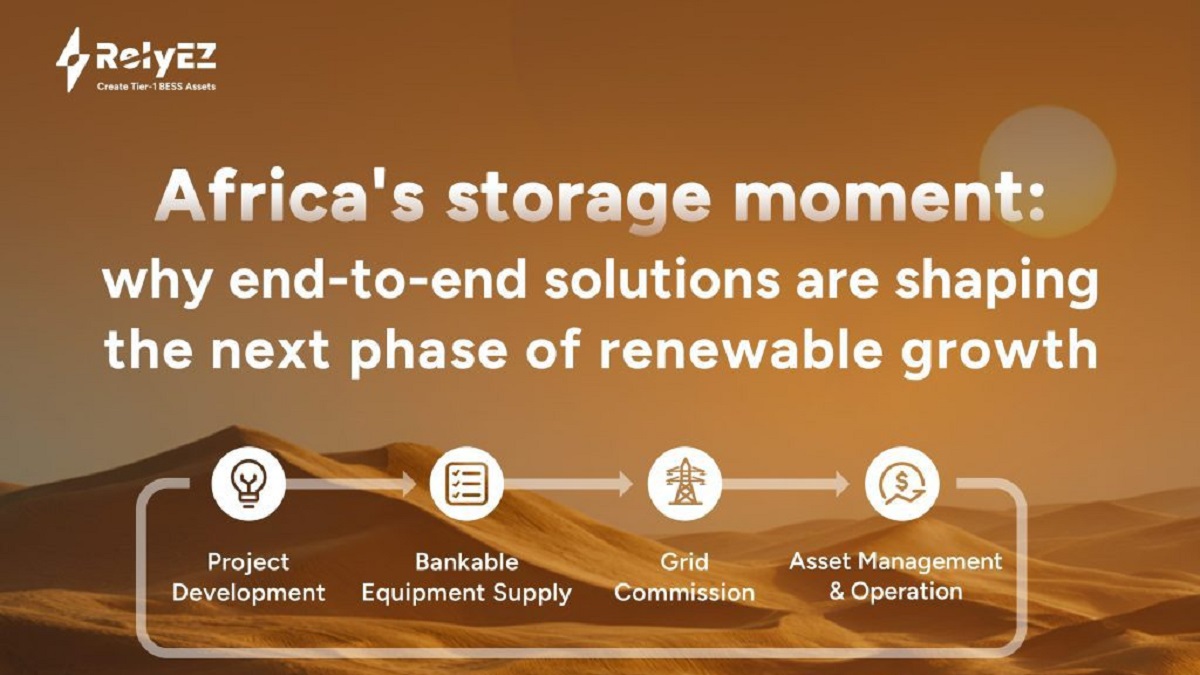
How RelyEZ is powering Africa’s growing solar and storage demand

Published

on

Africa

Find out why integrated storage is becoming essential

CAPE TOWN, South Africa, February 20, 2026/APO Group/ –Across Africa, the rapid rollout of solar generation is shifting the challenge from simply adding capacity to integrating power reliably into weak and unstable grids. Diesel dependence, frequency instability and limited transmission infrastructure are driving demand for battery energy storage systems (BESS) not as optional hardware, but as core infrastructure for resilient power systems.

In markets from East to West Africa, storage is increasingly deployed not for arbitrage but for reliability, stability and energy access — especially in hybrid microgrids and solar-plus-storage projects that reduce fuel costs and improve service continuity.

To meet these needs, developers and utilities are moving beyond standalone batteries toward end-to-end storage solutions that bundle engineered systems, intelligent controls and lifecycle support. This approach enables faster integration, higher performance under Africa’s challenging operating conditions and stronger bankability for long-term financing.

VUKA Group, as RelyEZ’s regional partner, plays a key role in delivering these solutions across Africa. VUKA Group provides local expertise, project management, and support services, ensuring that RelyEZ’s modular, containerised platforms and intelligent Energy Management Systems are deployed effectively and optimised for African conditions. Together, RelyEZ and VUKA Group are helping utilities and communities integrate storage, strengthen grid stability, and advance renewable energy access.

Want to understand how RelyEZ and VUKA Group are aligning storage delivery with Africa’s solar growth?
Read more here: https://apo-opa.co/3OodPKB

Distributed by APO Group on behalf of VUKA Group.

Energy

Copia Group’s Platinum Angola Oil & Gas (AOG) 2026 Sponsorship Highlights Commitment to Angola’s Oilfield Growth

Published

on

Energy Capital

Angola Oil & Gas 2026 provides a strategic platform for Copia Group to strengthen partnerships and showcase its technical capabilities at the forefront of Angola’s expanding hydrocarbon portfolio

LUANDA, Angola, March 16, 2026/APO Group/ –Angolan service provider Copia Group of Companies has joined the 2026 edition of the Angola Oil & Gas (AOG) Conference and Exhibition as a Platinum Sponsor. The company’s participation at the event  – Angola’s premier oil and gas forum – signals a broader commitment to developing the national hydrocarbon value chain as leading operators scale production. By joining AOG 2026, Copia Group strengthens its visibility within Angola’s evolving energy ecosystem while supporting exploration, development and infrastructure growth across the sector.

As Angola intensifies efforts to sustain crude production above one million barrels per day while accelerating new exploration campaigns and redevelopment programs, demand for high-quality infrastructure, fabrication, logistics and technical services is expanding. From deepwater developments and shallow water revitalization projects to non-associated gas monetization and refining enhancements, the country’s hydrocarbon value chain is entering a capital-intensive phase requiring experienced local and regional service providers capable of delivering at scale.

Within this context, Copia Group has positioned itself as a multidisciplinary provider supporting oil, gas and industrial operations. With capabilities spanning engineering services, construction support, project management and technical solutions, the company facilitates collaboration between operators, contractors and project stakeholders. Its Platinum Sponsorship at AOG 2026 reinforces this positioning at a time when Angola’s project pipeline is expanding across upstream and downstream segments.

In a 2025 interview with Energy Capital & Power, Adilson Mangueira Nelumba, Copia Group’s Chairman, and Grildo José Francisco, the company’s Project Director for Oil, Gas & Biofuels, highlighted that the company has “established itself as a strategic partner in Angola’s energy transformation, thanks to a solid combination of international partnerships, multidisciplinary technical expertise and a commitment to sustainable and local development.”

Beyond oil and gas services, Copia Group is playing a central role in expanding Angola’s hydropower portfolio. The company is leading the consortium developing the Caculo Cabaça Hydroelectric Project, set to produce 2,172 MW once completed. The first turbine is scheduled to operate in October 2026, with subsequent phases coming online through the end of 2028. As the project nears operation, Copia Group’s participation at AOG 2026 is expected to open new avenues for international collaboration, supporting accelerated project development.

Copia’s Platinum-level involvement underscores the importance of strong service sector collaboration in achieving Angola’s production and infrastructure targets. As the country aligns upstream expansion with downstream and midstream development, companies delivering engineering and construction solutions will remain critical to translating policy ambition into operational reality.

Distributed by APO Group on behalf of Energy Capital & Power.

Continue Reading

Energy

Caribbean Shallow-Water Plays Move into Focus as Guyana–Suriname Basin Expands

Published

on

Energy Capital

This month’s Caribbean Energy Week will host a technical workshop on shallow-water drilling as new licensing rounds, exploration wells and infrastructure investment drive growing interest across the region

PARAMARIBO, Suriname, March 16, 2026/APO Group/ –While deepwater discoveries have dominated the Caribbean’s upstream narrative, shallow-water blocks across Guyana, Suriname and Trinidad & Tobago are emerging as a parallel opportunity as operators seek lower-cost exploration prospects in the expanding Guyana–Suriname Basin. Governments across the region are advancing licensing frameworks, seismic programs and drilling campaigns aimed at unlocking offshore resources closer to shore, while improved geological data and drilling technology are strengthening the commercial case for shallow-water development.


These opportunities will be in focus during a dedicated technical workshop – “Operational Challenges in Shallow Water Drilling” – at Caribbean Energy Week (CEW) 2026. The session will focus on mitigating operational risk while leveraging new technologies to optimize cost and performance across the region’s mature and emerging basins.


Guyana Expands Beyond Deepwater Core


Guyana’s global oil story has been dominated by the deepwater Stabroek Block, but policymakers are increasingly focused on expanding exploration into adjacent shallow-water acreage. Following its offshore licensing round, the government finalized agreements for multiple shallow-water blocks under a standardized production sharing framework designed to attract a broader range of operators.


One example is the S7 block, awarded to Cybele Energy, covering approximately 200 square-kilometers offshore. The fiscal terms – 10% royalty, a 10% corporate tax and a cost-recovery cap – aim to balance investor incentives with higher state revenue, while lowering barriers to entry for mid-size explorers.


Geological studies across Guyana’s shallow-water acreage have identified roughly 90 exploration leads across 11 blocks, containing an estimated 90 billion barrels of oil in place, suggesting the petroleum system extends well beyond the basin’s deepwater fairway.


For investors, the appeal is straightforward: shallower wells typically require smaller capital commitments and shorter development timelines, offering an entry point into one of the world’s most prolific emerging hydrocarbon provinces.


Suriname’s Offshore Momentum Builds


Just across the maritime border, Suriname is experiencing similar momentum. In late 2025, Chevron and Petronas secured exploration rights for shallow offshore Blocks 9 and 10 alongside QatarEnergy and the state-backed Paradise Oil Company, marking one of the largest recent commitments to Suriname’s upstream sector.


Meanwhile, Chevron recently drilled the Korikori-1 exploration well in Block 5 in water depths of roughly 40 meters – demonstrating continued confidence in the shallow-water potential of the basin. These exploration activities complement major deepwater developments such as the $10.5 billion GranMorgu project led by TotalEnergies, which is moving toward production later this decade and strengthening the broader investment case for the basin.


The result is a layered offshore ecosystem where deepwater megaprojects anchor regional infrastructure, while shallow-water exploration expands the opportunity set for new entrants.


Trinidad’s Mature Basins Offer Redevelopment Potential


Trinidad & Tobago provides a different but equally important opportunity: redevelopment of mature shallow-water basins. Decades of production have left the country with a significant network of offshore infrastructure, pipelines and service capacity. For operators, this existing ecosystem creates opportunities for smaller discoveries that can be tied back quickly and economically. In a market increasingly focused on capital discipline, such infrastructure-led developments are gaining renewed attention as companies seek projects that balance resource potential with manageable costs.


Despite their advantages, shallow-water projects come with technical and operational challenges. Complex geology, environmental sensitivities and aging infrastructure can complicate drilling campaigns. Addressing these issues will be a key focus of the workshop at CEW 2026, where operators, engineers and service providers will examine strategies to improve well design, reduce drilling risk and deploy new technologies in the region’s offshore environment.


As the Guyana–Suriname Basin continues to mature and regional governments seek to diversify their upstream portfolios, shallow-water exploration may represent the Caribbean’s next wave of opportunity.


Join us in shaping the future of Caribbean energy. To participate in this landmark event, please contact sales@energycapitalpower.com.

Distributed by APO Group on behalf of Energy Capital & Power.

Continue Reading

Energy

African Liquefied natural gas (LNG) Could Be Europe’s Lifeline as Middle East, Russia Crises Escalate

Published

on

Energy Capital

Ministers from Africa’s LNG-exporting countries including Senegal, Equatorial Guinea, Nigeria and the Republic of Congo will gather in Paris for the Invest in African Energy Forum, showcasing the continent’s LNG as a reliable solution to Europe’s urgent energy needs

As tensions flare in the Middle East and Russian supply remains volatile, European buyers are urgently seeking stable alternative sources of gas – and Africa is emerging as a critical solution. Next month, energy ministers from Senegal, Equatorial Guinea, Nigeria and the Republic of Congo will convene in Paris at the Invest in African Energy (IAE) Forum, spotlighting the continent’s LNG capacity and its emerging role in European energy security.

Following the dramatic disruption of Russian pipeline flows, Europe has increasingly turned to LNG to fill supply gaps – contracting cargoes from the U.S., Qatar and, increasingly, African exporters. While African cargoes still represent a smaller share of total imports, their relevance is growing as utilities factor in insurance costs, geopolitical risk and supply diversification. And now, with the Middle East in turmoil and the Strait of Hormuz effectively at risk, African LNG offers European buyers a geographically insulated, lower-risk alternative that can be delivered quickly to key regasification hubs.

Nigeria remains Africa’s LNG backbone, with its volumes historically flowing into Europe’s Mediterranean and Atlantic terminals through a mix of long-term contracts and spot cargoes. As Russian pipeline volumes have declined, Nigerian LNG has become a significant component of LNG deliveries into Iberian terminals, with Portugal sourcing over half of its LNG from Nigeria and Spain among the key European destinations for Nigerian cargoes.

Continued expansion – including the Nigeria LNG Train 7 project – is expected to boost export capacity toward the mid-2020s, adding new volumes that European buyers could secure through multiyear supply agreements. This positions Nigeria not just as a major producer, but as a durable contender for Europe’s long-term LNG demand.

Equatorial Guinea’s LNG exports via the Punta Europa facility have also found consistent markets in Europe and across the Atlantic Basin. Recent upstream developments, including the Chevron Aseng Gas Project, aim to secure additional gas feedstock, reinforcing LNG supply and supporting both domestic gas use and exports. European utilities have shown particular interest in shorter-route shipments from West Africa, as cargoes from Equatorial Guinea reach European terminals faster and with lower freight and insurance costs than many Middle Eastern shipments.

The Republic of Congo has rapidly expanded its LNG ambitions through the Congo LNG project, where Phase 2 – anchored by floating LNG technology – is expected to lift export capacity to roughly 3 million tons per year. Floating LNG’s advantages, including faster deployment, modular expansion and lower upfront capital requirements, position Congo as a flexible supplier for Europe’s evolving gas portfolio. Increasingly, European traders and utilities are factoring in speed to market and supply flexibility alongside price when structuring procurement strategies.

Senegal’s Greater Tortue Ahmeyim project – developed jointly with Mauritania – represents West Africa’s newest entry into global LNG markets. First gas and initial cargoes began in 2025, marking a major milestone for the region’s gas export ambitions. Planned expansions could add several million tons per year of additional capacity as the project ramps up production.

African LNG’s appeal lies not only in rising volumes but in geostrategic positioning. Compared with cargoes that must pass through conflict-prone routes like the Strait of Hormuz or rely on Russian pipeline networks, African exports are less exposed to direct conflict or geopolitical disruption. This relative “risk discount,” combined with competitive pricing and expanding production capacity, could increasingly shape procurement strategies among European utilities and gas traders.

The ministers gathering in Paris – representing Africa’s leading LNG-exporting countries – will be tasked with converting this growing European interest into concrete investment decisions, offtake agreements and long-term supply partnerships, reinforcing Africa’s role as a stable and reliable energy partner at a time when Europe urgently needs alternatives.

African producers will not replace Russian or Gulf supplies overnight. But with operational LNG capacity already flowing and new projects coming online, the continent’s role in strengthening European gas security is steadily expanding – and the discussions in Paris will reflect that shift in the global energy landscape.

IAE 2026 (https://apo-opa.co/4bp66Um) is an exclusive forum designed to connect African energy markets with global investors, serving as a key platform for deal-making in the lead-up to African Energy Week. Scheduled for April 22–23, 2026, in Paris, the event will provide delegates with two days of in-depth engagement with industry experts, project developers, investors and policymakers. For more information, visit www.Invest-Africa-Energy.com. To sponsor or register as a delegate, please contact sales@energycapitalpower.com

Distributed by APO Group on behalf of Energy Capital & Power.

Continue Reading

Trending