Connect with us
Anglostratits

Energy

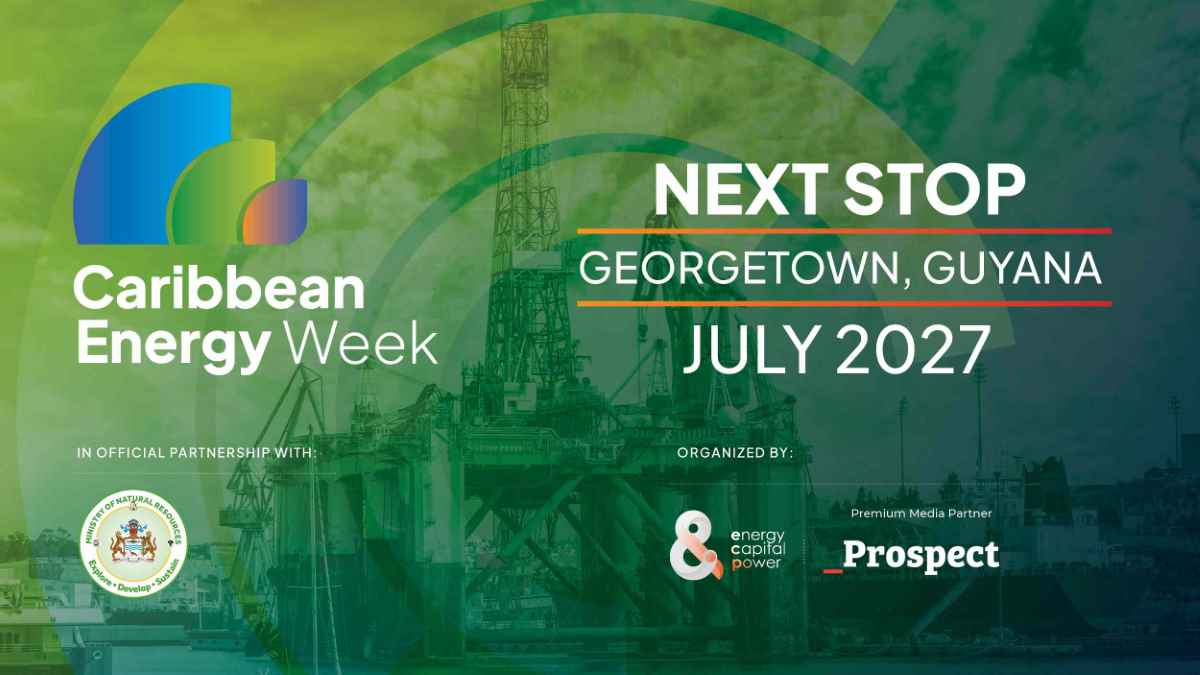
Guyana Confirmed to Host Caribbean Energy Week 2027 as Regional Energy Integration Gains Momentum

Published

on

Guyana

The second annual Caribbean Energy Week will take place in July 2027 in Guyana under the patronage of President Dr. Mohamed Irfaan Ali and the endorsement of The Honorable Minister of Natural Resources Vickram Bharrat, bringing together global investors and regional leaders to advance oil, gas and LNG development

GEORGETOWN, Guyana, May 25, 2026/APO Group/ –The second annual Caribbean Energy Week (CEW) will take place in Guyana in July 2027, convening regional governments, international energy companies and investors at a pivotal moment for the Caribbean’s emergence as a global energy hub. Held under the patronage of President Dr. Mohamed Irfaan Ali and with the endorsement of The Honorable Minister of Natural Resources Vickram Bharrat, the event highlights the country’s growing leadership in shaping the region’s energy future.


Under the theme, “Unlocking the Caribbean Energy Corridor: Oil, Gas, LNG & Investment for a New Global Hub,” CEW 2027 will focus on transforming the Caribbean from a set of fragmented markets into an integrated, globally competitive energy corridor. Central to this vision is deeper cross-border collaboration, accelerated infrastructure development and increased capital flows across the oil, gas and LNG value chains.

We are seeing unprecedented upstream growth in Guyana, major project development in Suriname and renewed momentum around regional gas and LNG integration in Trinidad and Tobago

Momentum across the region continues to build. In Guyana, offshore production from the ExxonMobil-led Stabroek Block averaged approximately 914,000 barrels per day in the first quarter of 2026, with output expected to exceed one million barrels per day following the startup of the Uaru development. At the same time, upstream expansion remains robust, supported by new seismic campaigns, FPSO developments and ongoing work tied to the Longtail project. In neighboring Suriname, TotalEnergies is advancing its $10.5 billion GranMorgu offshore development alongside new exploration activity, underscoring sustained investor confidence in the Guyana-Suriname Basin and reinforcing the region’s long-term growth trajectory.

In Trinidad and Tobago, the focus is shifting toward revitalizing mature gas production through new upstream partnerships and cross-border developments, including progress on projects such as Manatee and increased collaboration with Venezuela to unlock stranded reserves. At the same time, the country is advancing efforts to expand its LNG and petrochemical value chains, positioning itself to remain a key gas processing and export hub in the Atlantic Basin.

“We are seeing unprecedented upstream growth in Guyana, major project development in Suriname and renewed momentum around regional gas and LNG integration in Trinidad and Tobago,” said James Chester, CEO of Energy Capital & Power, the event organizer. “Caribbean Energy Week 2027 is about connecting those opportunities – bringing together governments, operators and investors to unlock a truly integrated energy corridor that can compete on the global stage.”

The inaugural Caribbean Energy Week in 2026 laid a strong foundation, attracting more than 400 attendees and over 90 companies, alongside high-level ministers and industry leaders from across the region and beyond. Hosted in Paramaribo, the event facilitated critical dialogue on cooperation, investment and infrastructure, while also serving as a platform for deal-making and knowledge exchange.

Building on this momentum, CEW 2027 is set to expand in both scale and impact, offering a premier platform for strategic dialogue, project showcases and investment engagement. As global demand for diversified energy supply grows, the Caribbean is increasingly well-positioned to play a central role – one defined by collaboration, connectivity and opportunity.

Distributed by APO Group on behalf of Energy Capital & Power.

Energy

Argentine Shale Expertise to Drive Venezuela’s Upstream Growth at Venezuela Energy Week (VEW) 2027

Published

on

Etu Energias

Long-standing commercial ties and 15 years of shale development position Argentine companies for participation in Venezuela’s expanding oil sector

CARACAS, Venezuela, November 23, 2026/APO Group/ –Venezuela Energy Week (VEW), taking place in Caracas on February 22-25, 2027, offers Argentine oil and gas companies a direct route into one of Latin America’s fastest-growing upstream markets. Argentina has built a mature drilling and oilfield services industry through the development of its Vaca Muerta shale play, while Venezuela is expanding activity across the Orinoco Belt and the Maracaibo Basin under new partnership agreements with international operators. VEW will connect Argentine producers and suppliers with Venezuelan officials, companies and engineering talent to accelerate the country’s production growth and forge new continental partnerships.


The two countries have a long-standing commercial relationship that predates Venezuela’s recent reforms. Argentina’s Tenaris, the Techint Group’s pipe and oilfield services company, was historically the leading pipe supplier to Venezuela’s oil industry and has retained experienced local personnel in the country. Its presence is expanding again under a long-term contract to supply oil country tubular goods and Rig Direct field services for Chevron’s Venezuelan operations, as well as a contract supporting Eni’s initial 20-well program. Tenaris expects around $60 million in Venezuelan revenue in 2026, with the number of rigs it serves in the country forecast to grow from five to 17 or 18 in 2027.

Argentina’s oilfield sector has expanded rapidly to keep pace with Vaca Muerta. The shale play has 42 rigs operating, up from 32 in 2025, and national crude output reached a record 926,925 barrels per day (bpd) in August. Argentine producers have also developed their own service companies, including Pluspetrol SPI, formed after Pluspetrol acquired Weatherford’s Argentine hydraulic fracturing division in 2024. The forecast rise in rigs Tenaris serves in Venezuela gives an early indication of the demand Argentine and other regional suppliers will be positioned to meet.

Venezuela’s expansion presents near-term openings for Argentine service providers and longer-term prospects for Argentine producers. Hydrocarbon output reached 1.218 million bpd in September, up 8% year-on-year, while Chevron’s joint ventures plan to invest more than $7 billion over five years to raise their production to around 600,000 bpd, sustaining demand for drilling and well services.

Beyond its conventional fields, Venezuela holds unconventional resources suited to the shale experience Argentine operators have built in Vaca Muerta. Published assessments cited by the American Association of Petroleum Geologists (AAPG) estimate 15.2 billion barrels of shale oil and 204.8 trillion cubic feet of shale gas in the country, most of it in the La Luna Formation of the Maracaibo Basin.

VEW 2027 will present the premier networking and deal-making space for Argentine companies to pursue these opportunities. The exhibition, conference program and dedicated site-visit day bring operators, national institutions and service providers together in Caracas, giving Argentine firms the opportunity and access to establish supply agreements, technical partnerships and joint ventures across Venezuela’s upstream sector.

Organized by Energy Capital & Power and taking place under the patronage of Acting President Delcy Rodríguez, PDVSA and the Ministry of Hydrocarbons, Venezuela Energy Week 2027 will convene in Caracas on February 22–25. To register, visit www.VenezuelaEnergyWeek.com. To sponsor or exhibit, visit https://apo-opa.co/4kroUZl.

Distributed by APO Group on behalf of Energy Capital & Power.


Continue Reading

Energy

South Sudan Targets 400,000 Barrels per Day (BPD), Calls for Investment Across Energy Value Chain at South Sudan Oil & Power (SSOP) 2026

Published

on

SSOP

South Sudan outlined its strategy to increase oil production, expand domestic energy infrastructure and improve electricity access during the opening of South Sudan Oil & Power 2026

JUBA, South Sudan, November 24, 2026/APO Group/ –South Sudan is targeting a long-term crude production goal of 400,000 barrels per day (bpd), leveraging new exploration, enhanced oil recovery and infrastructure development to drive economic growth. Speaking during the opening of the seventh edition of South Sudan Oil & Power (SSOP) in Juba today, government and industry leaders called for greater private sector participation across the energy value chain, positioning hydrocarbons as a catalyst for industrialization, electrification and socioeconomic development.


Delivering the opening keynote, Hon. Africano Mande Gedima, Minister of Presidential Affairs, South Sudan, emphasized that oil remains the backbone of the national economy, funding peace initiatives and public services. Challenging delegates to focus on tangible socioeconomic outcomes, he urged investors to partner with national oil company Nilepet across exploration, pipeline development, refining and regional energy infrastructure.

“While we are here, we must ask a simple question: how do we turn our oil into electricity, jobs, schools, hospitals and prosperity for all,” he said. “South Sudan is open for investment and it is ready and stable. We don’t want investors who only come to take, but partners who create jobs for our youth, respect the environment and share dividends fairly.”

Hon. Eng. Awow Daniel Chuang, Caretaker Minister of Petroleum, South Sudan, outlined a multi-pronged strategy to raise output from nearly 170,000 bpd to 200,000 bpd within two to three years, with a longer-term goal of 400,000 bpd. Alongside plans to launch a new five-block licensing round, Minister Chuang emphasized the deployment of enhanced recovery technologies at mature fields and the development of domestic refining and road infrastructure to reduce logistics costs, which account for $70 million in annual losses.

“We are looking for oil,” Minister Chuang stated. “We must use technology to improve our recovery factors and build our own refineries and roads so we can optimize costs and ensure energy security.”

With global demand rising to 120 million barrels per day by 2050, South Sudan is well-positioned to play a crucial role in ensuring energy market stability

On the global front, H.E. Haitham Al Ghais, Secretary General of the Organization of the Petroleum Exporting Countries, reaffirmed South Sudan’s strategic role in supporting oil market stability amid geopolitical disruptions to global supply chains.

“What is clear is that there are immense opportunities for investment and growth across South Sudan,” Al Ghais said. “With global demand rising to 120 million barrels per day by 2050, South Sudan is well-positioned to play a crucial role in ensuring energy market stability.”

Beyond the petroleum sector, South Sudan is looking to leverage hydrocarbon revenues to address its electricity deficit. Hon. Eng. Madhieu Achuil Mawien, Undersecretary of Energy and Dams, South Sudan, highlighted that national electricity access remains below 10%, while reliance on diesel-fired generation drives tariffs as high as 32 cents per kilowatt-hour.

Outlining a roadmap to achieve 50% electricity access by 2035, Mawien stated: “We want to move from diesel today to solar, hydropower, gas-to-power and regional power trade. South Sudan is safe, and we need committed partners with blended finance and private capital to help light up our nation.”

Reinforcing the importance of domestic resource development, NJ Ayuk, Executive Chairman of the African Energy Chamber, argued that South Sudan’s estimated 3.5 billion barrels of oil reserves represent merely the “tip of the iceberg” in one of the world’s most under-drilled basins. Rejecting external pressure to leave African hydrocarbons in the ground, Ayuk stressed that maximizing production and empowering local entrepreneurs are both moral and economic imperatives.

“We want South Sudanese to have a better life and we are going to produce every drop to lift our people out of poverty,” Ayuk declared. “Local content can no longer be an afterthought – it has to be something we push and participate in.”

The opening of SSOP 2026 underscored a shift toward integrated energy sector development, with South Sudan seeking to translate upstream investment into downstream expansion, regional trade and greater domestic electricity access. With new acreage coming to market and infrastructure development high on the government’s agenda, opportunities for investors increasingly extend beyond crude production to the broader energy value chain.

Distributed by APO Group on behalf of Energy Capital & Power.


Continue Reading

Business

C&I Decision Clinic Invites South African Businesses to Put Energy Project Questions to Financiers and Municipal Experts

Published

on

The clinic invites businesses, developers and investors to bring these decisions to a panel drawn from development finance, commercial banking, local government and sustainability

JOHANNESBURG, South Africa, November 20, 2026/APO Group/ –What does a lender need to see before it will finance a commercial energy project? Who carries the risk under a power purchase agreement? And when should a business bring its municipality into discussions about wheeling electricity across the grid? These are among the questions the C&I Energy + Storage Summit (https://apo-opa.co/4AIW6QX) will address in its live C&I Decision Clinic – Ask the Experts webinar on Wednesday, 25 November 2026 at 14:00 SAST.


South Africa’s evolving electricity market is giving commercial and industrial (C&I) energy users more choices in how they procure power. For a business considering buying electricity from an independent generator; the purchase agreement, financing and grid connection are closely linked. A lender needs to understand the risks the buyer and developer have agreed to take on, while both parties need clarity on how the electricity will reach the site.

The clinic invites businesses, developers and investors to bring these decisions to a panel drawn from development finance, commercial banking, local government and sustainability. The panellists are Luyanda Matlala, Transaction Originator at the Development Bank of Southern Africa (DBSA), Belinda Carreira, Chief Executive Officer of SustainableDNA, Sameer Bagwandeen, Head of Energy & Infrastructure at Standard Bank, and Sello Mphaga, Divisional Head of City Sustainability at the City of Tshwane Metropolitan Municipality.

The discussion will examine what makes a project ready for financing, which commercial risks to address during power purchase agreement negotiations and how to approach municipalities about grid access and wheeling. The panel will also consider where public and private partners can work together to move projects forward and how climate policy affects businesses planning to reduce emissions.

Distributed by APO Group on behalf of VUKA Group.


Continue Reading

Trending