Connect with us
Anglostratits

Energy

G20 Africa Energy Investment Forum Highlights Critical Role of Pension Funds in Closing Africa’s Investment Gap

Published

on

G20

The African Energy Chamber’s G20 Africa Energy Investment Forum brought together public and private sector players to discuss best financing mechanisms to address Africa’s infrastructure investment deficit

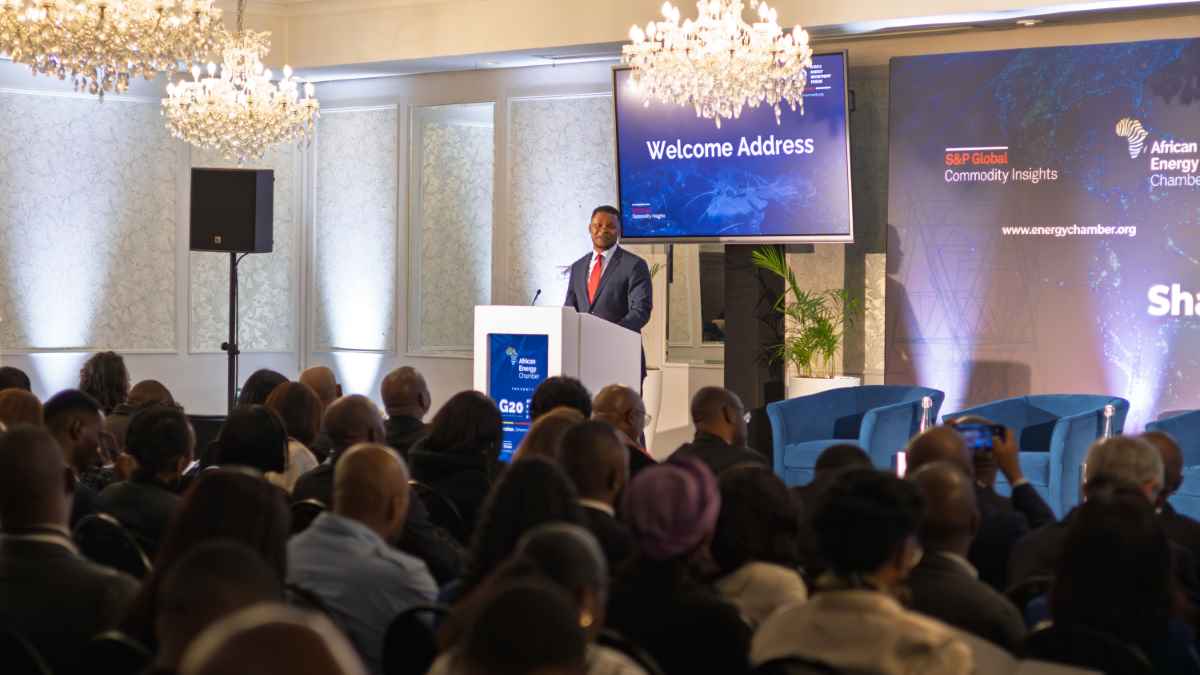
JOHANNESBURG, South Africa, November 21, 2025/APO Group/ –The G20 Africa Energy Investment Forum — hosted by the African Energy Chamber (AEC) (https://EnergyChamber.org/) — opened with calls for Africa to leverage its pension funds to address the continent’s growing infrastructure investment deficit.


NJ Ayuk, the Executive Chairman of the AEC, stressed that with global financial systems deprioritizing Africa’s industrialization, the continent must look inward.

“Millions of Africans still lack access to reliable energy — and that is a human rights issue,” Ayuk said. “We need more than $15 billion in refinery investment alone. We cannot continue relying on external actors. Africa sits on $400 billion in pension funds, and we must channel this capital into closing the energy deficit and giving Africans a real fighting chance. Whether it is renewables or oil, it’s time to innovate and get energy to the people.”

We must protect investments, embrace our oil, gas and renewable resources, and industrialize

He also underscored the importance of youth empowerment in driving Africa’s energy future.

“It starts with forums like this,” he noted. “We must protect investments, embrace our oil, gas and renewable resources, and industrialize. The opportunities we create should empower young people. It is time to pass the torch so they can lead and scale our progress.”

He added that while wealthy nations focus on decarbonizing, the use of pension funds will enable Africa to industrialize.

Echoing Ayuk’s remarks, Nardos Bekele-Thomas, CEO of the African Union Development Agency (AUDA-NEPAD), highlighted the scale of untapped domestic capital available to accelerate energy and infrastructure development.

“By optimizing the balance sheets of existing portfolios, governments can unlock billions without turning to external financing,” she said. “African pension funds hold $1.5 trillion in assets under management. We are working to channel even a fraction of this domestic capital into African infrastructure.”

Distributed by APO Group on behalf of African Energy Chamber.

Home  Facebook

Energy

Halliburton Repositions for Venezuela’s Upstream Revival at Venezuela Energy Week 2027

Published

on

Etu Energias

Halliburton will join Venezuela Energy Week as a Platinum Sponsor as international operators accelerate efforts to restore production, reactivate drilling capacity and rebuild the oilfield services ecosystem

CARACAS, Venezuela, August 27, 2026/APO Group/ –Halliburton has joined Venezuela Energy Week 2027 as a Platinum Sponsor, bringing one of the world’s leading oilfield services companies into a market where international operators are moving to restore production and expand upstream activity. Taking place February 22–25 in Caracas, Venezuela Energy Week comes as a new investment cycle is creating fresh demand for drilling, well services, reservoir evaluation and production technologies.


Halliburton has already begun repositioning its Venezuelan operations for the changing market. In April, Chairman, President and CEO Jeff Miller said the company was discussing commercial terms with customers and had visited its Venezuelan facilities, which he said were in better condition than expected. In July, Venezuela’s Supreme Court ordered the restart of Halliburton’s operations and the return of previously seized assets, removing a significant legal obstacle to the company’s reactivation. Halliburton has since posted new positions in Venezuela, including roles in Maturín covering logging and perforating maintenance and supply-chain procurement, as well as a technical sales position in Zulia.

The timing reflects growing demand for oilfield services as Venezuela moves to reactivate mature fields, expand drilling and bring new investment into production. Halliburton’s capabilities span the full well lifecycle, including drilling, formation evaluation, well construction, completion and production, with services such as well intervention, cementing and stimulation increasingly important as operators work to restore aging wells and infrastructure. As new investment moves from agreements into field activity, Halliburton is positioned to provide the technical expertise and equipment required to translate Venezuela’s resource potential into additional production.

The investment environment is also changing. Venezuela’s January 2026 reform of the Organic Hydrocarbons Law opened new avenues for private participation in primary hydrocarbons activities, including operating and production contracts under which private companies can assume technical, operational and financial management. Subsequent regulations issued in July established the framework for royalties and the integrated hydrocarbons tax, while oil companies have been working to migrate existing agreements into the new regime.

This evolving framework is creating an increasingly important role for international oilfield service companies capable of supplying technology, equipment and technical expertise at scale. Halliburton’s renewed engagement comes as Venezuela moves from regulatory reform and investment agreements toward the practical work of drilling wells, restoring production and expanding field capacity.

At Venezuela Energy Week 2027, Halliburton will bring its renewed Venezuelan presence into discussions on the practical requirements of production growth, from drilling and well construction to completion and intervention. Its Platinum Sponsorship will place the company at the center of conversations around how Venezuela can rebuild oilfield capacity and translate new investment into additional barrels.

Distributed by APO Group on behalf of Energy Capital & Power.


Continue Reading

Energy

Welligence Joins Angola Oil & Gas (AOG) 2026 as Associate Sponsor as Angola Enters New Production Cycle

Published

on

Etu Energias

As gas commercialization, deepwater developments and a shifting exploration landscape reshape Angola’s upstream sector, Welligence will bring its market intelligence expertise to the Angola Oil & Gas 2026 Conference and Exhibition

LUANDA, Angola, August 27, 2026/APO Group/ –Angola’s upstream industry is entering a new investment cycle, with gas commercialization, deepwater development, renewed exploration activity and an expanding independent operator base creating new opportunities across the market. Against this backdrop, energy intelligence firm Welligence has joined the Angola Oil & Gas (AOG) 2026 Conference and Exhibition as an Associate Sponsor.


Welligence provides upstream intelligence covering assets, reserves, production, economics, mergers and acquisitions and emerging investment opportunities, combining analyst expertise with data and AI-driven analytics. Its platform includes more than 4,000 asset-level reports and a database covering 40,000 M&A transactions, supporting companies evaluating upstream markets and investment decisions.

Angola represents an increasingly dynamic market for this type of intelligence. Welligence has identified the country’s upstream sector as entering a new phase of growth and repositioning, supported by gas developments, new oil projects, renewed exploration and rising activity among independent operators.

On the gas front, the start of Angola’s first non-associated gas project, led by the New Gas Consortium, is paving the way for increased feedstock supply to Angola LNG. Meanwhile, the country’s landmark dedicated gas discovery at Block 1/14 in 2025 has strengthened the role of gas commercialization within Angola’s broader upstream strategy.

At the same time, new oil developments are supporting production growth, although Welligence highlights the continued need for greenfield investment as mature assets decline. Recent milestones include the start-up of the Begonia and CLOV Phase 3 projects in 2025, the commissioning of the Agogo FPSO last August and continued progress at the Kaminho project, which is expected to begin production in 2028.

The operator landscape is also evolving. Welligence has highlighted renewed exploration activity by international majors alongside growing participation from independent companies, particularly as Angola’s onshore sector opens and operators seek to reactivate mature assets and build new portfolios.

Recent transactions reinforce this trend. Equinor entered TotalEnergies’ Block 17 in June 2026, while Afentra expanded its onshore footprint through operatorship of KON 5. Woodside Energy’s three-block deal signed in May further underscored growing confidence in Angola’s frontier opportunities, while Etu Energias strengthened its position through acquisitions in Blocks 14 and 14K.

These shifts are increasing the importance of reliable market intelligence as companies assess acreage, transactions, project economics and production potential. Welligence’s participation at AOG 2026 comes at a time when investors and operators are seeking greater visibility into the opportunities shaping Angola’s next phase of upstream growth.

As Associate Sponsor, Welligence will contribute an analytical perspective to discussions at AOG 2026, where industry leaders will examine the investments, partnerships and strategies driving Angola’s energy sector forward. With new entrants entering the market and established operators advancing major developments and exploration programs, data-driven insights will remain critical to guiding future investment decisions.

Distributed by APO Group on behalf of Energy Capital & Power.


Continue Reading

Business

Namibia’s Orange Basin Moves Toward First Oil at African Energy Week (AEW) 2026

Published

on

African Energy Chamber

The “Invest in Namibia: Transforming Discoveries into Production” session will examine how Namibia can turn its offshore oil boom into a broader industrial opportunity through local suppliers, skills development, technology transfer and domestic investment

CAPE TOWN, South Africa, August 27, 2026/APO Group/ –After a series of major offshore discoveries transformed Namibia into one of the world’s most closely watched exploration frontiers, attention is shifting from proving resources to building the infrastructure, partnerships and industrial capabilities needed to bring them into production. At African Energy Week (AEW) 2026, the session “Invest in Namibia: Transforming Discoveries into Production. Orange Basin’s Path to First Oil” will examine how the country can capture value beyond the development of individual oil fields and use the emerging petroleum sector as a catalyst for wider economic growth.


TotalEnergies’ Venus discovery is technically ready to move toward a Final Investment Decision, with negotiations on fiscal terms still underway. The project’s development concept targets around 150,000 barrels per day at peak production, with first oil potentially around 2030. FEED has been completed and major contractors selected, bringing Namibia’s first potential deepwater oil development closer to execution.

The real measure of Namibia’s oil opportunity will not simply be how many barrels it produces, but how much economic value those barrels create at home

Meanwhile, the Orange Basin continues to attract major international players. TotalEnergies and Galp strengthened their positions across the Venus and Mopane discoveries in 2025, with TotalEnergies becoming operator of Mopane and Galp taking a participating interest in Venus. In August 2026, Equinor agreed to acquire a 17.4% stake in Chevron’s PEL 90, marking its first upstream entry into a new country since 2017. The block is expected to see another exploration well before the end of the year.

The scale of investment now being contemplated makes the question of local economic participation increasingly urgent. Namibia’s draft Local Content Policy identifies the development of national capabilities, employment, local procurement and stronger domestic value chains as central to ensuring that petroleum resources generate benefits beyond government revenues. The government has also highlighted technical training and partnerships with universities and industry as priorities for preparing Namibians for the emerging oil and gas sector.

For Namibia, this means moving beyond an export-led model in which capital, equipment and specialist expertise flow in and crude flows out. Developing local suppliers, financing Namibian businesses, building research and training hubs and creating opportunities for joint ventures could help establish capabilities that extend well beyond the life of individual oil projects. The opportunity spans engineering and fabrication, logistics, marine services, environmental management, digital technologies and other areas of the petroleum supply chain.

“The real measure of Namibia’s oil opportunity will not simply be how many barrels it produces, but how much economic value those barrels create at home,” said NJ Ayuk, Executive Chairman of the African Energy Chamber. “Namibia has a chance to build a competitive African energy industry around its discoveries – one that creates jobs, develops local companies, transfers technology and gives Namibians a meaningful stake in the country’s energy future.”

The session will look beyond first oil itself to the ecosystem required to sustain production and translate upstream investment into long-term industrial development. With Venus, Mopane and further Orange Basin exploration moving toward development, Namibia has an opportunity to establish the commercial partnerships, financing structures and technical capabilities needed to ensure its petroleum boom becomes an economy-wide growth story.

Distributed by APO Group on behalf of African Energy Chamber.


Continue Reading

Trending