Connect with us
Anglostratits

Events

Africa’s Green Economy Summit (AGES) 2026 delivers definitive roadmap to turn Africa’s climate ambition into bankable, scalable reality
Published

on

AGES

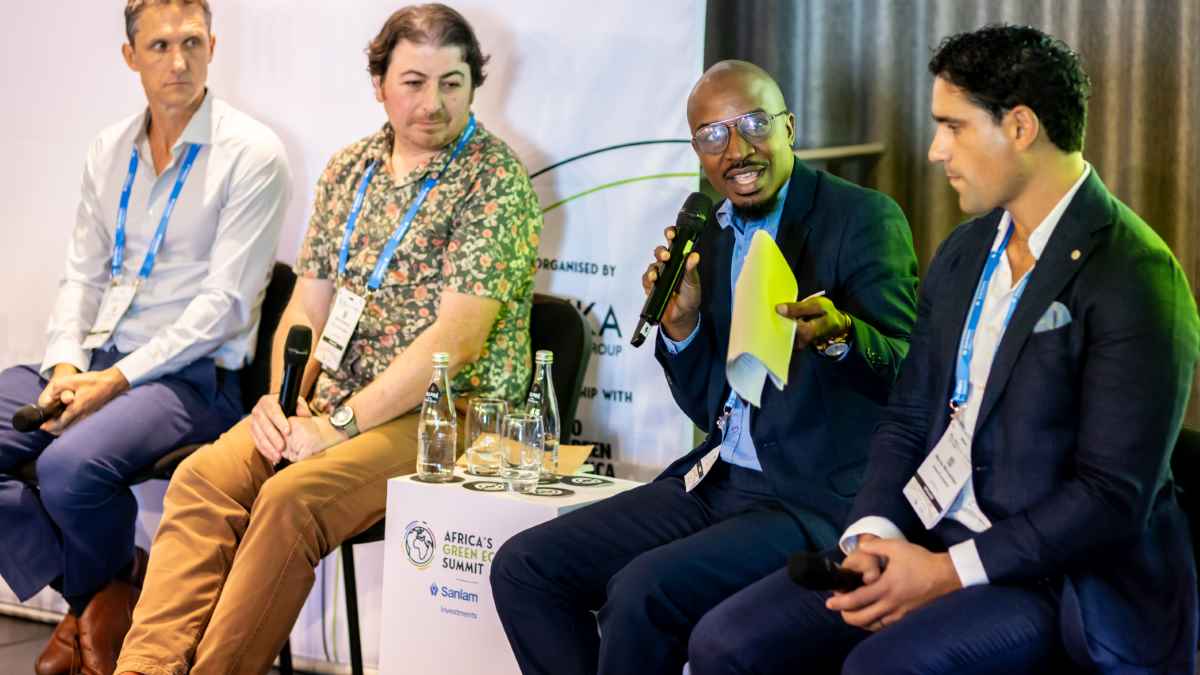
The summit opened with a focus on innovative finance for nature, exploring green, blue, and wildlife bonds, including the “Rhino Bond” and emerging biodiversity credits

CAPE TOWN, South Africa, March 5, 2026/APO Group/ –Africa’s Green Economy Summit (AGES) 2026 concluded in Cape Town with a resounding call to action, urging the continent to leverage its digital revolution, transform water financing and redesign agriculture to unlock a sustainable, net-zero future. The four-day platform united over 600 delegates from 42 countries, including global investors, project developers and policymakers. The consensus was clear that with sound policies and financial innovation, Africa can convert its climate vulnerabilities into economic opportunity.


Pioneering new models for climate finance

The summit opened with a focus on innovative finance for nature, exploring green, blue, and wildlife bonds, including the “Rhino Bond” and emerging biodiversity credits. A key lesson was the importance of engaging communities as core stakeholders, not merely beneficiaries.

Carl Roothman, CEO of Sanlam Investment Group, stressed the urgency of scale: “Africa needs billions of dollars. It’s great to dream, but we must act and at scale.” Iain Banner, co-founder of Go Green Africa and AGES, framed the shift as fundamental: “The green and blue economies are the new operating systems of the modern world.”

Government calls for practical collaboration

Deputy Minister of Forestry, Fisheries and Environment, Narend Singh, set a pragmatic tone: “This is where the rubber hits the road.” He emphasised moving from policy to tangible results, citing South Africa’s Just Energy Transition Partnership (JETP) and renewable energy procurement programme as examples. Singh urged African nations to move beyond exporting raw materials: “A low-hanging fruit is developing local value chains and beneficiating minerals here, creating jobs and advancing technology.”


A digital imperative for climate action

Integrating climate goals with digital transformation emerged as a central theme. Siddhartha Raja, Senior Digital Specialist at the World Bank, noted that data centres could act as “anchor loads” to stimulate new renewable energy but warned that climate resilience must be designed in from the start. From flood-proofing to managing e-waste, which could spawn new recycling industries.

The green and blue economies are the new operating systems of the modern world

Chrissy Meier of the Digital Impact Alliance highlighted a critical gap, noting that most African cities have climate plans but lack local data for implementation. She cautioned against AI models trained on non-African data, which risk missing the realities of African communities. Raja’s advice: “Carpe Digital, seize the digital to make economies more efficient, inclusive, and greener.”


Making water infrastructure bankable

A high-level panel tackled the perception that water projects are uninvestable. Obadiah Mungai of the World Resources Institute Africa argued the real issue is translation: “How do you convert water outcomes into bankable outputs?” Fixing governance and data is the first step to attracting capital.

Louise Stafford of The Nature Conservancy cited Cape Town’s post-“Day Zero” investment in catchment restoration, which proved far more cost-effective than desalination. “There is a bigger risk in business as usual than in investing in water,” she said. The panel concluded that with robust preparation and blended finance, water resilience can become an attractive asset class.


Strengthening food security through renewable energy

Energy instability directly threatens food systems, without reliable power, irrigation fails and cold chains break. Henry Roman of the International Water Management Institute called for a holistic approach to the water-energy-food nexus, showcasing data tools helping farmers optimise water use.

Ian de Jager of I&F Engineering noted a new trend: farmers becoming energy producers, using small-scale hydropower to power operations and sell excess renewable energy certificates. Andrea Campher of Standard Bank added that with the Carbon Border Adjustment Mechanism (CBAM) now in effect, a farmer’s emissions profile is as critical as product quality. “Renewable energy strengthens ESG credibility,” she said.

AGES 2026 has laid the cornerstone for a resilient green economy, proving that when climate goals are woven into the continent’s core systems, ambition transforms into tangible progress. The next summit takes place 17-19 March 2027 in Cape Town.

Distributed by APO Group on behalf of VUKA Group.

Energy

Gold Fields, Moore Global and Mali Chamber of Mines to Lead Gold Growth Dialogue at African Mining Week (AMW) 2026

Published

on

Gold Fields

As record prices reshape investment priorities, industry leaders will examine the strategies, partnerships and financing needed to expand Africa’s gold production

CAPE TOWN, South Africa, July 23, 2026/APO Group/ –As African governments and mining companies accelerate efforts to expand gold production and capitalize on strong global demand, African Mining Week (AMW) 2026, taking place October 14–16 in Cape Town, will spotlight the policies, partnerships and investments driving the continent’s next phase of growth in the gold sector.


The event will feature a dedicated panel, Expanding Africa’s Gold Output, exploring strategies to increase gold production, formalize artisanal and small-scale mining and strengthen investment across the value chain.

The session will be moderated by Matt Banton, Head of Mining at Moore Global, and feature Fousseni Togola, President of the Mali Chamber of Mines, and Benford Mokoatle, Executive Vice President: South Africa at Gold Fields.

The discussion comes as the global gold market continues to strengthen. Gold prices have remained above $4,000 per ounce throughout 2026, supported by sustained central bank demand as countries increase gold reserves to diversify foreign exchange holdings and strengthen financial resilience. Across Africa, central banks in Tanzania, Kenya, Ghana, Uganda, Egypt and Namibia have expanded gold purchase programs, reinforcing demand while creating new opportunities for domestic producers.

African gold-producing nations are responding by introducing reforms aimed at increasing production and improving sector governance. In Mali, the government is strengthening the artisanal and small-scale gold mining sector as part of its strategy to maintain annual gold production above 60 metric tons. In July 2026, the country established the Malian Office of Precious Substances, a new state institution responsible for regulating and formalizing artisanal gold production across approximately 400 mining sites employing nearly two million people. At the same time, Mali continues to strengthen partnerships with major mining companies, including Barrick, B2Gold, Toubani Resources and Cora Gold, to sustain long-term production growth and attract additional investment.

At AMW 2026, Togola is expected to discuss how the Mali Chamber of Mines is supporting these reforms while highlighting the investment opportunities emerging across the country’s gold sector. His participation will explore the role of chamber members in expanding production, strengthening local participation and positioning Mali among Africa’s leading gold producers.

South Africa is also advancing initiatives to revitalize its gold industry through increased exploration and long-term mine investment. Earlier this year, the government expanded the Junior Mining Exploration Fund to R600 million, improving access to exploration capital for emerging mining companies and supporting efforts to unlock new gold discoveries.

Complementing these national initiatives, Gold Fields is investing R1.714 billion through 2027 to deepen its flagship South Deep Mine, positioning the operation as a long-life production hub well beyond 2030. Gold Fields’ Mokoatle is expected to provide an update on the company’s long-term investment strategy, highlighting how innovation and sustained capital investment are supporting South Africa’s efforts to strengthen gold production.

As investment accelerates across Africa’s gold sector, AMW 2026 provides a premier platform to connect governments, producers, investors and service providers, advancing the partnerships and capital needed to unlock the continent’s next phase of gold production growth.

Distributed by APO Group on behalf of Energy Capital & Power.

Continue Reading

Energy

Viridien Brings Global Seismic Intelligence to Angola Oil & Gas (AOG) 2026 as Bronze Sponsor

Published

on

Etu Energias

Viridien is expanding advanced seismic coverage to support exploration decisions across Angola’s mature and frontier basins

LUANDA, Angola, July 22, 2026/APO Group/ –Global technology and data company Viridien is strengthening its presence in Angola through advanced seismic imaging, reprocessing and multi-client data programs designed to support the country’s next phase of exploration. The company has joined the Angola Oil & Gas (AOG) 2026 Conference and Exhibition, taking place September 9-10 with a pre-conference day on September 8, as a Bronze Sponsor, highlighting the growing role of subsurface intelligence as operators evaluate new acreage and pursue higher-confidence drilling targets.

Angola is accelerating exploration across offshore and onshore basins to replenish reserves and sustain crude production above one million barrels per day. This strategy is driving demand for higher-resolution seismic data that can help companies better understand complex geological structures, reduce uncertainty and identify prospective opportunities before committing capital to drilling.

Viridien maintains extensive 3D broadband seismic coverage across the Lower Congo and Kwanza basins, two of Angola’s most established offshore exploration regions. Its datasets support prospect generation and acreage evaluation across producing areas, as well as emerging deepwater and pre-salt plays.

A key component of Viridien’s Angolan portfolio is a regional 3D pre-stack depth migration dataset covering more than 7,200 km². The dataset delivers enhanced imaging of pre-salt and post-salt structures, where complex geology can make conventional interpretation challenging. These insights enable operators to refine geological models, prioritize prospects and better assess exploration opportunities.

Viridien expanded its portfolio in 2025 with the launch of a seismic reimaging program covering Block 22. The approximately 4,300 km² dataset is designed to support evaluation of underexplored structures along the Atlantic Hinge zone ahead of Angola’s upcoming licensing round. Final results are expected in the second half of 2026, providing prospective investors with updated subsurface insights as they assess potential participation in the block.

The program comes as Angola works to attract new entrants and encourage existing operators to increase exploration activity. Major developments in the Kwanza Basin, renewed interest in Namibe and Benguela, and upcoming licensing opportunities are expanding the range of acreage under evaluation. At the same time, operators are revisiting mature areas where improved seismic processing can reveal overlooked prospects close to existing infrastructure.

Viridien’s Bronze Sponsorship of AOG 2026 will connect the company with operators, regulators and investors assessing Angola’s next generation of exploration opportunities. By enabling more informed acreage evaluation and prospect selection, Viridien’s seismic technologies can help reduce exploration uncertainty and support the development of future drilling campaigns.

Distributed by APO Group on behalf of Energy Capital & Power.


Continue Reading

Energy

Local Content Leaders to Drive Workforce Development Agenda at African Energy Week (AEW) 2026

Published

on

African Energy Chamber

Senior executives from Petrofund, the NCDMB and IFP Training are expected to examine how African can build the skilled workforce needed to support the continent’s next phase of energy development

CAPE TOWN, South Africa, July 22, 2026/APO Group/ –As Africa enters a new energy investment cycle, building a skilled local workforce has become just as important as attracting capital. The African Energy Week (AEW) Conference and Exhibition, taking place on October 12-16 in Cape Town, positions this topic at the center of its program agenda, with leading voices in skills development, workforce training and local content policy speaking.


The speaker lineup includes Nillian Mulemi, CEO, Petrofund, Felix Omatsola Ogbe, Executive Secretary, Nigerian Content Development and Monitoring Board (NCDMB) and Loïc du Rusquec, Executive Board Member and Board Director, IFP Training. Together, they bring decades of experience developing national talent pipelines, strengthening institutional capacity and ensuring local professionals are equipped to support increasingly complex energy projects across the continent.

Africa’s energy future will not be determined solely by the projects we develop, but by the people we equip to lead them

Established in 1993, Petrofund advances human capital development through scholarships, institutional support and strategic partnerships that strengthen science, engineering and technical education. The organization operates under a mandate to build the skilled workforce needed to support Namibia’s emerging upstream petroleum industry. With TotalEnergies pursuing Venus FID in 2026 and the race for first oil production by 2030 on, Petrofund aims to position Namibia’s youth at the forefront of the country’s next development chapter. Mulemi is expected to share insight into this strategy during AEW 2026.

Representing Nigeria, Ogbe joins the conference at a time when the country is striving to reach two million barrels per day in oil production, driven by a renewed wave of billion-dollar investments. The NCDMB positions Nigerian companies and entrepreneurs at the center of this investment drive by promoting the development and utilization of in-country capacities for the industrialization of the country. Recent milestones reflect this vision, including the launch of a Cradle-to-Career academic excellence program, new oil and gas training certification and a human capital development program introduced alongside TotalEnergies and Geoplex.

Meanwhile, as a leader in professional training and skills development for the energy, mobility and environment sectors, IFP Training delivers specialized programs covering exploration, production, refining, energy transition technologies and operational excellence, helping companies and governments strengthen workforce capabilities across traditional and emerging energy sectors. Through its partnerships with operators and national institutions worldwide, IFP Training continues to support the development of highly skilled technical professionals capable of meeting the evolving demands of the global energy industry. Du Rusquec joins AEW 2026 to discuss the impact of these programs on Africa’s energy sector.

“Africa’s energy future will not be determined solely by the projects we develop, but by the people we equip to lead them. Building local technical expertise, strengthening national institutions and creating opportunities for African professionals are essential to ensuring the continent captures the full value of its natural resources,” says NJ Ayuk, Executive Chairman of the African Energy Chamber.

Distributed by APO Group on behalf of African Energy Chamber.


Continue Reading

Trending