

Business
Africa Women Innovation and Entrepreneurship Forum (AWIEF) Announces Finalists for 2023 AWIEF Awards
An international and independent Panel of Judges selected the twenty-four (24) finalists across eight (8) categories
CAPE TOWN, South Africa, September 20, 2023/APO Group/ —
The Africa Women Innovation and Entrepreneurship Forum (AWIEF) (https://www.AWIEForum.org) is delighted to announce the finalists for its 2023 AWIEF Awards.
Launched in 2017, the prestigious annual AWIEF Awards is an initiative to recognise, honour, and celebrate women entrepreneurs and business owners in Africa across various industry sectors for their achievements and contribution to the continent’s inclusive economic growth and social development.
An international and independent Panel of Judges selected the twenty-four (24) finalists across eight (8) categories. These outstanding women founders and business leaders operate in a diverse range of sectors and represent companies from fourteen (14) different African countries: Cameroon, Egypt, Ethiopia, Kenya, Morocco, Nigeria, Rwanda, Senegal, Sierra Leone, South Africa, Tunisia, Uganda, Zambia, and Zimbabwe.
The 2023 AWIEF Awards winners will be announced and celebrated at a special ceremony and gala dinner at the AWIEF2023 Conference and Awards, taking place on 9 and 10 November at the Kigali Convention Centre, Kigali, Rwanda.
AWIEF Founder and CEO, Irene Ochem, said: “Given the huge number and calibre of the nominations received this year, it is clear that female entrepreneurship and business leadership is thriving across Africa. It is our honour to recognise and celebrate the achievements and contributions of these women to the inclusive growth of their respective sectors, their countries and the continent’s economy.”
A member of the 2023 AWIEF Awards Panel of Judges, John-Paul Iwuoha, Founder of Smallstarter Africa, said: “As a Judge, I was thoroughly impressed by the quality of applications in all the categories. It is great to see how AWIEF continues to attract innovative women across Africa who are creating enormous value for society.”
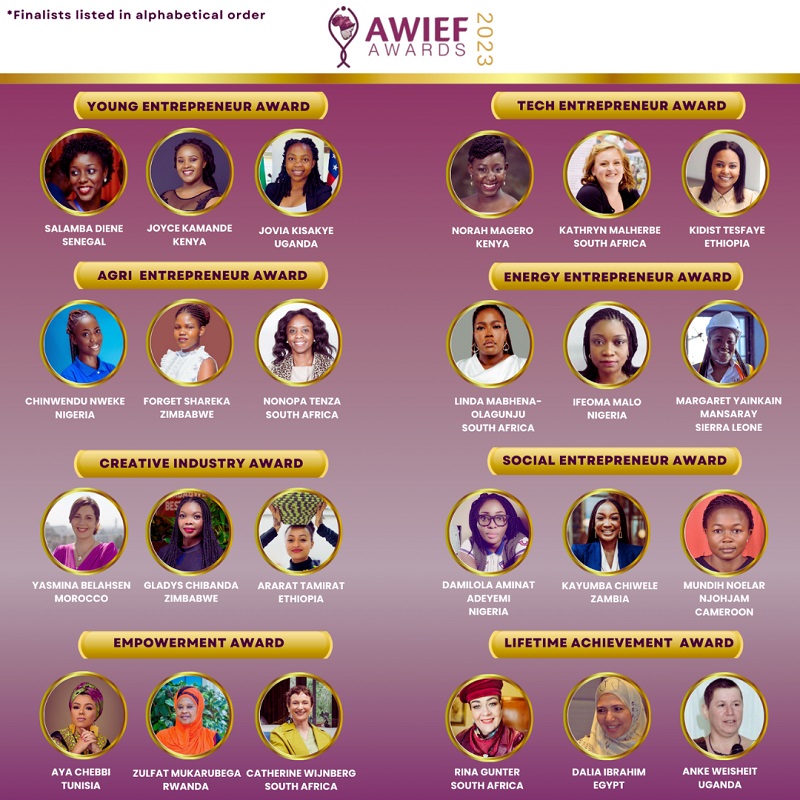
The finalists for the 2023 AWIEF Awards are (listed in alphabetical order):
Young Entrepreneur Award
Salamba Diene, CEO, BIOSENE SARL, Senegal
Joyce Kamande, Co-founder & CEO, Safi Organics, Kenya
Jovia Kisakye, CEO, Sparkle Agro Brand, Uganda
Tech Entrepreneur Award
Norah Magero, Founder & CEO, Drop Access Limited, Kenya
Kathryn Malherbe, CEO, Med Sol AI Solutions, South Africa
Kidist Tesfaye, Founder & CEO, YeneHealth, Ethiopia
Agri Entrepreneur Award
Chinwendu Nweke, CEO, Bridge Merchant Enterprise, Nigeria
It is great to see how AWIEF continues to attract innovative women across Africa who are creating enormous value for society
Forget Shareka, Founder, Chashi Foods, Zimbabwe
Nonopa Tenza, Founder & MD, Kevinot Farming, South Africa
Energy Entrepreneur Award
Linda Mabhena-Olagunju, Founder & CEO, DLO Energy Resources Group, South Africa
Ifeoma Malo, CEO, Clean Technology Hub, Nigeria
Margaret Yainkain Mansaray, Founder & CEO, Women in Energy Sierra Leone Limited, Sierra Leone
Creative Industry Award
Yasmina Belahsen, Founder, MayaDigital, Morocco
Gladys Chibanda, Founder & CEO, Krafted Ink, Zimbabwe
Ararat Tamirat, Founder & GM, Tuba By Ararat, Ethiopia
Social Entrepreneur Award
Damilola Aminat Adeyemi, Co-founder & CEO, D-Olivette Global Enterprise, Nigeria
Kayumba Chiwele, Founder & Principal Psychologist, MindAid Zambia, Zambia
Mundih Noelar Njohjam, Medical Doctor, Epilepsy Awareness, Aid and Research Association, Cameroon
Empowerment Award
Aya Chebbi, Founder & President, Nalafem Collective, Tunisia
Zulfat Mukarubega, Founder, University of Tourism, Technology and Business Studies, Rwanda
Catherine Wijnberg, Founder & CEO, Fetola, South Africa
Lifetime Achievement Award
Rina Gunter, Founding Partner, Gunter Attorneys, South Africa
Dalia Ibrahim, CEO, Nahdet Misr Publishing House, Egypt
Anke Weisheit, Co-founder & Chair, PHARMBIOTRAC, Mbarara University of Science and Technology, Uganda
Tickets for the AWIEF2023 Conference and Awards are available online at: https://apo-opa.info/3JHKUem
Distributed by APO Group on behalf of Africa Women Innovation and Entrepreneurship Forum (AWIEF).











Business
CIT VERICASH Recognized as Best Digital Financial Services Platform of 2026 by Global Business Outlook
Business
Comsol enters wholesale 5G home broadband market with backing from new shareholders
Business
Electra Mining Africa: Showcasing the Technologies Shaping the Future of Industry
More than 1,000 exhibitors, technical seminars, industry forums and networking opportunities will bring together the people, products and ideas shaping industrial progress across Africa
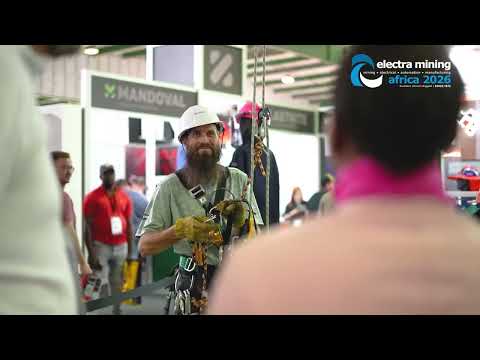
Taking place from 7-11 September at the Johannesburg Expo Centre in Nasrec, Johannesburg, Electra Mining Africa will once again provide a meeting place for industry. Recognised as one of Africa’s leading industrial exhibitions, the event will bring together more than 1,000 predominantly local exhibitors, together with international companies, country pavilions, industry organisations, technical specialists, business leaders and decision-makers from across mining, manufacturing and related industries.
By bringing together six complementary sectors—mining, manufacturing, automation, electrical and power, transport and related engineering sectors—under one roof, Electra Mining Africa enables visitors to explore how integrated technologies and solutions can improve productivity, safety and operational performance. The exhibition provides a unique opportunity to compare products, engage directly with technical experts and discover how innovations from different sectors are increasingly working together to support smarter industrial operations.
Reflecting continued industry confidence, Electra Mining Africa has expanded its footprint for the 2026 edition, growing by 4,000m² to a record 44,000m² of net exhibition space across six indoor exhibition halls and expanded outdoor display areas.
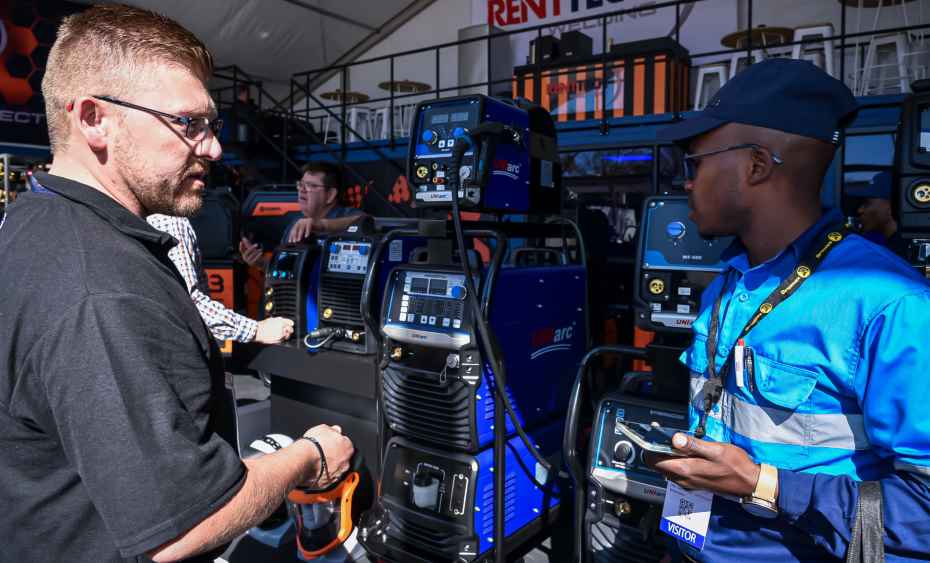
Visitors will have the opportunity to explore solutions ranging from large-scale mining equipment and industrial machinery to automation systems, artificial intelligence (AI), robotics, digital manufacturing, predictive maintenance technologies, power solutions and advanced engineering services. The exhibition also features pumps, valves, welding and fabrication equipment, safety solutions, personal protective equipment (PPE), tools, components and specialist industrial services.
Electra Mining Africa has become an important business platform for companies serving markets across Africa. At the previous edition, industry professionals from 58 countries were represented, reflecting the exhibition’s growing international reach and its role in connecting manufacturers, technology suppliers, distributors, buyers and decision-makers from across the continent and beyond. For many exhibitors, the exhibition provides opportunities to strengthen customer relationships, meet prospective buyers, appoint distribution partners and explore new business opportunities. For visitors, it offers access to both internationally recognised brands and locally developed technologies designed to address the operational requirements of African industry.
Electra Mining Africa brings together the technologies, expertise and industry relationships that help organisations make informed decisions
Beyond the exhibition floor
Electra Mining Africa offers an extensive programme of technical knowledge sharing, professional development and industry collaboration. Free-to-attend seminars hosted by the Southern African Institute of Mining and Metallurgy (SAIMM) will explore practical operational challenges and emerging technologies, while the Society for Automation Instrumentation Mechatronics and Computer Engineering (SAIMC) will present specialist workshops on advances in automation and mechatronics. WiMSA’s Women in Mining workshop will provide a forum for discussion around leadership, opportunity and professional development, and the Lifting Equipment Engineering Association of South Africa (LEEASA) will host its two-day National Conference, bringing together industry professionals to share knowledge and discuss developments affecting the sector.
New for 2026, the SA Institution of Mechanical Engineering (SAIMechE) Skills and Career Hub will strengthen collaboration between industry and the education and training sector, encouraging conversations around future workforce requirements, skills development and innovation. Visitors will also be able to experience the Geological Society of South Africa (GSSA) Explorers Pitch, where finalist student teams present their mineral exploration projects to an expert industry judging panel before the winning team is announced.
Also taking place during Electra Mining Africa are the New Products and Innovation Awards, which recognise outstanding achievements by both local and international exhibitors. Adjudicated by the South African Capital Equipment Export Council (SACEEC), entries are evaluated against a comprehensive set of criteria, including innovation, engineering excellence, research and development, product quality, technical expertise and the practical value each solution delivers to industry. The winners are announced during the exhibition, recognising companies whose products and innovations are advancing technology, performance and industrial application.
“Industrial businesses are facing increasingly complex challenges that cannot be solved in isolation. Electra Mining Africa brings together the technologies, expertise and industry relationships that help organisations make informed decisions, identify practical solutions and build partnerships that support long-term growth. That’s what makes the exhibition such an important meeting place for industry, not only in South Africa but for businesses operating across the African continent,” says Charlene Hefer, Portfolio Director at Montgomery Group, organisers of Electra Mining Africa..
Industry professionals wishing to attend Electra Mining Africa can register (https://apo-opa.co/4xthQPH) as a Standard Visitor free of charge. There is also an option to upgrade to a Diamond Select Visitor.
Distributed by APO Group on behalf of Montgomery Group Africa.