Connect with us

Business

The Supply Blockchain of Trust (By Viv Muthan Pr Eng)

Published

on

Blockchain

A blockchain is commonly described as a shared, tamper-resistant record of events that allows participants to trust the history of an asset without having to blindly trust one another

JOHANNESBURG, South Africa, August 17, 2026/APO Group/ —By Viv Muthan Pr Eng, Head of Export Sales and Operations.

Trust has been the invisible infrastructure of supply chains for decades. Maintenance engineers trusted procurement teams to source from credible suppliers, while procurement professionals trusted manufacturers to uphold the engineering integrity of the products they supplied. In the last two decades, this reality has dramatically shifted with counterfeiters becoming more sophisticated, technology becoming more accessible, and imitation products becoming increasingly difficult to distinguish from the genuine article. The result is that trust has fragmented and the onus of verification is falling back onto the shoulders of the product users. The problem is that even the most experienced engineer will struggle to verify a genuine product under these conditions because they are no longer competing against opportunistic non-expert counterfeiters making products that are ostensibly cheap and nasty. They are competing with networked operations with access to advanced manufacturing technologies, digital design tools and increasingly sophisticated methods of replication.

Many years ago, the humble bearing became one of the first industrial products to be widely counterfeited. Initially, identifying a fake was relatively straightforward. Products carried obvious tell-tale signs: dye marks instead of genuine heat-treatment discolouration, spelling mistakes in product markings, poor packaging quality, unreliable documentation and no verifiable connection to an authorised source of supply. Bearing original equipment manufacturers (OEMs) responded quickly. They launched awareness campaigns, strengthened distributor accreditation programmes and introduced anti-counterfeiting measures such as holographic labels, serialisation and QR-code verification systems. Packaging quality improved and traceability became more robust.

Within a few years, counterfeiters adapted. They started attending trade shows, copied packaging standards and used crude optical character recognition (OCR) technology to improve the visual appearance of their products. They invested in moving from copying to manufacturing replicas at scale, learning through the process, refining and getting better with each run. It became almost impossible even for a trained application engineer to spot the differences without a lab test and an electron microscope inspection of the raceways to verify surface finishes. In fact, copies became so good that one OEM actually bought production capacity at the counterfeiting facility and after implementing some standards, started mass production of some of its high-volume SKUs at that plant. This was all before the mass market availability of machine vision and deep learning tools.

So how might modern engineers respond to the very clear and present danger of counterfeit products that potentially jeopardise the lives and livelihoods of millions of people around the world? One useful way to think about the challenge is through the concept of a blockchain. A blockchain is commonly described as a shared, tamper-resistant record of events that allows participants to trust the history of an asset without having to blindly trust one another. It can be thought of as a digital chain of custody, recording the purchase transaction, handoffs, inspections, certificates or movements resulting in a single source of truth that all participants can verify. The value of a blockchain is not the technology but in its ability to preserve history. Once events are reliably recorded, they become difficult to alter without leaving evidence behind.

It can be argued that supply chains require precisely the same capability. Authenticity depends on provenance. Provenance depends on history. And history is only valuable when it can be trusted. A supply blockchain is not necessarily a technology platform but rather the accumulation of verified events across a product’s journey, from manufacture to point of installation or use. Every authorised transaction, inspection, storage movement, quality check and customer delivery contributes another link in the chain of trust.

Every verified event strengthens the supply blockchain and every authenticated transaction reinforces customer confidence

Trusted suppliers have always maintained such records. Historically, trust was established through reputation. Customers bought from suppliers they knew and relied on brands that had proven themselves over decades. Today, reputation remains essential, but reputation alone is no longer enough. Customers increasingly require evidence. The most trusted suppliers will therefore be those that combine reputation with verification. They will be able to demonstrate where products originated, how they moved through the supply chain and whether they remained within authorised channels throughout their journey.

In this sense, every verified event strengthens the supply blockchain and every authenticated transaction reinforces customer confidence. As it always has been, trust is built one memory at a time. The difference today is that digital technologies can make those memories visible, auditable and resistant to manipulation.

For engineers tasked with keeping people safe, equipment operational and production running, that may be the most valuable innovation of all. Not because it eliminates risk, but because it makes trust verifiable. And perhaps that will help them sleep a little better at night, when they are not on standby or working shift.


References:

Zheng, Z., Xie, S., Dai, H., Chen, X., & Wang, H. (2018). Blockchain challenges and opportunities: A survey. International Journal of Web and Grid Services, 14(4), 352-375.

Saberi, S., Kouhizadeh, M., Sarkis, J. and Shen, L., 2019. Blockchain technology and its relationships to sustainable supply chain management. International journal of production research, 57(7), pp.2117-2135.

Staake, T., Thiesse, F. and Fleisch, E., 2009. The emergence of counterfeit trade: a literature review. European Journal of Marketing, 43(3-4), pp.320-349.

RS South Africa (https://Africa.RSDelivers.com) is a trading brand of RS Group plc (LSE: RS1) and a leading provider of industrial product and service solutions.


Distributed by APO Group on behalf of RS South Africa.


Energy

United States (U.S.) Broadens African Energy Push as Volz Brings Washington to African Energy Week (AEW) 2026

Published

on

From LNG finance in Mozambique to grid technology and clean cooking, U.S. government agencies and companies are expanding their engagement with African energy markets as Department of Energy official Josh Volz prepares to join African Energy Week 2026

CAPE TOWN, South Africa, October 2, 2026/APO Group/ –The United States is widening its engagement with Africa’s energy sector, combining government-backed finance, technology partnerships and private-sector investment across markets from Mozambique and Nigeria to Kenya, Uganda and the Democratic Republic of the Congo. Josh Volz, Deputy Assistant Secretary for Europe, Eurasia, Africa and the Middle East at the U.S. Department of Energy, will bring that agenda to African Energy Week 2026 in Cape Town from October 12-16.


Volz returns to AEW as Washington’s engagement with African energy markets increasingly spans both hydrocarbons and electricity infrastructure. In April, the U.S. Trade and Development Agency brought energy decision-makers from the DRC, Ethiopia, Kenya and Uganda to the U.S. to meet American companies working on transmission and distribution technologies, including AI-enabled grid systems. The program was designed to connect U.S. technology providers with prospective projects and procurement opportunities in African power markets.

Mozambique illustrates the scale that U.S. financing can bring to an African gas project. In March 2025, the U.S. Export-Import Bank approved a nearly $5 billion loan for TotalEnergies’ Mozambique LNG development, reviving a financing package for the long-delayed project. The original $4.7 billion commitment had been approved during the first Trump administration but required reapproval after construction was suspended in 2021. Meanwhile, ExxonMobil and its Area 4 partners awarded approximately $1.1 billion in pre-investment contracts for long-lead equipment and early construction activities at the Rovuma LNG project in August.

Development finance is another part of the equation. The U.S. International Development Finance Corporation’s investment ceiling rose from $60 billion to $205 billion following its 2025 reauthorization, while the agency gained expanded authority covering international investments in strategic sectors including energy and critical minerals. The new authorization runs through 2031.

The DFC is better resourced than it has ever been, making this an opportune moment for African operators to make their case

The DFC has also continued to approve new transactions in Africa in 2026. On September 16, the agency announced more than $8 billion in new investments globally, including projects supporting infrastructure and resources across Africa, as part of an effort to promote U.S. exports, energy security and American technology.

U.S. companies such as GE Vernova are active across African power markets, providing generation, transmission, grid and software technologies. The company says its technology is installed in more than 50 countries across the Middle East and Africa; in Nigeria alone, its equipment is installed across more than 40 sites, while its grid technology has also supported regional integration through the West African Power Pool.

Energy access is another emerging strand of Washington’s engagement. U.S. Secretary of Energy Chris Wright co-chaired the July 2026 high-level summit on clean cooking in Africa alongside Kenyan President William Ruto, Norway and the International Energy Agency. The meeting produced $900 million in new commitments, taking total commitments since the 2024 Africa Clean Cooking Summit to more than $3.1 billion. Wright described clean cooking as a major but often overlooked energy-access challenge.

Volz has previously argued that African countries should determine their own energy pathways while the United States looks for ways to partner with them. Speaking at AEW 2025, he said: “International governments should not stand in the way of how African nations determine their energy futures. We are eager to hear how best we can, from a U.S. perspective, partner with Africa.” He also pointed to $65 billion in existing U.S. private-sector investment in Africa and a $2.5 billion U.S. government pledge to support energy expansion.

That approach will have a substantial U.S. presence at AEW 2026. The current program confirms Volz alongside U.S. Senator Ted Cruz, United States Energy Association President and CEO Mark W. Menezes and DFC Managing Director and Regional Head of Africa Vibhuti Jain, among other U.S.-linked executives and policymakers. Jain will also participate in the dedicated U.S.-Africa Energy & Investment Forum on October 14, which will bring together U.S. and African companies, investors and policymakers to discuss capital, technology and commercial partnerships.

“The DFC is better resourced than it has ever been, making this an opportune moment for African operators to make their case. This conference is about making sure the capital and the projects actually find each other,” said NJ Ayuk, Executive Chairman of the African Energy Chamber.

For African energy markets, the expanding U.S. role reaches across project finance, LNG, upstream development, electricity infrastructure, grid technology and clean cooking. Volz’s participation at AEW 2026 comes as those relationships increasingly move from broad policy discussions toward individual projects, commercial partnerships and technology deployment across the continent.

Distributed by APO Group on behalf of African Energy Chamber.


Continue Reading

Business

How Liberia’s Harper Basin Is Emerging as West Africa’s Next Deepwater Frontier

Published

on

The Harper Basin’s advancing exploration program is de-risking Liberia’s premier frontier basin, positioning TotalEnergies and BluEnergies for frontier deepwater drilling success

CAPE TOWN, South Africa, October 2, 2026/APO Group/ –Liberia’s Harper Basin is emerging as one of West Africa’s most compelling frontier exploration opportunities, attracting investment from TotalEnergies and BluEnergies as advanced subsurface studies progressively reduce geological uncertainty across three deepwater offshore blocks.


The basin remains undrilled despite sharing geological characteristics with some of Africa’s largest and latest deepwater plays. As seismic, geochemical and seabed datasets converge, the question now is whether that technical progress will translate into a commercially viable petroleum province?

Frontier Basin Moves Toward Drill-Ready Status

The Harper Basin covers Blocks LB-26, LB-30 and LB-31 under Reconnaissance License RL-003, spanning approximately 8,924 km2 offshore Liberia. TotalEnergies operates the project with a 65% interest alongside BluEnergies, which retains 35%.

The partnership formalized in January 2026 through a joint study and application agreement after BluEnergies secured an early position in the basin during 2023 and advanced independent prospect evaluation.

An independent prospective resource assessment completed in March 2025 estimated unrisked prospective resources of approximately 17.9 billion barrels of oil and 28.8 trillion cubic feet (tcf) of natural gas across seven mapped basin-floor fan systems.

Current work centers on reprocessing 6,167 km2 of legacy 3D seismic data using energy data and intelligence firm TGS. The program recently surpassed 50% completion, delivering improved subsurface imaging and enhanced amplitude versus offset analysis to identify potential hydrocarbon-bearing reservoirs.

Parallel offshore operations began on June 19, 2026, with subsurface specialists GeoPartners deploying the research vessel R/V GYRE, operated by TDI-Brooks, to survey approximately 4,045  km2 in water depths between 500 and 3,500 meters.

The campaign combines multibeam echo sounder mapping, water-column imaging, piston coring and heat-flow measurements. These datasets identify seepage pathways, characterize source-rock maturity and improve confidence in future drilling locations before integration during Q4 2026.

The Jubilee field in Ghana,the Venus field in Namibia and the recent discoveries offshore Ivory Coast have proven the significance of basin floor fan plays along the African margin

Once economically viable anomalies are finalized, TotalEnergies and BluEnergies plan to exercise their rights to convert the reconnaissance license into long-term PSCs by late 2026 or in 2027. This step legally locks in the drilling rights, positioning the partners to advance toward exploration drilling, subject to prospect maturation, regulatory approvals and investment decisions

Geological Analogues Strengthen Exploration Case

Unlike Liberia’s historically explored offshore basin, the Harper Basin occupies a structurally confined transform-margin embayment bounded by major fracture zones that concentrate sediment delivery into thick basin-floor fan complexes.

These Cretaceous-aged Cenomanian and Turonian fan systems are considered direct geological analogues to producing and discovered deepwater plays along the West Africa Transform Margin.

BluEnergies has identified seven discrete basin-floor fan complexes interpreted from seismic data. The current technical program seeks to validate reservoir quality before progressing toward production sharing contracts and exploration drilling.

Vice President of Exploration Sergio Laura says recent licensing activity across the West African margin reinforces BluEnergies’ early entry into Harper Basin, explaining in a press release, “The Jubilee field in Ghana, the Venus field in Namibia and the recent discoveries offshore Ivory Coast have proven the significance of basin floor fan plays along the African margin.”

Unlike earlier Liberian exploration focused primarily on structural traps, the Harper Basin targets stratigraphic pinch-out reservoirs sealed beneath regional marine shales, reducing reliance on fault-dependent trapping mechanisms that limited historical exploration success.

If the current technical program confirms reservoir quality, Liberia could move from being one of West Africa’s least explored offshore jurisdictions to one of its most closely watched frontier plays. With TotalEnergies providing technical expertise and BluEnergies holding an early strategic position, the next milestone is no longer identifying prospects—but determining whether they justify Liberia’s first deepwater exploration wells.

The Harper Basin’s progress comes as Liberia seeks to attract new investment through its 2026 Offshore Direct Negotiation Licensing Round, highlighting the country’s broader offshore potential and growing exploration momentum.


The Launch of the Liberia 2026 Offshore Direct Negotiation Licensing Round – organized by Energy Capital and Power – will take place at African Energy Week (AEW) 2026 on October 14 at The Orchid, CTICC 2. Visit, https://apo-opa.co/4rMJlS7 for more information.


 

Distributed by APO Group on behalf of Energy Capital & Power.


Continue Reading

Business

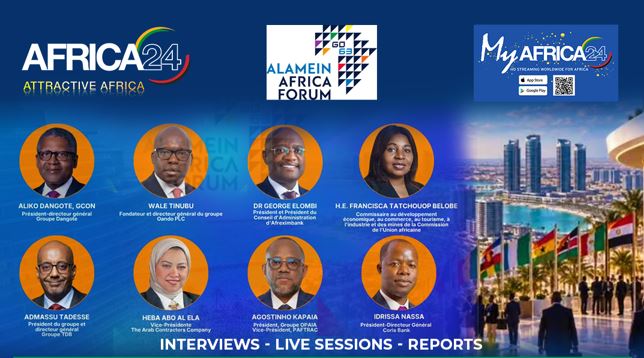
Alamein Africa Forum 2026: Live Coverage on Africa24

Published

on

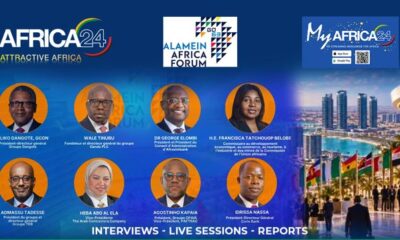
AFRICA24 Group, the continent’s leading TV and digital media group, available in 120 million households, is deploying an optimal set-up to provide full coverage of the ALAMEIN AFRICA FORUM 2026

AFRICA24 Group (www.AFRICA24Group.com) brings you full coverage, live from Al Alamein (Egypt), from 2 to 4 October 2026, of the first edition of the Alamein Africa Forum, a biennial forum co-organised by the Government of Egypt, the African Export-Import Bank (Afreximbank) and the African Union Development Agency (AUDA-NEPAD).

Al Alamein, Egypt’s fourth new city, is hosting Heads of State and Government, senior political figures, leaders of financial institutions, private sector players and institutional investors, on the sidelines of the African Union’s second 2026 annual high-level coordination meeting.


The Alamein Africa Forum is a leading economic and political event for the continent and for entrepreneurial boldness. The vision of African sovereignty championed by the Afreximbank Group, a major partner, is reflected in plenary sessions, sector panels, closed-door roundtables and B2B/B2G meetings dedicated to the key drivers of Africa’s transformation: infrastructure, energy, digital transformation, manufacturing, critical minerals, health markets and intra-African trade.

AFRICA24 GROUP, TV MEDIA PARTNER AND LEADER OF THE AFRICAN NARRATIVE TOLD BY AFRICANS

In a rapidly changing global context marked by the promotion of the African narrative by Africans, AFRICA24 Group is the exclusive TV partner and a pillar of the Alamein Africa Forum. Through its unique coverage, AFRICA24 Group showcases a strategic continental platform designed to turn the African Union’s Agenda 2063 into tangible economic results.

360° continental and global broadcasting with AFRICA24

AFRICA24 Group, the continent’s leading TV and digital media group, available in 120 million households, is deploying an optimal set-up to provide full coverage of the ALAMEIN AFRICA FORUM 2026:

  • Live broadcasts of the opening ceremonies, economic forums and thematic panels, with our special correspondents;
  • Exclusive interviews with political decision-makers, leaders of financial institutions, investors and young African leaders attending in New Alamein;
  • Immersive reports from all sessions and side events.

With AFRICA24 Group, together, let’s transform Africa

Distributed by APO Group on behalf of AFRICA24 Group.


Continue Reading

Trending

Exit mobile version