In an industry still affected by unprecedented disruptions and transformations, Stellantis and its dealer network in Europe have strengthened their partnership to improve customer experience and streamline the overall customer journey
AMSTERDAM, Netherlands, November 1, 2023/APO Group/ —
Net revenues of €45.1 billion, up 7% compared to Q3 2022, mainly reflecting improved volume and consistent pricing, partially offset by foreign exchange impacts; Consolidated shipments(1) of 1,427 thousand units, up 11% versus Q3 2022, with Enlarged Europe, Middle East & Africa, North America and South America reporting year-over-year improvements; Total new vehicle inventory of 1,387 thousand units at September 30, 2023. Company inventory of 388 thousand units, up 158 thousand units from December 31, 2022 reflecting a return to more normal levels after a multi-year period of materially-constrained supplies; Tentative agreement reached with both UAW and Unifor. Work stoppages negatively impacted Net revenues by approximately €3 billion, compared to planned production, through October; Global BEV sales up 37% versus Q3 2022 mainly driven by the Jeep® Avenger and growing commercial BEV vehicles sales led by the Citroën ë-Berlingo; The Company repurchased €0.5 billion in shares during Q3 2023. During the nine months ended September 30, 2023, €1.2 billion in shares were repurchased. The Company expects to complete the announced €1.5 billion 2023 Share Buyback Program during Q4 2023. “In the first half of this year, Stellantis (www.Stellantis.com) emerged as the industry leader for AOI, AOI margin, and Industrial Free Cash Flows among its comparable peers. Today, we are focused on maintaining our momentum by delivering industry-leading profitability and cash flows, addressing critical near-term industry challenges, and continuing our electrification and technology transformation. This growth is propelling the execution of our Dare Forward 2030 strategy”: Natalie Knight, CFO.
Stellantis N.V. continued to build momentum in Q3 2023, delivering a 7% year-over-year increase of Net revenues driven by continued strength in shipments. The Company’s “Third Engine”(5) achieved 25% revenue growth year-over-year. Global BEV sales were up 37% versus third quarter 2022, led by the following vehicles: Jeep® Avenger, Citroën Ami, Peugeot E-208, Fiat New 500e, and Citroën ë-Berlingo. Key activities executed to achieve the Dare Forward 2030 strategic plan include:
Care: In an industry still affected by unprecedented disruptions and transformations, Stellantis and its dealer network in Europe have strengthened their partnership to improve customer experience and streamline the overall customer journey. With the signing of over 8,000 sales and 25,000 aftersales contracts across 10 strategic European countries, it is clear that Stellantis and its business partners share the same goals when it comes to simplification, multi-brand approach, customer centricity, and quality assurance. Austria, Belgium, Luxembourg, and Netherlands have already adopted the new contracts, with the rest of Europe to begin adopting the new model starting in 2024.
Tech: Peugeot revealed the first application of STLA Medium – the first of Stellantis’ four global BEV-by-design platforms – with the new E-3008, offering a best-in-class range of up to 700 km, charging time, performance, efficiency, and driving pleasure. Fiat returned to the B-segment, leading the way for sustainable urban mobility, with the new 600e, which boasts state-of-the-art safety features and an electric range of more than 400km (WLTP(6) combined cycle) and more than 600 km (WLTP(6) urban cycle) in the city. Fiat also unveiled the new Topolino micro-mobility offer with a 75km range and a safe top speed of 45 km/h. The Company also announced the start of all-electric van production at Ellesmere Port – the UK’s first EV-only volume manufacturing plant – and the first Stellantis plant globally dedicated to electric vehicles.
Coming to the market soon is the all-electric Citroën ë-C3. The first affordable European electric car, the ë-C3 delivers best-in-class comfort, and easy electric life thanks to a 44kWh battery pack providing up to 320km (199 miles) WLTP(6) driving range, at fair and net prices in many European markets, starting at €23,300.
Stellantis celebrated the opening of its state-of-the-art Battery Technology Center at the Mirafiori complex in Turin, Italy. The center enhances the Company’s capabilities to design, develop and test battery packs, modules, high-voltage cells, and software to power upcoming Stellantis brand vehicles.
The Company continued to strengthen its global electrification ecosystem and support its carbon neutrality ambitions: (i) concluding testing with Aramco on the compatibility of 24 engine families to use advanced drop-in eFuels, which will lower CO2 emissions of a potential 28 million Stellantis vehicles currently on the road; (ii) unveiling with Saft the Intelligent Battery Integrated System, which the project team intends to make commercially available on Stellantis vehicles before the end of this decade; (iii) announcing plans for a sixth gigafactory globally to support its bold electrification plan of securing approximately 400 GWh of battery capacity; it will be the second facility to be built in the U.S. with Samsung SDI; (iv) investing in Controlled Thermal Resources Holdings Inc.’s Hell’s Kitchen project to produce up to 300,000 metric tons of lithium carbonate equivalent each year; and (v) completing its 33.3% purchase of Symbio, a leader in zero-emission hydrogen mobility to help secure Stellantis’ leadership position in hydrogen-powered vehicles.
Value: To accelerate the transition to electric vehicles in North America, Stellantis and six major global automakers will create an unprecedented charging network installing at least 30,000 high-powered charge points.
Stellantis is also implementing a multifaceted strategy designed to manage and secure the long-term supply of vital microchips, delivering the objectives laid out in Dare Forward 2030. Stellantis’ strategy combines agreements with chip makers for critical semiconductors, purchase of mission-critical parts, and full visibility of future chip needs.
The Company repurchased €0.5 billion in shares during Q3 2023. During the nine months ended September 30, 2023, €1.2 billion in shares were repurchased. The Company expects to complete the announced €1.5 billion 2023 Share Buyback Program during Q4 2023.
In October 2023, the Company announced its plans to acquire approximately 20% of Leapmotor for approximately €1.5 billion and to form Leapmotor International, a 51/49 Stellantis-led joint venture with exclusive rights for the export and sale, as well as manufacturing, of Leapmotor products outside Greater China.
In October 2023, the Company introduced Pro One as the enhanced strategic offensive of its commercial vehicles business to achieve global leadership, encompassing the professional offerings of six iconic brands of Stellantis – Citroën, FIAT Professional, Opel, Peugeot, Ram and Vauxhall, and to support achievement of the Dare Forward 2030 strategic plan targets.
On October 31, 2023 at 2:00 p.m. CET / 9:00 a.m. EDT, a live audio webcast and conference call will be held to present Stellantis’ Third Quarter 2023 Shipments and Revenues. The audio webcast and recorded replay will be accessible under the Investors section of the Stellantis corporate website at www.Stellantis.com. The presentation material is expected to be posted under the Investors section of the Stellantis corporate website at approximately 8:00 a.m. CET / 3:00 a.m. EDT on October 31, 2023.
Upcoming events:
Full Year 2023 Results – February 15, 2024
Investor Day 2024, Auburn Hills, Michigan, USA – June 13, 2024
Q3 2023
Q3 2022
Change
FY 2023 GUIDANCE – CONFIRMEDAdjusted Operating Income Margin(2) Double-DigitIndustrial Free Cash Flows(3) Positive€1.5 billion Share Buyback Program On-Track2023 INDUSTRY OUTLOOK(4)*North America +8% (from 5%)Enlarged Europe +10% (from 7%)Middle East & Africa +10% (from 7%)South America Stable (from 3%)India & Asia Pacific +5% (unchanged)China +2% (unchanged)*2023 Industry Outlook changed for NA, EE, MEA and SA compared to outlook provided on Jul 26 ’23
All reported data is unaudited. Reference should be made to the section “Safe Harbor Statement” included elsewhere within this document.
Segment Performance
NORTH AMERICA
Q3 2023
Q3 2022
Change
Shipments up 7%, led by Chrysler (in particular Pacifica PHEV) which more than doubled y-o-y; Dodge and Ram also improved; Jeep shipments down due to the discontinued current generation Cherokee and scheduled downtime of the Compass, partially offset by Grand Cherokee which nearly doubledNet revenues up 2%, primarily due to higher volumes, positive net pricing and positive mix, mostly offset by unfavorable FX translation effects
YTD 2023
YTD 2022
Shipments (000s)
470
441
+29
1,493
1,400
Net revenues (€ million)
21,523
21,071
+452
67,439
63,514
ENLARGED EUROPE
Q3 2023
Q3 2022
Change
Shipments up 11%, driven by increased shipments of Opel/Vauxhall (in particular Astra), Fiat Professional (led by Ducato) and Peugeot (led by 208), as well as increased demand for BEVs, led by Jeep AvengerNet revenues up 5%, mainly due to increased volumes and stable net pricing
YTD 2023
YTD 2022
Shipments (000s)
599
538
+61
2,077
1,900
Net revenues (€ million)
14,124
13,486
+638
48,985
44,805
MIDDLE EAST & AFRICA
Q3 2023
Q3 2022
Change
Consolidated shipments up 102%, led by robust growth in Fiat shipments; Opel, Peugeot and Citroën models also grew significantly, partially offset by a decrease in Jeep brand shipmentsNet revenues up 128%, primarily due to increased volumes and positive net pricing, partially offset by negative FX translation effects, mainly from Turkish lira
YTD 2023
YTD 2022
Combined shipments (000s)(1)
139
87
+52
440
286
Consolidated shipments (000s)(1)
105
52
+53
313
190
Net revenues (€ million)
3,021
1,324
+1,697
7,719
4,363
SOUTH AMERICA
Q3 2023
Q3 2022
Change
Shipments up 7%, due to higher Fiat volumes (led by Fastback), Fiat Professional, Peugeot and Ram shipmentsNet revenues up 8%, mainly due to increased volumes and favorable net pricing, partially offset by negative FX translation effects, mostly Argentinian peso
YTD 2023
YTD 2022
Shipments (000s)
227
213
+14
647
616
Net revenues (€ million)
4,285
3,965
+320
11,848
11,198
CHINA AND INDIA & ASIA PACIFIC
Q3 2023
Q3 2022
Change
Consolidated shipments down 33%, due to decreased shipments of Jeep and Peugeot; mitigated by increased Alfa Romeo (due to all-new Tonale)Net revenues down 38%, mainly due to decreased volumes and negative FX translation effects
YTD 2023
YTD 2022
Combined shipments (000s)(1)
37
48
(11)
127
148
Consolidated shipments (000s)(1)
20
30
(10)
78
92
Net revenues (€ million)
705
1,138
(433)
2,691
3,290
MASERATI
Q3 2023
Q3 2022
Change
Shipments down 20%, due to lower volumes in China; Levante and Ghibli shipments down, partially offset by higher Grecale volumesNet revenues down 21%, primarily due to decreased volumes and unfavorable FX translation effects
YTD 2023
YTD 2022
Shipments (000s)
5.3
6.6
(1.3)
20.6
16.8
Net revenues (€ million)
496
630
(134)
1,805
1,571
Reconciliations
Net revenues from external customers to Net revenues
Q3 2023
(€ million)
NORTH AMERICA
ENLARGED EUROPE
MIDDLE EAST & AFRICA
SOUTH AMERICA
CHINA AND INDIA & ASIA PACIFIC
MASERATI
OTHER(*)
STELLANTIS
Net revenues from external customers
21,522
14,077
3,022
4,320
705
495
995
45,136
Net revenues from transactions with other segments
(*) Other activities, unallocated items and eliminations
Rankings, market share and other industry information are derived from third-party industry sources (e.g. Agence Nationale des Titres Sécurisés (ANTS), Associação Nacional dos Fabricantes de Veículos Automotores (ANFAVEA), Ministry of Infrastructure and Sustainable Mobility (MIMS), Ward’s Automotive) and internal information unless otherwise stated.
For purposes of this document, and unless otherwise stated industry and market share information are for passenger cars (PC) plus light commercial vehicles (LCV), except as noted below:
Middle East & Africa exclude Iran, Sudan and Syria;
South America excludes Cuba;
India & Asia Pacific reflects aggregate for major markets where Stellantis competes (Japan (PC), India (PC), South Korea (PC + Pickups), Australia, New Zealand and South East Asia);
China represents PC only; and
Maserati reflects aggregate for 17 major markets where Maserati competes and is derived from S&P Global data, Maserati competitive segment and internal information.
Prior period figures have been updated to reflect current information provided by third-party industry sources.
Commercial Vehicles include vans, light and heavy-duty trucks and passenger vehicles registered or converted for commercial use.
EU30 = EU 27 (excluding Malta), Iceland, Norway, Switzerland and UK.
Low emission vehicles (LEV) = battery electric (BEV), plug-in hybrid (PHEV) and fuel cell electric (FCEV) vehicles.
All Stellantis reported BEV and LEV sales include Citroën Ami and Opel Rocks-e; in countries where these vehicles are classified as quadricycles, they are excluded from Stellantis reported combined sales, industry sales and market share figures.
Safe Harbor Statement
This document, in particular references to “FY 2023 Guidance”, contains forward looking statements. In particular, statements regarding future financial performance and the Company’s expectations as to the achievement of certain targeted metrics, including revenues, industrial free cash flows, vehicle shipments, capital investments, research and development costs and other expenses at any future date or for any future period are forward-looking statements. These statements may include terms such as “may”, “will”, “expect”, “could”, “should”, “intend”, “estimate”, “anticipate”, “believe”, “remain”, “on track”, “design”, “target”, “objective”, “goal”, “forecast”, “projection”, “outlook”, “prospects”, “plan”, or similar terms. Forward-looking statements are not guarantees of future performance. Rather, they are based on the Company’s current state of knowledge, future expectations and projections about future events and are by their nature, subject to inherent risks and uncertainties. They relate to events and depend on circumstances that may or may not occur or exist in the future and, as such, undue reliance should not be placed on them.
Actual results may differ materially from those expressed in forward-looking statements as a result of a variety of factors, including: the Company’s ability to launch new products successfully and to maintain vehicle shipment volumes; changes in the global financial markets, general economic environment and changes in demand for automotive products, which is subject to cyclicality; the Company’s ability to realize the anticipated benefits of the merger; the Company’s ability to offer innovative, attractive products and to develop, manufacture and sell vehicles with advanced features including enhanced electrification, connectivity and autonomous-driving characteristics; the continued impact of unfilled semiconductor orders; the Company’s ability to successfully manage the industry-wide transition from internal combustion engines to full electrification; the Company’s ability to produce or procure electric batteries with competitive performance, cost and at required volumes; a significant malfunction, disruption or security breach compromising information technology systems or the electronic control systems contained in the Company’s vehicles; exchange rate fluctuations, interest rate changes, credit risk and other market risks; increases in costs, disruptions of supply or shortages of raw materials, parts, components and systems used in the Company’s vehicles; changes in local economic and political conditions; changes in trade policy, the imposition of global and regional tariffs or tariffs targeted to the automotive industry, the enactment of tax reforms or other changes in tax laws and regulations; the level of government economic incentives available to support the adoption of battery electric vehicles; various types of claims, lawsuits, governmental investigations and other contingencies, including product liability and warranty claims and environmental claims, investigations and lawsuits; material operating expenditures in relation to compliance with environmental, health and safety regulations; the level of competition in the automotive industry, which may increase due to consolidation and new entrants; the Company’s ability to attract and retain experienced management and employees; exposure to shortfalls in the funding of the Company’s defined benefit pension plans; the Company’s ability to provide or arrange for access to adequate financing for dealers and retail customers and associated risks related to the establishment and operations of financial services companies; the Company’s ability to access funding to execute its business plan; the Company’s ability to realize anticipated benefits from joint venture arrangements; disruptions arising from political, social and economic instability; risks associated with the Company’s relationships with employees, dealers and suppliers; the Company’s ability to maintain effective internal controls over financial reporting; developments in labor and industrial relations and developments in applicable labor laws; earthquakes or other disasters; and other risks and uncertainties.
Any forward-looking statements contained in this document speak only as of the date of this document and the Company disclaims any obligation to update or revise publicly forward-looking statements. Further information concerning the Company and its businesses, including factors that could materially affect the Company’s financial results, is included in the Company’s reports and filings with the U.S. Securities and Exchange Commission and AFM.
_________________________________________
Notes:
(1) Combined shipments include shipments by Company’s consolidated subsidiaries and unconsolidated joint ventures, whereas Consolidated shipments only include shipments by Company’s consolidated subsidiaries. Figures by segments may not add up due to rounding.
(2) Adjusted operating income/(loss) excludes from Net profit/(loss) adjustments comprising restructuring, impairments, asset write-offs, disposals of investments and unusual operating income/(expense) that are considered rare or discrete events and are infrequent in nature, as inclusion of such items is not considered to be indicative of the Company’s ongoing operating performance, and also excludes Net financial expenses/(income) and Tax expense/(benefit). Effective from January 1, 2023, our Adjusted operating income/(loss) includes Share of the profit/(loss) of equity method investees. The comparatives for the respective periods for 2022 have been adjusted accordingly.
This change was implemented as management believes these results are becoming increasingly relevant due to the number of partnerships Stellantis has recently engaged in, and will continue to engage in in the future, around electrification and other areas critical to the future of mobility.
Unusual operating income/(expense) are impacts from strategic decisions, as well as events considered rare or discrete and infrequent in nature, as inclusion of such items is not considered to be indicative of the Company’s ongoing operating performance. Unusual operating income/(expense) includes, but may not be limited to: impacts from strategic decisions to rationalize Stellantis’ core operations; facility-related costs stemming from Stellantis’ plans to match production capacity and cost structure to market demand, and convergence and integration costs directly related to significant acquisitions or mergers.
(3) Industrial free cash flows is calculated as Cash flows from operating activities less: cash flows from operating activities from discontinued operations; cash flows from operating activities related to financial services, net of eliminations; investments in property, plant and equipment and intangible assets for industrial activities; contributions of equity to joint ventures and minor acquisitions of consolidated subsidiaries and equity method and other investments; and adjusted for: net intercompany payments between continuing operations and discontinued operations; proceeds from disposal of assets and contributions to defined benefit pension plans, net of tax. The timing of Industrial free cash flows may be affected by the timing of monetization of receivables, factoring and the payment of accounts payables, as well as changes in other components of working capital, which can vary from period to period due to, among other things, cash management initiatives and other factors, some of which may be outside of the Company’s control.
(4) Source: IHS Global Insight, Wards, China Passenger Car Association and Company estimates
(5) Refers to the aggregation of the South America, Middle East & Africa and China and India & Asia Pacific segments for presentation purposes only
(6) Worldwide Harmonized Light Vehicles Test Cycle
Share your expertise with Africa’s power, energy and water community, connect with decision makers from across the value chain and contribute to the conversations shaping the continent’s next generation of infrastructure and investment
CAPE TOWN, South Africa, September 25, 2026/APO Group/ –Speaker submissions are open for Enlit Africa, created by VUKA Group (www.WeAreVuka.com), as it returns to the CTICC, Cape Town from 11–13 May 2027.
Do you have a project, lesson, strategy or innovation that Africa’s energy sector should hear about?
We invite utilities, project owners, developers, IPPs, commercial and industrial energy users, municipalities, policymakers, regulators, financiers, researchers and industry practitioners to submit abstracts sharing practical experience, case studies, research, projects and lessons from across Africa’s changing energy and water sectors.
What are we looking for?
We particularly encourage non-vendor speakers to submit contributions across:
Enlit Africa Main Stage – From Strategy to Execution
Policy, market reform, investment, leadership and the decisions required to turn Africa’s energy ambitions into implementation.
Generation
New capacity, generation technologies, energy security, operating performance and Africa’s evolving energy mix.
Transmission & Distribution
Grid expansion, modernisation, open access, system operation, cross-border interconnection, digitalisation and infrastructure investment.
Municipal Forum:Municipal management, with an emphasis on electricity and water – with a strong emphasis on service delivery.
Power Hub:Technical advancements in power generation, transmission, distribution and more. Technical presentations encouraged.
Water Hub:Technical insights into water management and solutions.
Water Security Hub: Strategy, finance, management and technology application for water security.
Project & Investment Hub: Project developments, country roundtables, project briefings, finance, and innovative financing models (including M300).
Renewable Energy & Storage:Covering both technical and strategic applications of renewables and storage.
What makes a strong submission?
We want to hear about what is happening on the ground.
Tell us about:
A project being implemented or developed
A challenge your organisation has solved – or is still trying to solve
Lessons from implementation
New research or industry findings
Innovative financing or commercial models
Technologies being deployed in real operating environments
Policy or regulatory changes and what they mean in practice
Approaches that could be replicated elsewhere in Africa
Preference will be given to submissions that provide practical insights, measurable outcomes and lessons that the wider industry can apply.
Why present at Enlit Africa?
Africa does not need another conversation about what should happen. Help us explore how we make it happen and how we ensure Africa is future fit.
Share your expertise with Africa’s power, energy and water community, connect with decision makers from across the value chain and contribute to the conversations shaping the continent’s next generation of infrastructure and investment.
Submission details
Abstract length: 300–500 words Submission deadline: 29 January 2027 Speaker feedback: 7 December 2026 – 5 February 2027
The 2025 awards attracted more than 80 entries and 31 finalists, culminating in eight award winners
The calibre of organisations and individuals recognised through the CEM Africa Awards demonstrates just how much extraordinary CX work is being done across the continent
JOHANNESBURG, South Africa, September 25, 2026/APO Group/ –Customer experience professionals, teams and organisations across Africa have just days remaining to enter the 2026 CEM Africa Awards, with free applications closing on 30 September 2026.
Taking place on 10 November 2026 at the NH Hotel in Sandton, Johannesburg, the Customer Experience Africa Awards form part of the CEM Africa platform and recognise the individuals, teams, technologies and initiatives raising the standard of customer experience across the continent.
For organisations considering whether to enter, the company they could be keeping provides a compelling indication of the calibre of the awards.
A growing roll call of African CX leaders
The 2025 awards attracted more than 80 entries and 31 finalists, culminating in eight award winners. Finalists represented organisations spanning financial services, technology, telecommunications, retail, insurance, public services and social impact.
Among them were Absa, Capitec Bank, Santam, Telesure Investment Holdings, Equity Bank, Takealot.com, NTT DATA, Frogfoot, Telviva, Harambee Youth Employment Accelerator, the University of Pretoria and South Africa’s Department of Social Development.
The 2025 winners included Serisha Iyer of Absa Corporate and Investment Banking, named Rising Star in CX; Alma Angela Olela of Jubilee Health Insurance, named CX Leader of the Year; and Franco Cotumaccio of Shadow Global, winner of Breaking Barriers in CX.
Corporate winners included Telesure Investment Holdings for Best Overall CX Solution, Krisp for Best Use of AI, Telviva for Best Enterprise Contact Centre Platform, Harambee Youth Employment Accelerator for Best Customer Experience Team of the Year and the University of Pretoria for Best Citizen Experience Initiative.
That follows a 2024 edition in which winners included NCBA Bank, MultiChoice, Digital Solutions Group, Absa Bank and Telviva, alongside individual CX leaders from across the continent.
More than a trophy
For entrants, recognition through the CEM Africa Awards puts their work in front of a wider African CX community and an independent judging panel drawn from across the industry.
The 2026 judging panel includes global CX specialist Ian Golding; Andrew (Dré) Enebeli, Head of CX & Engagement at Access Bank; Dr Oliver Museka, President and Founder of IRDM College Eswatini; Jonathan Daniels, Managing Director of CX Centric; Joven Pillay, Partner and Head of Customer Consulting at KPMG; and Qaalfa Dibeehi, Managing Partner at Human2Outcome.
This year’s awards recognise excellence across four broad pillars – People, Innovation, Transformation and Government – covering categories including CX Leader of the Year, Rising Star in CX, Breaking Barriers in CX, Best Overall CX Solution, Best Use of AI, Best Enterprise Contact Centre Platform, Best Customer Experience Team of the Year, Best Digital Transformation in Public Services and Best Citizen Experience Initiative.
“The calibre of organisations and individuals recognised through the CEM Africa Awards demonstrates just how much extraordinary CX work is being done across the continent. These awards give that work a platform. Whether it is a major transformation programme, an innovative use of technology or an individual changing how their organisation thinks about the customer, we want to make sure Africa’s best work is being seen and recognised.”
Briteny Price, Event Manager and CEM Africa Awards Director
Final opportunity to enter
Applications for the 2026 CEM Africa Awards are free and remain open until 30 September 2026. Finalists will be announced in October, ahead of the awards ceremony on 10 November at the NH Hotel, Sandton.
Organisations, teams and individuals working to improve customer and citizen experience across Africa are encouraged to submit their entries before the deadline.
Apply for the CEM Africa Awards 2026 by 30 September 2026
The introduction of the A350 also marks the first time Emirates’ highly acclaimed Premium Economy cabin will be available to customers flying to and from Kenya, complementing the airline’s enhanced Business and Economy offerings
NAIROBI, Kenya, September 25, 2026/APO Group/ —
From 25 October, Nairobi becomes the 32nd destination to be served by the Emirates A350
Latest-generation aircraft introduces Emirates’ acclaimed Premium Economy cabin to Kenya for the first time, along with enhanced Business and Economy Class cabins
Deployment reinforces Emirates’ continued investment in Kenya and commitment to delivering an exceptional customer experience across its Africa network
Emirates (www.Emirates.com), the world’s largest international airline, will soon serve Nairobi with its newest aircraft type, the Airbus A350 (https://apo-opa.co/47hy1nv). From 25 October 2026, the A350 will operate on EK717 and EK718, bringing Emirates’ latest-generation cabin experience to customers travelling between Dubai and Nairobi. The Emirates A350 is defined by spacious, bright cabins, enhanced technology, connectivity, and the airline’s signature hospitality across all three cabins.
The introduction of the A350 also marks the first time Emirates’ highly acclaimed Premium Economy cabin will be available to customers flying to and from Kenya, complementing the airline’s enhanced Business and Economy offerings.
Christophe Leloup, Emirates Country Manager in Kenya said, “The arrival of the A350 in Nairobi marks an exciting new chapter for Emirates in Kenya. We’re delighted to bring our latest aircraft and onboard experience to our customers in market, with more comfort, choice and thoughtful touches in every cabin. Combined with our growing flight schedule, the A350 gives customers travelling on the Dubai-Nairobi route something new to discover, while building on the experience they know and love from Emirates.”
What passengers can expect from the A350
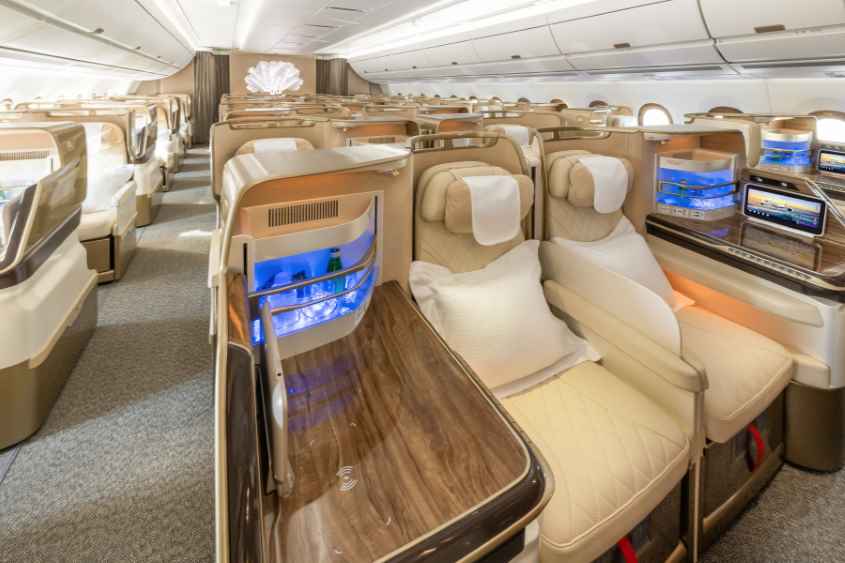
The newest aircraft type to join Emirates’ all widebody fleet, the A350 accommodates 298 passengers in three spacious cabins – Business, Premium Economy and Economy. The bright and airy cabins have been thoughtfully designed to provide more space and comfort in every cabin, whilst cutting-edge technology and enhanced entertainment options elevate every journey.
Making its debut in Kenya, Emirates’ Premium Economy cabin offers elevated comfort, comparable to a Business Class experience on many airlines. The cabin is spacious with leather reclining seats that feature a generous pitch, adjustable headrests and more legroom. Customers can enjoy in-seat charging points, a wood-finished side cocktail table, a 13.3-inch TV screen, a generously sized pillow and blanket, complimentary amenity kits on select flights – including the Dubai-Nairobi route – and a globally exclusive sparkling wine, Chandon Vintage Brut 2017.
We’re delighted to bring our latest aircraft and onboard experience to our customers in market, with more comfort, choice and thoughtful touches in every cabin
Business Class is configured in a 1-2-1 layout ensuring every passenger has direct aisle access and a spacious, private environment for both work and relaxation. The fully lie-flat seat is wrapped in soft cream leather and features a personal minibar and wireless charging for comfort and convenience. At the back of the cabin is a snack display area allowing passengers to help themselves to refreshments throughout the flight.
Economy Class features an all new, airy colour palette of sky blue, bronze and cream, complemented by lighter-toned wood finishings. Each seat features the airline’s upgraded ice inflight entertainment system on a 13.3inch 4K adjustable touchscreen, while generous seat pitch and leather headrests provide support, comfort and extra legroom.
Continuing to raise the bar in Kenya
The deployment of the A350 follows a series of enhancements to the Emirates customer proposition in Kenya, including the introduction of the third daily flight between Dubai and Nairobi in July. With 21 flights per week, customers have greater flexibility and connections between Kenya and key markets across Europe and the US, via Dubai.
Nairobi is also home to Africa’s first Emirates World (https://apo-opa.co/4yeI34C) store, which opened in 2024, offering customers a more immersive way to discover Emirates’ products, while offering more convenience and personalised service.
Earlier this year, Emirates introduced further flexibility for customers in Kenya through a partnership with Cellulant, launching a split-payment solution (https://apo-opa.co/4xLYG6R) that allows travellers to combine multiple payment methods across 24-hour instalments when purchasing airfares.
Tickets can be booked now on Emirates.com, the Emirates App, or via both online and offline travel agents as well as Emirates World Store (https://apo-opa.co/46Kglkc) in Nairobi. Emirates continues to offer flexible booking policies for added peace of mind while travelling. Every ticket booked after 10th August 2026 comes with free unlimited dates changes to Dubai and one complimentary date change to anywhere else in the world, in addition to significantly reduced refund fees across all cabins and fare types, allowing passengers to adjust their travel plans with minimal penalties.
Distributed by APO Group on behalf of The Emirates Group.
We use cookies on our website to give you the most relevant experience by remembering your preferences and repeat visits. By clicking “Accept”, you consent to the use of ALL the cookies.
This website uses cookies to improve your experience while you navigate through the website. Out of these, the cookies that are categorized as necessary are stored on your browser as they are essential for the working of basic functionalities of the website. We also use third-party cookies that help us analyze and understand how you use this website. These cookies will be stored in your browser only with your consent. You also have the option to opt-out of these cookies. But opting out of some of these cookies may affect your browsing experience.
Necessary cookies are absolutely essential for the website to function properly. These cookies ensure basic functionalities and security features of the website, anonymously.
Cookie
Duration
Description
cookielawinfo-checkbox-analytics
11 months
This cookie is set by GDPR Cookie Consent plugin. The cookie is used to store the user consent for the cookies in the category "Analytics".
cookielawinfo-checkbox-functional
11 months
The cookie is set by GDPR cookie consent to record the user consent for the cookies in the category "Functional".
cookielawinfo-checkbox-necessary
11 months
This cookie is set by GDPR Cookie Consent plugin. The cookies is used to store the user consent for the cookies in the category "Necessary".
cookielawinfo-checkbox-others
11 months
This cookie is set by GDPR Cookie Consent plugin. The cookie is used to store the user consent for the cookies in the category "Other.
cookielawinfo-checkbox-performance
11 months
This cookie is set by GDPR Cookie Consent plugin. The cookie is used to store the user consent for the cookies in the category "Performance".
viewed_cookie_policy
11 months
The cookie is set by the GDPR Cookie Consent plugin and is used to store whether or not user has consented to the use of cookies. It does not store any personal data.
Functional cookies help to perform certain functionalities like sharing the content of the website on social media platforms, collect feedbacks, and other third-party features.
Performance cookies are used to understand and analyze the key performance indexes of the website which helps in delivering a better user experience for the visitors.
Analytical cookies are used to understand how visitors interact with the website. These cookies help provide information on metrics the number of visitors, bounce rate, traffic source, etc.
Advertisement cookies are used to provide visitors with relevant ads and marketing campaigns. These cookies track visitors across websites and collect information to provide customized ads.


























 Business5 days ago
 Business5 days ago
 Business4 days ago
 Business5 days ago
 Business3 days ago
 Business4 days ago
 Business4 days ago