Connect with us

Business

Stellantis Pro One Achieves No. 1 Spot in Middle East & Africa Region and Strengthens Commercial Vehicle Leadership in Europe and South America

Published

on

Stellantis

The performance highlights the strength of Stellantis Pro One in global markets and puts it on track to achieve global leadership in commercial vehicles by 2027

AMSTERDAM, The Netherlands, May 14, 2024/APO Group/ — 

Achieves No. 1 spot with a record 26% market share in Middle East & Africa, led by strong performance in Algeria with the FIAT Professional brand; Confirms market leadership in Europe 30 and South America; North America plays a key role in Pro One success; Ram announces new professional commercial vehicle division; Stellantis Pro One (www.Stellantis.com) on track to global leadership by 2027; achieve Dare Forward 2030 target. 

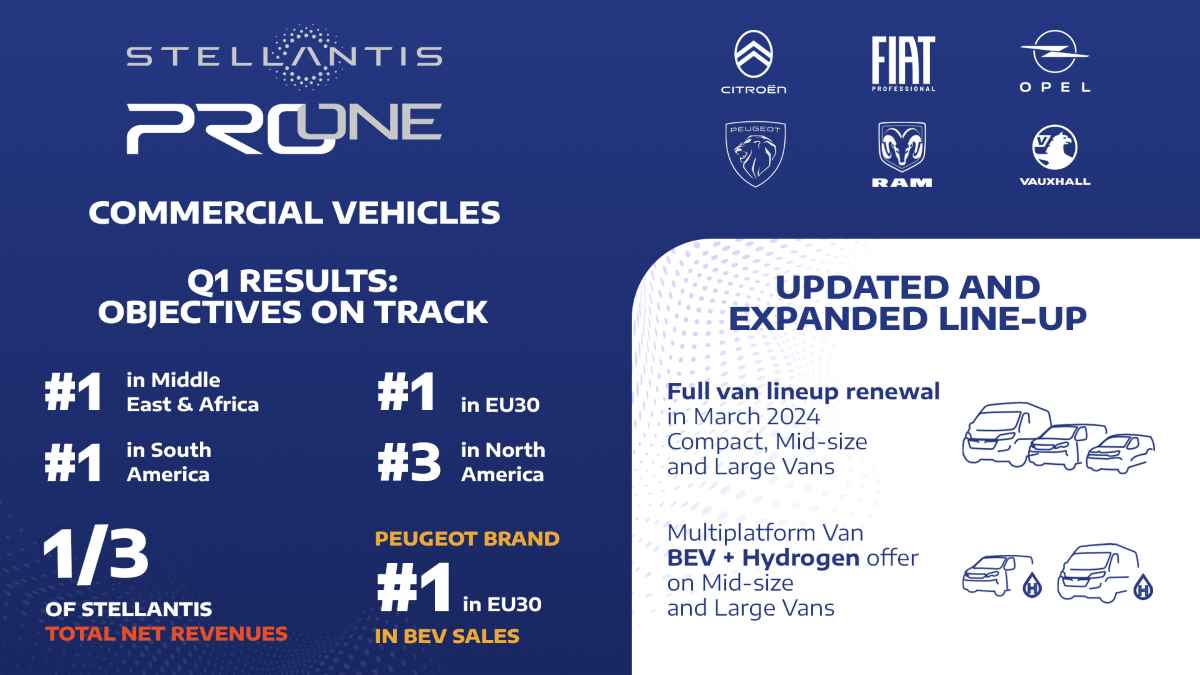
Demonstrating its market leadership in the Middle East and Africa region for the second quarter in a row, the Stellantis Pro One commercial vehicles offensive delivered an excellent performance in the first quarter of 2024, accounting for one-third of Net revenues reported by Stellantis.

The performance highlights the strength of Stellantis Pro One in global markets and puts it on track to achieve global leadership in commercial vehicles by 2027 and reach the targets outlined in the Dare Forward 2030 strategic plan.

Stellantis Pro One Middle East and Africa region market share reached 26% in the first quarter of 2024. In addition, it maintained the No. 1 position in both EU30 and South America regions. For EU30 BEV (battery electric vehicle) sales for the quarter, Pro One takes the top spot with 33% market share, with the Peugeot brand leading across the region. 

“The Q1 2024 sales performance in commercial vehicles confirms and validates our Stellantis Pro One strategy,” said Xavier Peugeot, Stellantis Senior Vice President, Commercial Vehicles Business. “The enthusiastic welcome of our entirely new van line-up, combined with new connected services and concrete hydrogen fuel cell propulsion van offers confirm Stellantis’ position as the relevant choice for professionals.”

Regional highlights include:

Europe 30:

The Q1 2024 sales performance in commercial vehicles confirms and validates our Stellantis Pro One strategy

  • Maintained commercial vehicle leadership with 30% market share (ICE + BEV)  
  • Continued BEV leadership with 33% market share; Peugeot No. 1 brand
  • No. 1 in France and Spain; No. 1 in Italy with FIAT Professional market leader; No. 1 in Germany with market share up 3.6 percentage points vs. Q1 2023
  • BEV leadership in Poland, Belgium, and Portugal; and in the Netherlands with a 2.7 percentage point increase in total market share
  • Expansion of in-house production of hydrogen fuel cell vehicles on both mid-size and large vans during the year in Hordain (France) and Gliwice (Poland) will boost the Company’s Pro One hydrogen offerings and help cement Stellantis’ standing as the undisputed leader in European commercial vehicle market.

Middle East & Africa:

  • Stellantis Pro One achieved the No. 1 spot in the Middle East & Africa region for the second consecutive quarter
  • Led by strong performance in Algeria with the FIAT Professional brand, Stellantis achieves leadership in the region becoming No. 1 in light commercial vehicles (LCV) with 26% market share, up 7.5 percentage points versus Q1 2023
  • More than 60% volume growth fueled by Algeria, Turkey, and GCC (Saudi Arabia, Kuwait, the United Arab Emirates, Qatar, Bahrain, and Oman)
  • Stellantis maintained its No. 1 position in Turkey, Israel and overseas departments and regions of France.

North America:

  • Ram maintains its No. 3 position in the region 
    New Ram trucks: 2025 Ram 1500 with more powerful, fuel-efficient Hurricane Twin Turbo engine now available; 2025 Ram 1500 Tradesman tailored for fleet customers; and Ram 1500 RHO with 540-horsepower Hurricane H/O
  • In March, Ram announced the new Ram Professional commercial vehicle division with full-service customer mobility and value solutions.

South America:

  • Leader in LCV with 31.5% market share versus 26.6% in Q1 2023
  • Market leader in van and pickup sales in the region, with 37.7% and 36.5% share, respectively
  • FIAT Professional is the leading LCV brand in the region with 23.1% share vs. 19.9% Q1 23; Strada is the “most sold” LCV in the region with 13.8% market share vs. 11.5% Q1 23
  • Ram Rampage No. 2 in Brazil (C-segment pickup) with a 23% market share.

India & Asia Pacific:

  • Peugeot light commercial vehicles retail sales improved 50% versus the first quarter of 2023
  • FIAT Professional commercial performance increased 8% year-over-year, thanks to the brand’s strong performance in Australia
  • Ram remains the No. 1 brand in the 1-ton-plus pickup segment in the Australian market.

Distributed by APO Group on behalf of Stellantis.

Energy

African Mining Week (AMW) to Unlock Zimbabwe’s $12B Mining Vision Through Direct Investor Partnerships

Published

on

A dedicated country spotlight at African Mining Week 2026 will showcase regulatory reforms and project developments across Zimbabwe’s mining value chain

CAPE TOWN, South Africa, June 25, 2026/APO Group/ –African Mining Week 2026 – The Most Influential Mining Conference in Africa – will connect Zimbabwean regulators and mining stakeholders with global investors to advance partnerships, as the country accelerates efforts to build a $12 billion mining industry by 2030.

Taking place from October 14 – 16 in Cape Town, AMW 2026 will feature a dedicated Zimbabwe Country Spotlight, showcasing lucrative opportunities across the country’s mining value chain. The country spotlight will feature high-level panel discussions, exclusive networking sessions and project showcases, connecting global investors and service providers with senior decision-makers from the Ministry of Mines and Mining Development of Zimbabwe, the Chamber of Mines of Zimbabwe and leading mining companies operating across the country.

The spotlight comes at a pivotal moment for Zimbabwe, as the country seeks fresh capital to unlock value from more than 60 known mineral occurrences spanning gold, lithium, platinum group metals, chrome, coal and rare earths.

https://apo-opa.co/43Z71HR

In a major move to improve investment competitiveness, Zimbabwe reduced mining-related license and permit fees in May 2026, lowering operational costs for investors while streamlining market participation. Registration fees for dealing in precious stones have been reduced from $15,000 to $10,000, while export permit fees have been cut from $1,875 to $500. New licensing categories – including permits for gold jewellery manufacturing and lithium processing plants – have also been introduced as part of a broader strategy to promote investments across in-country value addition projects. The reduction in fees for beneficiation projects follows the April 2026 introduction of export quotas for lithium concentrates ahead of a planned 2027 ban on concentrate exports. The shift is already reshaping the country’s lithium industry, with Zhejiang Huayou Cobalt achieving Zimbabwe’s first export shipment of lithium sulphate salts in April 2026.

https://apo-opa.co/4w3X7R3

https://apo-opa.co/4uTlYpG


https://apo-opa.co/44ziVZ3


Coming into this picture, AMW 2026’s Zimbabwe Country Spotlight will provide investors with direct insights into these evolving regulatory frameworks, highlighting emerging investment and partnership prospects in lithium processing and across the mining value chain.

Zimbabwe’s gold sector is also positioned for renewed growth amid sustained high global gold prices (averaging $5,000 per ounce). In line with this momentum, Zimbabwe’s sovereign wealth fund, Mutapa Investment Fund, is seeking $250 million to expand gold mining operations. Against this backdrop, AMW 2026 offers a timely platform for investors to engage with one of Africa’s most prospective brownfield gold markets and explore opportunities across exploration, mine expansion and processing infrastructure.

https://apo-opa.co/4eCDMiU


AMW 2026’s strong emphasis on artisanal and small-scale mining (ASM) formalization also aligns closely with Zimbabwe’s national mining development strategy. In May 2026, Zimbabwe certified 300 small-scale miners following completion of training programs safety, compliance and productivity. Supported by funding from Mutapa Gold Resources – a subsidiary of Mutapa Investment Fund – the initiative aims to train and formalize 1,500 ASM players.


https://apo-opa.co/44rhsUH

As the official platform where Africa’s mining opportunities are discussed and maximized, AMW 2026 will provide stakeholders with market intelligence on Zimbabwe’s evolving mining landscape and investment outlook.

Distributed by APO Group on behalf of Energy Capital & Power.

Continue Reading

Business

Afreximbank Africa Trade Report shows Africa can turn geopolitical disruptions into long-term growth opportunity

Published

on

The report highlights Africa’s continued growth resilience despite significant headwinds occasioned by escalating geopolitical tensions and ensuing economic shifts

CAIRO, Egypt, June 24, 2026/APO Group/ –African Export-Import Bank (Afreximbank) (www.Afreximbank.com) has launched the 2026 edition of its flagship African Trade Report themed “Leveraging Geopolitics for Trade and Industrialisation in Global Africa.” The report presents a comprehensive review of trade and economic developments across Africa and globally in the context of the 2025 operating environment, while outlining available strategic options for Africa to transform ongoing geopolitical tensions and associated supply chain disruptions into long-term resilience for growth and shared prosperity across the continent.


The report highlights Africa’s continued growth resilience despite significant headwinds occasioned by escalating geopolitical tensions and ensuing economic shifts. Reflecting the continent’s growth resilience, the report shows that while global economic growth slowed to 3.4 percent in 2025 and is projected to further ease to 3.1 percent in 2026, Africa’s real GDP growth strengthened from 3.4 percent in 2024 to 4.5 percent in 2025. This performance not only surpasses the global average but also highlights the continent’s improving economic fundamentals in a fractured world economic order.

Africa’s merchandise trade also delivered strong performance, expanding by 6.1 percent to reach approximately US$1.5 trillion, while aggregate inflation declined sharply from 21.6 percent in 2024 to 13.1 percent 2025. These outcomes reflect the stabilising effects of prudent macroeconomic management, ongoing policy and institutional reforms, and the countercyclical interventions of development finance institutions across the continent.

Commenting on the Africa Trade Report’s findings, Dr Yemi Kale, Group Chief Economist and Managing Director of Research and Trade Intelligence at Afreximbank, said:

By strategically leveraging these shifts, Africa can build a more resilient, competitive and inclusive economic future

Africa stands at a critical juncture. Geopolitical tensions and economic fragmentation are reshaping global trade patterns, but they also present a historic opportunity for the continent. By strategically leveraging these shifts, Africa can build a more resilient, competitive and inclusive economic future.

“It is imperative for the continent to act decisively to strengthen regional value chains, deepen industrial capacity, expand access to trade finance, and accelerate continental integration. Through coordinated policy action, strategic infrastructure investment, and stronger development finance institutions, Africa can build a more resilient, inclusive, and value-added trade ecosystem. Africa cannot afford to delay.”

The report further highlights that Africa’s export performance remains constrained by a persistent trade finance gap, estimated at approximately US$74 billion in 2025. The challenge is exacerbated by limited foreign exchange liquidity and the continued decline in correspondent banking relationships, factors that restrict the continent’s capacity to fully realise its trade and industrial potential.

At the same time, evolving shipping routes and prolonged disruptions to global logistics networks continue to extend delivery timelines and increase freight and trading costs. These pressures are particularly acute for African economies that remain heavily reliant on imported inputs and external markets, even as global supply chains increasingly reconfigure toward resilience, diversification, and emergence of alternative production hubs.

The report also outlines several strategic priorities, including the accelerated implementation of the African Continental Free Trade Area (AfCFTA), the expansion of digital payments infrastructure through the Pan-African Payment and Settlement System (PAPSS), and coordinated reforms to the global financial architecture. It further underscores the growing role of African financial institutions in strengthening economic resilience. Afreximbank, a founding member of the Alliance of African Multilateral Financial Institutions (AAMFI), disbursed US$17.5 billion in 2024 and is working to double intra-African trade finance by 2026. Meanwhile, Pan African Payment and Settlement System (PAPSS) is already helping to reduce transaction costs and lessen reliance on foreign currencies across the continent.

As geopolitical tensions continue to reshape global supply chains and trade patterns, the continent’s ability to leverage these shifts will depend on strengthening industrial ecosystems, expanding intra-African trade, and sustaining coordinated financial support. Ultimately, a combination of adaptive policy frameworks, strategic trade positioning, and robust direct foreign investment interventions will be central to driving a resilient, inclusive, and sustainable industrialisation pathway for Global Africa. The imperative now is to act with ambition and urgency. This would require accelerating the implementation of the African Continental Free Trade Area (AfCFTA), expanding intra-African trade finance, strengthening transport and logistics infrastructure, and deepening digital payment systems through the Pan-African Payment and Settlement System (PAPSS).

The full report can be downloaded here:  https://apo-opa.co/4xNkbFx

Distributed by APO Group on behalf of Afreximbank.


Continue Reading

Business

Islamic Development Bank (IsDB) Institute Strengthens Global Partnerships through Strategic Bilateral Engagements at 2026 Group Annual Meetings

Published

on

The meetings reaffirmed IsDBI’s commitment to advancing Islamic economics and finance as a catalyst for sustainable development, innovation, financial inclusion, and economic transformation across Member Countries and beyond

BAKU, Azerbaijan, June 24, 2026/APO Group/ –The Islamic Development Bank Institute (IsDBI) (https://IsDBInstitute.org/) successfully conducted a series of bilateral meetings with government institutions, multilateral organizations, financial regulators, academic institutions, development agencies, and industry leaders on the sidelines of the 2026 IsDB Group Annual Meetings in Baku, Azerbaijan.


The meetings reaffirmed IsDBI’s commitment to advancing Islamic economics and finance as a catalyst for sustainable development, innovation, financial inclusion, and economic transformation across Member Countries and beyond.

The engagements covered a wide spectrum of strategic themes, including Islamic finance ecosystem development, regulatory and legislative reform, capacity building, sukuk market development, Islamic social finance, digital transformation, fintech, sustainable finance, waqf innovation, and knowledge partnerships.

Among the key engagements were discussions with representatives from the Governments of Tajikistan, Libya, Maldives, Türkiye, Ethiopia, and Sierra Leone on strengthening Islamic finance ecosystems through technical assistance, regulatory enhancement, and institutional capacity development.

The Institute also met with leading international organizations and standard-setting bodies, including the Islamic Financial Services Board (IFSB), AAOIFI, the Eurasian Development Bank, and the Islamic Microfinance Development Fund (FDMI). The meetings explored avenues for collaboration in research, standards development, capacity building, and strategic initiatives aimed at broadening the global reach and impact of Islamic finance.

Several meetings focused on innovation and emerging opportunities, including discussions with Rosatom State Corporation on sustainable financing solutions and sukuk structures, Islamic Money Australia on digital Islamic banking models, and INCEIF University on Islamic social finance data, waqf tokenization, and applied research collaboration.

The Institute also explored partnerships with organizations from Brazil, Palestine, Somalia, Senegal, Djibouti, and the private sector to advance knowledge dissemination, capacity-building programs, blended Islamic finance solutions, cash waqf digitalization initiatives, and investment-related research.

Commenting on the outcomes of the engagements, the Institute’s team, led by Acting Director General, Dr. Sami Al-Suwailem, noted that the meetings reflected the growing global interest in leveraging Islamic economics and finance to address contemporary development challenges and unlock new opportunities for inclusive and sustainable growth.

The discussions generated a pipeline of follow-up initiatives, including technical assistance programs, joint research projects, capacity-building activities, policy advisory support, and collaborative knowledge-sharing platforms.

The 2026 IsDB Group Annual Meetings provided a valuable platform for strengthening existing partnerships, establishing new strategic relationships, and advancing the Institute’s mission of promoting innovative, impactful, and development-oriented Islamic economics and finance solutions worldwide.

Distributed by APO Group on behalf of Islamic Development Bank Institute (IsDBI).


Continue Reading

Trending

Exit mobile version