Connect with us

Business

New strategic partnership in the Arab States region to enhance access to green finance for small and medium-sized enterprises

Published

on

ICIEC

It will support financing across a broad range of sustainability-related areas

Across our region, SMEs are the backbone of economies and helping them grow and innovate is critical to strengthening economic resilience and climate ambition

AMMAN, Jordan, April 23, 2026/APO Group/ –The United Nations Development Programme (UNDP), has signed a Joint Statement of Intent with the Islamic Corporation for the Development of the Private Sector (ICD) (https://ICD-PS.org) and the Islamic Corporation for the Insurance of Investment and Export Credit (ICIEC) —both members of the Islamic Development Bank (IsDB) Group—introducing a new blended finance structure that leverages credit insurance to catalyze private investment in climate-smart sectors.


This partnership will unlock capital for green small and medium-sized enterprises (SMEs) and support national efforts to achieve climate and sustainable development goals across the Arab States region. It will support financing across a broad range of sustainability-related areas, including climate change mitigation and energy transition, climate adaptation and resilience, sustainable water usage and governance, circular economy and management, sustainable agriculture and food systems and other green finance sectors.

“Across our region, SMEs are the backbone of economies and helping them grow and innovate is critical to strengthening economic resilience and climate ambition,” said Abdallah Al Dardari, UN Assistant Secretary General and Director of UNDP’s Regional Bureau for Arab States. “Through this new partnership we will work closely with regional financial institutions to expand SMEs access to green finance, to accelerate inclusive, climate-resilient development in line with UNDP’s flagship Green Finance Platform.”

In countries benefiting from the new partnership, ICD will provide financing facilities to partner banks and financial institutions while ICIEC will offer comprehensive credit insurance and risk-sharing solutions to encourage financial institutions to expand financing to green sectors, in addition to leveraging reinsurance partnerships to enhance the facility’s capacity and long-term sustainability.

“By uniting ICIEC’s risk mitigation, ICD’s financing, and UNDP’s development network, we are creating a scalable engine for green private sector growth,” stressed Mohammad Asheque Moyeed, Acting Director, Banking Department at ICD. “This partnership is our shared commitment to building a more inclusive and sustainable future for SMEs across our member countries.”

“Our role in this partnership is to unlock capital for the SMEs driving a greener, more diversified economy,” explained Yasser Alaki, Director of Business Development, ICIEC. “Through our credit insurance solutions, ICIEC provides the essential risk assurance that enables financial institutions to confidently channel financing toward this vital growth sector.”

Serving as a convener of the partnership, UNDP will facilitate linkages between financial institutions and SMEs engaged in its programmes and will coordinate joint efforts to mobilize resources to lower the cost of risk-sharing mechanisms.

Distributed by APO Group on behalf of Islamic Corporation for the Development of the Private Sector (ICD).

Business

Canon Central & North Africa Strengthens Morocco Channel Strategy Through ‘Power to Move: Partnering for Growth’

Published

on

Casablanca engagement brings channel partners together around a market-specific partner approach, new imagePROGRAF and imageFORCE technologies, and opportunities for B2B growth across key Moroccan sectors

CASABLANCA, Morocco, October 26, 2026/APO Group/ –Canon Central & North Africa (CCNA) (https://en.Canon-CNA.com/) has brought together its channel partners in Morocco for a dedicated business and technology engagement aimed at strengthening local partnerships, expanding market reach and unlocking new opportunities across the country’s fast-evolving business landscape.


Under the platform “Power to Move: Partnering for Growth,” the Casablanca event reflects Canon’s approach of moving closer to its partners and customers by combining local market insight, a strong channel ecosystem and an expanding portfolio of business imaging and print technologies.

Morocco is an important market within CCNA’s regional growth strategy. Canon recognises the country’s development priorities, with sustained national investment in transport, aviation, maritime infrastructure, healthcare, education and renewable energy creating new demand for productivity, digitalisation and more efficient, secure ways of working, and with it, opportunities for technology partners who understand local requirements.

Central to the engagement is a market-specific approach to partner collaboration, developed to support partners across Canon’s B2B portfolio. It focuses on strengthening partner capabilities, joint planning and closer commercial engagement, providing a framework better aligned with local market opportunities and customer requirements.

Morocco’s investment in infrastructure, healthcare, education and renewable energy is creating real demand for technology that helps organisations work more productively

The event also introduced Canon’s latest technology developments to the Moroccan channel, including the new imagePROGRAF large-format printing solution and imageFORCE, enabling partners to experience the latest additions to Canon’s portfolio and explore their relevance across different customer applications and business environments.

These technologies are linked directly to real business requirements, from office and large-format printing for infrastructure projects, to scanning and document management that digitise and manage information in healthcare, education and public institutions, and to streamlining document-intensive workflows across businesses of all sizes.

The Casablanca engagement therefore goes beyond product introduction. Discussions with partners covered upcoming projects, customer needs and potential areas for collaboration, creating a platform for Canon and its partners to exchange market insights, align joint planning and bring a broader range of imaging, print and workflow solutions closer to end users. The focus now is on what Canon and its partners can achieve together: turning these discussions into joint plans, stronger partner capabilities and new business opportunities across Morocco’s priority sectors.

The initiative also reflects CCNA’s ICE strategy – Innovation, Customer Experience and Employee Experience. In practice, this means pairing new technology with closer engagement with customers and partners, so that Canon can respond more effectively to the specific requirements of individual markets and support sustainable business growth.

Tushar Vashnavi, Business Unit Director, B2B, Canon Central & North Africa, said: “Morocco’s investment in infrastructure, healthcare, education and renewable energy is creating real demand for technology that helps organisations work more productively. Unlocking that demand starts with understanding the market locally and working closely with the partners who are closest to our customers. Our approach is not simply about introducing new technology. It also means strengthening service network readiness through local partner capabilities, technical training and access to Canon’s expertise, so customers have the support they need beyond installation. By bringing together the right portfolio, knowledge and service capabilities, we can extend our reach and create greater value for customers across Morocco.”

The Morocco engagement forms part of a broader approach by Canon Central & North Africa to deepen channel engagement across its markets. Through closer collaboration, market-specific partner strategies and access to its evolving B2B portfolio, Canon aims to strengthen its partner ecosystem and create new pathways for shared growth.

Distributed by APO Group on behalf of Canon Central and North Africa (CCNA).


Continue Reading

Business

International Islamic Trade Finance Corporation (ITFC) Surpasses US$100 Billion in Trade Finance Approvals

Published

on

Milestone reflects nearly two decades of trade finance supporting essential imports, exports, food and energy security, private-sector growth and economic resilience across Member Countries

Surpassing US$100 billion in cumulative approvals is more than a measure of scale

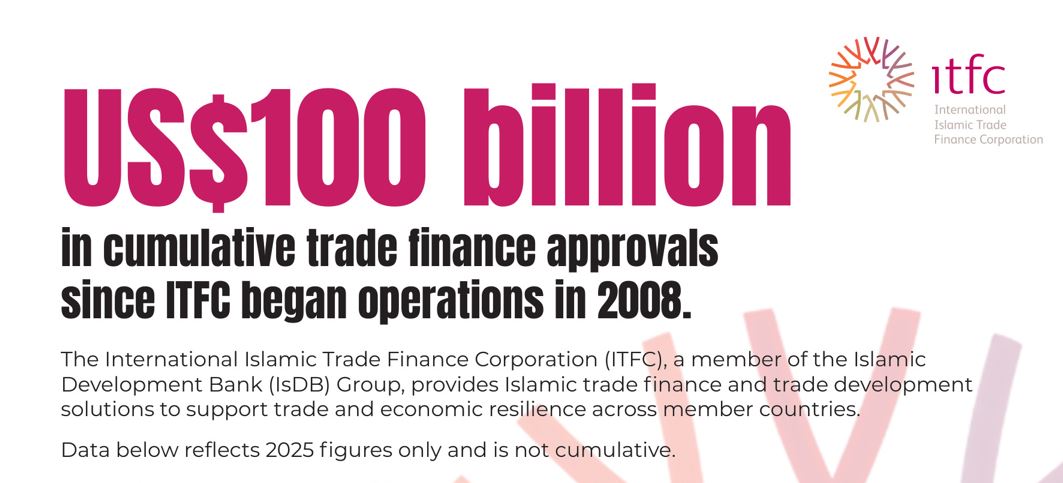
JEDDAH, Saudi Arabia, October 26, 2026/APO Group/ –The International Islamic Trade Finance Corporation (ITFC) (www.ITFC-idb.org), the trade finance and trade development arm of the Islamic Development Bank (IsDB) Group, has surpassed US$100 billion in cumulative trade finance approvals since commencing operations in 2008.

The milestone marks a significant chapter in ITFC’s contribution to supporting trade, economic resilience and sustainable development across its Member Countries.


Over nearly two decades, ITFC has provided and mobilized trade finance to support essential imports and exports, strengthen food and energy security, connect producers and exporters to markets, and provide businesses with the financing and inputs required to operate and grow.

The development impact extends beyond the scale of financing. In 2025 alone, ITFC-supported operations contributed to food access for approximately 24 million households and electricity access for an estimated 17.8 million households, reached around 460,000 farmers, and provided access to finance to 546 corporates and SMEs.

More than one-third of ITFC’s cumulative approvals have supported Least Developed Countries, reflecting the Corporation’s focus on markets where access to trade finance is often most constrained.

ITFC has also played an important countercyclical role during periods of global and regional disruption. Through financial crises, the COVID-19 pandemic and recent geopolitical shocks, the Corporation continued supporting critical trade flows at times when commercial trade credit became increasingly constrained.

Commenting on the milestone, Eng. Adeeb Yousuf Al Aama, Chief Executive Officer, ITFC said: “Surpassing US$100 billion in cumulative approvals is more than a measure of scale. It represents nearly two decades of partnership with our Member Countries and a sustained commitment to using trade as a driver of development, resilience and opportunity. Behind this milestone are essential commodities delivered, businesses supported, markets connected and livelihoods strengthened. It also demonstrates what can be achieved when ITFC combines its own resources with the capital, expertise and partnerships of the wider IsDB Group and our financing partners.”

The milestone comes as the IsDB Group advances implementation of its Ten-Year Strategic Framework 2026–2035 and Five-Year Corporate Strategies 2026–2030. ITFC will build on its track record by scaling trade finance sustainably, mobilizing greater private and institutional capital, expanding access for SMEs, advancing digital trade finance solutions, and deepening partnerships across Member Countries.

As it enters its next phase, ITFC remains focused on strengthening trade as a catalyst for economic growth, resilience and shared prosperity across the markets it serves.

Distributed by APO Group on behalf of International Islamic Trade Finance Corporation (ITFC).


Continue Reading

Business

Strategic Architect of African Convention Bureaus Rick Taylor Joins African Collaborations Group (ACG) Advisory Board to Advance Sport and Entertainment Districts Across Africa

Published

on

Rick Taylor is one of Africa’s most experienced strategists in destination development and the business tourism sector

LONDON, United Kingdom, October 26, 2026/APO Group/ –African Collaborations Group (ACG) (www.ACGafrica.com), the leading strategic project origination and collaboration platform focused on the industrialisation of sport in Africa through the origination of bankable sport and entertainment district ecosystems, today announced the appointment of Rick Taylor to its Advisory Board.


Rick Taylor is one of Africa’s most experienced tourism strategists, with more than three decades of expertise in destination development and business events, also known as MICE (Meetings, Incentives, Conferences, Events and Exhibitions). As Founder and Chief Executive Officer of The Business Tourism Company, a Cape Town-based international consultancy, he has led more than 100 tourism advisory, strategy and training projects worldwide and has been the strategic architect of national destination strategies and Convention Bureau projects across Africa, including in South Africa, Namibia, Rwanda, Kenya, Tanzania, Ethiopia, Uganda, Senegal, Cameroon, Zambia, Togo and Mozambique.

Rick was the architect of Africa’s first Convention Bureau in Cape Town, which has maintained the #1 position in Africa in the International Congress and Convention Association (ICCA) city ranking for more than two decades. Since then, he has devoted his career to positioning business events as a strategic pillar of tourism, investment and socio-economic development across the continent.

The global business events sector has now surpassed pre-pandemic levels, reaching an estimated USD 1.5 trillion, yet Africa hosts only around 3% of the world’s association meetings. Rick has spent his career addressing this structural gap by helping countries build the strategies, institutions, infrastructure and international positioning required to compete for a greater share of the global business events economy.

His presence on our Advisory Board significantly strengthens ACG’s capacity to originate projects that combine these dimensions from the outset

A defining feature of Rick’s approach is what he calls “Lalibela thinking” — a 50- to 100-year perspective that sees MICE not simply as an events industry, but as long-term economic infrastructure capable of driving investment, tourism, job creation, skills development and poverty alleviation. His work has helped shape business events infrastructure, convention bureaus and national MICE strategies across Africa.

His appointment to the ACG Advisory Board reflects a core ACG conviction: that large-scale sport and entertainment districts must be conceived from the outset as integrated economic ecosystems spanning sport, entertainment, hospitality, tourism and business events. Convention Centres, conference facilities and other business events infrastructure are essential components of such districts. They can generate high-value activity on non-match and non-concert days, strengthen year-round hotel and hospitality demand, and connect the district to the wider tourism and business travel economy of its host country.

Rick therefore brings to ACG a rare combination of strategic and practical expertise: deep knowledge of African destination development; pan-continental relationships with tourism ministries, national tourism organisations and other public-sector stakeholders; hands-on experience in establishing Convention Bureaus and business events infrastructure; and a long-term perspective on the role of business events in African socio-economic development. These capabilities are directly relevant to ACG’s work in originating and structuring large-scale sport and entertainment district projects across the continent.

“Rick Taylor is one of the most respected voices in African business tourism, and his career has literally built the Convention Bureau architecture that powers business events across the continent. His appointment reflects a foundational conviction at ACG: that sport and entertainment districts are not stadiums and concert halls standing alone, but integrated ecosystems that generate value across sport, entertainment, hospitality and business events. Sport, entertainment and convention infrastructure is district infrastructure. His presence on our Advisory Board significantly strengthens ACG’s capacity to originate projects that combine these dimensions from the outset,” said Nicolas Pompigne-Mognard (www.Pompigne-Mognard.com), Founder and Executive Chairman of ACG.

The ACG Advisory Board provides strategic guidance as ACG originates and structures large-scale sport and entertainment district projects across the continent, aligning governments, development finance institutions (DFIs), investors, sport bodies and infrastructure partners to support the development of financially sustainable, mixed-use district ecosystems.

Africa’s sport economy is projected to reach $20 billion by 2035, yet the continent continues to lack the integrated district ecosystems required to support large-scale development. ACG addresses this gap by originating bankable sport and entertainment district projects, moving beyond single-venue development models towards mixed-use, revenue-generating and financially sustainable district ecosystems.

Through its collaborative model, ACG convenes governments, PPP authorities and regulators, development finance institutions, private investors, developers, designers and engineers, legal and transaction advisors, operators, sport federations and leagues, event promoters, media and broadcast partners, academic institutions and host communities, creating structured pathways from concept to feasibility, bankability and delivery.


Distributed by APO Group on behalf of African Collaborations Group (ACG).


Continue Reading

Trending

Exit mobile version