Connect with us

Business

Liquid Intelligent Technologies introduces Tanzania’s second Azure Stack, further accelerating the local digital transformation

Published

on

Liquid Intelligent Technologies

The innovative solution offered by Azure Stack HCI ensures that businesses meet the local compliance standards by letting customers run applications designed for virtualised infrastructure

DAR ES SALAAM, Tanzania, October 10, 2023/APO Group/ — 

Liquid Intelligent Technologies (Liquid) (https://www.Liquid.Tech/), a business of Cassava Technologies, a pan-African technology group, has partnered with wingu.africa a pioneer provider of carrier-neutral data center services in Tanzania, and the foremost specialist carrier-neutral data center group in East Africa to introduce the second Azure Hyperconverged Infrastructure (HCI) stack. This investment from Liquid Tanzania will provide a more conducive environment for local businesses to accelerate their digital transformation journeys.

“In 2021, we were the first to bring Azure Stack to Tanzanian businesses, helping them gain access to cloud solutions that met the local data regulatory requirements and efficiently run latency-sensitive business applications. This is yet another milestone we achieved as we continue to work towards empowering our customers to adopt cloud and contribute to making Tanzania a digital economy,” said Manish Govindji, Acting CEO of Liquid Intelligent Technologies Tanzania.

The innovative solution offered by Azure Stack HCI ensures that businesses meet the local compliance standards by letting customers run applications designed for virtualised infrastructure. Additionally, with the carrier-neutral offering from the Wingu group, companies have a further advantage of choosing the connectivity service provider.  

Our carrier-neutral data center complements this initiative, allowing companies to choose their preferred connectivity service provider

“The Wingu group is thrilled to collaborate with Liquid Intelligent Technologies in introducing Tanzania’s second Azure Stack, a pivotal step in accelerating the nation’s digital transformation. By offering local businesses access to cutting-edge cloud solutions, we aim to empower them to thrive in the digital age. Our carrier-neutral data center complements this initiative, allowing companies to choose their preferred connectivity service provider. Together with Liquid, we are contributing to Tanzania’s digital economy, fostering economic ties, and leveling the technology playing field for local businesses. This partnership signifies a significant milestone in expanding technology access and affordability in Tanzania. We look forward to a future of increased connectivity, innovation, and growth for the region, “said Nicholas Lodge, Co-Founder and Chief Strategist at wingu.africa.

Liquid’s continuous investment towards extending its fibre backbone and improving access to affordable digital solutions is critical to enhancing digital transformation in Tanzania and the rest of the continent. Ensuring local businesses have access to high-speed connectivity and digital services fosters economic and technological ties across countries. Also, it levels the technology playing field for businesses as they push themselves to a global stage to compete against their counterparts in more developed economies.

“With the availability of the second Azure Stack in the region, Liquid is yet again ensuring that it is a one-stop shop for all technology requirements. Especially since one of the greatest deterrents to cloud adoption in Tanzania is the high cost of accessing cloud solutions locally. Liquid has deployed Azure Stacks in multiple African countries, and we have the in-house expertise required by our customers to ensure that their IT needs are catered to by us end-to-end while they focus on their core business,” concluded Govindji.

Distributed by APO Group on behalf of Liquid Intelligent Technologies.

Business

Afreximbank’s Zimbabwe Country Brief explores the country’s Critical Mineral advantage and reform-driven economic outlook

Published

on

Zimbabwe holds the largest lithium reserves on the continent and boasts some of the highest-grade spodumene deposits globally, positioning the country as a critical supplier of battery minerals at a time of surging global demand for electric vehicle and energy storage technologies

CAIRO, Egypt, October 16, 2026/APO Group/ –African Export-Import Bank (Afreximbank) (www.Afreximbank.com) has released its Zimbabwe Country Brief, providing a comprehensive analysis of the southern African nation’s macroeconomic outlook, trade performance, financial sector development and debt sustainability profile. The brief explores Zimbabwe’s economic growth potential support by its deep regional ties and diverse natural resource endowment that is increasingly central to the global energy transition.


Among the brief’s key highlights is Zimbabwe’s strong growth momentum. Real GDP growth is estimated to have strengthened to 8.3% in 2025, driven by a rebound in agricultural production, robust gold exports and elevated global gold prices. Growth is forecast to remain solid at 5% in 2026, supported by stronger agricultural yields, elevated government spending and a favourable outlook for gold mining. Most strikingly, inflation is forecast to ease dramatically to 3.9% in 2026, down from an estimated 55% in 2025, as the Zimbabwe Gold currency stabilises on the back of stronger domestic gold output and improved foreign-currency inflows.

Zimbabwe holds the largest lithium reserves on the continent and boasts some of the highest-grade spodumene deposits globally, positioning the country as a critical supplier of battery minerals at a time of surging global demand for electric vehicle and energy storage technologies. Gold, platinum group metals, diamonds and chrome complete a resource profile that few economies on the continent can rival.

Zimbabwe’s rich endowment of critical minerals offers a powerful opportunity to move beyond the export of raw commodities

Furthermore, this edition reveals how Zimbabwe’s trajectory is particularly compelling, given the government’s deliberate shift from raw commodity exporter to industrial processor. The brief highlights February 2026 restrictions on exports of raw minerals and lithium concentrate as a decisive step in the value-addition agenda, with the potential to reposition Zimbabwe within global battery supply chains. The National Development Strategy 2 framework for 2026-2030 reinforces this direction, prioritising macroeconomic stability, infrastructure, industrialisation and job creation. The brief also points to further longer-term upside from the May 2026 petroleum production-sharing agreement covering the Cabora Bassa Basin oil and gas project.

The brief further highlights a growing and evolving financial sector, with InnBucks MicroBank’s May 2025 partnership with Mambu marking a significant step in the development of digital banking and broader financial inclusion.

With a solid GDP growth outlook for 2026, a dramatically improved inflationary environment and one of Africa’s most strategically valuable mineral endowments being actively developed for higher-value production, Zimbabwe presents a timely and powerful story of economic transformation.

Commenting on the release of the brief, Yemi Kale, Group Chief Economist and Managing Director, Research and Trade Intelligence at Afreximbank, said:

“Zimbabwe’s rich endowment of critical minerals offers a powerful opportunity to move beyond the export of raw commodities and build competitive regional value chains anchored in local production, beneficiation and value addition. By converting its lithium, gold, platinum-group metals and other resources into higher-value products, Zimbabwe can deepen its industrial base, create quality jobs and expand trade with markets across Africa. This is fully aligned with Afreximbank’s mandate to transform the structure of African trade and accelerate the continent’s industrialisation under the AfCFTA.”

Read more in the Afreximbank Country Brief on Zimbabwe here (https://apo-opa.co/47kgH1p)

Distributed by APO Group on behalf of Afreximbank.


Continue Reading

Business

The Digital Webinar Series builds momentum towards the full Democratic Republic of the Congo (DRC) Critical Minerals & Industrialisation Forum 2027

Published

on

“In Four live sessions, one goal: turning mineral wealth into industrial growth

CAPE TOWN, South Africa, October 16, 2026/APO Group/ –The organisers of the DRC Critical Minerals & Industrialisation Forum, co-located with the DRC-Africa Battery Metals Forum, have announced a four-part digital webinar series running from September to November 2026. Bringing together government, industry and investment leaders, the series will examine the opportunities, challenges and partnerships shaping the DRC’s next phase of economic development.


Across four live sessions, the discussions will explore the policies, infrastructure, technologies and investment models needed to unlock greater value from the country’s critical mineral resources. Speakers will share market intelligence, practical case studies and perspectives on how the DRC can strengthen local value creation, attract investment and build a more competitive and sustainable minerals economy.

The webinar series also provides a platform for continued engagement ahead of the full in-person Forum in Kinshasa in 2027. VUKA Group RDC rescheduled the Forum to align with the DRC Government’s evolving national policy frameworks and allow the revised roadmaps for the $58 billion Master Plan for Industrialisation (Plan Directeur d’Industrialisation, PDI) to further develop.

The first four editions of the digital webinar series will focus on the following:

Webinar 1: 23 September 2026, 10h30–12h00 (https://apo-opa.co/4zwms7Z)

UNLOCKING THE DRC’S INDUSTRIAL POTENTIAL:  The A-to-Z masterclass strategy

The DRC masterclass examines how the nation can harness its mineral wealth for sustainable growth and industrialization. Experts will discuss policies to move beyond raw exports, enforce security and strengthen ESG standards. Priorities include local beneficiation, human capital development and tailored financing to balance global markets. By defining collaborative actions and investment pathways, the session seeks to accelerate value addition, enhance competitiveness and position the DRC as a responsible global leader in the minerals value chain. VIEW ON DEMAND (https://apo-opa.co/4zHqbjn)
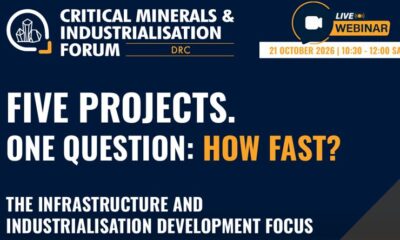
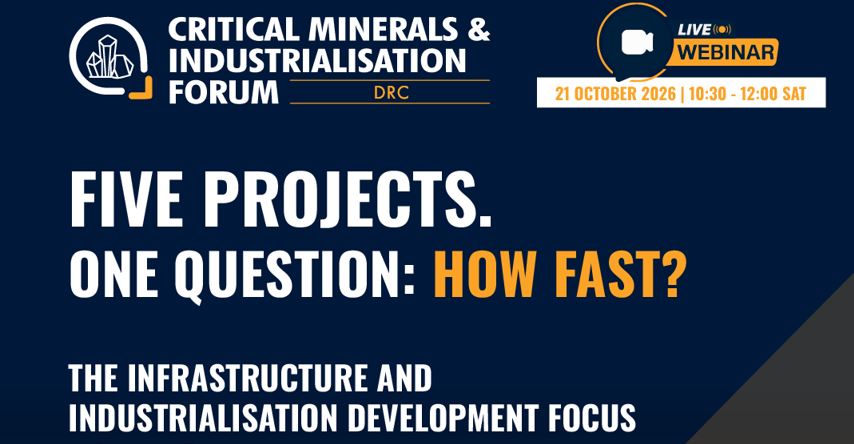
Webinar 2: 21 October 2026, 10h30–12h00   (https://apo-opa.co/4zwms7Z)

FOCUS ON INFRASTRUCTURE & INDUSTRIALISATION DEVELOPMENT

The panel on infrastructure and industrialisation highlights the DRC’s need to move beyond raw material extraction by focusing on local transformation. Building resilient industries will drive job creation and strengthen the economy. Experts will examine how transport, energy and logistics projects accelerate industrialisation, with case studies such as ports, railways and cross‑border initiatives. By prioritising strategic development and leveraging mineral revenues, the DRC can unlock sustainable growth and position itself as a competitive hub within the African Continental Free Trade Area.

Key discussion points

–  Understanding the DRC’s industrial strategy to capitalise on the African Continental Free Trade Area (AfCFTA)

–  The Lobito Corridor project: now or tomorrow?

–  Prioritising development projects in energy, transport linkages (road and railway rehabilitation), maritime infrastructure and port networks by utilising mineral revenues

Case studies

–  The Banana Port (developers: DP World and Mota-Engil contractors)

–  The Matadi Multipurpose Terminal, the DRC’s maritime gateway (AD Ports Group and the DRC Ministry of Transport)

–  Port of Boma maritime project

–  Banana–Matadi–Kinshasa railway

–  DRC–RSA Industrialisation Project, linking South Africa and the DRC and establishing 12 Economic Zones

Speakers

–  Chairperson: Bob Bononge, President, Caplaine Consulting, DRC

–  Popaul Madiana, Managing Partner, Prime Mineral Consulting, DRC

–  Serge Nawej, Partner, ADNA ALN, DRC*

REGISTER TO ATTEND (https://apo-opa.co/4dKfbsZ)

Webinar 3: 11 November 2026, 10h30–12h00   (https://apo-opa.co/4zwms7Z)

NEW TECHNOLOGIES DRIVING THE GLOBAL ENERGY TRANSITION

This session explores how technology and ESG‑aligned investment can transform the DRC’s critical minerals sector. With global demand for lithium, cobalt, nickel and copper rising, responsible sourcing and compliance are essential to build investor confidence. Discussions will focus on local processing, advanced metallurgical methods, renewable energy and automation to accelerate industrialisation. By shifting from raw exports to in‑country beneficiation, the DRC can strengthen sustainability, unlock long‑term value and position itself as a competitive player in the global energy transition.

Webinar 4: 25 November 2026, 10h30–12h00   (https://apo-opa.co/4zwms7Z)

STRATEGIC PARTNERSHIPS: BUILDING A STRONGER AND MORE SUSTAINABLE CRITICAL MINERALS VALUE CHAIN

This discussion explores how strategic partnerships can strengthen the DRC’s critical minerals value chain. By fostering collaboration between governments, regional integration systems and investors, the focus is on building resilience and supporting sustainable growth. Key themes include industrialisation through global partnerships, prioritising sectors for development and aligning with international partners. With effective models of cooperation, the DRC can unlock socio‑economic benefits, enhance competitiveness and establish a stronger foundation for a sustainable and inclusive minerals sector.

DRC’s transition
DRC Critical minerals & Industrialisation forum unites government, industry and investors to accelerate the country’s transition from raw‑material extraction to high‑value manufacturing, underscoring the nation’s opportunity to convert mineral wealth into infrastructure, jobs and sustainable economic growth.

The DRC’s Ministry of Mines (https://apo-opa.co/4jZPwjF) and the DRC’s Ministry of Industry (https://apo-opa.co/3UpRU98) as well the Federation of Enterprises of Congo (FEC) (https://apo-opa.co/4dHvFC4) are official partners of the event.

Distributed by APO Group on behalf of VUKA Group.


Continue Reading

Business

CRDB Bank launched FMO and Shelter Afrique partnerships, and renewed its Memorandum of Understanding (MoU) agreement with Afreximbank

Published

on

A USD 75 million FMO facility, CRDB’s release of its Sustainable Development Impact Disclosure, a USD 10 million Shelter Afrique facility for CRDB Bank DRC and a renewed MoU agreement with Afreximbank marked the forum, which CRDB Bank hosted with Invest Africa during the World Bank Group and IMF Annual Meetings

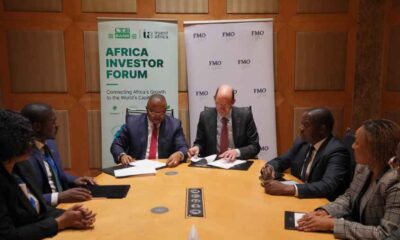
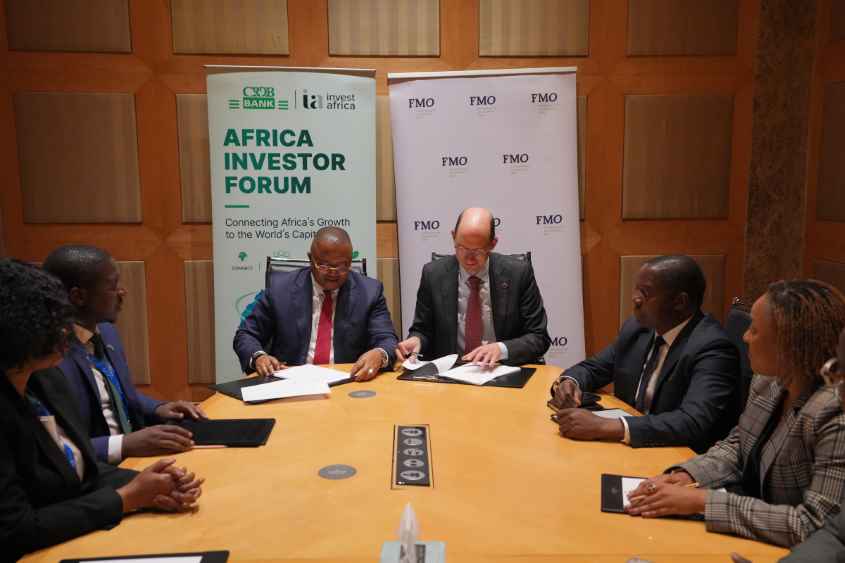
BANGKOK, Thailand, October 16, 2026/APO Group/ –CRDB Bank Plc signed a USD 75 million long-term financing facility with FMO, launched its Sustainable Development Impact Disclosure Framework, renewed its memorandum of understanding with Afreximbank, and marked the extension of a USD 10 million Shelter Afrique Development Bank facility to CRDB Bank DRC at the Africa Investor Forum on 15 October. The forum, hosted by CRDB Bank with Invest Africa (https://www.InvestAfrica.com/) at the Sheraton Grande Sukhumvit, took place on the sidelines of the World Bank Group and IMF Annual Meetings. It brought CRDB’s Group leadership and its subsidiary teams in Tanzania, Burundi, Democratic Republic of Congo (DRC) and United Arab Emirates (UAE) together with development finance institutions, institutional investors and private capital, under the theme One Bank, Every Bridge: Connecting Africa’s Growth to the World’s Capital.


The facility from FMO, the Dutch Entrepreneurial Development Bank, will run for approximately ten years. It enhances CRDB’s Tier II capital base, which supports the Bank’s growth and resilience, and it expands the Bank’s capacity to lend to micro, small and medium enterprises (MSMEs), the segment that underpins entrepreneurship, job creation and inclusive economic development. For both institutions it advances a shared aim of financial inclusion and business growth across Tanzania and the wider region. The facility also includes support from the European Commission’s MSME platform guarantee, unlocking finance for this segment of society.

CRDB Bank has applied the Impact Disclosure Guidance to its impact strategy, helping the Bank to measure and monitor the anticipated and realized impacts of its operations and portfolio. The Guidance, published in October 2024 by the Impact Disclosure Taskforce co-chaired by J.P. Morgan and Natixis, was a voluntary standard for measuring and reporting development impact. CRDB’s framework rests on three objectives: equal access to financial services, local economic development and job creation, and digital financial innovation. These supported SDG 1 (No Poverty), SDG 2 (Zero Hunger), SDG 5 (Gender Equality) and SDG 8 (Decent Work and Economic Growth), and each carried metrics and targets against which the Bank would monitor its progress. CRDB Bank was the first Tanzanian issuer to adopt the Guidance.

Shelter Afrique Development Bank had extended a USD 10 million facility to CRDB Bank DRC to support affordable housing development and the construction value chain, and the two institutions marked the extension at the forum. It realised the memorandum of understanding they had signed at the 2025 World Bank and IMF Annual Meetings in Washington, D.C., which also provided for advisory support from Shelter Afrique to CRDB’s housing finance team across the full housing value chain.

CRDB Bank also renewed its memorandum of understanding with the African Export-Import Bank (Afreximbank), building on the two institutions’ 2023 agreement and broadening the scope of their cooperation. The renewed framework covers trade finance, syndication and structured financing, digital and payments platforms such as the Pan-African Payment and Settlement System (PAPSS), capital markets advisory, specialist insurance, and capacity building through staff training and secondments. It also links the CRDB Bank Foundation’s lending to women and youth-led enterprises with Afreximbank’s Export SME Programme, strengthening support for the small businesses at the centre of CRDB’s inclusion agenda.

Our objective is to convert Tanzania’s international relationships into investment, trade, technology, skills and sustainable economic growth

The forum opened with remarks from Dr. Abdulmajid Mussa Nsekela, Group CEO of CRDB Bank, followed by an executive panel exploring how partnerships between African institutions and Asian and international investors could mobilise capital. The programme also featured signing engagements and the official launch of the Sustainable Impact Disclosure Framework. The forum anchored an engagement week running from 13 to 16 October, featuring private roundtables and bilateral investor meetings focused on Burundi, the Democratic Republic of the Congo (DRC) and Tanzania. During these engagements, subsidiary leadership presented priority, bankable projects to investors.

Recognising the Government’s pivotal role in fostering an enabling policy and regulatory environment, aligning investment with national development priorities and facilitating capital flows, Tanzanian government leaders at the Africa Investor Forum underscored the importance of strong public-private partnerships in building investor confidence and unlocking sustainable economic opportunities. Their participation reaffirmed Tanzania’s commitment to translating international partnerships into tangible investments that drive economic growth, strengthen key sectors and create long-term value for its people.

Emmanuel Tutuba, Governor of the Bank of Tanzania, emphasised the importance of financial-sector resilience in supporting investment and economic growth. He said: “A sound and resilient banking sector is essential to mobilising investment and financing economic growth. Tanzania’s banking sector continues to demonstrate resilience, supported by strong capital and liquidity positions and a non-performing loan ratio that remains within the regulatory threshold. This provides an important foundation for banks, investors and businesses to work together to finance productive opportunities.”

Ambassador Khamis Mussa Omar, Minister of Finance of the United Republic of Tanzania, highlighted the role of international partnerships in advancing the country’s long-term development ambitions. He said: “Our objective is to convert Tanzania’s international relationships into investment, trade, technology, skills and sustainable economic growth. We welcome credible investors who are ready to partner with us in building a productive, competitive and sustainable economy, and we want investment conversations to lead to bankable projects, financing and measurable economic results.”

Dr. Abdulmajid Nsekela, Group CEO and Managing Director, CRDB Bank, said: “Bangkok was where we brought the whole of CRDB to investors, and that week put our Tanzania, Burundi and DRC teams in front of the international capital. The USD 75 million from FMO strengthened our balance sheet and widened our lending to MSMEs. The Impact Disclosure Framework gave investors targets to hold us to, and Shelter Afrique’s facility for CRDB Bank DRC put capital into affordable housing and the construction value chain. Each one was a bridge between African opportunity and global capital, which was what One Bank, Every Bridge meant in practice.”

Michael Jongeneel, Chief Executive Officer, FMO, said: “We are pleased to partner with CRDB Bank on this significant transaction, which reflects our shared commitment to strengthening access to finance for entrepreneurs and businesses that drive economic growth and job creation. By enhancing CRDB’s Tier II capital base and leveraging the support of the European Commission’s MSME Platform Guarantee, this facility will help expand financing for micro, small and medium enterprises across Tanzania. We commend CRDB for its continued leadership in advancing financial inclusion and fostering sustainable, inclusive economic development in the region.”

Alexandra Barry, Executive Director, Head of Development Impact Advisory, J.P. Morgan, said: “We would like to congratulate CRDB on this important milestone and the release of its Sustainable Development Disclosure. As the first Tanzanian entity to publish such a disclosure, the framework provides greater transparency around CRDB’s impact objectives, including how it intends to deliver and measure progress towards financial inclusion, job creation and gender equality.”

Thierno-Habib Hann, Managing Director and CEO, Shelter Afrique Development Bank, said: “The memorandum we signed in Washington last year set out an intention. This facility turned it into funding for CRDB Bank DRC, supporting affordable housing and the construction value chain around it. We were glad to see it move from paper to delivery.”


Distributed by APO Group on behalf of Invest Africa.


Continue Reading

Trending

Exit mobile version