



Business
How Choosing the Right Printer Helps Small Businesses and Content Creators


The compact Wi-Fi, refillable All-in-One Canon PIXMA G3411 printer is clearly ideal, with high yield inks for low-cost home or business printing from smart devices and the Cloud
DUBAI, United Arab Emirates, August 8, 2022/APO Group/ —
Any small business owner will tell you – time is a precious, and finite resource. Not having enough of it, is often one of the biggest stumbling blocks to achieving optimum business growth.
African business owners are adopting technologies that make their lives easier and give them more time to focus on customer service and new orders. Many work long hours, tackling operational and administrative tasks after the workday ends. That steals time from family, friends, and self-care.
The Canon PIXMA G series printers were designed with both home and office users in mind. Achieving an impressive 85% average saving on the total cost of ownership versus the top 10 laser and inkjet printers, these continuous ink printers are dependable, deliver quality results at low cost, and incorporate user-friendly features to ensure a flawless printing experience.
When combined with Canon’s Print Hub, your first point of call to find a fountain of knowledge to make the most from your Canon printer, your imagination is the only limitation to achieving increased creativity, productivity and realigning your operations at home and at work to give you back precious time, every day.


Choosing Efficiency and Greater Productivity to Fuel Growth
Mark Henrietta Ogochukwu (https://bit.ly/3P8MfLQ), a cake baker and food blogger from Lagos, Nigeria, creates masterpieces worthy of a coffee-table book. Her sumptuous creations require hard work, creativity, and long hours. It requires patience and fewer distractions. “We’re always looking for ways to save time and improve our processes,” she explains.
Her team wasted a lot of time coordinating and outsourcing their printing needs. High volume printing costs, such as cake baking instruction manuals for her classes and workshops, hurt the business’s profitability. Urgent client requests with printing components were difficult to accept, which meant turning away business, something you never want to do in your growth phase.
Rather than battling the Lagos traffic and relying on printing vendors who were expensive and didn’t always understand the urgency of the jobs, Ogochukwu decided to bring her printing in-house and it has made a tangible difference to her business. “For any growing business like mine, there comes a point when you have to carefully invest in amenities that will nurture the growth by making the business more agile.”
The Canon PIXMA G series printers were designed with both home and office users in mind

“We chose the Canon Pixma G3411 printer, and it has been a blessing in many ways for my business as we no longer need to run around to get our prints outsourced. It has also provided lucrative benefits such as high-volume printing, impeccable quality, and lower costs. Any of us can connect to the printer, from anywhere, through Canon’s printing app which allows us to be even more efficient and productive.”
High on Performance, Low on Budget
The Campus Sports Club has grown significantly since it opened in 2014. What began as a few football courts and competitions has expanded to serve children and adults. Members can learn martial arts, gymnastics, basketball, football, and more, and the club offers birthday parties, edutainment workshops, and summer camps. Abdelhakim El Arjoun’s vision as a director in 2016 led to the club’s growth.
Every business owner wants growth, but it comes with obstacles. El Arjoun’s operational and administrative duties increased. It also required printing receipts of vendor quotes, invoices, cheques, and new equipment instructions, children’s absence charts for each activity and sport session, program schedules, invitations, policy and internal regulatory documents, business plans, wage slips, and more. The club initially invested in a printer from another leading company, however it did not yield beneficial results when it came to the print quality or cost-savings. The club still faced issues with color-printing and had to resort to printing its letterheads with another printing-provider which became an expensive activity as the club intensified its offerings rather quickly.
El Arjoun realized that besides the ability to print quickly in black and white, and color, in high volume one of his key requirements really was to get solid in-store advice and reliable after-sales service. In June 2021, the Canon Pixma G3411 printer caught his eye, and it has been meeting the club’s requirements ever since. The integrated ink-tanks along with the hybrid-ink system allows for maximum printing productivity while the smart connectivity feature with Canon printing app allows ease of use to the employees without being tied to their desktops or laptops for printing.

Achieving work and life balance
While businesses are increasing their reliance on powerful in-house printers, there has also an uptake in the demand for at-home printers capable of handling schoolwork, and work-from home requirements.
Asma Mekni (https://bit.ly/3BOFjkg) is a mother and content creator who juggles work and family. Bloggers spend hours perfecting their content to match their audiences’ tastes and researching trending topics. Young mothers lack time. To strike a balance, I had to find ways to keep my child engaged in activities he would enjoy and find time to do what I love. With the help of the Canon PIXMA G3411 printer, I was able to print activity charts and coloring books at home for my child, which unlocked great potential.
The printer proved invaluable when the pandemic broke, allowing Mekni to continue creating content that emulated her child’s school environment and provided hours of fun entertainment without buying activity books. She loves its quality and how Canon’s Print Hub (https://bit.ly/3Ae7WWZ) helps new users learn about printer features.
As demonstrated by Mark Henrietta, El Arjoun, and Asma Mekni, the compact Wi-Fi, refillable All-in-One Canon PIXMA G3411 printer is clearly ideal, with high yield inks for low-cost home or business printing from smart devices and the Cloud. Businesses can now save money with unrivaled page yields and low-cost printing of high-quality documents and vivid photos, as well as simple smart device and cloud connectivity, thanks to the Canon PIXMA G-Series.
Create it, snap it, style it, print it – get creative with Canon’s wide range of printers. Whether you are looking for useful ‘how to videos’, case studies, creative ideas, or you’re ready for a print challenge, we have it all. Click here to learn more! (https://bit.ly/3A42C8c)
Distributed by APO Group on behalf of Canon Central and North Africa (CCNA).















Business
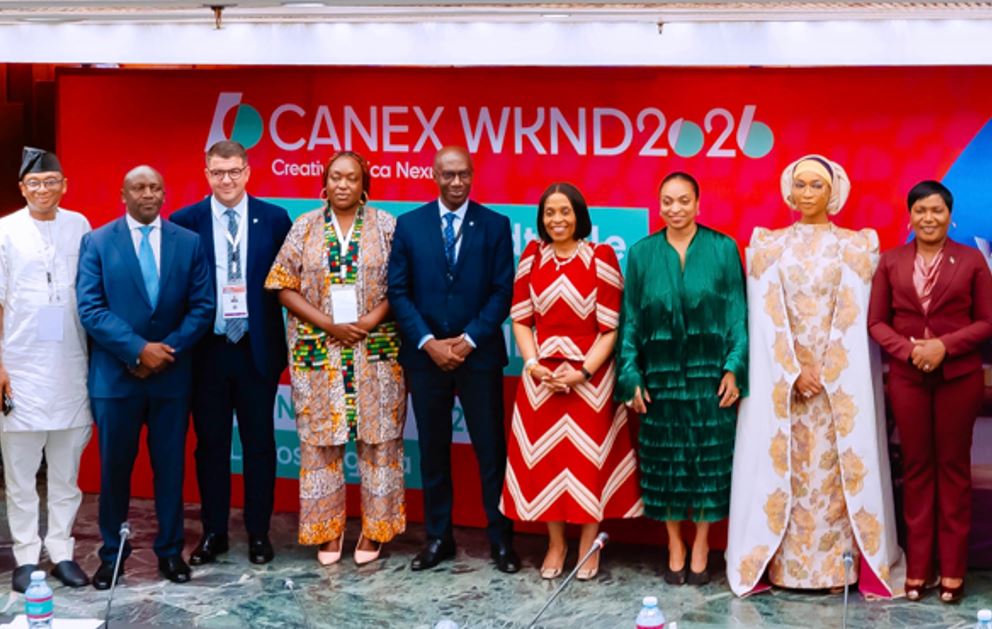
Creative Africa Nexus (CANEX) WKND 2026 opens in Lagos, bringing together leading African and diaspora creatives, investors and policymakers

Business
Coca-Cola system invests USD 1.22 million to strengthen water security in Namibia


Business
‘Power, Protect, Purchase’: Africa Made It unveils blueprint to capture USD 34B in GDP and accelerate African industrial sovereignty

Africa Practice research shows that Africa exports up to 98% of its raw cotton overseas and captures only 2% of its total value while incurring a USD 35 billion annual trade deficit


African culture, design, and storytelling influence global fashion, music, and media like never before
Africa Made It is driven by a consortium of leading pan-African organisations, advocacy groups, and media organisations who are positioning Africa as a global investment hub. Its flagship campaign, spotlighting the fibre-to-fashion value chain, presents a clear roadmap for continental industrialisation: securing competitive energy power for local industrial mills, enacting policy measures to protect emerging domestic manufacturers from unfair foreign imports, and rallying African consumers to purchase locally manufactured apparel. Together, these three pillars ensure that value created from African resources remains on African soil.
Africa Practice research shows that Africa exports up to 98% of its raw cotton overseas and captures only 2% of its total value while incurring a USD 35 billion annual trade deficit. Building the continent’s domestic processing capacity in spinning, weaving, and sewing locally produced cotton will sustain nearly two million permanent industrial jobs and inject approximately USD 33 billion directly into domestic household incomes every year, in addition to a recurring contribution of USD 34 billion to the continent’s GDP.
While these figures reveal the immense macro-economic potential of the value chain, the true heart of this transformation lies in its human impact. Industrial wages and local lint purchases leading to increased capital circulation in rural communities can drive community micro-economic vitality and contribute to rural poverty reduction. Additionally, formal employment opportunities can expand drastically for women, as they currently make up between 70-90% of garment factory workers on the continent.
Realising this vision and changing the lives of millions of people requires a deliberate combination of targeted investments, supportive trade policies, and consumer mobilisation. A USD 1.8 billion capital allocation toward critical structural enablers for garment transformation is the foundation for bridging Africa’s missing middle in the fibre-to-fashion value chain.
Marie Wilke, editor-in-chief of the Africa Made It magazine, said, “African culture, design, and storytelling influence global fashion, music, and media like never before. Yet, without domestic manufacturing infrastructure, Africa’s creative authority yields very little economic return. Linking raw cotton harvest directly to local processing ensures that the intellectual property, commercial margins, and industrial jobs remain on the continent. It is time to wear our power.”
To learn more about the potential of Africa’s fibre to fashion value chain, watch the campaign video (https://apo-opa.co/4BKAIvY) or read the Africa Made it (https://apo-opa.co/4zvA5VF)magazine (https://apo-opa.co/4zvA5VF). Access the campaign website and resources in English (https://apo-opa.co/4zvA5VF) and French (https://apo-opa.co/4zrK8e2).
Distributed by APO Group on behalf of Africa Made It.
-

 Business5 days ago
Afreximbank supports Veenocks’ US$145 million project for industrial expansion and regional growth
-

 Business5 days ago
Visa and Senegal join forces to accelerate digital transformation and the development of digital payments
-
Business5 days ago
Afreximbank Country Brief Explores Gabon’s Reform Momentum and Diversification Drive
-

 Business5 days ago
5 Investment Opportunities Putting Congo Energy & Investment Forum (CEIF) 2027 on the Map for Central Africa
-

 Business5 days ago
Oando Production Hits 42,985 boepd as Revenue Grows 9% in 9M 2026
-

 Energy5 days ago
Energy costs, storage value and industrial competitiveness led Day 2 of C&I Energy + Storage Summit
-

 Business4 days ago
Joint Statement: Afreximbank and African Petroleum Producers’ Organisation (APPO) formally establish Africa Energy Bank
-
Business5 days ago
Afreximbank Country Brief Charts Côte d’Ivoire’s Rise as a Regional Growth Leader in West Africa