Connect with us

Business

Highly award-winning creative ideas double campaign impact new WARC insights reveal

Published

on

WARC
  • One in five (21%) of all creatively awarded ideas are also awarded for effectiveness
  • Nearly half (45%) of highly awarded creative ideas are also awarded for effectiveness
  • TV’s role as lead channel is declining among top ideas
  • Most (88%) of highly creative and effective ideas aim for brand building. Two-thirds (61%) drive sales
  • Social justice, partnerships and emotion are creative effectiveness cheat codes.

WARC releases 5th edition of WARC Rankings analysis linking creativity and effectiveness in The health of creativity 2026


17 September 2026 – Each year, WARC tracks the results of the top regional and global award shows for creativity and effectiveness for the WARC Rankings, the ultimate benchmark for marketing.

Using 11 years of WARC Rankings data of show results from 2015 to 2025, a total of 6,360 ideas have been analysed to assess the correlation between creativity and effectiveness, the characteristics of the best-in-class campaigns, and the creative conversion by sector, brand and agency work.

Amy Rodgers, Head of Content, WARC Creative, says: “Mounting evidence demonstrates how creativity plays a crucial role in driving campaign success. Drawing on findings from 11 years’ worth of WARC Rankings data, we examined whether campaigns recognised for creative excellence have sustained or strengthened their performance edge compared to last year’s findings and what are the current shared characteristics that define the most creative and effective ideas.”

As creativity increases, so does effectiveness

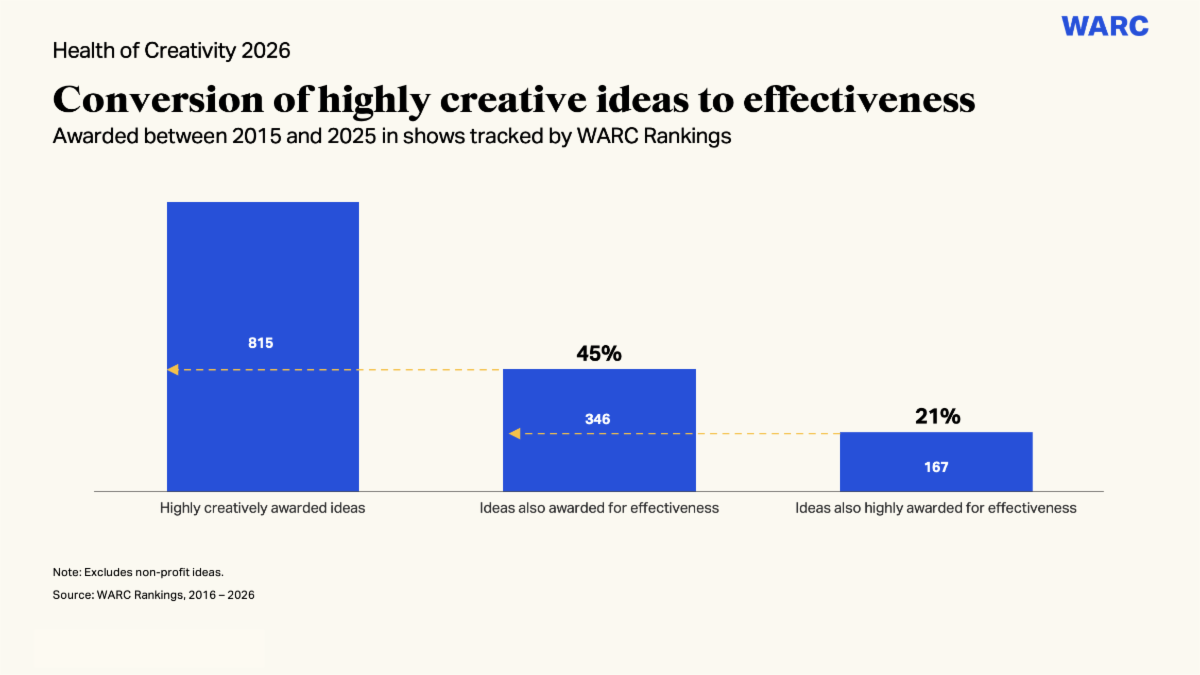
Over a fifth (21%) of ideas awarded for creativity in shows tracked by the WARC Rankings were subsequently awarded for effectiveness. This conversion rate remains the same as last year.

However, when ideas are highly awarded for creativity, making it into the WARC Creative 100, the conversion to effectiveness more than doubles, rising from 21% to 45%, up from 44% last year.

“Should the 21% conversion rate be higher?” asks Rodgers. “Perhaps not, when viewed in the context of all the advertising produced. Winning both a creative and an effective award for the same campaign is hard. Factors include the current shift away from brand building to performance, brand size, and resources to measure effectiveness and prepare for strong award entries.”

Takeaways from WARC’s analysis of 167 best-of-the-best ideas, which are highly creative and highly effective having ranked in both the WARC Creative 100 and Effective 100 between 2016 and 2026, are:

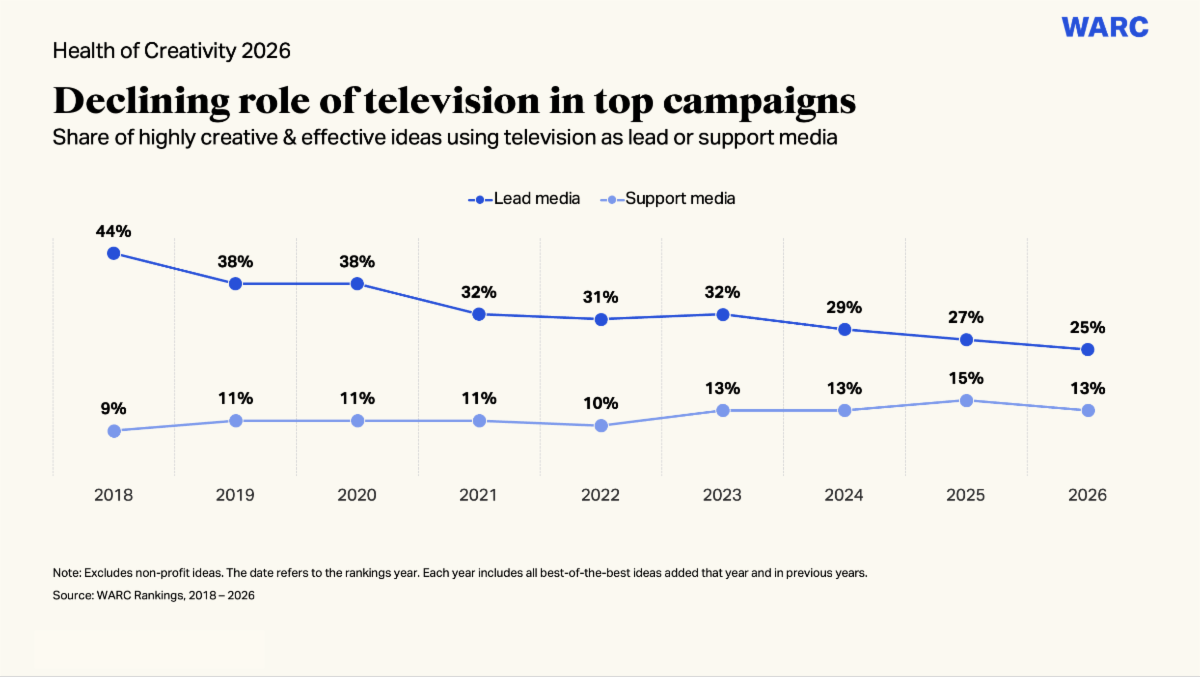
  • TV’s role as a lead channel is declining among top ideas despite its strength for emotion and storytelling strategies

A quarter of best-in-class ideas (25%) led with television in 2025, down from 44% in 2018. Its strength still lies in its ability to reach engaged audiences in large numbers, and exploit emotion and storytelling, both key strategies for encoding marketing messages in memory.

Data suggests that no single channel is taking its place – instead, the lead role is now spread across a broader mix of channels.

 
  • Top ideas target brand building


Most campaigns (85%) aim for brand building, an objective seen only slightly more often in highly creative and effective work (88%). Strong brands drive growth and command premium pricing through long-term equity investment. Success requires consistent delivery of the brand promise across product performance, advertising, and pricing strategy, with a focus on building equity and awareness.


  • The best of the best ideas favour social justice, partnerships and emotion


Compared to the average, nearly half (49%) of highly creative and highly effective ideas significantly over-index in the use of social justice issues – including CSR, advocacy, and brand activism. Customer experience is used by 42% of the top ideas and strategic partnerships by 40%.


The data suggests that the strongest ideas go beyond conventional customer-focused tactics to engage with broader societal issues and wider audiences.


  • Best ideas drive sales and gain customers


Almost two-thirds (61%) of the best ideas have a measurable impact on sales and almost half on market penetration. ROI and revenue also over-index significantly in award-winning work. Behavioural change emerges as a distinctive metric for top-performing campaigns.


This suggests that the best ideas aim to not only build brands, but also to influence behaviour and generate wider impact.


  • Top ideas measure PR value


PR value is a soft metric measured by 70% of highly creative and highly effective ideas – more than double the 27% for all cases – highlighting the importance of fame. Best-of-the-best ideas also over-index in other soft metrics including social media buzz, brand health and search.


  • Best ideas have longer campaign durations


Highly creative and effective ideas play the long game. Over a third (37%) of award-winning campaigns run for a year or longer, compared to just 15% of typical cases. This aligns with research showing that highly creative campaigns build emotional resonance that drives lasting impact, while less creative efforts tend to deliver short-term results.


  • Creative effectiveness is strongest in the retail sector


One in five (20%) of the 167 most creative and effective ideas come from the retail sector, despite making up just 13% of all cases. The food sector follows with 10%, technology & electronics, toiletries & cosmetics and financial services (8%).


  • Successful ideas have higher creative commitment scores

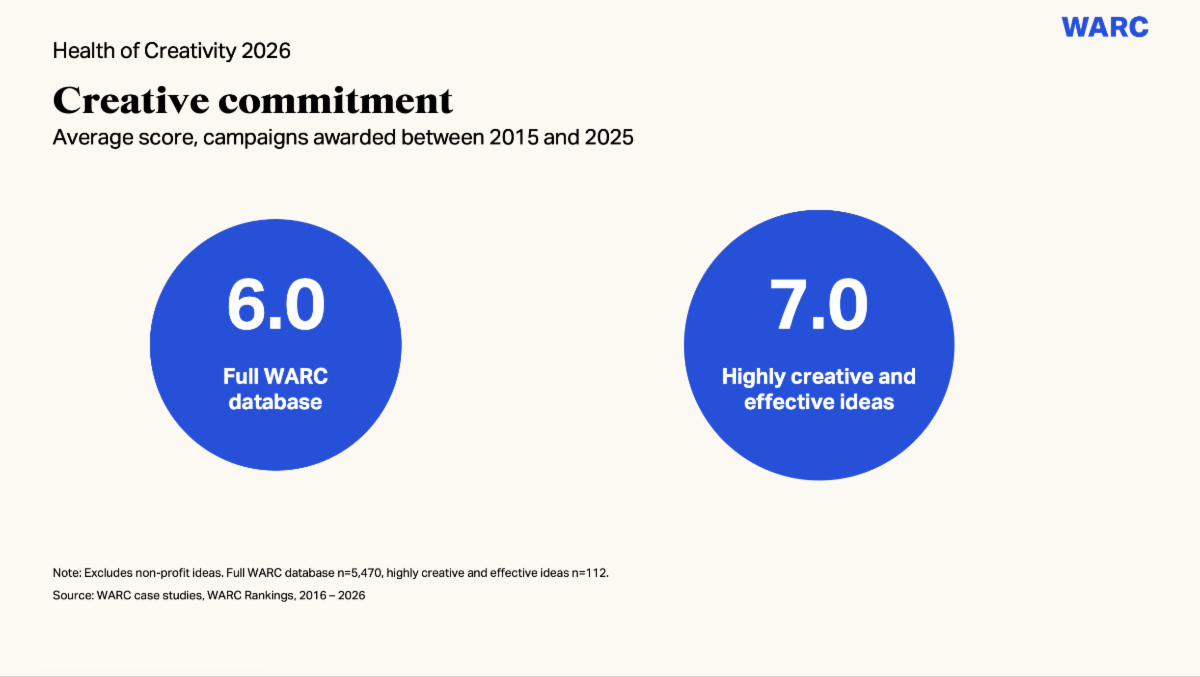
Creative commitment is a composite measure of the media budget, duration and number of media channels used for a creative campaign or initiative. Creative commitment correlates strongly with effectiveness – as creative commitment increases, so does effectiveness (sales, brand building, market share and profit).

Comparing case studies in the full WARC Rankings dataset with ideas ranked in the WARC Creative 100 and Effective 100, creative commitment is higher (score of 7.0) in highly successful ideas than the average (6.0). Importantly, these numbers are not a reflection of brand size.

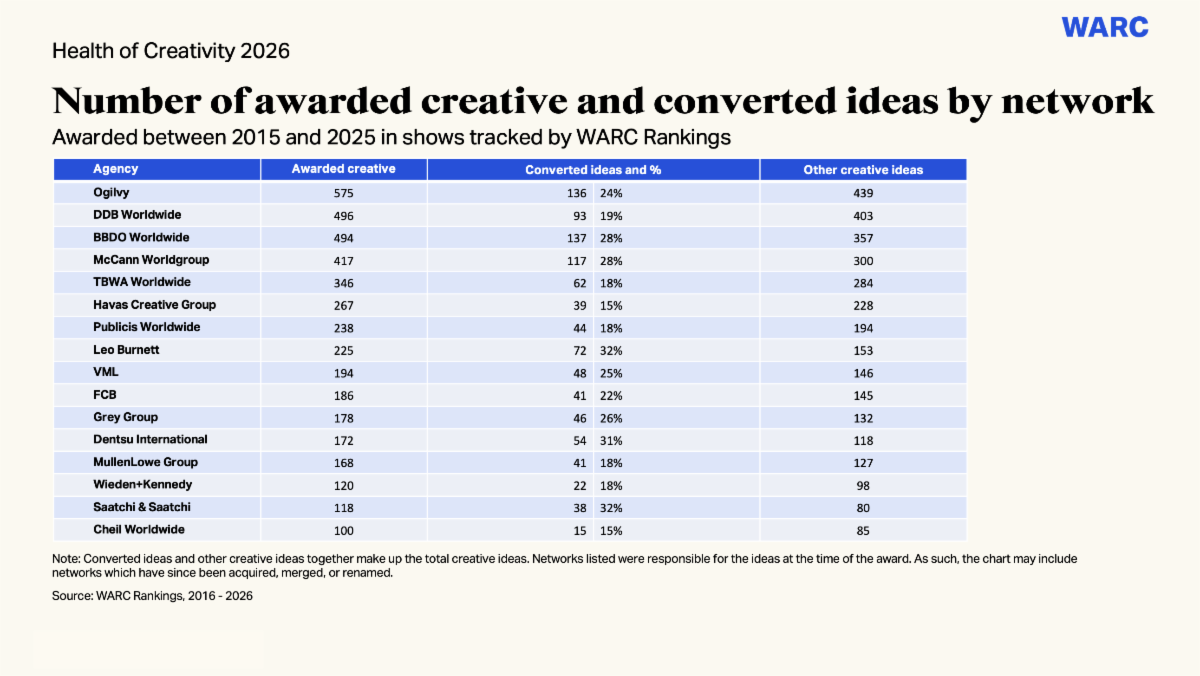
Creative conversion to effectiveness by agency network

For creatively awarded ideas, Ogilvy leads with a total tally of 575, adding 84 this year, while BBDO tops the number of creatively awarded ideas that converted to effective at 137. VML showed the strongest growth, adding 27 converted ideas. By conversion % rate, Saatchi & Saatchi leads agency networks with a 32% conversion rate of its creatively awarded ideas also awarded for effectiveness, rising to 44% for highly creative ideas. (Data reflects agency networks as credited at the time of award, including those since acquired, merged, or rebranded).

Now in its fifth year, The Health of Creativity report also includes information on creative conversion by category, brand, agency network and the full list of the 167 best-of-the-best ideas. WARC subscribers can read the report in full. An infographic is available here.

The next edition of the WARC Rankings – Creative 100, Media 100, Effective 100 – will be published in March 2027, following analysis of work awarded during 2026.


Business

Afreximbank Announces Speakers for Africa’s Largest Compliance Forum

Published

on

Bankers, compliance specialists and fintech leaders from more than 40 countries will explore how regulatory cooperation and technology can align compliance approaches, reduce barriers and advance intra-African and global trade

CAIRO, Egypt, November 3, 2026/APO Group/ –Afreximbank (www.Afreximbank.com) has announced speakers for its 2026 Compliance Forum, Africa’s largest compliance-focused gathering. Discussions will address regulatory fragmentation and barriers across Africa, improve access to correspondent banking services, and explore how technology can strengthen compliance and facilitate cross-border trade


Organised in partnership with the Botswana Investment and Trade Centre (BITC), the Forum will take place from 16 to 18 November 2026 at the Gaborone International Convention Centre in Botswana. Discussions will focus on strengthening regulatory cooperation, improving access to financial services and using technology to support effective compliance across African markets.

Confirmed speakers include Governor Lesego Caster Moseki, Bank of Botswana, Dr. Patrick Ndzana Olomo, Ag. Director, Economic Development, Integration and Trade, and Head of Economic Policy and Sustainable Development, African Union Commission (AUC), Luis Koberg, Founder and CEO of Klearium Group; Shane Ridel, CEO of Elucidate, Sophie Barre, Global Head of Risk and Compliance at Wave Mobile Money Group; Mr Mooketsi Ramanteba, Non-Bank Financial Institutions Regulatory Authority (NBFIRA), Nellie Nuyoni, Head of Private Sector, CBZ Holdings, Moira Mapundu, Head of Compliance, NMB Bank Limited and Boitumelo William of Continental Reinsurance. Compliance specialists from Dow Jones and Standard Chartered will also participate.

Mr Keletsositse Olebile, Chief Executive Officer of the Botswana Investment and Trade Centre, said: “Strong and predictable compliance systems build investor confidence, protect institutions, and create the conditions in which trade and enterprise can flourish.”

Under the theme “Better Compliance – Better Trade: Leveraging Compliance to Promote African Regulations that Advance Intra-African Economic and Trade Integration,” the Forum will examine how African markets can make their regulatory systems work more effectively together while preserving national sovereignty.

Idrissa Diop, Compliance Director at Afreximbank, said: “Our banks across Africa operate across very different legal systems, supervisory approaches and levels of digital maturity. Africa does not need uniformity at any cost. It needs interoperability that reduces friction while preserving regulatory sovereignty.

Our banks across Africa operate across very different legal systems, supervisory approaches and levels of digital maturity

“We invite regulators, compliance specialists, banks, fintechs, trade institutions and technology providers from across the continent to come to Gaborone ready to turn shared principles into practical cooperation, because better compliance can and should deliver better trade for Africa.”

The opening session, “Is Better Compliance Leading to Better Trade?”, will assess how regulatory cooperation can facilitate cross-border business. Other sessions will cover anti-money laundering and countering the financing of terrorism, sanctions, cybersecurity, consumer protection and the use of artificial intelligence in compliance.

Access to correspondent banking services will be a key focus. Luis Koberg, Founder and CEO of Klearium Group, said: “Many African banks continue to face barriers to accessing correspondent banking services. The reasons given often overlook a fundamental challenge: limited visibility across the payment chain. Improved transparency gives our industry the ability to accurately assess and manage risk, on a case-by-case basis with confidence.”

Delegates will also examine how fintech and risk-based onboarding can extend access to affordable financial services while meeting compliance requirements.

Sophie Barre, Global Head of Risk and Compliance at Wave Mobile Money Group, said: “Fintechs are rewriting the rules of financial inclusion and efficiency. By combining world-class technology with intelligent, risk-based onboarding, they can deliver affordable, simple and reliable services within a compliant ecosystem.”

The Compliance Forum will also feature an exhibition of AI-enabled anti-money laundering and counter-terrorist financing compliance systems. These demonstrations will let delegates engage with emerging technologies that can strengthen risk detection, monitoring, and reporting.

This Forum comes as artificial intelligence, automation, cybersecurity, third-party risk and diverging regulatory requirements place new demands on financial institutions. These developments reinforce the need for compliance approaches that reflect Africa’s regulatory, economic and institutional realities while drawing on global good practices.

ACF2026 will provide a platform for stakeholders to redefine compliance strategies for a changing financial environment and develop practical approaches that protect institutions while enabling more efficient movement of capital, goods and services across African borders.

For programme details and registration, visit ACF2026 (https://apo-opa.co/4iVtopG)

Distributed by APO Group on behalf of Afreximbank.


Continue Reading

Business

Gas Exporting Countries Forum (GECF) Leadership Roundtable Brings Gas Producer Coordination to Paris

Published

on

As African gas producers navigate rising domestic demand, global LNG competition and a renewed push for investment, the GECF Leadership Roundtable at the Invest in African Energy 2027 Forum will examine how greater coordination can support project development, market access and long-term gas monetization

PARIS, France, November 3, 2026/APO Group/ –Africa’s gas industry is entering a period in which cooperation between producing countries could become increasingly important. Demand is rising, LNG markets are being reshaped by geopolitical disruptions and new supply, while major gas developments across the continent continue to compete for capital.


Against this backdrop, the GECF Leadership Roundtable at the Invest in African Energy (IAE) Forum 2027 in Paris will bring the perspectives of gas-producing countries into a discussion focused on the commercial and strategic priorities shaping the sector.

The session comes as Africa continues to expand its role in global LNG markets. The GECF forecasts LNG exports from the continent to reach about 110 billion cubic meters (bcm), or 80 million tons per annum (mtpa), by 2030, rising to 215 bcm, or 160 mtpa, by 2050. The outlook spans producers including Algeria, Angola, Egypt, Equatorial Guinea, Mozambique, Mauritania, Senegal and Nigeria, while GECF projections point to growing LNG trade with Asia and within African markets.

Recent developments have reinforced the strategic value of that supply base. Tanzania’s long-delayed $42 billion LNG project has gained renewed attention as disruptions to Middle Eastern gas supplies have increased the value of diversified LNG sources, while ExxonMobil is advancing preparations for Mozambique’s Rovuma LNG project after years of delay.

For African producers, however, expanding exports is only one part of the equation. Domestic gas demand is rising at the same time that governments are seeking to use gas to improve electricity supply, support industrial development and create new revenue streams. That creates a need to balance export projects with domestic offtake, pipeline infrastructure, gas processing and gas-to-power development.

Coordination between producing countries can help address some of these challenges. Sharing experience on fiscal frameworks, project development, infrastructure and market access can help governments compete for investment while strengthening the case for regional gas infrastructure and cross-border trade.

The global market is also becoming more competitive. Reuters reported this month that gas and LNG infrastructure investment is expanding across multiple regions, with Asia accounting for the largest share of planned LNG import capacity. At the same time, disruptions to Middle Eastern supply have reinforced concerns around security of supply and increased the strategic importance of alternative producers. That creates an opening for African gas producers, but converting that opportunity into projects will require capital, infrastructure and credible long-term markets.

The GECF Leadership Roundtable at IAE 2027, taking place in Paris from May 11-13, will provide a senior-level setting to examine those issues alongside the investors and project developers needed to advance them. The wider forum is designed to connect African energy markets with global capital, with a focus on projects spanning gas, LNG, infrastructure and power.

For African gas producers, the question is how effectively its resources can be developed, connected to markets and converted into reliable energy and industrial growth. The Paris roundtable will put producer coordination at the center of that investment conversation.

Distributed by APO Group on behalf of Energy Capital & Power.


Continue Reading

Business

Islamic Corporation for the Development of the Private Sector (ICD) and Open Bank Sign Expression of Intent for a Potential USD 10 Million Line of Financing in Uzbekistan

Published

on

The EoI sets out the intent to establish a Shariah-compliant LoF facility of up to USD 10 million from ICD to Open Bank to be deployed for the onward financing of eligible private sector projects, including small and medium-sized enterprises (SMEs) and corporates operating in the Republic of Uzbekistan

JEDDAH, Saudi Arabia, November 1, 2026/APO Group/ –
  • ICD and JSC Open Bank (Uzbekistan) have signed an Expression of Intent for a potential Shariah-compliant Line of Financing facility of up to USD 10 million
  • The facility aims to channel funds to eligible private sector projects, including SMEs and corporates across Uzbekistan
  • The potential Line of Financing facility intends to support job creation and SME growth, contributing to broader economic development in Uzbekistan
  • Open Bank, a privately owned digital bank licensed by the Central Bank of Uzbekistan, will serve as the intermediary institution to channel the funds to private enterprises


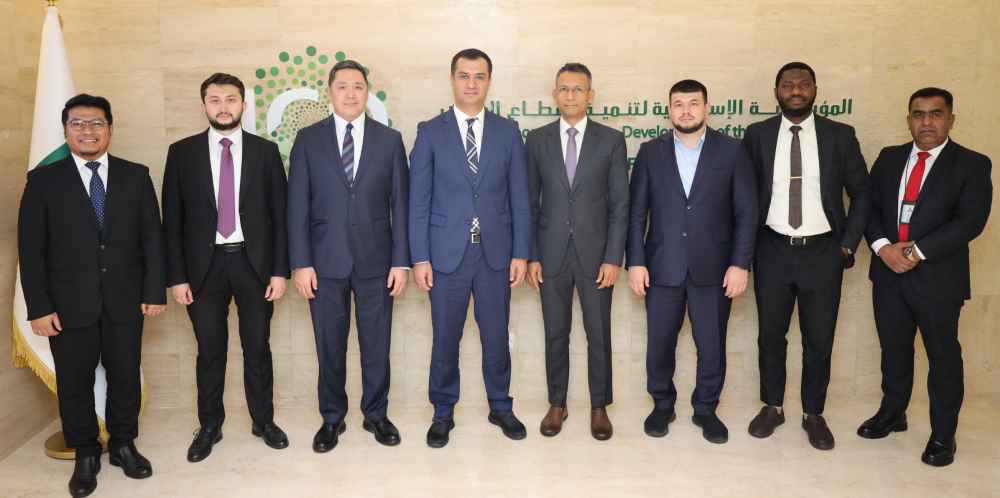
The Islamic Corporation for the Development of the Private Sector (ICD) (www.ICD-PS.org), the private sector arm of the Islamic Development Bank (IsDB) Group, and Joint Stock Company “Open Bank” (Open Bank) from Uzbekistan have signed an Expression of Intent (EoI) in Jeddah, Saudi Arabia, on 26 October 2026, for a potential Shariah-compliant Line of Financing (LoF) facility of up to USD 10 million, aimed at supporting eligible private sector projects in the Republic of Uzbekistan.

The EoI sets out the intent to establish a Shariah-compliant LoF facility of up to USD 10 million from ICD to Open Bank to be deployed for the onward financing of eligible private sector projects, including small and medium-sized enterprises (SMEs) and corporates operating in the Republic of Uzbekistan. The facility is designed to ensure that financing reaches productive segments of the economy in a manner consistent with Shariah principles and in line with the development objectives of ICD and Uzbekistan.

The intended facility reflects ICD’s commitment to expanding access to Shariah-compliant financial services in Central Asia. By working through Open Bank, a digitally oriented institution with a focus on retail and SME customers, the proposed LoF aims to direct resources toward businesses that can generate meaningful employment opportunities and contribute to sustainable economic growth in Uzbekistan. SME support of this nature plays an important role in strengthening the private sector and broadening economic participation across the country.

ICD’s development mandate centers on advancing private sector growth and improving livelihoods in its member countries through Shariah-compliant financing solutions. The intended LoF with Open Bank aims to contribute to job creation and SME support in Uzbekistan, outcomes that align with ICD’s broader objective of fostering inclusive and sustainable economic development across the IsDB Group’s member countries.

Distributed by APO Group on behalf of Islamic Corporation for the Development of the Private Sector (ICD).


Continue Reading

Trending

Exit mobile version