Connect with us

Business

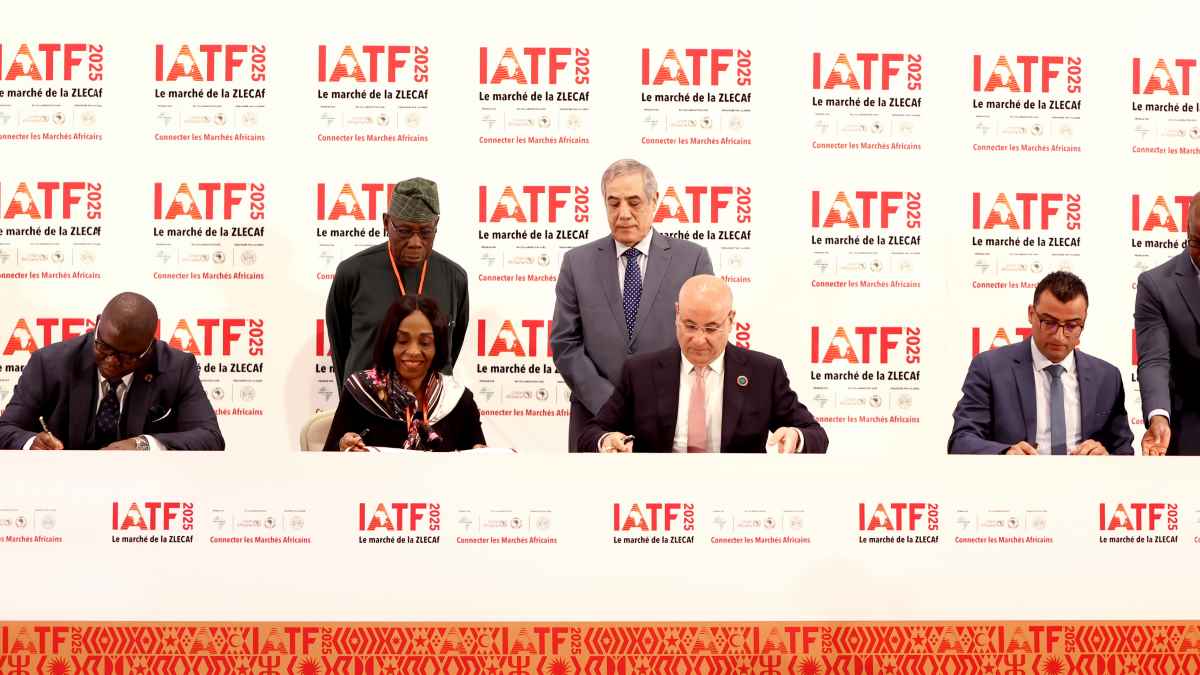
Countdown begins to the fourth Intra-African Trade Fair (IATF2025) in Algiers

Published

on

IATF2025

IATF2025 will build on past successful editions in promoting trade and investment across Africa

ALGIERS, Algeria, September 5, 2024/APO Group/ — 

Over 35,000 visitors from more than 140 countries across the world are expected to converge in Algiers, Algeria from 4 – 10 September 2025 to attend the Intra-African Trade Fair 2025 (IATF2025), Africa’s premier trade and investment event.

During the week-long fair, more than 2,000 exhibitors, including businesses from the African continent and globally, will be showcasing their goods and services to the visitors and buyers while exploring opportunities and exchanging information. This is projected to translate into over US$44 billion in trade and investment deals.

Hosted by the Government of the People’s Democratic Republic of Algeria under the theme ‘Gateway to New Opportunities’, the week-long event offers a platform for boosting trade and investment. It aims to tap into opportunities from the single market of the African Continental Free Trade Area (AfCFTA) of over 1.4 billion people and a GDP of over US$3.5 trillion. The fair is held biennially by the African Export-Import Bank (Afreximbank), in collaboration with the African Union and the AfCFTA Secretariat.

The Chairman of the Advisory Council of IATF and former President of Nigeria, H.E. Chief Olusegun Obasanjo said: “The IATF has distinguished itself as an instrument for promoting intra-African trade and investment by enabling businesses to interact and access trade and market information opportunities. Over $100 billion in trade and investment deals have been closed cumulatively with over 70,000 visitors and more than 4,500 exhibitors participating in the last three editions of IATF. We welcome African businesses to tap into the opportunities to market, grow sales, expand to new markets and to exchange ideas with peers. We thank our host, Algeria, which is one of the continent’s more advanced economies”.

IATF is the largest, holistic trade fair championing the continent’s growth and development

Heads of State and Governments, Ministers of Trade, Finance, Culture and other ministries as well as high profile business, small & medium enterprises and industry leaders are expected to attend IATF2025.

Chief Obasanjo added: “IATF is the largest, holistic trade fair championing the continent’s growth and development. It serves as a collaborative platform for driving shared aspirations for prosperity and stability, as envisioned by AfCFTA. It is a strong backbone for meaningful transformation of Africa and enhancing resilience by creating a gateway to new opportunities for economies and businesses through intra-African trade and investment.

Key activities lined up for IATF2025 include a trade exhibition by countries and businesses; the Creative Africa Nexus (CANEX) programme with a dedicated exhibition and summit covering fashion, music, film, arts and craft, sports, literature, gastronomy and culinary arts; a four-day Trade and Investment Forum featuring leading African and international speakers; and the Africa Automotive Show for auto manufacturers, assemblers, original equipment manufacturers and component suppliers.

There will be Special Days dedicated for countries as well as public and private entities to showcase trade and investment opportunities, and tourism and cultural attractions, as well as IATF Diaspora Day which highlights commercial and cultural ties between Africa and its diaspora, featuring a Diaspora Summit, market and exhibition, cultural and gastronomic showcase.

Also planned is a business-to-business (B2B) and business-to-government (B2G) platform for matchmaking and business exchanges; the AU Youth Start-Up programme showcasing innovative ideas and prototypes; the Africa Research and Innovation Platform @ IATF for university students, academia and national researchers to exhibit innovations; and the African Sub-Sovereign Governments Network to promote trade, investment, educational and cultural exchanges at the local level. The IATF Virtual platform is already live, connecting exhibitors and visitors throughout the year.

To participate in IATF2025 please visit www.IntrAfricanTradeFair.com.

Distributed by APO Group on behalf of Afreximbank.

Business

Africa Energy Forum 2026: Building Africa’s Industrialised Future

Published

on

Cape Town to host continent’s largest energy gathering as focus shifts from aspiration to execution

CAPE TOWN, South Africa, May 13, 2026/APO Group/ –The Africa Energy Forum (https://apo-opa.co/4ugdl9y) returns from 16-19 June 2026, bringing together the companies, investors and governments driving Africa’s move from energy access to industrial-scale infrastructure.

The companies gathering in Cape Town are deploying capital into transmission infrastructure, building mining corridors that will define trade routes for decades, financing baseload capacity that can power heavy industry, and developing renewable projects that will anchor Africa’s manufacturing future. Forum Sponsor Sun Africa leads a group of sponsors whose projects and investments are already shaping how the continent builds its industrial base.

“I am looking forward to joining the conversation in Cape Town this June. What excites me about this year’s Summit is the calibre of capital and commitment in the room — companies that are financing baseload capacity for heavy industry, building mining corridors that will define trade routes for decades, and deploying renewable projects that will anchor Africa’s manufacturing future. That is the kind of long-term, structural thinking that Sun Africa has always believed this continent deserves, and it is exactly the conversation we need to be having.” Sun Africa, CEO, Adam Cortese.

ACWA Power, Infinity Power and AMEA Power are building gigawatt-scale renewable capacity across the continent. Globeleq and TotalEnergies are financing and operating projects that demonstrate how private capital can deliver industrial-grade infrastructure. British International Investment and IFC are structuring deals that blend concessional and commercial finance to unlock sovereign wealth fund participation. Nedbank CIB is providing the sustainable finance structures that allow projects to reach financial close.

“As Africa moves from aspiration to execution, this year’s agenda focuses on the hardware of industrialisation – the steel, concrete and transmission lines that will define Africa’s industrial future,” said Simon Gosling, Managing Director of EnergyNet.

The companies driving this shift face common challenges: structuring bankable projects where perceived risk exceeds actual performance, moving critical minerals from extraction to processing, building transmission corridors that serve both mines and cities, and deploying patient capital into long-term infrastructure.

As Africa moves from aspiration to execution, this year’s agenda focuses on the hardware of industrialisation – the steel, concrete and transmission lines

Cape Town provides the right setting. South Africa is navigating private transmission investment, energy trading, mining-driven renewable deployment, and tensions between industrial growth and climate commitments – challenges the rest of the continent will face. The city’s reforms offer a live case study.

The agenda reflects where these companies are focusing their resources. Critical minerals receive a two-day dedicated stream exploring downstream processing, transport corridors and value capture from reserves representing over 30% of global supply. Sessions examine the Lobito Corridor, Liberty Corridor and Simandou infrastructure as models for large-scale project finance.

Transmission and baseload themes address grid expansion, private investment structures and 24/7 availability for data centres and manufacturing. Energy trading sessions explore how sponsors are transforming project finance through creditworthy off-take, whole technology discussions will cover AI for revenue protection, data centre supply chains and CBAM compliance.

More broadly, the forum structure supports deal-making. The speaker programme includes closed-door roundtables bringing together DFIs, sovereign wealth funds, Middle East ministers, utilities, regulators and the private sector for frank discussions on capital deployment.

This will bring together senior public and private sector leadership, with notable speakers including H.E. Honourable Dr. Kgosientsho Ramokgopa, Minister of Electricity & Energy, South Africa; H.E. Honourable Samantha Graham-Marè, Deputy Minister of Electricity & Energy, South Africa; Dan Marokane, GCE, Eskom, South Africa; H.E. Honourable Jeremiah Kpan Koung, Vice President, Liberia; H.E. Honourable Dr. Kgosientsho Ramokgopa, Minister of Electricity & Energy, South Africa; H.E. Honourable Lerato Mataboge, African Union Commissioner for Infrastructure and Energy; Precious Edward, Head, IPP Office, South Africa; Obaïd Amrane, CEO, Ithmar Capital, Morocco, Chair, Africa Sovereign Investors Forum (ASIF) & Chair, International Forum of Sovereign Wealth Funds (IFSWF); Mike Teke, Group CEO, Seriti Resources; and Jonathan Hoffman, CEO, Globeleq.

Regional fireside chats, meanwhile, will spotlight opportunities across North, East, South and West Africa. Day One features ministerial sessions with participation from Sierra Leone’s Ministry of Energy and The Gambia’s Ministry of Environment, Climate Change & Natural Resources.

Additional sponsors driving the programme include AKSA as Exhibitor Sponsor, with lead sponsor support from Synergy Consulting, ATIDI, Engie, European Investment Bank, Standard Bank, Red Rocket, USP&E Global and Sungrow.

On the final day, YES! (Youth Energy Summit) takes place as part of the aef stream under the theme ‘Empowering Today’s Entrepreneurs – Building Tomorrow’s Industrialists’. Here, impact leaders will present scalable initiatives creating entrepreneurship opportunities in Africa’s energy sector, while industry partners lead interactive workshops building practical skills for 600 young people in attendance.

Distributed by APO Group on behalf of EnergyNet Ltd..

Continue Reading

Business

Canon Introduces Coalition for Content Provenance and Authenticity (C2PA)-Compliant Authenticity Imaging System for News Organisations

Published

on

Canon’s Authenticity Imaging System reliably embeds provenance information into images at the point of capture as the foundation for authenticity, thereby enabling verification of content history throughout the workflow

DUBAI, United Arab Emirates, May 13, 2026/APO Group/ –Canon Inc. (www.Canon-CNA.com) and Canon Europe Ltd. announced today that Canon will roll out its Authenticity Imaging System for supported models in May 2026 initially in Europe, the Middle East, and Africa (EMEA)1. This system is a comprehensive solution based on the C2PA2 (Coalition for Content Provenance and Authenticity) standard to manage image provenance records, issue certificates, apply trusted timestamps and verify content history. Designed for images captured with C2PA-enabled3 cameras, specifically the EOS R1 and EOS R5 Mark II, the system helps support the preservation of provenance information from the point of capture onward, in accordance with each organisation’s editorial and technical workflows.


As generative AI technologies continue to advance, image manipulation and the spread of fake images have emerged as significant societal challenges. News organisations are increasingly expected to clearly demonstrate the provenance of the images they publish to ensure their authenticity. Canon joined C2PA and the Content Authenticity Initiative (CAI)4 in 2023 and has since been advancing the research and implementation of provenance management technologies based on international standards. Canon’s Authenticity Imaging System reliably embeds provenance information into images at the point of capture as the foundation for authenticity, thereby enabling verification of content history throughout the workflow, from initial intake through editing, distribution and publication.

The solution uses manifest information5 generated by C2PA-compatible cameras as its starting point, issuing public certificates and applying timestamps from trusted time-stamping authorities to help maintain verifiable provenance records over time. It provides an environment in which provenance information, including records added during editing and distribution processes, can be verified at the time of publication. This is designed to enhance transparency in how images are handled in news operations, accommodating both speed and authenticity in photojournalism.

Ahead of the official launch, Reuters, the global news organisation, collaborated with Canon on initial technical enablement and specific testing of C2PA cameras. Using the EOS R1 and EOS R5 Mark II with the Image Authenticity feature enabled, Reuters found that authenticated provenance data could be generated reliably.

Canon will continue to support the assurance of image authenticity in news organisations through its Authenticity Imaging System while also exploring expansion into a wide range of fields where authenticity is critical, including government, healthcare, and research. In addition, Canon will work toward the broader adoption of international standards such as C2PA by collaborating with related organisations and partners and further advancing provenance management technologies.

For more information, please visit the Authenticity Imaging System website: https://apo-opa.co/42yWNNH


1. Launch dates differ by country and region.

2. C2PA is an organisation which develops technical standards for establishing content provenance and authenticity of digital content.

3. C2PA functionality requires paid activation.

4. CAI is an organisation that promotes the adoption of C2PA, for example by recording content provenance in compliance with C2PA and providing open-source tools to verify that content.

5. Refers to metadata (such as capture date and time, location, equipment used, and camera settings) which is assigned a digital signature to prevent post-capture alteration. The date and time of capture are recorded based on the camera’s internal clock and are therefore not guaranteed to exactly match the actual date and time of capture.


Distributed by APO Group on behalf of Canon Central and North Africa (CCNA).

Continue Reading

Business

Driving Africa’s Fair Energy Transition Through Technology and Innovation (By Prof. Bart O. Nnaji)

Published

on

According to the International Energy Agency, Africa needs about $90 billion annually to achieve a successful energy transition, but current funding falls short

Africa must not embrace renewable energy primarily when they have abundance of fossil fuel for their industrialization

ABUJA, Nigeria, May 13, 2026/APO Group/ —By Prof. Bart O. Nnaji FAS, FA Eng. CON, NNOM – Founder/Chairman, Geometric Power Limited and former Nigerian Minister of Power.


Africa’s energy journey is often portrayed as a stark choice between climate responsibility and development. In reality, the continent faces a more nuanced challenge: finding a fair, gradual energy transition that matches its unique needs and ambitions. Technology and innovation can drive this change, helping secure affordable and sustainable energy for all.

In the coming decades, Africa’s population is expected to soar to nearly 2.5 billion. Cities will grow. Industries will expand. Digital connections will multiply. The demand for energy will increase significantly. Right now, expecting Africa to abandon fossil fuels overnight is neither realistic nor fair. In the near future, fossil fuels remain crucial for base power that is reliable, and affordable. In particular, natural gas is key transition fuel that will remain the base power solution for the next decade. Africa must not embrace renewable energy primarily when they have abundance of fossil fuel for their industrialization as other emerging and emerged nations have done. A just energy transition recognises these realities and seeks ways to build cleaner, more resilient systems over time.

Technology as the Enabler of Africa’s Energy Future

Exciting new technologies are already reshaping Africa’s energy landscape:

  • Decentralised solutions, like mini-grids, off-grid solar, and batteries, bring electricity to places traditional grids can’t reach. By 2030, these distributed renewables could provide most new connections in underserved communities.
  • Smart grids and AI-driven management can reduce waste. They help utilities serve people better.
  • Modern batteries ensure that solar and wind energy can be delivered steadily, even when the sun isn’t shining or the wind isn’t blowing.

Decentralised approaches are essential to Africa’s path toward universal energy access. While technology is not a fix-all solution, it is a crucial enabler of efficiency, resilience, and affordability, shaping Africa’s energy future.

African entrepreneurs are leading much of this change. They’re developing solutions that meet local needs, such as pay-as-you-go solar, community-run mini-grids, and mobile payment platforms. These innovations don’t just bring power; they create jobs, build skills, and reap economic benefits for the continent.

But innovation alone isn’t enough. Investment is critical. According to the International Energy Agency, Africa needs about $90 billion annually to achieve a successful energy transition, but current funding falls short. Governments can help by setting clear, supportive policies that attract investment and make projects more affordable. Organisations like the African Development Bank say grid investment must rise dramatically, and clean energy spending should double by 2030 to keep up with growing demand.

From Energy Access to Economic and Human Impact

Reliable energy is more than just a technical necessity – it’s what fuels industrial growth. Picture the continent’s factories buzzing with activity, transport networks connecting people and goods, and data centres powering a vibrant digital economy.

Expanding decentralised solutions brings light to places that have been left in the dark for too long. It’s about giving children a place to study at night, helping clinics store vaccines safely, and empowering entrepreneurs to launch new businesses.

Of course, none of this works in isolation. Supportive policies, strong regulations, and partnerships between governments and private companies are essential. When African countries harmonise their rules and work together, they can create bigger markets. This draws even more investment and innovation.

Ultimately, Africa’s energy transition must be shaped by Africans themselves. The path forward is about collaboration, pragmatism, and investing in homegrown solutions. Africa’s mobile phone revolution showed the world how quickly the continent can leapfrog old systems. The same can happen with energy; by embracing flexible, tech-driven models that serve today’s and tomorrow’s needs.

Now is the time to come together to act boldly and invest in Africa’s energy future. By uniting efforts, we can turn potential into progress, ensuring resilient, inclusive, and sustainable energy for generations to come. Let’s power Africa’s future, together.

Distributed by APO Group on behalf of Prof. Bart O. Nnaji.


Continue Reading

Trending

Exit mobile version