Connect with us

Energy

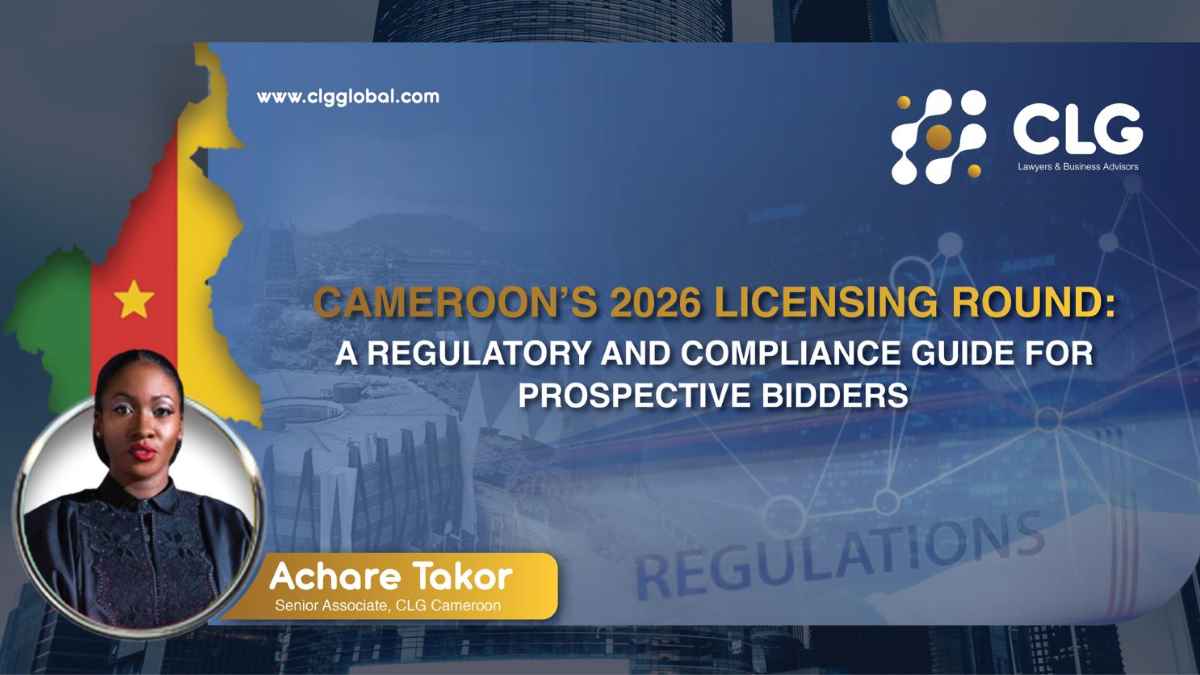
Cameroon’s 2026 Licensing Round: A Regulatory and Compliance Guide for Prospective Bidders

Published

on

Cameroon

Cameroon’s 2026 licensing round provides access to blocks located in established producing basins with available subsurface data

SANDTON, South Africa, February 26, 2026/APO Group/ —Introduction

Cameroon’s 2026 licensing round represents one of the most structured and commercially compelling entry points into  proven producing basins in Central Africa in recent years. Within its mandate to promote and valorise hydrocarbon resources in the national oil and gas domain of the Republic of Cameroon, the The Société Nationale des Hydrocarbures (SNH) has brought to market nine blocks located in the Rio del Rey and Douala/Kribi-Campo basins, all of which lie in close proximity to existing producing fields and are supported by 2D and 3D seismic coverage, drilled wells, discovery wells, identified leads and undrilled prospects. This is taking place in a country with approximately 200 million barrels of proven oil reserves (U.S Energy Information and Worldometer Data) and significant gas potential, governed by a modern legislative framework under Law No. 2019/008 of 25 April 2019 instituting the Petroleum Code, its enabling acts and and Decree n° 2023/232 of May 04, 2023.

For investors, the decisive question is whether their bid satisfies the legal and regulatory conditions for participation and evaluation. Entry into the round is determined at the submission stage by a number of mandatory parameters: the choice of petroleum contract under the Petroleum Code, the commitment to a minimum work programme within the exploration periods, the ability to meet the corporate, technical, financial, environmental and local content requirements set out in the Call for Expression of Interest. These are the criteria against which bids will be assessed.

This article sets out the legal and regulatory framework governing participation in Cameroon’s 2026 licensing round. It focuses on the mandatory requirements bidders must satisfy under the Petroleum Code and the SNH Call for Expression of Interest.

Key Milestones in the Bidding Process

Although the licensing round was launched on 1 August 2025, the process is now approaching its final stages. With the data consultation period closing on 15 March 2026 and the bid submission deadline fixed for 30 March 2026, prospective bidders are in the critical phase of finalising their technical evaluation, corporate structuring and financing arrangements. At this stage, the focus is on the preparation of a compliant and competitive proposal. The Call for Expression of Interest sets out the procedural timetable below.

No Milestone Date
1 Launch of the licensing round 1 August 2025
2 Opening of data consultation period 1 September 2025
3 Close of data consultation period 15 March 2026
4 Deadline for submission of proposals 30 March 2026 – 12:00 noon (local time)
5 Public opening of proposals in the presence of

all bidding companies or their representatives:

30 March 2026- 13:00 (local time)
6 Publication of the results:


24 April 2026


Participation in the Licensing Round: Pre-Qualification and Eligibility

Participation in the licensing round is subject to the pre-qualification requirements of the Petroleum Code and the Call for Expression of Interest. Under Law No. 2019/008 of 25 April 2019 Sections 2 and 7, petroleum operations may be conducted only by a petroleum company, defined as a commercial company or public industrial and commercial establishment with the technical and financial capacity to carry out such operations in safe, hygienic and environmentally safe conditions, accordance with applicable laws and international standards.

The process is open to both Cameroonian and foreign petroleum companies and there is no nationality restriction. A foreign company must, prior to the signing of the petroleum contract, establish a locally registered subsidiary that will remain in place for the duration of the contract. Participation is therefore limited to legally constituted entities, and the corporate, financial and operational documentation required in the proposal effectively excludes individuals.

Bids may be submitted by a single company or by a consortium. In the case of a consortium, the legal structure of the bidding vehicle is examined prior to the technical evaluation of the proposal and, where only one petroleum company is involved, that company must act as operator and hold the majority participating interest.

The Call for Expression of Interest further provides that the State reserves the right, following evaluation of proposals and notification of the results, to enter into negotiations with several companies simultaneously for a given block with a view to securing the most favourable contractual terms. It also retains the discretionary power to accept or reject any proposal without assigning reasons. This underscores the competitive nature of the process and the importance of submitting a proposal that is not only technically and financially credible but also fully compliant with the legal and corporate requirements of the round.

Assets on Offer and Minimum Work Programme Commitments

The Call for Expression of Interest invites bids for nine exploration blocks located in the Rio del Rey and Douala/Kribi-Campo basins. Bids may be submitted for one or more blocks, subject to compliance with the proposal requirements.

Each block is associated with a defined minimum work obligation which must be reflected in the bidder’s technical and financial offer. These commitments constitute the baseline for the evaluation of the proposal and are summarised below.


Work Obligation


Block(s) Minimum Work Program Requirement
3D Seismic Acquisition + 1 Exploration Well Ntem, Tilapia, Etinde Exploration, Elombo Drilling of at least one exploration well during the initial exploration period together with 3D seismic acquisition and geoscience studies
2D/3D Seismic Acquisition + 1 Exploration Well Kombe-Nsepe, Bomono Drilling of at least one exploration well during the initial exploration period together with 2D and/or 3D seismic acquisition and geoscience studies
3D Seismic Reprocessing + 1 Exploration Well Bolongo Exploration Drilling of at least one exploration well together with reprocessing of available 3D seismic data and geoscience studies
2D/3D Infill Seismic + 1 Exploration Well Ndian River, Bakassi Drilling of at least one exploration well together with 2D/3D infill seismic acquisition


Mandatory Selection of the Petroleum Contract

The Call for Expression of Interest requires each bidder to specify in its proposal the type of petroleum contract for which it is applying. The choice of contract is therefore a mandatory condition for participation in the licensing round and forms part of the admissibility of the bid.

In accordance with section 14 of Law No. 2019/008 of 25 April 2019 instituting the Petroleum Code, upstream petroleum operations in Cameroon are conducted under one of the following contractual models concluded with the State:


(a) Concession Contracts: where the holder shall be responsible for financing petroleum operations and, in accordance with the terms of the contract, dispose of the hydrocarbons extracted during the contract validity period, subject to the right of the State to collect royalties in kind.

(b) Production Sharing Contracts: where the holder shall be responsible for financing petroleum operations and, hydrocarbon production shall be shared between the State and the holder in accordance with the terms of such contract.

(c) Risk Service Contracts: where the holder shall be responsible for financing petroleum operations and, shall be remunerated in cash in accordance with the terms of such contract.

The legal and fiscal consequences of the choice of contract, shape the entire bid. From a financing perspective, it determines how reserves are booked, how lenders analyse the revenue stream and how the contractor’s return is structured. From a governance perspective, it determines the degree of operational control, the mechanisms for cost recovery and the conditions under which the State exercises its supervisory powers.

Consortium Structure and Operator Requirement

The Call for Expression of Interest permits bids to be submitted by a single company or by a consortium. In all cases, the bidding vehicle must satisfy the qualification requirements of the Petroleum Code.

In practical terms, this means that operational responsibility must rest with a petroleum company. Where a consortium includes only one petroleum company together with other investors, that company is required to act as operator and to hold the majority participating interest. This allows financial or strategic partners to participate in the project while ensuring that the entity responsible for petroleum operations has the technical and financial capacity required by law.

The legal and corporate structure of the consortium is examined before the technical and financial evaluation of the proposal. The composition of the consortium, the allocation of participating interests and the identification of the operator must therefore be established at the time of submission.

In practical terms, the legal architecture of the consortium is assessed before the geological interpretation of the block or the scale of the work programme. The bid therefore succeeds or fails first as a corporate structure and only subsequently as a technical proposal.

Training Budget as a Mandatory Financial Commitment

Beyond the technical work programme, the Call for Expression of Interest requires bidders to incorporate a defined training budget into their financial offer. The minimum amount is set at USD 100,000 per year during the exploration phase and USD 250,000 per year during the development and exploitation phase.

This obligation forms part of the financial parameters on which the proposal is evaluated and must therefore be reflected in the bid at the time of submission.

From a regulatory perspective, the training budget is one of the instruments through which the State implements the national capacity-building objectives of the Petroleum Code. It operates as a contractual commitment linked to the duration of petroleum operations and must be integrated into the overall project economics from the outset.

Environmental Protection and Local Content

The Petroleum Code integrates environmental protection and local content into the core obligations of the contractor. Sections 87, 88 and 89 require the promotion of employment and training of Cameroonian nationals, the use of local goods and services and the development of national technical capacity.

The SNH requires bidders to submit a specific note explaining how the proposed work programme will address environmental protection and how it will implement the local content obligations established by the Code. These elements are therefore part of the competitive assessment of the bid. Investors who integrate them into their operational model at the bid stage are structurally better positioned to move rapidly into the development phase.

Conclusion:

Cameroon’s 2026 licensing round provides access to blocks located in established producing basins with available subsurface data. At this stage of the process, the differentiating factor for bidders is the ability to submit a compliant proposal supported by demonstrable technical and financial capacity and a credible work programme.

Early and strategic engagement with experienced legal, technical and financial advisers is therefore imperative. The structure adopted for the bid must satisfy the requirements of the Petroleum Code and the SNH’s call for Expression of Interest while at the same time producing a project capable of attracting capital and moving to first production within the contractual timeframe.

*********

CLG advises investors throughout the licensing process, from the structuring of a compliant bidding vehicle to the preparation of the proposal and the negotiation of the petroleum contract. With an established presence in Cameroon and across the Central African energy market, CLG also supports the post-award phase, including regulatory approvals, joint venture arrangements and the implementation of the legal framework required to move from licence to first production.


Achare Takor
Senior Associate, CLG Cameroon

Distributed by APO Group on behalf of CLG.


Energy

S&P Global Energy, CLC Solutions and Colibri Bring Market Intelligence to African Mining Week (AMW) 2026

Published

on

Leading market intelligence and advisory experts will examine the investment trends, policy reforms, infrastructure and local content strategies shaping the future of Africa’s mining sector at this year’s African Mining Week

CAPE TOWN, South Africa, July 27, 2026/APO Group/ –The upcoming African Mining Week (AMW) 2026 – Africa’s Most Influential Mining Conference, taking place October 14–16 in Cape Town – will feature experts from leading market intelligence and advisory firms, including S&P Global Energy, Colibri Business Development and CLC Solutions, across high-level panel discussions and exclusive networking sessions.


With the continent holding around 30% of the world’s critical mineral reserves, these firms are providing strategic insights into market trends, policy reform and investment opportunities while supporting governments in developing competitive regulatory frameworks that attract international capital.

Experts from S&P Global Energy will lead several strategic discussions throughout the event. As African governments prioritize mineral beneficiation and downstream industrialization, building competitive value chains has become central to mining policy. Atul Arya, Chief Energy Strategist, will join the Strategic Minerals: Developing a Value Chain that Works for Africa ministerial panel, offering insights into the policy and investment strategies needed to strengthen regional value chains.

Regional infrastructure development will also feature prominently at AMW 2026. Rahul Kapoor, Vice President and Head of Shipping & Metals, will examine investment in transport corridors and cross-border infrastructure during the Regional Connectivity: Financing Africa’s Mineral Infrastructure panel, highlighting projects such as the Lobito Corridor and TAZARA Railway and their role in supporting regional industrialization.

Addressing operational challenges across the sector, Gavin Montgomery, Critical Minerals Market Lead, will participate in the Accelerating Mineral Production: The Energy, Water & Waste Nexus panel. He will explore strategies to improve mining competitiveness through reliable energy supply and sustainable resource management as operators increasingly adopt renewable power purchase agreements, onsite generation, power wheeling and long-term fuel supply agreements to strengthen operational resilience.

Broader geopolitical dynamics will also take center stage at AMW 2026. Thomas Rodriguez, Local Content Director and Developer at CLC Solutions, will participate in the Africa’s Mining Opportunity in the Geopolitical Sphere session, examining how global competition for critical minerals is reshaping investment flows and creating new opportunities for African mining jurisdictions.

As governments intensify efforts to increase in-country value addition, local content and supplier development have become central to mining policy. Ileana Ferber, Founder and CEO of Colibri Business Development, will join the Strengthening Local Content in Africa’s Mining Supply Chain panel to discuss strategies for expanding local procurement, developing competitive supplier ecosystems and increasing the participation of domestic businesses across Africa’s mining value chain.

By convening market intelligence firms, advisory experts, policymakers, investors and mining leaders, AMW 2026 provides a platform for informed dialogue that supports investment decisions and advances the sustainable development of Africa’s mining sector.

Distributed by APO Group on behalf of Energy Capital & Power.

Continue Reading

Business

Bestselling Angola Reform Book Set for Exclusive Luanda Launch on September 2

Published

on

The Amazon bestseller will be launched in Luanda this September, offering insight into the reforms that help shaped the country’s oil and gas market

LUANDA, Angola, July 27, 2026/APO Group/ —Crude Oil: Power, Turnaround and Transformation in Angola {https://apo-opa.co/4wnVNZP} – the latest bestselling book by African Energy Chamber (https://EnergyChamber.org) Executive Chairman NJ Ayuk – will take center stage in Luanda on September 2 with an exclusive launch event at the InterContinental Luanda Miramar. The Luanda launch brings the book directly to the country at the heart of its story, convening Angola’s oil and gas industry around an examination of the policies, leadership and investment decisions that have reshaped one of Africa’s largest oil-producing markets.


Released earlier this year, Crude Oil debuted as a Top Amazon New Release. A Portuguese edition was also released in July, expanding access to readers across Angola and the wider Lusophone market. Blending political history, industry analysis and first-hand perspectives from key decision-makers, Crude Oil traces Angola’s evolution through periods of production decline, economic pressure and structural change to its emergence as one of Africa’s most attractive upstream investment destinations. The book features perspectives from Diamantino Azevedo, Minister of Mineral Resources, Oil and Gas, alongside Sonangol Chairman of the Board Sebastião Gaspar Martins and National Oil, Gas & Biofuels Agency (ANPG) Chairman Paulino Jerónimo.

At the center of the book is Angola’s reform agenda and the role it has played in restoring investor confidence and stimulating exploration. Under efforts to curb production decline and attract capital into both mature and frontier basins, the country established a dedicated upstream regulator (ANPG) and downstream regulator (IRDP), while embarked on a multi-year licensing round targeting 50 concessions by 2025. The introduction of a Permanent Offer Regime further opened the market to international capital while policies such as the Incremental Production Decree and Marginal Field program further stimulated investment.

Angola has demonstrated that reform is most powerful when it is followed by execution

These measures have been accompanied by renewed investment from international and independent operators alike. TotalEnergies, Azule Energy, ExxonMobil and Chevron have since expanded their portfolios through license extensions at legacy assets and forays into Namibe and Benguela, while Shell and Petrobras returned to Angola’s deepwater basins in 2025. Onshore, independents are leading drilling and seismic campaigns, led by Afentra, Corcel, Etu Energias, Oando and more. Following a restructuring, Sonangol strengthened its status as an operator through projects spanning both onshore and offshore margins.

The investment push is translating into new production. Begonia and CLOV Phase 3 came online in 2025, collectively adding 60,000 barrels per day, while the commissioning of the Agogo FPSO supported the next phase of the Agogo Integrated West Hub Development. The Kaminho deepwater development is advancing toward a 2028 start, reinforcing the role of large-scale offshore investment in Angola’s long-term production outlook. With up to $70 billion in upstream investment planned over the next five years, the book argues that Angola’s experience offers lessons beyond its own borders: regulatory predictability, competitive fiscal terms and institutional reform can turn resource potential into sustained capital deployment.

“Angola has demonstrated that reform is most powerful when it is followed by execution. The country made difficult decisions, listened to investors, strengthened its institutions and created mechanisms that allowed capital to return to exploration and production,” states Ayuk.

The September 2 launch in Luanda will provide a platform to reflect on the industry’s transformation while looking ahead to the next phase of Angola’s oil and gas development. As new exploration, major projects and billions of dollars in investment move forward, Crude Oil presents Angola’s turnaround not as a completed chapter, but as a reform playbook whose ultimate success will be measured by sustained investment, production and economic impact.

To register, click here https://apo-opa.co/4wnVNZP.


Distributed by APO Group on behalf of African Energy Chamber.

Continue Reading

Business

Why Venezuela’s Energy Reforms Are Bringing Investors Back to the Table in London

Published

on

The Venezuela Energy Week London Industry Showcase taking place next week will unpack the regulatory changes, upstream economics and market opportunities shaping the country’s next investment cycle

LONDON, United Kingdom, July 27, 2026/APO Group/ –With Venezuela introducing sweeping reforms to its hydrocarbons sector and renewed international interest gathering pace, the Venezuela Energy Week London Industry Showcase will bring together policymakers, investors and industry leaders on July 30 to examine how the country’s evolving investment landscape is reshaping opportunities across the oil and gas value chain. Hosted as part of the lead-up to Venezuela Energy Week 2026, the event will move beyond discussions of resource potential to focus on the commercial realities driving the sector’s next phase of growth.


The agenda opens with a keynote address outlining the government’s strategic vision for the sector, including production targets, investment priorities and the policy framework designed to attract long-term international capital. As Venezuela works to accelerate upstream development, the session will offer insight into the country’s roadmap for rebuilding one of the world’s largest hydrocarbon industries. That strategy is already translating into commercial activity: Repsol signed an agreement in April with Venezuela’s Ministry of Hydrocarbons and PDVSA to regain operational control of the Petroquiriquire joint venture and increase production, followed in June by a memorandum of understanding to evaluate development of the Horcón area near Lake Maracaibo.

Building on this outlook, attendees will receive an in-depth overview of Venezuela’s newly enacted hydrocarbons law and its implementing regulations. The session will examine the upstream business models now available under the revised framework and how they are expanding investment flexibility across exploration, development and production. The reforms are already reshaping the operating landscape, with Chevron, Repsol and Eni among the international companies currently migrating their contracts to Venezuela’s new hydrocarbons regime, which provides greater operational autonomy under an updated fiscal framework.

The commercial case for investment will come into focus through an asset-level assessment of Venezuela’s upstream competitiveness. Focusing on mature fields in the Maracaibo Basin and extra-heavy crude developments in the Orinoco Belt, the session will evaluate field valuations, breakeven economics and the competitive advantages created by the country’s revised fiscal regime, giving investors a clearer picture of where value is emerging. In April, Chevron signed two agreements with PDVSA to increase its stake in the Petroindependencia joint venture to 49% and add the Ayacucho 8 block alongside its Petropiar operations, further strengthening its position in the Orinoco Belt.

As production continues to recover, efficient routes to international buyers will play an equally important role in sustaining growth. A dedicated presentation will examine how Venezuela is optimizing storage infrastructure, strengthening export logistics and rerouting crude into premium global markets following the significant inventory clearances achieved earlier this year. The improving export outlook is also drawing renewed interest from international commodity traders, including Vitol and Trafigura, as Venezuelan crude volumes increasingly return to global markets.

The program concludes with a high-level panel discussion featuring international companies with firsthand experience operating in Venezuela. The conversation will examine the practical realities of doing business in the country, from investment and partnership opportunities to operational challenges and the outlook for future collaboration under the evolving regulatory framework.

As the first international event leading up to Venezuela Energy Week 2026, the London Industry Showcase offers a timely opportunity for the global energy community to assess how policy reform, competitive project economics and improving market access are converging to reposition Venezuela as one of the world’s most closely watched upstream investment destinations.

To register for the London Industry Showcase on July 30, visit https://apo-opa.co/4yMg9OkTo learn more about delegate, sponsorship and partnership opportunities for the showcase or to secure your place at Venezuela Energy Week 2026 in Caracas this October, contact info@venezuelaenergyweek.com.

Supporting Venezuela’s Earthquake Recovery

Energy Capital & Power’s thoughts are with the people and communities affected by the recent earthquakes in Venezuela. As the country begins the long process of recovery, we encourage members of the global energy community to support relief and reconstruction efforts through the CAF Recovery and Reconstruction Fund for Venezuela, which channels contributions from individuals, companies and organizations to emergency assistance, essential services and long-term rebuilding efforts.

To learn more or make a contribution, please visit the CAF Recovery and Reconstruction Fund for Venezuela (https://apo-opa.co/4fVaait).

Distributed by APO Group on behalf of African Energy Chamber.

Continue Reading

Trending

Exit mobile version