Connect with us
Anglostratits

Business

African Development Bank Partners with Interpol to Combat Financial Crime and Strengthen Anti-Corruption Efforts in Africa

Published

on

African Development Bank

According to Interpol’s 2024 Global Financial Fraud Assessment, business email compromise, romance baiting, phishing, and other online frauds pose growing threats to Africa’s digitalized economy

ABIDJAN, Ivory Coast, February 21, 2025/APO Group/ –The African Development Bank Group (www.AfDB.org) has taken a significant step forward in its fight against corruption and financial crime by signing a Letter of Intent with the International Criminal Police Organization (Interpol) today. The Bank Group is the first multilateral development bank to establish such a collaboration with Interpol.

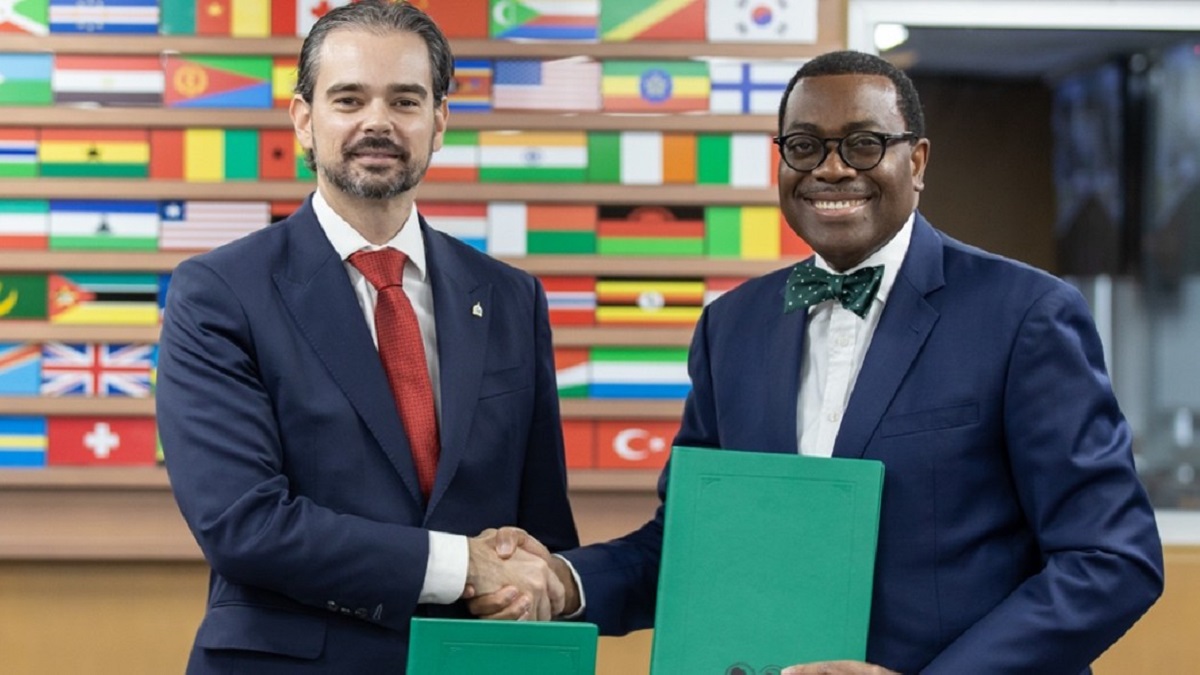
The Letter of Intent was signed on Wednesday by African Development Bank Group President Dr. Akinwumi Adesina and Interpol Secretary General Valdecy Urquiza, who visited the Bank’s headquarters in Abidjan.

The partnership will enhance collaboration between the Bank’s Office of Integrity and Anti-Corruption (https://apo-opa.co/3QrB4ku) and Interpol’s Financial Crime and Anti-Corruption Centre. It will focus on sharing expertise, enhancing investigative capabilities, and developing preventive measures against emerging financial crime threats, including cybercrime, anti-corruption measures, and counter-terrorism financing.

This initiative comes as Africa faces significant challenges of illicit financial flows, estimated at nearly $90 billion annually—a loss of resources that could otherwise be invested in critical development needs including water, sanitation, health, food, and energy infrastructure.

As an institution that deploys approximately $10 billion annually in development financing, with the majority going to government projects, the African Development Bank Group brings crucial insight into regional financial flows and development challenges, Adesina said.

Corruption and financial crime are among the biggest obstacles to economic and social development in Africa and around the world

“This partnership demonstrates our commitment to protecting development resources and ensuring they reach their intended beneficiaries,” said Adesina. “As the world’s most transparent financial institution for two consecutive editions (https://apo-opa.co/41o3TVt) [according to Publish What You Fund’s assessment of sovereign portfolios], we maintain zero tolerance for corruption and terrorism financing. By joining forces with Interpol, we are strengthening our capacity to help African countries build robust systems against money laundering and financial crime.”

Rapid advancements in digital technology have also led to an increase in internet-enabled financial crimes. According to Interpol’s 2024 Global Financial Fraud Assessment, business email compromise, romance baiting, phishing, and other online frauds pose growing threats to Africa’s digitalized economy.

Secretary General Urquiza, who was elected to his position in November 2024, said, “Corruption and financial crime are among the biggest obstacles to economic and social development in Africa and around the world. The evolving nature of financial crime, particularly in the digital environment, requires strong partnerships between law enforcement and financial institutions. Interpol’s closer relationship with the African Development Bank Group will help law enforcement agencies and financial institutions across Africa tackle increasingly sophisticated financial crime threats.”

Adesina said the Bank will continue to tackle these challenges by:

  • Building capacity and supporting African countries in strengthening transparent and accountable governance and strong institutions capable of driving inclusive and sustainable growth and resilient economies.
  • Strengthening Know Your Customer and Due Diligence systems to prevent and to fight fraud and corruption.
  • Ensure that the Bank’s resources are used for their intended purposes in a transparent and accountable manner, a practice that has led to the Bank being recognized for two consecutive editions as the most transparent multilateral development bank in the world by Publish What You Fund.

The high-level Interpol delegation that accompanied Secretary General Urquiza included Mr. Silvino Schlickmann, Director of Governance and Ms. Paule Ouedraogo, Head of Interpol’s Regional Bureau.

The African Development Bank Group was represented by members of President Adesina’s senior management team including the director of the Office of Integrity and Anti-Corruption, Ms. Paula da Costa.

Distributed by APO Group on behalf of African Development Bank Group (AfDB).

Business

In Africa’s Creative Economies, Women Are Claiming Ownership (By Libby Allen)

Published

on

APO

Each March, International Women’s Day fills the calendar with campaigns, flowers, and carefully timed announcements. The day has real historical weight – born from early twentieth century demands for the right to work, vote, and organise. The question it rarely reaches is the one worth asking: not who is being celebrated, but who controls what they have built.

In African creative industries in 2026, that question has instructive answers. They’re economic, not symbolic. And they’re being written by women.

The ownership argument

In Senegal, Diarra Bousso grew up in a home where art and style were a daily language. She went on to study mathematics, worked on Wall Street, and came back to Dakar with a model for a fashion and lifestyle brand: nothing gets made until someone has asked for it.

DIARRABLU, the brand she built from her parents’ rooftop, uses proprietary mathematical algorithms to generate designs, puts them to a community vote before a single garment is cut, and produces entirely on demand – achieving a 60% reduction in waste, and cutting excess stock. Her supply chain is almost entirely Senegalese artisans. The IP – the algorithms, the methodology, the design system – is entirely hers. The value is in Bousso’s process, and the process is owned.

In South Africa, game studio Nyamakop spent years building something hard to copy. Relooted, released last month, is a heist adventure set in a futuristic Johannesburg in which the player recovers 70 real African artefacts from Western museums and private collections. The game was built by a team drawn from more than ten African countries. Mohale Mashigo – its narrative director, a novelist, and comic book writer who has also worked for Marvel and DC – is precise about ownership. Every artefact in the game maps to a real object with a documented history belonging to a named people.

That specificity isn’t just artistic rigour. The world of Relooted is built so it can’t be detached from its own context and repurposed elsewhere. Culture travels differently when it’s self-authored.

Women’s creative output is feeding systems they don’t own

In Nigeria, Mo Abudu applies the same logic to distribution. EbonyLife Media – the production house and TV network she founded in 2012, whose films and series have drawn millions of viewing hours – launched EbonyLife ON Plus in November last year. It’s a membership-based platform designed to keep the value of African storytelling on the continent. The platform is new; the strategy is not: own the infrastructure, or someone else sets the terms.

Three countries. Three creative sectors. Find the point in the chain where value is captured. Own it.

Owned but exposed

AI-generated content has intensified the pressure. GenAI models are trained, in large part, on creative output they don’t pay for – and whether that output counts as a compensable input is now being tested in courtrooms and policy chambers. In African creative economies, where the volume of visual, narrative, and cultural material is vast and formal IP infrastructure is uneven, exposure is significant. Women’s creative output is feeding systems they don’t own.

The AI question and the infrastructure question aren’t separate. One is playing out in courtrooms. The other is playing out in markets.

Narrative control

Reaching the right markets requires a different kind of ownership. Africa isn’t a single market. It is 54 distinct countries, each with its own media landscape, languages, cultures, and decision-makers. Many communications partners offer visibility but don’t know the nuances of each market; they’re not present on the ground – so they offer approximation, which costs while the narrative is diluted.

The same logic that drives Bousso to keep her algorithms proprietary, that drove Mashigo and Nyamakop to build a game precisely, that led Abudu to build her own platforms rather than license outward – it applies here too. Who tells the story, in which markets, in whose language, through which channels: this is where narrative control is either held or lost. For brands to reach across Africa, brand communications must be African.

What happens next? 

International Women’s Day will generate thousands of posts this March. It’s worth watching what happens in the days after – whether the women building ownership across African creative industries control more of their work, their distribution, and their narrative than they did the year before. That is the only measure that matters.

Distributed by APO Group on behalf of APO Group Insights.


Continue Reading

Business

Equatorial Guinea to Showcase 2026 Licensing Round to Global Investors at Invest in African Energy (IAE)

Published

on

Energy Capital

Minister of Mines and Hydrocarbons Antonio Oburu Ondo will deliver a keynote at the Invest in African Energy Forum, unveiling strategic licensing opportunities tied to EG Ronda 2026

PARIS, France, March 6, 2026/APO Group/ –Reflecting a renewed drive for growth and upstream revitalization, Equatorial Guinea’s Minister of Mines and Hydrocarbons, Antonio Oburu Ondo, will deliver a keynote address at the Invest in African Energy Forum, scheduled for April 22–23, 2026, in Paris. Designed to connect African energy opportunities with institutional and private capital, the forum provides a strategic platform for governments to present bankable projects directly to global investors.


At the center of Equatorial Guinea’s investor outreach is EG Ronda 2026, an upcoming licensing round expected to offer 24 upstream blocks across offshore and onshore basins. First announced at African Energy Week, the round will run through late 2026 and features updated fiscal terms and a competitive open-door framework aimed at attracting both majors and independents. In preparation, the Ministry has advanced seismic data acquisition and reprocessing programs, strengthening the technical dataset available to bidders and materially reducing exploration risk.


Equatorial Guinea’s strategy extends beyond licensing. In early 2026, the government signed a reconnaissance license agreement with Eni to support renewed upstream evaluation and field revitalization efforts. At the same time, cross-border collaboration on the Yoyo-Yolanda gas fields continues to advance, with a recent unitization agreement between Equatorial Guinea and Cameroon paving the way for joint development. The move reinforces the country’s ambition to deepen regional integration, optimize shared resources and accelerate monetization through coordinated infrastructure planning.


Project-level momentum further supports this positioning. The Aseng Gas Project, backed by Chevron, represents an estimated $690 million investment aligned with Equatorial Guinea’s flagship Gas Mega Hub initiative – a multi-phase strategy to strengthen domestic processing capacity and position the country as a regional gas hub. National oil company GEPetrol recently increased its stake in Aseng to more than 32%, signaling deeper national participation alongside international operators and a clearer pathway to execution.


For capital providers focused on the Gulf of Guinea and broader African energy markets, Minister Ondo’s address in Paris will provide direct insight into fiscal reforms, licensing mechanics, partnership models and infrastructure expansion plans through 2026 and beyond. As global capital becomes more selective, IAE 2026 offers a critical space for engagement, due diligence and deal origination – helping convert announced opportunities into executed transactions.

Distributed by APO Group on behalf of Energy Capital & Power.


Continue Reading

Business

African Development Bank Group (AfDB) Unveils Africa-Wide Aviation Financing Platform to Turn Growth into Sustainable Profit

Published

on

AfDB

The priority now is execution—aligning policy, capital and infrastructure to ensure aviation becomes a durable driver of inclusive growth and regional integration across the continent

NAIROBI, Kenya, March 5, 2026/APO Group/ –With Africa poised to become the world’s fastest-growing aviation market, policymakers and industry leaders are focused on a central challenge: how to translate rising demand into sustainable connectivity, competitiveness, and financial viability.

This question anchored deliberations at the two-day Airlines, Capital and Connectivity Forum convened in Nairobi on 25–26 February 2026 by the African Development Bank Group in partnership with the African Airlines Association (AFRAA).

Despite strong demand fundamentals, Africa’s aviation sector continues to face structural constraints, including high costs of capital, fragmented regulatory regimes, infrastructure gaps, and limited access to long-term financing. To address these challenges, the Bank is advancing the Integrated Aviation Transformation Program (IATP), a continent-wide platform designed to modernise the aviation ecosystem and mobilise private, institutional, and concessional capital at scale. The programme seeks to align policy reform, innovative financing instruments, and project execution within a single, bankable framework.

The Forum brought together airline executives, transport ministers, regulators, investors, manufacturers, and development partners to explore how the IATP can accelerate coordinated delivery across the sector. Participants underscored aviation’s role as a strategic enabler of regional integration, trade facilitation, tourism, and economic diversification.

Opening the Forum, the Bank’s Director for Infrastructure and Urban Development, Mike Salawou, noted that while Africa’s aviation demand outlook ranks among the strongest globally, supply-side capacity and investment readiness have lagged. The IATP, he said, seeks to de-risk priority investments, support early pilot transactions, and restore confidence among commercial and institutional financiers.

Africa represents nearly 18 percent of the global population but accounts for less than three percent of worldwide air traffic

From the industry’s perspective, AFRAA Secretary General Abderahmane Berthé highlighted the scale of the opportunity and the imbalance confronting the continent. “Africa represents nearly 18 percent of the global population but accounts for less than three percent of worldwide air traffic, reflecting structural and regulatory barriers rather than weak demand,” he said.

Remarks delivered on behalf of Kenya Airways described Africa as the largest structural aviation opportunity of the 21st century. Over the next two decades, one in four new global air travellers is expected to originate from Africa, driven by rapid urbanisation, a growing middle-income population, and a youthful demographic profile.

However, the industry’s financial performance remains constrained. According to the International Air Transport Association (IATA), African airlines are projected to generate net margins of only 1–2 percent, below the global average forecast of 3.9 percent in 2026. High fuel costs, heavy taxation, incomplete liberalisation and limited hub infrastructure continue to undermine profitability.

Connectivity remains a critical bottleneck. Intra-African traffic accounts for only about a quarter of total air travel, with many passengers required to transit outside the continent. Participants emphasised that full implementation of the Single African Air Transport Market is essential to unlock efficient intra-continental connectivity.

A keynote address delivered by Eric Ntagengerwa, Head of Transport and Mobility at the African Union Commission (AUC) on behalf of Lerato Dorothy Mataboge, Commissioner for Infrastructure and Energy, framed aviation reform as an imperative for sovereignty, integration, and competitiveness. He observed that the Single African Air Transport Market is the designated African Union Theme for the Year 2027.

Discussions over two days focused on practical delivery, including strengthening airline bankability, advancing climate-aligned aviation, developing cargo and logistics, building skills, and deploying innovative risk-sharing mechanisms under the IATP. Country experiences from Nigeria, Kenya, and Ethiopia illustrated how continental objectives can translate into coordinated national reforms and near-term investment opportunities.

Samuel Obafemi Bajomo, Senior Adviser to Nigeria’s aviation ministry, emphasised that forward-looking, pro-investment policy frameworks are critical to strengthening connectivity and unlocking Africa’s growth potential and positioning aviation as a catalyst for trade, tourism, and shared prosperity.

The Forum concluded with a clear message: Africa’s aviation demand is real, accelerating, and irreversible. The priority now is execution—aligning policy, capital and infrastructure to ensure aviation becomes a durable driver of inclusive growth and regional integration across the continent.

Distributed by APO Group on behalf of African Development Bank Group (AfDB).

Continue Reading

Trending