Dr Akinwumi Adesina delivered an inspiring address to a diverse audience of diplomats, investors, academics, politicians, and media, emphasizing Africa’s untapped potential and abundant opportunities
LONDON, United Kingdom, June 11, 2024/APO Group/ —
Financing is key to unlocking Africa’s development opportunities; Dr Adesina tells Chatham House: “Africa can no longer be ignored.”
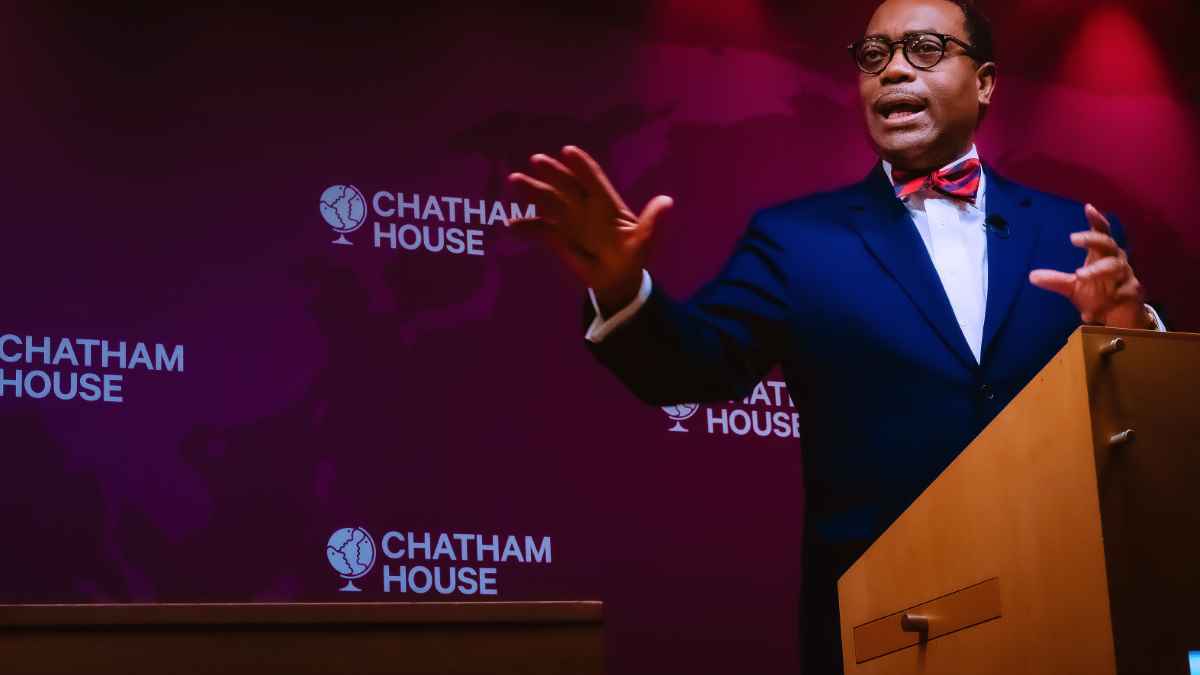
In a packed auditorium at the renowned Chatham House, African Development Bank President Group Dr Akinwumi Adesina delivered an inspiring address to a diverse audience of diplomats, investors, academics, politicians, and media, emphasizing Africa’s untapped potential and abundant opportunities.
In his presentation on Friday, “Envisioning Africa’s Economic Prospects,” Adesina explained the reasons behind his optimism and passion for Africa.
The Bank Group president said Africa is a continent of tremendous opportunities. It is endowed with and characterized by a young, dynamic and vibrant workforce, massive renewable energy potential, abundant biodiversity resources, rapid regional integration and innovative solutions designed to unlock the continent’s vast natural capital.
Adesina outlined the resilience of Africa’s economies despite global challenges, noting that the continent remains the second-fastest-growing region after Asia. He cited the Bank’s African Economic Outlook Report (https://apo-opa.co/4aUEW5r), which shows the the continent’s 3.7% economic growth for 2024, increasing to 4.3% in 2025. The report which was launched during the Bank’s May Annual Meetings in Nairobi revealed that 15 countries achieved real growth rates of at least 5 percent, and half of the world’s 20 fastest-growing economies are in Africa.
However, he said achieving strong economic prospects and resilience will require overcoming some significant headwinds, including tackling climate change and rising debt, and through critical global financial reforms.
“As Africa’s economic resilience is bolstered, unlocking its economic prospects requires ensuring structural change of its economies, raising the productivity of agriculture, provision of electricity, accelerating infrastructure investments, supporting faster pace digitalization, unleashing economic and job opportunities for women and youth, and driving industrialization through greater mobilization of the private sector,” he stated.
Addressing infrastructure and agricultural production, Adesina shared successes like the Bank’s flagship Technologies for African Agricultural Transformation (TAAT) program, which has helped 13 million farmers to increase crop productivity. In Ethiopia, the distribution of 65 metric tons of heat-resistant wheat has led to self-sufficiency in wheat production, covering 2.2 million hectares.
The event, attended by over 150 guests in person and hundreds more virtually, included diplomats from more than 18 African countries, the Commonwealth Secretariat, international financial institutions, private and corporate investors, startups, civil society, students and academics from some of the UK’s leading academic institutions and international media houses.
Adesina acknowledged challenges such as youth unemployment, poverty, debt vulnerability, and political instability but dispelled perceptions of Africa as a risky investment destination. He referenced a 14-year Moody’s Analytics study showing Africa’s low infrastructure loan default rate at 1.9 percent, compared to between 4.6 and 12.4 percent in other regions around the world.
He reiterated the Bank’s advocacy for an independent African credit rating agency to counteract misperceptions that lead to underinvestment due to excessive risk premiums. Quoting the United Nations Development Program, Adesina said fairer credit ratings for African countries could save at least $75 billion annually in debt service payments.
“The trajectory for Africa will be much stronger as we tackle these challenges, as well as improve security and expand more concessional financing and private sector financing,” he emphasized.
Repositioning the Bank to do more
As Africa’s economic resilience is bolstered, unlocking its economic prospects requires ensuring structural change of its economies
Adesina recalled the Bank Group shareholders’ recent approval of a $117 billion callable capital increase (https://apo-opa.co/3VqLXFE), raising the Bank’s total authorized capital to $318 billion to preserve its AAA credit rating and enhance its lending capacity. The approval announced during the just concluded 2024 annual meetings of the Bank will align the institution with the changing global financial architecture and enhance its support for the continent.
“We’re going to be bigger, bolder, and better,” he declared, predicting Africa’s rise as a pivotal global region.
Reflecting on the Bank’s achievements, Adesina highlighted the Bank’s successful launch of sustainable hybrid capital (https://apo-opa.co/3Vj4IKT), marking the first such issuance by a multilateral development bank in line with the G20 Capital Adequacy Framework recommendations to boost lending capacity. The transaction won global commendation, including from the G7 finance ministers (https://apo-opa.co/4aUEZOF) and central bank governors.
Adesina also cited the Bank’s Alliance for Green Infrastructure In Africa (AGIA), which the G7 has backed with a $150 million contribution (https://apo-opa.co/3Vgnq5X). AGIA is working to leverage $3 billion in private sector investment for green projects.
He also mentioned the $20 billion Desert-to-Power project in the Sahel to generate 10,000 megawatts of solar power for nearly 250 million people across 11 countries. When completed, it will be the largest solar zone in the world. In addition, Adesina and the President of the World Bank Group Ajay Banga recently announced a joint effort by their two institutions to connect 300 million Africans to electricity by 2030.
The Bank Group president praised the recent International Monetary Fund approval of $20 billion Special Drawing Rights channeling for hybrid capital in line with proposals by the African Development Bank and the Inter-American Development Bank.
“The African Development Bank is mobilizing more private sector investments into Africa. We supported the $24 billion LNG (Liquified Natural Gas) project in Mozambique, which will provide over $66 billion in revenue for Mozambique and make it the third-largest exporter of LNG in the world. We supported the $19.5 billion Dangote Refinery Complex, the largest single-train refinery in the world and the largest ammonia plant globally. We supported the $13 billion OCP phosphate company in Morocco, the largest phosphate fertilizer plant in the world,” he said.
He said these achievements have fuelled the Bank’s ambitions as reflected in its new ten-year strategy (2024-2033), which outlines the vision of an Africa that is prosperous, inclusive, resilient and integrated.
“Africa can no longer be ignored. I fully expect Africa to be the pivotal continent in the world, given its economic prospects,” he said.
He said that the future of energy transition for a world primarily powered by renewable energy will depend on Africa, which accounts for 25 percent of global biodiversity and contributes substantially to providing key minerals. According to African Development Bank estimates, Africa’s natural capital stood at $6.2 trillion in 2018, with mineral and fossil fuel resources alone valued at $290 billion and $1.05 trillion, respectively.
He said Africa must work out how to tap the potential of its youth, turning this asset into an economic dividend.
“We are supporting universities of science and technology, expanding training in science, technology, engineering and mathematics, centers of excellence in biotechnology and material sciences, as well as technical and vocational training. We have committed $700 million to education and skills development, which has supported 4,000 tertiary education and training facilities, and provided 1.7 million African youths with access to science, technology, engineering and mathematics education, providing critical digital skills in computer coding.”
He added that the African Development Bank is also focusing heavily on women. “The African Development Bank’s flagship initiative, Affirmative Finance Action for Women in Africa (AFAWA), is de-risking financial institutions to lend to women. It is working with 169 financial institutions in 43 countries and has so far approved $1.7 billion in financing for 18,300 women-led businesses. Our goal is to mobilize $5 billion for women-led businesses.”
He also mentioned the Africa Investment Forum, founded by the Bank group and seven other partners, saying it continues to provide a transparent platform for investors interested in Africa to meet, assess projects, evaluate risks, seek counter-risk mitigants, as well as address political risks to investors. Since the establishment of the Africa Investment Forum in 2018, it has attracted investor interests in Africa worth over $180 billion.
He expressed optimism that Africa’s prosperity is within reach and it will emerge as a pivotal continent: “Africa is critical to the future of the world. It’s a vision Africa deserves and it’s a vision we’ll achieve.”
Distributed by APO Group on behalf of African Development Bank Group (AfDB).





















 Business4 days ago
 Events4 days ago
 Energy4 days ago
 Business4 days ago
 Business4 days ago
 Business3 days ago
 Business4 days ago
 Business3 days ago