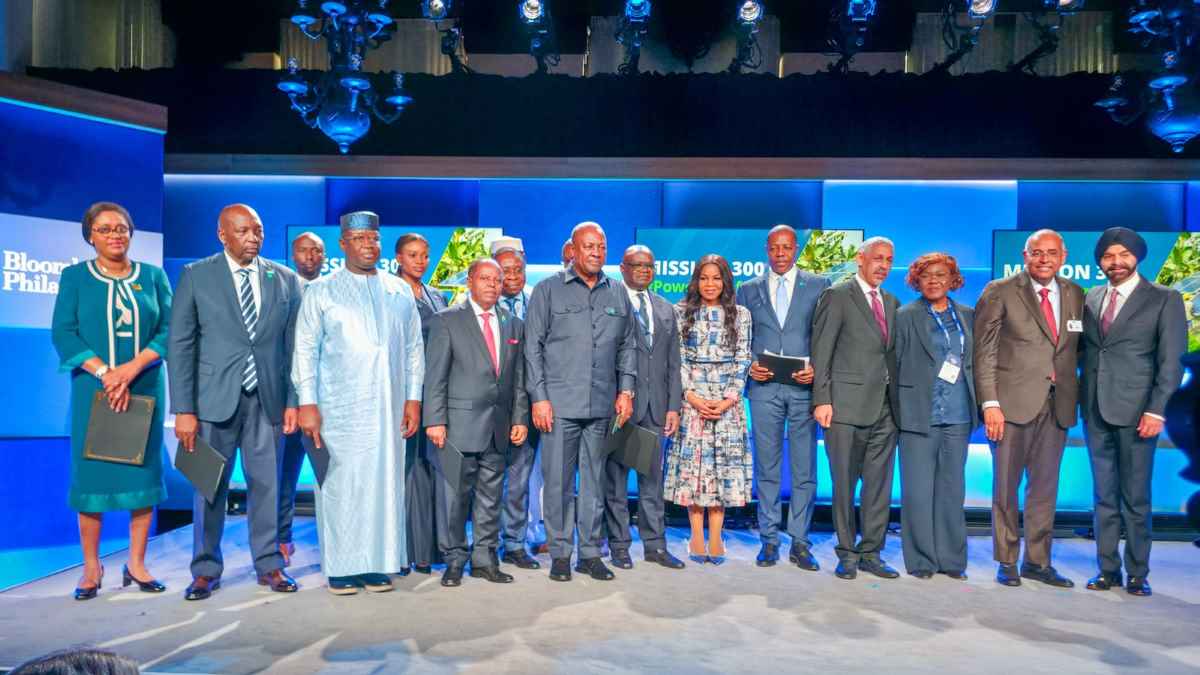
Seventeen African governments today committed to reforms and actionable plans to expand electricity access as part of Mission 300—an ambitious partnership led by the World Bank Group and African Development Bank Group (https://www.AfDB.org/) that aims to connect 300 million Africans to electricity by 2030.
At the Bloomberg Philanthropies Global Forum (https://apo-opa.co/42dhJtN) , national Energy Compacts—practical blueprints that guide public spending, trigger reforms, and attract private capital—were endorsed by Benin, Botswana, Burundi, Cameroon, Comoros, the Republic of the Congo, Ethiopia, Gambia, Ghana, Guinea, Kenya, Lesotho, Mozambique, Namibia, São Tomé and Principe, Sierra Leone, and Togo.
“Electricity is the bedrock of jobs, opportunity, and economic growth,” said World Bank Group President Ajay Banga. “That’s why Mission 300 is more than a target—it is forging enduring reforms that slash costs, strengthen utilities, and draw in private investment.”
Since the launch (https://apo-opa.co/3KfhisX) of Mission 300, 30 million people have already been connected, with more than 100 million in the pipeline.
“Reliable, affordable power is the fastest multiplier for small and medium enterprises, agro-processing, digital work, and industrial value-addition,” said African Development Bank Group President Dr Sidi Ould Tah. “Give a young entrepreneur power, and you’ve given them a paycheck.”
National Energy Compacts are at the core of Mission 300, developed and endorsed by governments with technical support from development partners. Tailored to each country’s context, these practical blueprints integrate three core tracks—infrastructure, financing, and policy.
Earlier this year, Energy Compacts were endorsed by Chad (https://apo-opa.co/4gF13Bj), Côte d’Ivoire (https://apo-opa.co/4mE9sWZ), Democratic Republic of Congo (https://apo-opa.co/3IB2YKL), Liberia (https://apo-opa.co/46oLQkz), Madagascar (https://apo-opa.co/3W9jaG5), Malawi (https://apo-opa.co/3IvVnx2), Mauritania (https://apo-opa.co/4mB96Re), Niger (https://apo-opa.co/4njBRTr), Nigeria (https://apo-opa.co/4mFo48O), Senegal (https://apo-opa.co/4nysQ96), Tanzania (https://apo-opa.co/3VBpA0A), and Zambia (https://apo-opa.co/4nxsNKT)—together pledging to make more than 400 policy actions to strengthen utilities, reduce investor risk, and remove bottlenecks.
The World Bank Group and the African Development Bank Group are working with partners including the Rockefeller Foundation (https://apo-opa.co/42bC2b2), Global Energy Alliance for People and Planet (GEAPP) (https://apo-opa.co/3KkwtkA), Sustainable Energy for All (SEforALL) (https://apo-opa.co/4nqxGFA), and the World Bank’s Energy Sector Management Assistance Program (ESMAP) (https://apo-opa.co/4gS8ZiP) trust fund to align efforts in support of powering Africa. Many development partners and development finance institutions are also supporting Mission 300 projects through co-financing and technical assistance.
Quotes by African Heads of State and Ministers Committing to Mission 300 Energy Compacts today:
Duma Boko
President of Botswana
“This National Compact is our shared pledge to ensure accessible, reliable and affordable energy as a basic human need, to transform our economy and create jobs, and to electrify our journey to an inclusive high-income country.”
Paul Biya
President of the Republic of Cameroon
“The government of the Republic of Cameroon is committed, through its Energy Compact, to a determined transition towards renewable energies, promoting inclusive universal access and sustainable development based on partnerships and ambitious reforms to build a low-carbon future.”
Mission 300 is more than a target—it is forging enduring reforms that slash costs, strengthen utilities, and draw in private investment
Azali Assoumani
President of the Union of the Comoros
“The Comoros Energy Compact is a call for collective action to achieve universal access to electricity by 2030, in order to ensure the country’s emergence in dignity, equity, and shared progress.”
Denis Sassou Nguesso
President of the Republic of Congo
“In addition to abundant sunlight and gas resources capable of generating more electricity, the Republic of Congo has a certified hydroelectric potential of nearly 27,000 MW and more than 100,000 MW currently under study. The Energy Compact will enable Congo to achieve universal access to electricity, supply industries in special economic and mining zones, and export surplus energy to other countries. Harnessing this renewable and sustainable energy will cover more than one-third of Africa’s electricity needs. Since Congo has liberalized the electricity sector, investors are invited, within the framework of Mission 300, to establish themselves and engage in profitable and sustainable business.”
Taye Atske Selassie
President of Ethiopia
“Our National Energy Compact exemplifies Ethiopia’s unwavering dedication to ensuring universal, affordable, and sustainable energy access for all. By unlocking our vast renewable resources, strengthening regional interconnections, we aim to foster inclusive growth domestically and propel Africa’s collective momentum toward ending energy poverty. Together, we are committed to building a resilient, equitable, and sustainable energy future for generations to come.”
Adama Barrow
President of The Republic of The Gambia
“The Gambia’s Energy Compact reaffirms our commitment to universal electricity access by 2030, scaling renewables, strengthening infrastructure, integrating the private sector and improving sector governance. Through partnerships, it aims to transform power supply – ensuring reliability, affordability, and sustainability for all citizens.”
John Dramani Mahama
President of the Republic of Ghana
“Ghana believes universal energy access is key to empowering businesses, reducing poverty, and creating equal opportunities. This goal can only be achieved through strong government–private sector partnerships, supported by an enabling environment for sustainable investment.”
Mamadi Doumbouya
President of the Republic of Guinea
“The Republic of Guinea reaffirms its commitment to guaranteeing, by 2030, universal access to reliable, clean, and affordable electricity, while providing sufficient capacity to support national industrialization, particularly in the mining sector, through a transparent and constructive partnership with the private sector.”
William Ruto
President of the Republic of Kenya
“Energy is a key enabler under the infrastructure component of Kenya’s Bottom-Up Economic Transformation Agenda. The Energy Compact anchors our commitment to achieve universal access to electricity and clean cooking and transition our grid to full reliance on clean energy by 2030.”
Sam Matekane
Prime Minister of the Kingdom of Lesotho
“Mountain winds blow, waters flow, the sun shines brightest – Lesotho, the kingdom in the sky. Universal access to renewable energy is our proud imperative. Experience elevation with agility and scale. Be part of our journey and pride. Invest in Lesotho.”
Daniel Chapo
President of Mozambique
“Mozambique is on track to achieve Mission 300 targets and consolidate our role as a regional powerhouse through export of our abundant, affordable and clean energy. We welcome support from partners to achieve universal access, promote economic growth and green industrialization, and increase regional trade and integration.”
Julius Maada Bio
President of Sierra Leone
“Our M300 Compact is the most ambitious and comprehensive energy infrastructure initiative ever developed for Sierra Leone. Powered by evidence-based solutions and data, this single plan for Sierra Leone’s energy transformation holds the greatest promise for unlocking sustainable and inclusive development for our people.”
Faure Essozimna Gnassingbé
President of the Togolese Republic
“We guarantee reliable, affordable and clean electricity for all, and access to clean cooking. This Compact massively mobilizes the private sector to accelerate our industrialization and make Togo a competitive energy hub.”
Américo d’Oliveira dos Ramos
Prime Minister, São Tomé and Principe
“Our Compact provides a forward-thinking framework to fuel a sustainable and inclusive model of economic growth for Saotomeans. We are enacting strong reforms and developing innovative business models to raise US$190 million from the private sector to finance this objective.”
Edouard Bizimana
Minister of Foreign Affairs, Burundi
“The Republic of Burundi has set ambitious targets for access to electricity and clean cooking to improve the economic and social development of its population. Private sector participation is crucial to achieving these goals.”
















 Business5 days ago
 Business5 days ago
 Business5 days ago
 Business5 days ago
 Business5 days ago
 Business5 days ago
 Business4 days ago